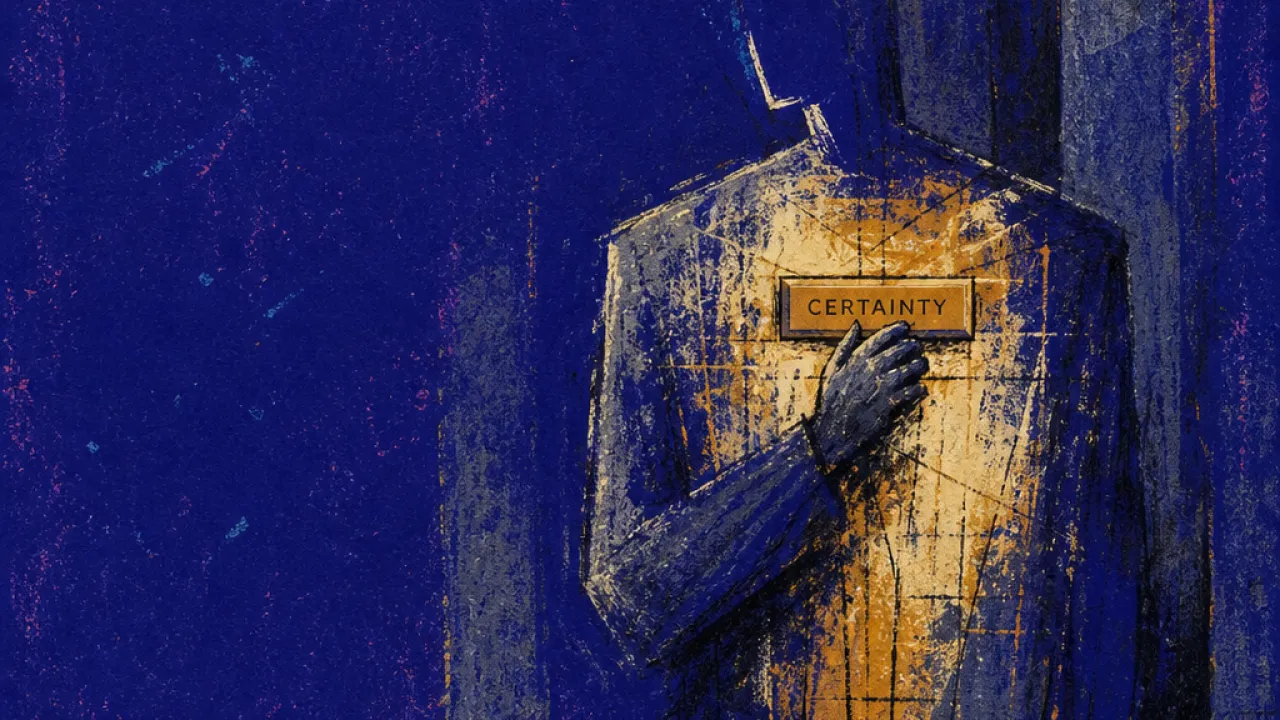
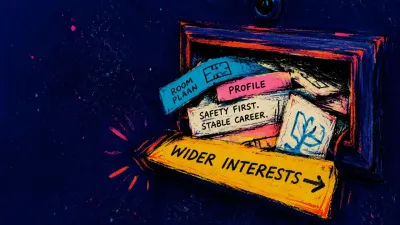
That sealed-room feeling, where a chosen role starts deciding what you are allowed to become, is the core signal of identity foreclosure. You may notice it in the small pause before you explain your plan again, with your chest held tight and your breath pulled shallow. Jungian archetypal theory gives this pattern a language for the self caught inside a finished image before it has fully formed. The Tarot Cards below reflect the unconscious dynamics of that early closure and the structures that keep it in place.
The Tower UprightThe crown does not fall separately from the tower; it falls as part of the same collapse. The figures are thrown from a structure that once elevated them, so status, shelter, and self-position are visually fused into one unstable height. In a choice reading, that fusion shows why changing direction can feel like losing yourself rather than updating a plan. The pattern appears when a path has become a container for identity, and the real work is separating who you are from the structure that used to prove it.
ReversedThe crown falls separately from the tower, showing authority detached from the structure that used to display it. The figures are forced out of the height that once organized their place in the scene. What collapses is not only a building, but a whole arrangement of identity, status, and future direction. Identity Foreclosure appears when a career path becomes too narrow to survive disruption. You may have committed so completely to one role, company, industry, or leadership track that alternatives do not feel like options; they feel like exile from the self you were trying to become. The tower's verticality mirrors that single-route identity structure. The reversed force of the card shows the crisis that follows when the chosen structure can no longer hold. The rupture does not mean the self has ended. It reveals that the self was being housed in a career container too narrow to carry the full range of your agency.
The Star ReversedThe woman is exposed under the open sky, yet the strongest point in the image is the single bright star above her. The body is present, but the eye is easily pulled toward one dominant symbol of meaning. Reversed, Identity Foreclosure fits when one path, title, or dream becomes the whole self before the rest of you has had room to speak. You may have chosen a direction that looked meaningful from a distance, then found that the life built around it leaves key parts of your desire unwatered.
Judgement ReversedJudgement shows the individual body waking inside a collective arrangement. The mirrored family groups repeat the same structure, and the trumpet gathers attention into one dominant call. The person is visible, but the larger system frames what visibility means. In the reversed family field, that image becomes identity foreclosure. A family-approved life path can arrive before the self has had room to explore: the acceptable career, the respectable relationship, the role of the reliable child, the emotional style that keeps everyone comfortable. The person appears awakened, but the identity has been preselected by the container. The card’s enclosure is important because foreclosure often feels like safety, not force. The mountains and coffins create a familiar structure that can be mistaken for destiny. The audit is to notice where family recognition has replaced self-recognition.
The World UprightThe small wreath on the figure's head echoes the massive wreath around the body, turning identity and environment into a single mirrored image. The four corner figures reinforce the sense that this is not a partial self, but a complete and officially witnessed form. That visual completeness can harden into Identity Foreclosure when a decision is treated as the final answer to who you are allowed to become. Instead of asking what path fits the next stage of life, the mind asks which option preserves the most coherent identity story. For you, the trap appears when changing direction feels like betraying a version of yourself that once made sense. The World shows the beauty of integration, but it also exposes the risk of sealing the self too early around one polished life script.
ReversedThe central figure looks complete because everything around her agrees with the shape of completion. The wreath, the mirrored crown, the balanced corners, and the ritual dance all reinforce one coherent image, leaving little visual space for experimentation. In reversal, that coherence becomes premature closure. Identity looks settled not because it has been freely explored, but because the available story has already been wrapped into a finished circle. For you, Identity Foreclosure names the family pattern where a life path, role, belief, or relational style is chosen before the self has fully had room to test alternatives. The World reversed makes the trap precise: wholeness can be real, but it can also become a polished enclosure when completion arrives before individuation.
Three of Cups ReversedThe harvest at the women's feet proves that a cycle has worked: effort became fruit, and the result is visible enough to be celebrated. Reversed, that same abundance can harden into an identity container where the self becomes organized around what has already been rewarded. Identity Foreclosure appears when a successful role becomes easier to preserve than to question. The raised cups mirror back a version of you that everyone recognizes, while the wider horizon of possible futures quietly disappears behind the ceremony of what has already been achieved. For a direction question, the card can reveal why the next path feels blocked even when the old path still looks successful. The issue is not failure; it is the psychological cost of staying loyal to a self-image that once brought belonging, praise, or certainty but no longer carries your real momentum.
Five of Cups ReversedThe figure's body is turned toward the fallen cups and away from the standing ones, as if the lost route has become the only mirror available. The bridge is present, but the river reads as a stronger boundary than the passage across it. Identity Foreclosure appears when a collapsed plan hardens into a definition of the self. Instead of reading the loss as one chapter in the map, the mind uses it to close down possible identities before they can be tested. In a direction reading, this can happen after leaving a career track, missing a social timeline, outgrowing a role, or reaching a goal that no longer feels alive. The card shows a self-image organized around what failed, while the remaining cups quietly challenge the idea that the future has only one name.
Six of Cups UprightThe cups are arranged like stable containers inside a contained domestic space. The children remain within the courtyard's emotional perimeter, and the house behind them gives the whole scene the feeling of a finished inner world rather than a threshold into unknown terrain. That structure can become a belief system. A person may confuse the earliest coherent story about who they were with the truest story about who they can become. The protected space offers certainty, but certainty can quietly close the search before the adult self has gathered enough evidence. Identity Foreclosure names the moment when a life direction is selected too early because it reduces ambiguity. In this card, the past is not only remembered; it is organized, beautified, and made to look complete, which is exactly why it can feel safer than exploring a future that has not yet proved itself.
Seven of Cups ReversedThe mask-like head and the hidden figure appear in separate cups, while the castle and wreath offer status, security, and recognition as visible anchors. The image places a ready-made identity beside a concealed self that has not yet been fully seen. Identity Foreclosure forms when the mind chooses a role too early because uncertainty feels harder to tolerate than commitment. In an academic path, the major, degree, institution, or graduate plan can become a borrowed face that stabilizes anxiety before actual fit has been investigated. The Seven of Cups makes this pattern especially sharp because the options look symbolic before they become lived. You may have chosen the cup that looked secure or impressive, while the shrouded part of the self is still waiting to be consulted.
Nine of Cups ReversedThe composition is arranged around a completed display, not an unfolding path. The man's crossed arms and the row of cups create the image of someone who has arrived at a recognizable version of success and is now sitting inside that identity. When reversed, the completed image can become a trap. The psyche may defend a role, path, or self-concept because revising it would disturb the polished mirror that has been used to feel coherent. In a choice reading, this pattern exposes a decision made to preserve who you have already become on paper. You may be choosing the option that protects the finished identity, while the deeper audit asks whether that identity is still chosen or simply being defended.
Ten of Cups ReversedThe house in the distance and the rainbow above it create a powerful image of the life that is supposed to mean arrival. Reversed, those symbols can harden into a single approved script, where safety is allowed to have only one shape. Identity Foreclosure shows up in career life when an old success image keeps deciding for the current self. A role, industry, title, or professional persona may once have promised stability, but the same container can become too narrow when your actual skills, values, and ambitions have moved on. The reversed Ten of Cups points to the emotional weight behind staying. You may not be clinging to the job itself; you may be clinging to the identity contract that made this path feel like proof that everything would finally be secure.
Page of Cups ReversedThe Page stands as the keeper of the chalice, dressed for a role before the fish has been understood. His posture is composed around the object he is meant to carry, making the duty look stable even while the water behind him remains in motion. Identity Foreclosure forms when a role, timeline, or inherited future becomes the container before your own desire has had room to speak. You may be maintaining a path because it looks coherent from the outside, while the inner signal is still asking whether that role was ever chosen.
Ace of Pentacles ReversedThe pentacle is enclosed by its own circle, and the garden below is enclosed by a fence that defines what belongs inside the cultivated field. The archway offers access, but it also implies that entry happens through a recognized gate. In the reversed psychological field, these visual boundaries can become overidentified with legitimacy itself. Identity Foreclosure appears when a life path becomes fixed before the self has fully tested whether it still fits. The stable pentacle turns into a closed symbol of what counts as a valid future, while the fence turns possibility into acceptable versus unacceptable territory. The person may keep holding the chosen path because it is coherent, not because it is alive. For a direction question, this pattern reveals where an old decision, credential, role, or success script has become a substitute for ongoing self-inquiry. The card does not demand rebellion for its own sake; it asks whether the identity you are protecting still has contact with your actual inner compass.
Three of Pentacles ReversedThe arch is geometric, symmetrical, and heavy with pentacles set into stone, while the blueprint projects a finished form onto a still-unfinished structure. The visual language of permanence arrives before the living process has finished negotiating what it wants to become. Identity Foreclosure fits when a life plan hardens into a self before the self has fully consented. For you, the card shows how a stable-looking future can become a psychological container that is too tight, especially when the plan is impressive, legible, and difficult to revise.
Four of Pentacles ReversedThe pentacle on the crown gives the figure's identity a fixed emblem, while the square seat holds him in a hard, frontal position. He appears established, but the same structure that confirms him also reduces him to the identity he is defending. When this image turns inward, the seat becomes less like a base and more like a box. The self is not exploring new roles, skills, or expressions; it is maintaining the version that already feels legible and safe. In personal growth, this can look like deciding too early who you are and then calling that decision realism. Identity Foreclosure is the premature closing of the self's future possibilities. You may say, 'I am just not that kind of person,' but the card shows a more exact mechanism: an old identity is being protected because a larger one would require uncertainty, visibility, and the temporary loss of familiar control.
Five of Pentacles ReversedThe card gives the figures a visually fixed role: outside, injured, cold, and separated from the protected interior. The window above them is stable and radiant, while their bodies are defined by exposure and lack of access. Identity Foreclosure happens when a temporary position hardens into a self-definition. The mind stops saying this is where I am right now and starts saying this is who I am, which can make a narrow survival role feel like a complete life path. In direction work, this pattern is especially costly because the future gets selected from an outdated identity. You may be mistaking the role shaped by hardship for the full range of selves still available to you.
Seven of Pentacles ReversedThe figure is positioned so close to the cultivated vine that the path and the self begin to feel visually fused. The open background exists, but the gaze does not travel there; it stays fixed on what has already been grown. That fixation can harden into an identity structure. A project, career track, relationship arc, city, or long-held plan stops being something you chose and starts becoming the proof of who you are. In direction work, Identity Foreclosure names the moment when the already-built path blocks contact with the future self that has not been allowed to form. You are not only evaluating a direction; you are evaluating whether an old self-story has taken over the steering system.
Nine of Pentacles ReversedThe robe, falcon, pentacles, vineyard, and manor assemble a finished portrait of someone who has arrived. The scene is stable and admirable, yet its completeness leaves little visible room for trial, contradiction, or becoming someone else. That finished image can close the future too early. Identity Foreclosure appears when you accept a successful role, lifestyle, or trajectory as the final answer before your deeper desires have been tested, so direction becomes performance of a self you have outgrown.
Ten of Pentacles UprightThe crest, arch, walls, elder, and property markers make the scene feel already authored. The household has a name, a history, a boundary, and a visible order before any individual figure has to explain who they are. For academic decisions, that kind of structure can become seductive. A prestigious major, a graduate track, a professional title, or a research identity may seem to solve the discomfort of not knowing, because it gives the self a finished shape before exploration has done its work. Identity Foreclosure appears when uncertainty is managed by premature commitment. The card's strength is its stability, but the psychological audit asks whether the study path is genuinely chosen or simply inherited from the most respectable version of the future.
ReversedThe child is partly hidden behind the mother while the elder, crest, arch, property, and distant wall define the field before the child ever steps forward. The visual order is already complete, and individual movement happens inside an older structure that has decided what stability and value should look like. Identity Foreclosure appears when becoming is narrowed into a pre-approved role before genuine exploration can happen. In personal growth, You may confuse a familiar future with an authentic one, treating an inherited script as maturity when it is actually limiting the range of selves You are allowed to test.
Page of Pentacles ReversedThe Page's face is close to the pentacle, and the object sits almost where a self-image would be placed. When reversed, the same focused gesture can harden into a mask: the symbol no longer supports development; it starts defining who the figure is allowed to be. That visual compression maps onto Identity Foreclosure. The psyche chooses a stable label too quickly because uncertainty feels harder to hold than a fixed story about the self. In introspection, this can happen through healing language as much as through old roles. You may become the wounded one, the rational one, the disciplined one, or the self-aware one, while other contradictory parts lose permission to speak.
Queen of Pentacles ReversedThe throne gives the Queen a place, a function, and a visible identity. In reversal, that seat can stop feeling like support and start feeling like a role that has already decided where the body belongs. The pentacle, garden, and carved stone all reinforce a stable image of provision and grounded care. When that image hardens, the family system may reward one version of you so consistently that other possible selves feel disloyal, immature, or unsafe. Identity Foreclosure appears when the responsible one, the good child, the provider, or the calm one becomes a finished story before you have chosen it. The card exposes the moment when a respected role becomes an inherited script that blocks individuation.
King of Pentacles ReversedThe King's robe blends into the greenery of the estate, while the crown, throne, pentacle, and castle make his role almost indistinguishable from the world he manages. The image does not only show possessions; it shows a self organized around what has been built. When the built role becomes the whole identity, a new choice can feel like a threat to the person you have proven yourself to be. You may reject paths that are genuinely alive because they would require admitting that an older version of success has become too small.
Six of Swords ReversedThe passengers' faces are hidden, and their bodies are not the ones steering the boat. The ordered swords stand around them with enough structure to feel protective, but also enough rigidity to suggest a path already defined before the inner self has spoken. Identity Foreclosure appears when a life direction becomes complete-looking before it becomes personally inhabited. You may be moving along a recognizable route, but the obscured faces show the cost of letting inherited logic, early choices, or social scripts harden into identity too soon. The reversed Six of Swords connects to this pattern because it shows transition without visible self-authorship. The boat is going somewhere, but the image asks whether the person inside has chosen the crossing or merely learned how to be carried by it.
Eight of Swords ReversedThe red-robed figure carries visible vitality, but her arms are tied and her route toward the distant castle is interrupted by a field of swords. The image separates living force from enacted agency. A larger terrain is present, yet the body remains fixed inside a story about what it can safely become. Identity Foreclosure appears when the self closes its future too early. You may decide you are not the disciplined one, the visible one, the ambitious one, the creative one, or the person who can handle more, long before reality has been allowed to test that identity. The belief becomes a fence around possible selves. In personal growth, this pattern blocks evolution by making an old self-description feel responsible and realistic. The card exposes the cost of that premature certainty: potential remains visible in the distance, but the current identity keeps obeying the swords around it. The work begins by noticing where a self-concept has been mistaken for a final verdict.
Ten of Swords UprightThe figure's face is turned away from the viewer, leaving no expression to read and no visible self-reflection to meet. The body is not simply injured; it is overwritten by a row of blades, while the river and distant mountains remain separated from any active movement toward them. Identity Foreclosure appears when direction has been assigned before inner consent has been consulted. For you, the danger is not simply choosing the wrong path; it is mistaking a role, milestone, or inherited script for a living compass. The card gives that mechanism a physical form: the self disappears from the image, and the body becomes the surface where external conclusions land.
Page of Swords ReversedThe squire's hands are wrapped around the sword he is responsible for maintaining, and his whole posture is organized around that role. The high ridge gives him position, duty, and visibility, but it does not make the terrain feel like home. Identity Foreclosure happens when a role becomes a ready-made answer before the self has had enough room to form its own question. You may stay loyal to a life plan, career story, or achievement identity because it offers structure, even when the inner compass has stopped recognizing it as yours. The Page's responsibility is real, but the card also shows the cost of confusing responsibility with direction. A borrowed map can keep you standing upright while quietly preventing a more honest path from entering the field.
Queen of Swords ReversedThe Queen's crown, throne, and formal posture create a powerful image of identity held in place. In the reversed psychological field, that same solidity can become a fixed container: the seat supports authority, but it also keeps the body locked above a changing landscape. Identity Foreclosure happens when a self-definition becomes final too early. You may cling to a role, career story, achievement identity, or 'sensible path' because reopening the question would disturb the stability that once protected you. For direction work, the card reveals where sovereignty has hardened into immobility. A path that once proved your strength may now be functioning as a closed identity, and the future cannot widen until that container is audited.
King of Swords ReversedThe king's crown, throne, and fixed front-facing posture make identity look finalized, while the butterfly carved into the stone is a symbol of change trapped inside a hard surface. The background has moving birds and clouds, but the body remains locked on the mound, separate from the living horizon. For you, this points to Identity Foreclosure when a life path is chosen as a verdict before enough of the self has been allowed to test, revise, and become. The pattern calms direction anxiety by making the self legible and decided, often through the path that looks safest, smartest, or most defensible. The cost is subtle at first because the future may appear stable while the inner compass keeps signaling that the verdict arrived too early.
Two of Wands ReversedOne wand is held by the figure, but the other is fastened to the castle wall. The body stands inside the secured structure while the gaze reaches toward the open world. The card shows a life path that has form, status, and stability, but also a visible pull toward an untested horizon. Identity Foreclosure appears when a path becomes fixed before the self has fully explored its own range. The secured wand and castle wall can represent the role, plan, or life script that once offered coherence but now limits discovery. The psyche stays loyal to the chosen structure because reopening the question would disturb the identity built around it. For direction questions, this card can name the unease of realizing that a stable path may have been chosen too early, too narrowly, or under too much external noise. You are not being asked to reject structure; the pattern asks whether the structure still reflects the self that is trying to emerge.
Four of Wands ReversedThe castle in the distance gives the Four of Wands a powerful image of an already built destination. In reversal, that destination can stop functioning as support and start functioning as a finished script, as if the future has been architected before the self has had enough room to question it. Identity Foreclosure appears when the psyche commits too early to a role, path, or version of adulthood because it offers relief from uncertainty. The square wands and distant home make the life shape look complete, but the bridge between present self and future structure still matters. Without that crossing, stability becomes premature closure. For you, this pattern exposes the pressure to become legible before becoming honest. Direction is not found by accepting the first coherent identity that reduces anxiety; it is found by testing whether the structure still leaves room for desire, doubt, and future growth.
Six of Wands ReversedThe rider appears already crowned by the scene: the laurel is on his head, the wand is raised, and the procession frames him as someone who has become something specific. The image is powerful because it shows recognition arriving before the inner life of the next chapter is visible. That is the mechanism of closing identity too early. You may lock onto a role, achievement, title, or life script because it gives the future a stable shape, even while other possible selves remain untested and unnamed. In direction work, the reversed Six of Wands exposes the cost of letting one celebrated identity end the conversation. The card asks whether the current role is a true orientation, or whether it has become a polished container that makes revision feel like betrayal.
Nine of Wands ReversedThe bandage sits where thought, memory, and self-image would be visually centered, while the wall behind the figure fixes him inside a role of guarded endurance. The card does not show a person freely exploring identity. It shows someone whose current position is still shaped by what had to be defended. Identity Foreclosure appears when an old role becomes mistaken for the whole self. The survivor, achiever, responsible one, practical one, or externally approved version of life can become so familiar that other futures feel unreal. The wall protects the identity, but it also limits the imagination. For a direction reading, this pattern points to a future blocked by premature closure. You may be trying to choose the next path while still assuming that the old defensive role is non-negotiable. The card asks what becomes visible when identity is no longer defined only by the battles that made you competent.
Ten of Wands ReversedThe destination is visible, and the bundle is organized enough to make the journey look coherent. Yet the figure's body is locked into the load before he ever reaches the place that supposedly explains it. In its reversed texture, the card shows a prematurely closed life map. The psyche treats an already-started route as an identity, so reassessment feels like threatening the self rather than updating the plan. In a direction reading, Identity Foreclosure points to a future chosen too early or too narrowly. You may be carrying a life path because it looks stable, but the card asks whether stability has quietly replaced self-discovery.
Page of Wands ReversedThe young figure appears already costumed as a messenger of fire, holding the wand with the seriousness of a defined role. Yet the environment around him is still mostly empty, which makes the identity look more formed than the path underneath it. Identity Foreclosure emerges when a future self is selected too early because uncertainty feels harder to tolerate than commitment. You may keep defending a life direction, aesthetic, title, or storyline that once gave shape to the future but now limits what the next stage is allowed to become. The reversed mechanism is visible in the mismatch between the finished-looking role and the unfinished terrain. The card asks for an audit of whether the identity is still a living compass or has become a container that prevents the compass from updating.
Knight of Wands ReversedThe Knight's armor, emblem, wand, and lifted riding position create a complete image of someone who already knows what role he is playing. The desert sits beneath the horse's hooves, while the costume of purpose is far more detailed than the actual road ahead. Reversed, that visual certainty can become premature identity closure. The psyche locks onto a heroic version of the future because ambiguity feels too exposed, and the chosen role starts doing the work that real exploration has not yet done. For you, this pattern can make a life direction feel settled because it looks compelling, coherent, or impressive. The card asks whether the identity you are riding under has been tested by the terrain, or whether it became fixed too early because not knowing felt unbearable.
Queen of Wands ReversedThe Queen's robe, throne, and desert background share a heated visual field, so the person and the seat of power nearly merge. The throne is not just furniture; it becomes an identity architecture around her body. Identity Foreclosure appears when a family-approved role is occupied before the self has had enough space to choose. You may inherit a script about success, gender, loyalty, faith, caretaking, ambition, or emotional style, then mistake that script for your own desire because it has always been the available seat. The card's reversed psychology lives in that merge between person and throne. Inner authority becomes difficult to separate from inherited authority. The audit is not whether the family role is entirely false, but whether it has left enough room for an adult self to form beyond it.
King of Wands ReversedThe throne rises in a bare desert with almost no competing structures, plants, or roads. The king has a wand, a crown, and a defined station, but the surrounding world offers very few visible alternatives to the identity already being performed. Identity Foreclosure emerges when that visual certainty becomes psychologically premature. The psyche chooses a role because it looks stable, legitimate, and recognizable, then treats exploration as a threat to the structure that has been built. The single wand becomes the only sanctioned line of vitality, even if other parts of the self have not been allowed to speak. For You, this pattern may appear when the future feels locked by a choice that once made sense but now feels too narrow. The card exposes the difference between a true inner commitment and an identity that was selected because it reduced anxiety, pleased an external script, or made the path look respectable from the outside.
No cards available for this filter.