After 'We're Great' at Dinner, a Boundary Made Room for Repair

The Smile I Could Hear Before the Door Opened
I can read a stakeholder room for a living, but after a fight, a family dining room turns every pause into data and every face into a possible verdict. That was the pressure I heard beneath Maya’s question when she came to me: why did she play the happy couple at family dinners after a fight?
Maya (name changed for privacy) was twenty-nine, a London UX researcher with the trained attention of someone used to noticing what people click, omit, and hesitate over. She told me about 6:52 p.m. outside her family’s terraced house in South London. Drizzle had caught in her hair. The black screen of her phone showed the unfinished argument above an Uber receipt. Roast garlic floated through the open doorway, warm and almost accusing against the cold pavement.
She checked her reflection in the phone, pressed her lips together, and said to her partner, “Let’s just be normal tonight.”
I could picture the rest because she gave it to me in sharp pieces: her jaw locking before she rang the bell; the hand she placed on her partner’s shoulder when someone lifted a phone for a family photo; the automatic “We’re great” that came out when an aunt asked how they were doing. She wanted privacy, so she performed certainty. She wanted connection, so she postponed repair. She wanted to belong, so she tried to make ordinary conflict invisible.
Her apprehension was not a vague cloud. It was like holding a showroom-flat door shut with one shoulder while everyone waited in the hall: every unfinished thing had been moved out of sight, but she could feel the pressure of it behind her.
“You are not wrong for wanting to keep the argument private,” I told her. “But privacy should not require this much acting. Let’s make a map for the difference, and find some clarity without handing your relationship over to the room.”

Choosing a Map for the Dinner Table
I invited Maya to put both feet on the floor, notice the support of the chair, and take one unforced breath. I shuffled slowly while she held the question in mind. I use that pause as a transition into observation, not as a demand to feel mystical or calm on command.
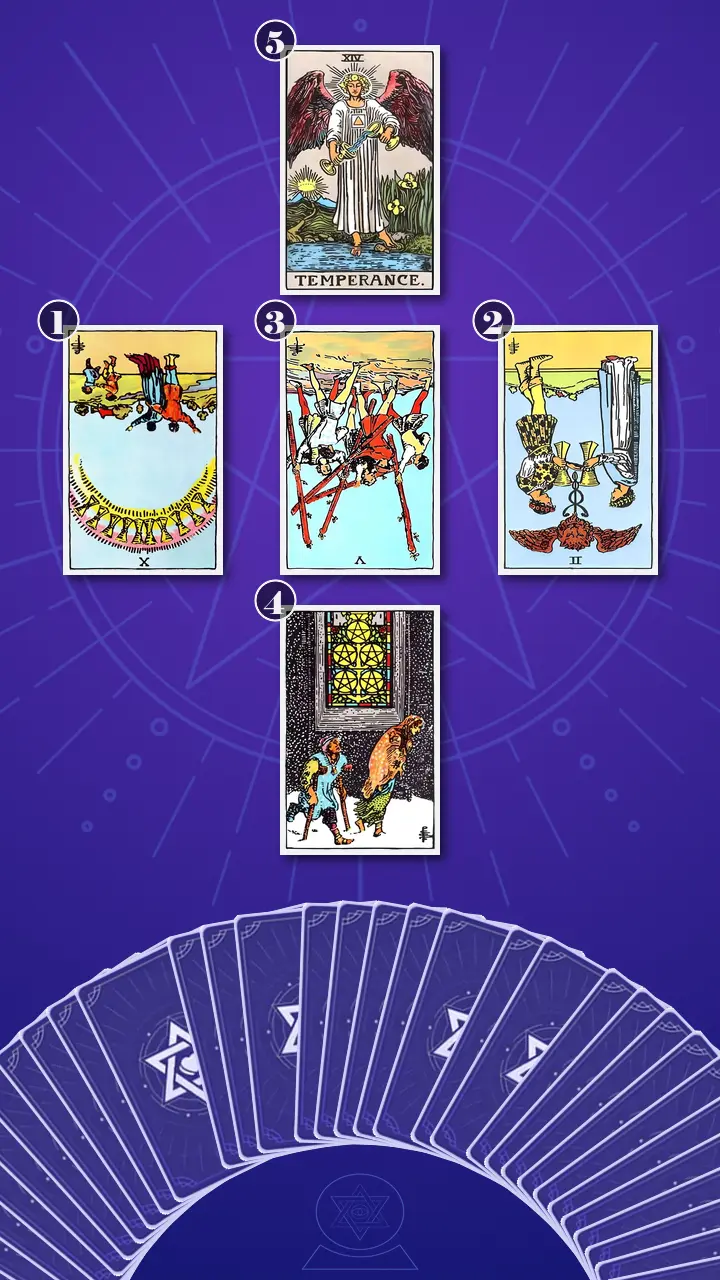
For this reading, I chose the Relationship Spread · Context Edition, a contextual five-card relationship tarot spread. It fits family dinner anxiety after relationship conflict because it is small enough to stay focused while still separating five things that get tangled together: Maya’s public stance, her perception of her partner, the shared conflict loop, the belonging fear underneath it, and a constructive next direction.
I explained that the second position would not tell me what her partner secretly thought. It would show how Maya was reading their availability after a fight, where her observations ended, and where fear might start filling in the blanks. The centre card would show whether the argument had actually been repaired or merely made quiet for dinner. The final card would look for a way to protect privacy without pretending everything was perfect.
The Cards Beneath the Polished Photo
The Rainbow Turned Upside Down
“Now I’m turning over the card for your observable happy-couple performance and the ideal of family harmony you try to maintain after a fight,” I said.
It was the Ten of Cups, reversed.
In its upright image, ten cups form a rainbow over a home and a family scene: a complete, presentation-ready picture of belonging. Reversed, I read it as a gap between that picture and the lived emotional weather beneath it. This was Maya at 9:03 p.m., placing a hand on her partner’s shoulder for the family photo, supplying a cheerful couple update, and checking everyone’s faces to see whether the image had worked.
“The card is not calling you dishonest,” I said. “It is showing an overcorrection. When the bond feels strained, you add warmth until the room cannot see a crack. But the more perfect the dinner looks, the less room the real relationship has to breathe.”
For a second, Maya gave a dry little laugh and looked down at the card. “That is painfully accurate,” she said. “The more unresolved we are, the more couple-y I become. It’s almost embarrassing.”
I watched her thumb run once along the edge of her mug. “It makes sense as protection,” I said. “The question is what it costs you afterward.”
When Two Cups Do Not Meet
“Now I’m turning over the card for your current perception of your partner’s emotional availability after conflict, without pretending this gives us access to their private thoughts.”
It was the Two of Cups, reversed.
The upright Two of Cups shows two people voluntarily offering cups to one another. Its reversal does not declare a relationship broken. It points to a blocked or unbalanced exchange: a moment when connection has not yet been restored, but one person tries to manufacture public coordination anyway.
I described the modern scene that came through it: Maya hears one clipped answer from her partner, then thinks, Their short reply means I need to manage this before everyone notices. Before her partner can answer the aunt’s question, Maya says, “We’re good,” for both of them. She cues a shared joke. She supplies the warmth that has not yet been jointly agreed.
“That is a deficiency of mutual exchange, not a deficiency in you as a person,” I told her. “When you answer for the couple, you may gain a few seconds of control. But your partner can feel managed, and the disconnection you are trying to hide gets a little more space.”
Maya’s fingers tightened around the mug, then loosened. “I keep telling myself I’m helping,” she said. “But I have never actually asked what kind of evening they want after we fight.”
“That is the distinction,” I said. “Intimacy is coordinated consent. Control is trying to make the scene work alone.”
The Argument That Lost Permission to Make Noise
“Now I’m turning over the card for the shared conflict-management loop: the disagreement pushed out of public view but not turned into private repair.”
It was the Five of Wands, reversed.
The five crossing staves show friction without a common direction. Reversed, the visible clash has gone underground. The energy is blocked rather than resolved. I saw the front-door moment Maya had described: voices dropping, a key turning in the lock, both people switching into public mode because dinner had begun.
“You paused the argument for dinner,” I said. “You did not necessarily finish it.”
It was like muting a heated Slack thread without resolving the ticket. Notifications stop. The work remains open. At dinner, every careful answer, staged gesture, and redirected topic becomes part of the unresolved task. Then the Overground carries two tired people home under fluorescent light, and reopening the issue feels too expensive.
In my work with sound and pressure, I call this a Communication Dissonance Audit. I do not begin with who had the better argument. I listen for the tempos that no longer match. Maya’s tempo was fast, anticipatory, tuned to every relative’s glance. The repair tempo between the couple had slowed to near-silence. They were no longer fighting loudly, but they were not moving together either.
Maya’s shoulders lifted toward her ears as she listened. Then she exhaled through her nose. “We stopped making noise,” she said quietly, “so I told myself we had stopped having the conflict.”
The Window That Looked Like Belonging
“Now I’m turning over the card for the underlying fear: that visible relational imperfection could threaten family belonging or invite scrutiny you do not want.”
It was the Five of Pentacles, upright.
In the card, two figures move through snow beneath an illuminated stained-glass window. The image can speak to hardship and exclusion, but I was careful with the distinction here. It did not tell me that Maya’s relatives would reject her. It showed how intensely Maya behaved as though one visible rough edge could put her outside the warm family picture.
I placed the card beside the memory of the family WhatsApp photo: heart reactions arriving before the couple had said a real word to each other on the journey home. “A curious glance can become a one-star review in your head before anyone has submitted feedback,” I said. “You see a pause, and your nervous system supplies the verdict: If they see the crack, they may stop seeing us as one of the couples who belong here.”
The radiator ticked in the quiet room, a small metronome refusing to rush her. Maya’s breath paused. Her eyes went briefly unfocused, as if she were replaying a dozen dinners at once. Then her mouth pressed into a line and her chest dropped on a slower exhale.
“I hate that I am so scared of looking unstable,” she said. “No one has even said that word.”
“That matters,” I replied. “We can separate present evidence from anticipated judgment. Your fear deserves care. It does not have to run the whole dinner.”
When Temperance Changed the Tempo
The Cup That Holds Only What It Can Hold
The room seemed to settle before I turned over the final card. “This is the card for the key shift toward bounded authenticity: limited truth, protected details, and a separate repair process.”
It was Temperance, upright.
The angel on Temperance pours water carefully between two cups. One foot stands on land and one in water. Nothing is dumped. Nothing is denied. The image is balance, regulation, and proportion. It is the middle path between performing total harmony and opening the argument to a family table that cannot responsibly hold it.
At 6:52 p.m., Maya had been caught in the binary that makes conflict masking feel inevitable: either be the convincing happy couple, or let dinner become a relationship referendum. The unfinished argument was still glowing on her phone. She was bracing to monitor every glance, touch her partner’s shoulder for the photo, and make the evening look settled before the couple had settled anything privately.
Stop equating a visible rough edge with relationship failure; offer one measured truth and one clear boundary, as Temperance pours only what the moment can hold.
I left the sentence in the space between us.
Maya became very still. First her breath caught high in her chest, and her hand hovered near the Ten of Cups as though she had forgotten what she meant to do with it. Then her gaze shifted away from the spread, not evasive but distant, as if an old memory were playing in a room behind her eyes: family voices, a raised phone, the obligation to smile quickly enough. Finally, her face changed. Her eyebrows drew together in a flash of anger, and she said, “But does that mean I have been doing it all wrong?”
I shook my head. “No. It means your old strategy was trying to protect something real: privacy, belonging, and control over your own story. It gave you temporary relief. It just asked too much from you and from the relationship.”
Her fingers uncurling from the mug were almost imperceptible. Her shoulders lowered. Her eyes brightened at the rims, though she did not cry. There was relief in the long breath she let out, but also a slight dizziness, the kind that can arrive when a heavy role has been set down and the hands do not yet know what to hold instead.
I continued, “Privacy is a boundary around the details; performance is a demand that no rough edge be visible. You can protect the relationship without proving that it is perfect.”
She looked back at Temperance. “I can acknowledge the weather,” she said slowly, “without handing over the whole storm.”
“Exactly. Now, with this perspective, think about last week. Was there a moment when this could have changed how you felt?”
“When my aunt asked if we were okay,” Maya said. “I could have said we had a tense day and left it there. I thought my only options were to lie or explain everything.”
That was the crossing point in her Journey to Clarity: from fear-driven relationship image management and postponed repair toward bounded authenticity, proportionate disclosure, and intentional private repair. Temperance did not promise that dinner would become effortless. It offered Maya a different rhythm to practise.
As someone who studies emotional tempo, I also heard the practical invitation in this card. In a rising argument, there are often defensive high notes that can shatter emotional safety before either person has chosen their words. My Syncopation Pause is simple: before entering the house, or before replying to a probing question, let three silent seconds pass. Feel both feet. Unclench the jaw on one exhale. The point is not to become serene for the audience. It is to lower the emotional BPM enough to choose a boundary instead of reflexively launching into a performance.
A Smaller, Clearer Truth
When I looked across the full spread, the story was coherent. The reversed Ten of Cups showed Maya maintaining a polished family image. The reversed Two of Cups showed what happened when she tried to coordinate the couple before mutuality had returned. The reversed Five of Wands showed the conflict being hidden rather than given a repair process. The Five of Pentacles named the fear beneath it: not merely awkwardness, but the possibility of losing a place inside the family picture.
The cognitive blind spot was the belief that privacy required her to erase every visible sign of difficulty. But a boundary can be honest without becoming an invitation to intervene. The spread’s missing Air element mattered too: there were feelings, friction, and belonging fears, but no clear language. Maya did not need more facial-expression analytics. She needed one short sentence.
I offered these as optional experiments, not rules. They were designed to return choice to Maya and her partner.
- The One-Truth, One-Boundary CheckThree minutes before the next family dinner, Maya can draft two Notes app lines: “We’ve had a tense day, but we’re okay being here,” followed by, “We’re keeping the details between us.” She can ask her partner in the flat or by text whether either line feels accurate for both of them.If “tense day” feels too exposing, use only: “We’d rather keep relationship stuff private tonight.” Neither person owes relatives a polished explanation.
- The Five-Minute Consent CheckBefore leaving, Maya can set a five-minute timer and ask, “What level of warmth and privacy feels honest for both of us tonight?” They can agree not to answer for each other, choose a low-key redirect signal, or decide that separate answers are fine.No staged touch, shared joke, or coordinated story is required. “Neither is also fine” is a complete option.
- The Dinner-to-Repair BridgeBefore dinner begins, Maya and her partner can schedule a 20-minute repair window within the next 24 hours, covering one named issue. Each gets up to four uninterrupted minutes before any discussion of intent, and they finish by writing one next step in a shared calendar or message.If capacity drops or voices rise, stop and choose another time, format, or support. A planned pause is different from indefinite avoidance.
“You do not need a better performance,” I told Maya. “You need a smaller, clearer truth.”

The Quiet Proof on the Overground
A week later, Maya sent me a message after another family meal. She and her partner had done the five-minute check-in in the hallway. When someone asked how they were doing, Maya said, “We’ve had a tense day, but we’re keeping the details between us.” Then she changed the subject to her cousin’s new job. No extra affection. No explanation. No attempt to make the sentence harmless by smiling through it.
She told me the train ride home was still quiet at first. The family group chat photo arrived, warm and polished as ever. But this time, she did not react with a heart before she had checked in with herself. At home, they used the 20-minute timer. The conversation was not magically complete, and Maya woke the next morning with the old thought, What if I made it awkward? She noticed it, smiled once, and opened the shared calendar anyway.
That was enough proof for me. Tarot had not made a decision for her or guaranteed anyone’s response. It had helped her see a pattern, name the difference between privacy and performance, and choose a steadier next step. The power was always hers: not to make every dinner perfect, but to decide what truth belonged in the room and what repair belonged in private.
When the dinner table feels like a referendum on whether your relationship still belongs, your jaw can lock into a smile while one part of you protects privacy and another fears that one honest pause will put you outside the picture. Clarity can begin when you stop treating the photo as the whole story.
If you let one small truth exist without handing over the whole storm, what sentence might feel honest enough for you and private enough for your relationship?