From Going Quiet When Parents Defend a Sibling to One Calm Sentence

The 501 Queen Ride Before Another Quiet Family Dinner
When Maya sat across from me, I recognized a question I hear all the time from late-20s city adults: they can speak clearly in a client meeting, send a clean Slack message, hold a boundary in dating, and then go strangely quiet the second Sunday dinner turns into, once again, “let’s explain your sibling.” If you’ve ever wondered why you can speak up everywhere else but freeze at home, I want to say this gently and early: that is not a lack of insight. It is a family freeze response.
She told me about 5:38 p.m. on a Sunday, riding the 501 Queen streetcar to her parents’ place. One AirPod in. Notes app open. A draft that began with, “I notice we explain this differently…” The metal floor hummed under her boots, the stop-request bell kept dinging, and somebody’s takeout fries made the whole car smell aggressively salty. Before she had even reached the condo, her jaw was already tight.
Then she gave me the cutaway scene: 7:14 p.m., bright Toronto dining room, cutlery clicking against plates, roasted garlic and dish soap still hanging in the air. One parent moved instantly to soften her sibling’s behavior before anyone else had to sit with it. Maya looked down, kept moving her fork through the same section of food, and felt her throat narrow. “I don’t want a fight,” she said, “but I hate pretending that was normal.”
The hurt in her was not dramatic. It was quieter than that, and heavier — like standing at subway doors that are technically open while your body acts like they’re locked. I told her I did not hear weakness in that. I heard a nervous system trying to buy a few minutes of family peace at a price she kept paying later on the ride home. “So let’s not shame the silence,” I said. “Let’s make a map for it. That’s how we get to clarity.”

Choosing the Map: How This Relationship Spread Works
I asked Maya to take one slow breath and keep the question simple in her mind: Why do I go quiet when my parents defend my sibling? Then I shuffled slowly, not as some theatrical ritual, but as a way of helping both of us focus. I always think of this part as the camera settling before the real scene begins.
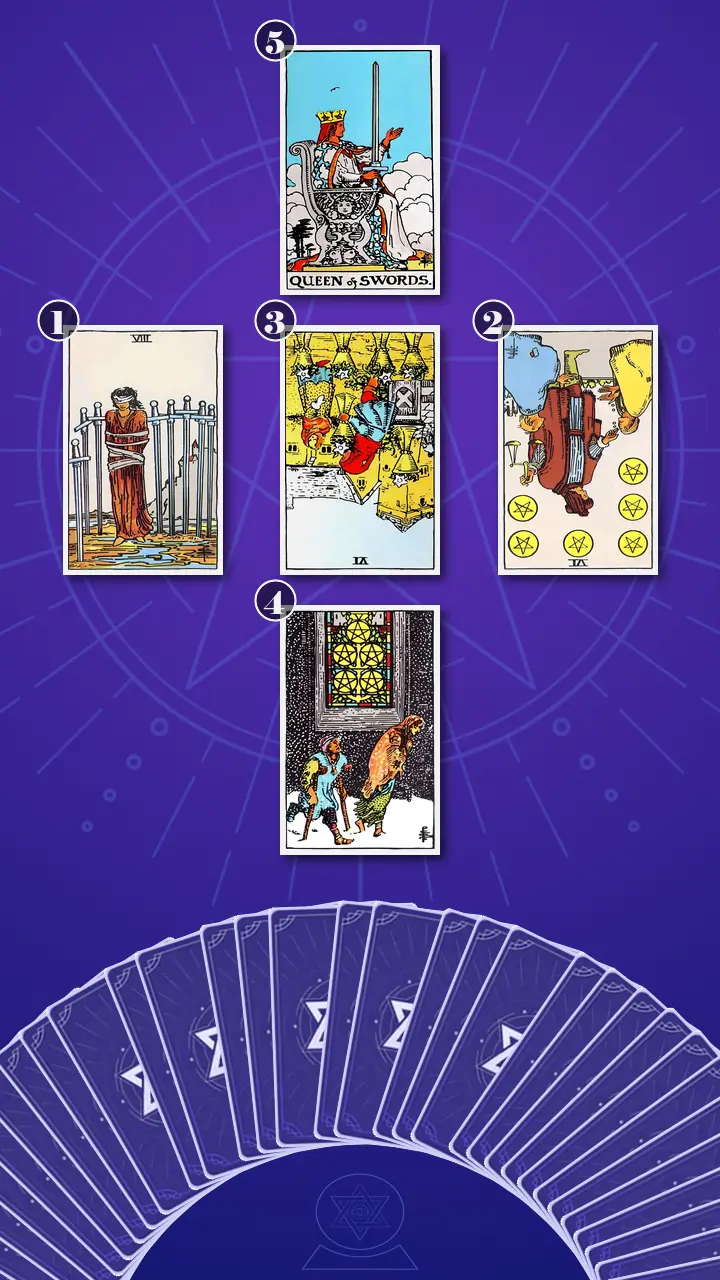
For her reading, I chose the Relationship Spread · Context Edition. I used it because this wasn’t just a private mood she needed help decoding. This was a repeating family interaction — a whole pattern with roles, pressure points, and an emotional logic that kept replaying at the dinner table. A five-card relationship spread is ideal for this kind of question because it moves cleanly from the visible shutdown response, to the family stance she is reacting to, to the old script holding it all together, down into the deeper belonging wound, and finally up into a practical, boundary-based next step.
I told her what I most wanted us to see. The first position would show the exact freeze response that takes over her body when the sibling rescue begins. The center card would reveal the shared family script that makes a present-night conversation feel much older than it is. The fourth card would touch the deeper fear underneath the silence. And the fifth — the guidance card, and the key card of the whole spread — would show the clearest way to stay present and speak without turning dinner into a trial.
When Dinner Auto-Logs You Into an Old Role
Position 1: The Freeze That Pretends to Be Good Manners
I turned over the first card and said, “Now we’re looking at the card that represents your current self in the conflict — the specific freeze response that shows up when your parents cover your sibling at dinner.” The card was the Eight of Swords, upright.
I explained that this is the exact Sunday-dinner moment she had described to me: eyes dropping to the plate, body going still, voice disappearing not because she has no thought, but because speaking feels riskier than swallowing it. The energy here is blocked Air — discernment that is active, but turned inward against the self. It is like having the full text already typed out and still being unable to hit send. I looked at her and said the line I most wanted her to hear: “You’re not blank. You’re self-editing at speed.”
She reacted before she answered. First her breathing caught. Then her fingers pinched the edge of her sleeve. Then she gave one short laugh with a bitter edge to it and said, “Wow. That’s accurate enough to feel rude.” I smiled a little and told her, “Accurate is kinder than shame. This card isn’t calling you weak. It’s showing me the inner rule that snaps on in real time: Don’t make this weird. Don’t be the difficult one. Keep it smooth.” When I said that, I saw her chest drop just slightly. Being named that precisely can feel like oxygen.
Position 2: The House Rules for Grace
I turned to the second card. “This card represents the family stance as you experience it — the enabling or overly protective response that triggers your shutdown.” The card was the Six of Pentacles, reversed.
In real life, I told her, this looks like a lopsided customer-service system. When her sibling slips, context and cushioning arrive immediately. When Maya reacts, maturity and restraint are quietly expected from her. The card’s energy is distorted Earth: imbalance, unequal accountability, support that is distributed selectively rather than fairly. It is the grading curve that only applies to one person in the class. “Family peace and fairness are not the same thing,” I said, and I let that sentence sit there for a beat.
Her face changed on that line. Not dramatic — just a tightening around the mouth, then a nod that came late, like it had to travel through years of evidence first. I told her this card did not require her to psychoanalyze anyone at the table. It only asked her to stop gaslighting herself about the pattern she kept experiencing: one child gets explanation, another gets expected composure.
Position 3: The Auto-Login to the Old Profile
I placed my hand lightly on the center card before turning it. “This is the shared dynamic,” I said, “the old family script that pulls everyone back into familiar roles during dinner.” The card was the Six of Cups, reversed.
This is the card that made the whole spread click into place. I told Maya that nothing mystical was happening at that table; it was simply a room that still knew everybody’s earlier part by heart. She might walk in as a capable 27-year-old woman with adult language, adult perspective, adult boundaries — and then one parental tone, one rescue comment, one uneven joke, and it was like her whole system got auto-logged back into an old identity without asking permission. Like a phone reconnecting to outdated Wi-Fi the second it gets close enough.
Through my own Family Casting Analysis lens, I could see the role immediately: not the dramatic one, not the needy one, not even the truth-teller. She had been cast as the Peacemaker — the easy one, the one who could handle more, the one whose job was to keep the room from tipping. That role can look flattering from the outside. Inside, it is exhausting. And it quietly trains a person to confuse self-erasure with maturity.
She winced and half-laughed at the same time. “So I’m not imagining it,” she said. “I actually do feel twelve.” I shook my head. “Feeling twelve at the table does not mean you are twelve at the table. It means the old script still has muscle memory.” As an artist, I have learned that some scenes don’t keep repeating because the actor lacks range; they repeat because the script still rewards the same performance. That was exactly what I was seeing here.
Position 4: The Fear of Being Outside the Warmth
I turned the fourth card. “This one shows the deeper challenge — the belonging wound and the core fear that make silence feel safer than speaking.” The card was the Five of Pentacles, upright.
I told her this was why the dinner moment felt so much bigger than a single unfair comment. Underneath the shutdown was a body-level fear that one honest sentence could move her outside the emotional warmth she still wanted from family. The energy here is deprivation and exposure: not ‘they may disagree with me,’ but ‘if I name this, I may become the difficult one and lose my place in the room.’ In the imagery of the card, there is cold street outside and lit window inside. Maya’s body had been treating truth-telling as if it might place her on the wrong side of that glass.
She went very still. Then she pressed her lips together. Then she said, quietly, “I don’t think they’d cut me off. I think they’d harden.” That distinction mattered. I nodded and answered carefully: “Yes. And your nervous system has been reading that hardening in advance.” Then I gave her another line I wanted her to keep: “A tense pause is not the same thing as exile.” I watched sadness move across her face, but it was the useful kind — the sadness that arrives when something finally makes sense.
When the Queen of Swords Cut Through the Old Script
Position 5: The Table-Safe Truth
When I turned the final card, the room changed. Even the little sounds outside seemed to pull back. “This,” I told her, “is the guidance card — the clearest boundary-based way to stay present and speak without turning the whole dinner into a trial.” The card was the Queen of Swords, upright.
The Queen of Swords is mature Air: clear discernment, proportionate truth, boundaries without performance. In modern life, I translate her like this: not a twelve-paragraph apology email, but one clean Slack message. Not a memoir about why the location matters, but a map pin. Maya did not need to expose the whole family system over roast chicken. She needed one factual sentence in her normal voice.
She was still holding herself like someone who expected cross-examination. I could feel the familiar bind she had been living in: either say nothing, or say everything perfectly. And meanwhile her real voice kept showing up only later — on the streetcar ride home, in a voice note, after the room was gone.
Your silence is not proof that your view matters less; offer one clean sentence and let the Queen's upright sword cut through the old peacekeeping script.
I let the sentence hang between us.
Her reaction came in layers. First, a full stillness — breath paused, fingers hovering over her tea mug as if waiting for impact. Then the faraway look people get when they’re replaying an old scene frame by frame, checking whether the new meaning really fits. Then, instead of relief, came heat. “But if that’s true,” she said, and now there was anger braided with grief in her voice, “doesn’t that mean I’ve been helping the pattern by going quiet?”
“No,” I said. “It means you learned a role early and performed it brilliantly because it helped you stay connected. But you’re not obligated to keep renewing that contract.” Through my Family Casting Analysis lens, the Queen looked to me like the exact moment the Peacemaker resigns from unpaid emotional stage management. And through my Narrative Enmeshment Diagnosis lens, I could see something else too: part of Maya’s life story had been hijacked to keep the family plot coherent — one child gets context, one child keeps the peace. The Queen interrupts that plot with adulthood.
I know this turning point well. It feels like an edit-suite moment to me — the place in a film where the whole story shifts, not because someone gives a grand speech, but because one line gets delivered differently. I saw it happen in her body. Her shoulders dropped. Her jaw unclenched. Then came that strange little lightheadedness that sometimes follows clarity, the mild dizziness of putting down a weight you had mistaken for part of your posture.
I kept my voice simple. “In the next ten minutes,” I told her, “open your Notes app and write one line that begins with ‘I notice…’ Keep it short enough to say in one breath. Read it once in your normal voice. If your body spikes, stop there. The point is not to become fearless tonight. The point is to give your future self one clean bridge back to her voice.” Then I asked, “Now, with this lens, think about last Sunday. Was there a moment this would have changed how you felt?”
She nodded slowly. “Yes,” she said. “Right after my mom explained him. I thought the silence meant I should disappear. But maybe it just meant everyone felt it.” That was the shift. Not perfection. Not instant ease. Just the first real move from tight-throat self-erasure and belonging fear toward steady adult self-trust at the table.
From Finding Clarity to One Clean Sentence
By the end of the spread, the story was coherent. A present-day fairness breach was hitting an old belonging wound. Maya’s discernment was never missing; it was being redirected into monitoring, editing, and staying agreeable fast enough to keep dinner smooth. The blind spot was this: she had been treating discomfort at the table as proof she should disappear, when in fact it was often just the cue that the old script had been activated.
That meant the transformation direction was very clear. She did not need better arguments. She did not need to diagnose her parents. She did not need to fix the whole sibling dynamic in one meal. She needed to stop reading every tense pause as rejection, and start treating one calm, factual sentence as an act of adult self-respect. I put it to her plainly: “You do not need a closing argument. You need one clean sentence.”
- The One-Sentence BoundaryBefore the next family dinner, open your Notes app and write one line that begins with ‘I notice…’ Keep it under 15 words. Practice it once on the streetcar in your normal voice — not your polished, perfect-calm voice. If the pattern happens, say it once and then take one sip of water instead of adding five more examples.The urge to over-explain is old survival. Let the sentence be a map pin, not a memoir.
- Old Script, New VoiceRight before you walk in, feel both feet on the ground for one full breath and orient yourself to the present: ‘I am 27. I am in Toronto. I am walking into dinner as me now.’ If you feel yourself shrinking at the table, touch your water glass or napkin and ask privately, ‘Is this about tonight, or is an old role showing up?’If the full cue feels cheesy, make it smaller. Notice one present-day fact — your boots on the floor, the dishwasher humming, the date on your phone.
- The Script-Flipping RehearsalThis is my own strategy for rigid family casting. Decide in advance on one out-of-character but proportionate response. After you say your sentence, count slowly to three before deciding what the silence means. If tone-policing starts, use one exit line: ‘I’m not trying to start a fight. I’m naming what I noticed.’ Then stop. Later, text one trusted friend with a success metric that is not ‘they agreed with me’ but ‘I stayed with my sentence.’This works because it disrupts the old power dynamic without handing the whole night over to it. A tense pause is data, not a verdict.

A Week Later, the Quiet Proof
A week later, Maya sent me a text after dinner. It was short, which I loved. “I used the line,” she wrote. “I said, ‘I notice we explain this differently depending on which child it is.’ The table went quiet. I counted to three. My mom looked annoyed. My dad changed the subject. Nobody exploded. On the ride home I wasn’t rehearsing a better version of it. I just felt shaky and weirdly proud.”
That is usually what a real journey to clarity looks like in family readings like this one. Not a cinematic confrontation. Not instant harmony. Just one adult sentence returning to the room it used to abandon. She told me the next morning her first thought was still, Did I make it weird? Then she caught herself and laughed. Clearer, not perfect. That was enough.
When the room gets smoother at the exact moment your throat closes, it can feel like belonging is being bought with your silence. If that’s where you are tonight, I want you to know that noticing the price is already the beginning of self-trust.
If you did not have to fix the whole family dynamic at once, what one clear sentence would your present-day self want to save in Notes for the next table?