Can Your Work Count Without Permission?
Understand the approval lock, meet its related Tarot Cards, and explore Tarot Reading Insights shaped by the same academic bind.

Mentor Approval Lock
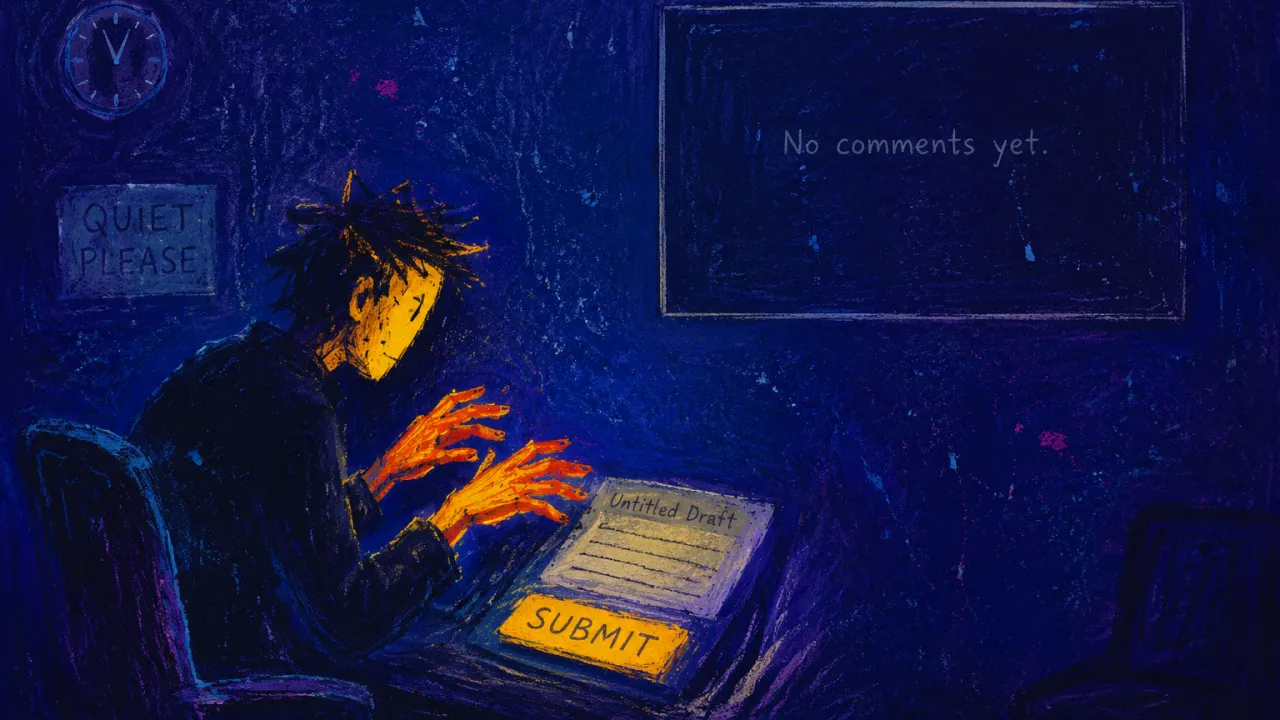
What does this feel like?
Mentor Approval Lock: you finish a paragraph at 11:47 p.m., read it twice, and move the cursor toward Send, then pull back as if the page has become less solid the moment nobody senior is looking at it. Your shoulders creep upward while you reopen your supervisor's last email, the rubric, and a document full of tracked changes, searching for a sentence that can tell you whether this version is allowed to count. You already have a research question; you may even know which argument you want to make. Still, an inner voice keeps asking, "Would they agree?" before it lets you ask, "What do I think?" In a meeting, a brief nod can loosen your whole body, but the relief lasts only until the next choice appears: the title, the method, the claim, the submission. Even "use your judgment" can become one more instruction to perform correctly. So you revise past the point of clarity, keep sensible ideas in private notes, or wait for feedback that was never meant to carry the full weight of beginning. The mentor is not the problem, and wanting calibration is not a flaw; the bind is that their response has become the floor beneath your own decision, so silence feels like there is nowhere to place your foot. Over time, the work stops being where your thinking takes shape and becomes a waiting room where your voice can be heard only after someone else echoes it back, much like the craftsperson in the Three of Pentacles, tool in hand beneath the arch while two robed figures face the work with the plan.
What's pulling at you?
You want expert feedback because it can sharpen the work, while your own judgment has to carry the work between moments of feedback. You get stuck when those roles collapse: guidance stops informing your next move and becomes the permission that must arrive before any move feels valid.
How It Shows Up?
- It is 12:30 a.m. You have the submission portal open and the file attached, but your hand stays on the trackpad while you reread one margin comment from three weeks ago. Your fingers cool, your eyes sting, and your shoulders hold themselves high, as though the two robed figures with the plan are already standing behind your chair. You change a word, undo it, then leave the cursor hovering over Submit. The draft can remain at this threshold for a moment without the pause becoming a verdict.
- A friend asks over coffee, "So what do you think your project should argue?" You begin with "My supervisor said..." and watch their face before offering half of your own answer, making it smaller as you speak. A tight patch settles across your chest, and your palm presses flat against the cup while the idea hangs between you, waiting for a receiving gesture. The thought can stay unfinished here without being replaced by someone else's answer.
- Your professor ends a meeting with "That direction makes sense," and you feel your back drop against the chair for the first time in twenty minutes. Then, as they close their notebook, you ask whether the outline, sources, and opening sentence are also okay, trying to stretch one nod across every choice waiting outside the room. Your breath shortens and your hands clasp around your pen as the available minute narrows. A single meeting does not have to settle every next step before you leave it.
- You sit down to revise and spend the first forty minutes arranging the rubric, sample papers, and old feedback around your document. Each time an original sentence appears, you compare it with what earned praise before; the notification sound from your inbox begins to feel like a distant trumpet that could finally start the session. Pressure gathers behind your eyes, and your shoulders drift toward the screen while the page itself barely changes. The silence between messages can simply be silence while you notice what is already on the page.
- In a seminar or team review, someone asks for your take before the lead tutor speaks. You inhale, glance toward the tutor's blank expression, and turn a clear sentence into "I'm not sure, but maybe..." while your fingertips rub the edge of your notes. Your jaw stays set through the rest of the discussion, and you track every nod more closely than your own line of thought. For this round, noticing the edit is enough; you do not have to force a bolder version on the spot.
Mentor Approval Lock in Tarot Cards
Mentor Approval Lock lives in the gap between wanting useful guidance and needing an evaluator's signal before your work can move. You can feel that gap when your shoulders rise and your fingers hover over an unsent draft. From an existential view, its structural framework shows what happens when permission sits with the authority watching the work instead of the person doing it. The Tarot Cards below mirror the visible outline of that waiting threshold.
Mentor Approval Lock in Tarot Card Reading Insights
Others have brought Mentor Approval Lock into readings when a draft, direction, or decision still seems to need a mentor's signal before it can count. The Tarot Reading Insights below gather what came up around that same waiting threshold.

Mentor Feedback and Two Decks at 10:43 P.M.; One Bounded Pivot Test
Topic:Timing Tarot Reading
Struggle:Mentor Approval Lock
Context:Authority Approval Bottleneck

A Recommendation Draft Rewritten Again: Sending Without a Verdict
Topic:Timing Tarot Reading
Struggle:Mentor Approval Lock
Context:Academic Resource Readiness

When Executive Silence Reopened a Finished Deck: Learning to Stop
Topic:Career Tarot Reading
Struggle:Mentor Approval Lock
Context:Authority Approval Bottleneck

An Empty Inbox, Three Citation Fixes, and One Thesis Claim Tested
Topic:Study Tarot Reading
Struggle:Internal Authority Collapse
Context:Productivity Theater

Missing Advisor Feedback Kept the Draft Waiting: One Provisional Move
Topic:Study Tarot Reading
Struggle:Cycle-Action Desynchronization
Context:Advisor Feedback Void