The 7:38 a.m. Mirror Spiral
When Maya sat down with me, she asked a question I hear in different forms from a lot of young women in big cities: why do I buy clothes I never wear, and why do my so-called future-me outfits keep hanging there like tabs I never close? She was 27, worked in marketing in London, could plan campaigns, answer Slack, and get herself across the city on time—yet getting dressed for work could still unravel into outfit anxiety before she even reached the Tube.
As she spoke, I could almost see the scene she was living inside. It was 7:38 on a Tuesday morning in a small East London flat, half-dressed between the wardrobe and the mirror, kettle clicking off in the kitchen, grey light flattening the room, a statement blazer cool against her fingers on the hanger. She would put it on, like it for one clean second, then feel the split happen: coworker, stranger on the Central line, someone from her past, all arriving in her head before she had even put on her shoes. Her chest tightened. Her shoulders crept up. The mirror stopped being a mirror and became a public trial.
She looked at me and said, “I bought it because it feels like me, just not me yet.” Then, after a breath that sounded tired all the way through, “I keep dressing for invisibility and then wondering why I feel flat.” The contradiction was plain: she wanted clothes to express who she already was, but she kept holding them back as if self-expression belonged to a calmer, more effortless, more fully approved future version of herself.
The feeling around her was not vanity. It was self-consciousness that clung like static under the skin—like standing in the black reflection of a Tube window and feeling your whole body become too readable at once. Sometimes the safest outfit is not the most comfortable—just the least exposing.
I have spent decades noticing the exact second a body tells the truth before a person has the words for it. I told her gently, “Nothing about this is silly. We’re not here to force confidence or talk you into a whole new personality. We’re here to map the loop, and then find one honest way through it. Let’s see where clarity begins.”

Choosing the Compass: A Five-Card Cross for Future-Me Outfits
I asked Maya to take one slow breath and hold the real question in mind. Not as theatre. Not as a mystical performance. Just as a way of helping the nervous system stop sprinting for a moment so the pattern could come into view. Then I shuffled, slowly and evenly, until the room settled.
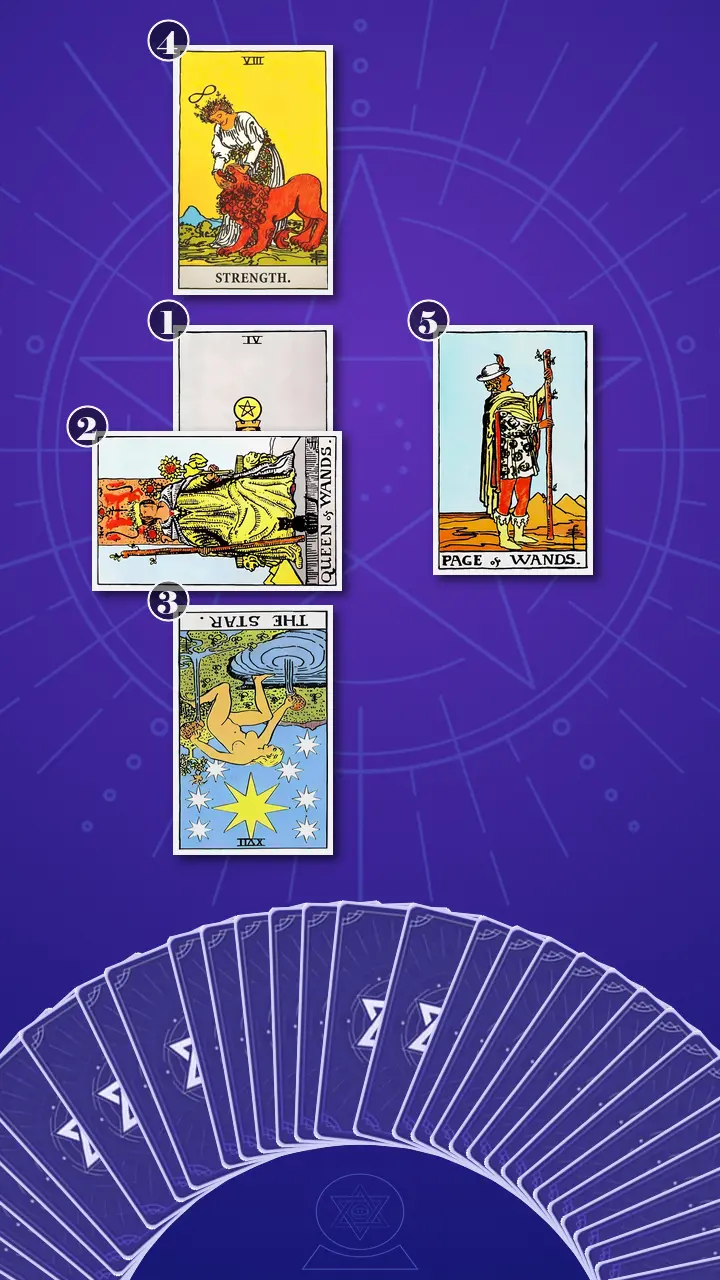
For this reading, I chose the Five-Card Cross · Context Edition. When people ask me how tarot works for something as specific as saving nice clothes for later, this is exactly the kind of spread I trust. It uses the fewest cards needed to show the full logic of a habit: the visible symptom, the active blocker, the deeper root, the shift that changes the pattern, and the first real-life step that turns insight into movement.
The shape mattered too. I placed the first card at the centre for the behaviour she could already see. The second crossed it, showing the pressure that made visibility feel risky. The third went below, where the quieter belief sat under the whole thing. The fourth rose above, offering the corrective perspective. The fifth moved out to the right, showing what could leave the room with her. In my mind, it always resembles a fitting-room mirror with a spine.
That is why this spread works so well for a problem like “future me outfits.” It does not waste time forecasting some glamorous external outcome. It tracks the permission loop itself. For a tarot reading about self-expression, visibility fear, and buying clothes you never wear, that kind of clean logic matters.
I told her what I would be watching for: where she was storing permission in fabric, what inner audience showed up before any actual people did, and what kind of small embodiment act might help her practise being seen now instead of waiting to become someone else first.
Reading the Closet Like a Waiting Room
The Blazer That Never Leaves the Flat
Now turning over was the card representing the observable wardrobe pattern named in her question: keeping aspirational pieces in reserve while defaulting to safer clothes. It was the Four of Pentacles, upright.
In modern life, this card looked exactly like her Tuesday-morning ritual: in a tiny flat where storage was already tight, the blazer still hung untouched because wearing it on a normal office day felt less like getting dressed and more like spending social safety she was not sure she could afford. The closet held clothes, yes. But it also held permission.
Upright, the Four of Pentacles is excess earth—too much gripping, too much protecting, too much control gathered around the chest. The figure on the card clutches value so tightly that nothing can circulate. Looking at it, I saw what she was doing with those unworn pieces: she was not using them; she was guarding them. She had turned her wardrobe into a museum archive instead of a working wardrobe. She was treating self-expression like money she was scared to spend.
I said, “A lot of ‘I’m being practical’ is really ‘I don’t want to be interpreted today.’”
She gave a short laugh that carried a sting in it. “That is horrible,” she said. “And also exactly it.” Her breath caught, then left her in one long stream. One hand moved to the cuff of her jumper and stayed there, pinching the knit as if she had caught herself choosing armor in real time.
The Inner Audience Arrives Before the Train Does
Now turning over was the card representing the active blocker crossing that pattern: the self-conscious inner audience that made visibility feel risky. It was the Queen of Wands, reversed.
I told her this was the card of liking the outfit in private for ten solid seconds and then mentally sending it through a hostile comment section before anyone had actually seen it. Satin skirt, black top, office loo before drinks, fluorescent lights buzzing, front camera warm in the hand, and suddenly the room inside the mind got crowded: colleague, stranger on the Tube, maybe an ex, maybe nobody specific at all—just the feeling of being read. Before a single person reacted, she edited herself down.
Reversed, the Queen’s fire is not absent; it is blocked and turned inward. Taste is still there. Instinct is still there. Presence is still there. But instead of warming her from the inside, that fire becomes self-surveillance. She starts doing PR crisis prep for a blazer. She pre-reads Slack reactions that do not exist yet. It was Fleabag-level self-awareness in front of a mirror, only without the relief of breaking the fourth wall.
When I said that, Maya’s nose wrinkled and her jaw unclenched at the same time. “I like it, but… it feels like me, but… what if it reads as…” she said, half to herself, already tracing the loop. Then came the exhale—the one that only happens when a person hears their private pattern described out loud and realises it is visible.
The Future-Self Tab That Never Closes
Now turning over was the card representing the deeper mechanism beneath the loop, especially the belief that the desired self belonged to a later version of her rather than the present one. It was The Star, reversed.
This is where the problem stopped being about clothes and became about postponed identity. In real life, The Star reversed looked like a wardrobe turning into a vision board: the sharp dress, the silk slip, the blazer, all treated as proof of the woman she could be once she felt more settled, more effortless, more socially fluent, more whatever her brain believed would make the look seem natural. She could open Vinted, Pinterest, or a saved folder and feel movement there; but in real life, the clothes stayed untouched, as if curating the fantasy counted as progress.
Reversed, The Star shows a deficiency of trust. The water exists, but it is not being poured into present life. Authenticity is imagined, but deferred. I asked her what she secretly believed had to be true first—about her confidence, her body, her work life, her whole vibe—before one specific piece became allowed for the current version of her.
She answered very quietly. “I think I need to stop looking like I’m still figuring myself out.”
“Your closet became a waiting room because visibility started feeling like a test,” I said.
She went still. Her gaze dropped to the floor, then slid sideways, as if one particular hanger had just appeared in her head with painful clarity. I know that look. It is the moment an abstract idea turns into one unworn dress, one Sunday night, one radiator clicking in the dark while a person tells herself, for when… for when… for when…
When Strength Put a Hand on the Lion
The Card Above the Mirror
When I turned over the fourth card, the atmosphere changed in the way it sometimes does when the central truth arrives. Outside the window, the London light had been dull all afternoon, but a pale patch of sun slipped free of the clouds and laid a warmer stripe across the table. This was the card representing the key shift that directly challenged her fear of not belonging when seen. It was Strength, upright.
At first, I did not rush. I wanted her to feel the shape of it. This card did not ask her to become instantly confident, or to stride out of her flat like a fantasy-level reinvention. It asked for something much more real: that Tuesday-morning pause with one hand on the hanger, one eye on the mirror, kettle clicking in the kitchen, chest going tight because the outfit had suddenly become a public statement instead of just clothes—and then not obeying the alarm immediately.
Strength is balance. Not bravado. Not force. Not “fake it till you make it.” The woman on the card does not kill the lion; she stays in relationship with it. Growing up in the Highlands, I learned early that a skittish creature will read the quality of your hand before it trusts your intention. Every time I see this card, I remember that. Fear gets louder under force. It settles under steadiness.
Stop treating visibility like a lion you must defeat; with Strength, place a steady hand on it and let one outfit become practice instead of proof.
Confidence is not the cover charge for self-expression; sometimes self-expression is how confidence gets built.
This was the moment to use the tool I have spent years refining: my Body Signal Interpretation. I leaned in and said, “When your chest tightens, your jaw locks, your face gets hot, your breath goes shallow—that is not always your soul telling you the outfit is wrong. Those are energy messages. Most of the time, they mean one thing: this choice makes me visible. Visibility is a sensation. It is not a sentence.”
Maya froze in three clear stages. First, her inhale stopped halfway, as if her body had been caught listening. Then her eyes lost focus for a beat, replaying some mirror scene only she could see. Then a flicker of resistance crossed her face. “But if I walk out in it and feel awkward,” she said, “doesn’t that just prove I’m not that person?”
I shook my head. “No,” I said. “It proves you are in the first minute of being that person in public. That is a very different thing.”
What happened next was small, and because it was small, I trusted it. Her brow softened first. Then her shoulders dropped, not dramatically, just enough to show the body had stopped bracing for judgment quite so hard. One hand rose to rest over her sternum without her thinking about it, as if testing whether that tightness could be met instead of instantly escaped. Her eyes brightened, but there was also a strange little dizziness in them—the vulnerable feeling people get when an old rule suddenly stops sounding inevitable. I let the silence do its work and then asked, “With this new lens, can you think of a moment last week when the outfit wasn’t wrong—you were just feeling the sensation of being seen?”
She laughed, softer this time. “Thursday,” she said. “The satin skirt. I thought the panic meant I looked ridiculous. I think it just meant I noticed myself.”
That was the turning point. Not a makeover. Not certainty. Just one clean step from self-conscious outfit anxiety and delayed permission toward grounded ease and active self-expression. I asked her to reinforce it physically: within ten minutes of getting home that night, she was to choose one “not yet” item, pair it with her safest basics, and wear it for five minutes—or take it on one tiny errand if that felt manageable. If her body spiked hard, she could scale down to one visible element or stop entirely. This was data, not a dare.
The Page Who Turns Style into Real-World Data
Now turning over was the card representing the concrete embodiment step that could interrupt the defense strategy in real life. It was the Page of Wands, upright.
This card made me smile, because it carried exactly the right energy after Strength: not polished icon energy, not “I have arrived,” but beginner courage. In practical terms, it looked like wearing one once-saved piece on an ordinary day—a coffee run, a Wednesday commute, a low-key office day—simply to collect real evidence. Not a dramatic reveal. Not Emily in Paris confidence. More like beta-testing a look instead of launching a whole new identity.
The Page’s fire is alive and curious. Balanced, but young enough to learn by doing. That matters because Maya’s whole pattern had been built on prediction, fantasy, and pre-living everyone else’s opinion. The Page asks for contact with reality. Wear it to gather data, not to pass a test.
She smiled then, the first unguarded smile of the reading. “That,” she said, “I can actually do.”
When I looked back over the full cross through my Elemental Balance lens, the pattern was beautifully blunt: earth clenched around safety in the Four of Pentacles, fire turned inward into self-monitoring in the reversed Queen of Wands, water withheld from present life in The Star reversed, then Strength regulating the system so fire could move again through the Page. The issue was never truly fashion taste. It was whether she could stay in contact with herself while visible.
From Mirror Spiral to a One-Hanger Courage Rep
By the time I gathered the cards into one story, the logic was clean. On the surface, she was storing permission in the closet and calling it practicality. The blocker was an imagined audience so loud that she could enjoy an outfit alone and distrust it the second she pictured the commute, the office, or dinner. Underneath sat the real belief: future me gets the clothes; present me must stay lower-risk, lower-volume, harder to misread. The antidote was not more confidence as a prerequisite. The antidote was steadiness. The next step was not to become someone else. It was to let one visible choice teach her body that being seen is survivable.
The blind spot mattered. She had been reading discomfort as misalignment. But some of what she called “not me” was simply the first awkward minute of being more readable in public. That is the transformation direction I wanted her to leave with: a shift from treating confidence as a prerequisite for self-expression to treating self-expression as a small practice that builds confidence.
I gave her three actions, all deliberately small. In my own Nature Empathy Technique, I never ask a new shoot to face full wind on its first day. Change works best when it is sized to what the body can consent to.
- The One-Hanger Courage RepTonight, choose one item you usually save for “future you” and pair it with your safest basics. Wear it at home for 10 minutes. Before taking it off, place one hand on the fabric and one hand on your chest, then name the body signals in plain language: tight chest, hot face, clenched jaw, shallow breath, buzzing stomach.If 10 minutes feels too loaded, use my 5-minute balcony energy awakening practice: step onto a balcony, doorway, or open window in the outfit, feel the air on your skin, and stop at five. It still counts.
- The 90-Second No-Spiral ExitPick one low-stakes outing this week—a coffee run, corner shop, quick dinner, commute, or ordinary office day—and build around one “not yet” piece while the rest of the look stays familiar. Set a 90-second timer before leaving the flat: no extra mirror angles, no panic-styling, no front-camera checks in the lift, no group-chat reassurance.Use my weather-based activity selection guide if your system feels tender: choose the softest, least socially loud window in the week, not the busiest Friday night. Curiosity is the goal, not drama.
- Reality Over Prediction LogAfter the outing, open your notes app and write three lines: what I predicted, what actually happened, and what felt true in my body after 20 minutes. If you needed to add a coat, swap shoes, or come home early, write that too.Do not use the note to grade your style. The point is to gather evidence. Wear it to gather data, not to pass a test.
None of this was designed to create transformation theatre. It was designed to interrupt the automatic retreat. That is how a closet stops being a waiting room. Not with a dramatic reveal, but with repeated proof that self-expression can happen in ordinary life, on ordinary Tuesdays, in the middle of a very normal city week.

A Week Later, the Proof Was Quiet
A week later, I received a voice note from Maya while she stood outside a coffee shop after work. She had worn the blazer on a grey Thursday commute with her usual tee and jeans. “I did the thing,” she said, laughing. “At the door I still had the thought, ‘What if this looks ridiculous?’ But this time I smiled and left anyway. By the second stop, I forgot to keep panicking.”
That was enough for me. Not because one blazer solves a life, but because this is how clarity usually arrives. Quietly. In the moment a person notices the alarm went off and they did not automatically hand the wheel to it.
In this journey to clarity, the cards did not tell her who to become. They showed her that the self she was waiting to earn had needed less postponement and more inhabiting. The Five-Card Cross gave her a structure sturdy enough to see the loop, and gentle enough to step out of it.
When being seen feels like a belonging test, even a hanger can make your chest tighten—so you keep saving the version of you that feels most alive for a later date. If one outfit did not have to prove anything about you this week, what piece would you be curious to wear simply to meet yourself in it—just once, as your own one-hanger courage rep?
This story is adapted from psychological research, written so that those in a similar struggle can see their own pattern in it — and find their next step clearly.These insights are not a substitute for professional psychological, medical, legal, or financial advice.
Learn more about our Journey to Clarity.
How did this insight land for you?
🫂 This Resonates Deeply
🌀 Living This Story
✨ Now I See Clearly
🌱 Seeing New Possibilities
🧰 Useful Framework
🔮 The Confirmation I Needed
💪 Feeling Empowered
🚀 Ready for My Next Step
Author Profile
 AI
AI“As the seventh generation of a Highland healing family, I see modern anxieties as a simple, temporary disconnection from nature's rhythm. I bring 67 years of lived seasons not to instruct you, but to hold space for you. Using tarot as a mirror, I want to gently guide you out of the chaos, helping you breathe deeply and rediscover the organic, steady heartbeat of your own life.”
In this Introspection Tarot Reading :
Core Expertise
- Somatic Shadow Sensing: Identifying where chronic mental fatigue and unexpressed emotions are physically trapped within your body's architecture.
- Ecosystem Bandwidth Restoration: Using the metaphor of nature's self-cleansing cycles to diagnose and clear the 'mental static' of an overstimulated nervous system.
Service Features
- The Grounding Transmutation Ritual: A sensory, physical practice designed to literally discharge excessive mental rumination into the earth, instantly restoring bodily presence.
Also specializes in :
Explore Related Patterns:
Visibility Shame LoopYou can like the blazer in private for one clean second, and then the whole scene changes as soon as the colleague, stranger on the Tube, or person from your past shows up in your head. The mirror turns into a public trial, your chest tightens, and the outfit gets recoded as something to hide rather than something to wear. That is the loop: visibility triggers shame, shame drives you toward the least exposing option, and the retreat then feels like proof that you were right to be cautious. What keeps the clothes in the closet is not a lack of taste, but a nervous system that has started treating being seen as a test.
Future Self IdealizationYou keep buying pieces because they feel like you, but you keep telling yourself they belong to a later version of you. That split is the core of Future Self Idealization: the outfit is accepted as identity, but the permission to wear it is deferred until some imaginary moment when you are finally more settled, more effortless, and more approved. Because of that deferral, the closet stops functioning like a wardrobe and starts functioning like a staging area for a self you never quite arrive at. Curating the fantasy feels productive, so the loop stays alive: you can collect proof of a future identity without having to inhabit it in ordinary public life.
Aesthetic Identity FusionYou are not buying these clothes as neutral objects. You are buying them because they feel like you, which means the wardrobe is carrying identity weight instead of just fabric. The blazer, the dress, and the saved pieces become proxies for who you think you are allowed to be. That is why the wardrobe turns into a vision board and why each unworn item feels emotionally loaded before it ever gets worn. When the aesthetic object becomes a container for selfhood, wearing it stops feeling like a small daily choice and starts feeling like a statement about who you are.
Explore Related Struggles:
Identity Verdict LockMaya asks whether walking out in the outfit and feeling awkward would prove she is not that person. In that question, one ordinary blazer is forced to carry an impossible job: confirm her identity, prove her belonging, and erase the first-minute discomfort of being seen. You can feel the lock when awkwardness stops being a temporary body state and starts being used as evidence against the self you are trying to inhabit. A visible choice becomes a pass-fail test instead of a normal experiment in public embodiment. Identity Verdict Lock softens when the first minute is allowed to be messy without becoming the whole verdict. Feeling exposed in a new outfit may only mean you have reached the edge of an older self-image, not that the newer one is false.
Inner Tribunal LockMaya is still in her East London flat when the inner audience arrives: a coworker, a stranger on the Central line, someone from her past, maybe nobody specific at all. The mirror becomes crowded before the street has had any chance to respond. You are not reacting to actual feedback in that moment. You are standing in front of an internal court that has already started cross-examining your visibility, your taste, and your right to take up a little more space than usual. Inner Tribunal Lock explains why a private yes can collapse before it reaches the front door. The work is to notice when prediction has put on the judge's robe, then let real life supply evidence before the imagined room gets to deliver the final ruling.
Visibility-Safety SplitMaya can like the blazer in private for one clean second, then the commute, the office, and someone from her past arrive in the mirror before her shoes are even on. The garment has not changed, but the field around it has: it stops being fabric and starts feeling like a public statement she has to survive. You are not simply choosing between a bold outfit and a safe outfit. You are carrying a body-level equation where being more visible seems to reduce social safety, so the closet fills with pieces that feel true while daily life keeps rewarding the lower-risk version of you. The pressure eases when visibility is treated as a sensation rather than a verdict. One ordinary outing in one visible piece gives your system real evidence that being noticed does not have to become a full social trial.
Aesthetic Self-Management TrapMaya's wardrobe stops functioning as a set of clothes and starts functioning as a control room. The blazer, the saved folders, the mirror angles, and the imagined Slack reactions all become part of a system for managing how readable she might become. You are not wrong for caring how you look. The trap begins when every aesthetic choice has to prevent misinterpretation, regulate other people's possible reactions, and prove that the visible version of you is polished enough to be allowed outside. Aesthetic Self-Management Trap turns style into social risk management. The repair is not to stop having taste; it is to let one choice be ordinary data again, so an outfit can return to being something you wear rather than a whole identity launch.
Perfect Readiness TrapThe sharp dress, the silk slip, and the blazer are all treated as evidence of a woman Maya could become once she feels more settled, effortless, and socially fluent. She can recognize the self inside the clothing, but she places that self just beyond the present tense. You get caught when readiness becomes a moving finish line. The outfit is allowed after the confidence, the confidence is allowed after the identity feels stable, and the identity is not allowed to look unfinished in public. Perfect Readiness Trap makes self-expression depend on a future state that keeps getting refined before it can be lived. The interruption is small but decisive: wearing one piece before you feel fully ready lets your body learn that becoming often starts while you still look like you are figuring it out.
Permission ParalysisMaya says the blazer feels like her, just not her yet, and the closet turns into a waiting room for that future version. The pieces are not rejected; they are preserved, protected, and kept just out of reach as if wearing them now would spend a permission she has not fully earned. You may recognize the paralysis in that exact delay: present-you wants the outfit, future-you is allowed to have it, and the hanger becomes the place where the decision never has to land. The body stays safe from exposure, but the self that wanted to move stays paused too. Permission Paralysis keeps desire available as a preview while blocking it as a lived action. The way through is not a dramatic reinvention; it is one small act of letting the current version of you use something that has been waiting for a version of you that may never need to arrive first.
Explore Related Emotions:
Anticipatory ShameBefore anyone reacts to the outfit, Maya has already run it through a hostile inner comment section. The colleague, the stranger, the ex, and the vague nobody-specific audience all appear inside the room, and the sentence 'what if it reads as...' starts deciding what she is allowed to wear. Anticipatory Shame is the sting that arrives before the event. You pre-feel the embarrassment, edit yourself down in advance, and treat the imagined reaction as if it has already happened. The painful part is not just being seen; it is being judged in your mind before reality has had a chance to speak.
Exposure DreadThe mirror stops being a mirror when Maya imagines the coworker, the stranger on the Central line, and someone from her past arriving before she has even put on her shoes. Her chest tightens, her shoulders rise, and the blazer shifts from fabric into evidence that could be read by other people. Exposure Dread names the moment when visibility feels too total, too soon. You are not simply choosing clothes; you are sensing the possibility of becoming legible to the room, the train, the office, and the old versions of yourself you still imagine being watched by.
Identity PR FatigueMaya starts doing PR crisis prep for a blazer, pre-reading Slack reactions that do not exist and editing herself down before the workday has even started. The outfit becomes less like a personal choice and more like a public-facing statement that has to survive interpretation. Identity PR Fatigue captures the exhaustion of managing your possible image before you have entered the room. You are not only getting dressed; you are trying to control the story other people might tell about you, which turns self-expression into reputation management.
Permission AnxietyAt 7:38, Maya can touch the statement blazer and recognize it for one clean second, but the garment stays suspended because wearing it feels like spending social safety she is not sure she can afford. The closet holds clothes, but it also holds permission: the dress, the slip, and the blazer become access passes for a calmer, more approved future self. That makes Permission Anxiety the clean emotional fit. The tension is not whether the outfit has meaning, but whether the current version of you is allowed to use that meaning in public. You can feel the strain of having desire already in your hands while the inner gatekeeper keeps saying not yet.
Shame SpiralMaya likes the outfit for ten solid seconds, and then the split happens: the body tightens, the mirror becomes a public trial, and the thought begins to form that if she feels awkward, it must prove she is not that person. A small dressing moment starts pulling in identity, belonging, and proof. Shame Spiral fits because the loop feeds on itself. You notice yourself, then judge the noticing, then use the discomfort as evidence that you should retreat. The outfit is not the whole problem; the spiral is what turns a visible choice into a verdict on who you are allowed to be.
Visibility PressureThe black reflection of the Tube window, the office bathroom lights, and the grey morning mirror all make Maya's body feel too readable at once. Even the 'safe' outfit is not described as the most comfortable one; it is the least exposing one. Visibility Pressure names the compressed feeling of being looked at before anyone has actually looked. You are carrying the weight of imagined readability, where a blazer, skirt, or brighter silhouette feels like it might make your inner self available for public comment.
Hollow FantasyThe sharp dress, the silk slip, the blazer, the Vinted searches, and the saved folders all create a convincing sense of movement, but the clothes still do not enter ordinary life. The wardrobe starts behaving like a vision board: full of evidence for who Maya could be, but not yet connected to what she actually does on a Tuesday. Hollow Fantasy names that suspended emotional atmosphere. You can keep curating the version of yourself that feels most alive while staying protected from the risk of embodying it. The fantasy is not empty because the desire is false; it feels hollow because the desire never gets poured into the present.
Cautious Self-TrustThe one-hanger courage rep asks Maya to name the body signals plainly: tight chest, hot face, clenched jaw, shallow breath, buzzing stomach. Those signals are not dismissed, but they are also not allowed to become the final meaning of the outfit. Cautious Self-Trust lives in that distinction. You begin to believe your body is giving information, not issuing a sentence. The trust is careful because it does not pretend the discomfort is gone; it simply gives you enough room to ask what is real before you retreat.
Embodied EaseAfter Maya hears that awkwardness can simply be the first minute of being seen, her brow softens and her shoulders drop. One hand moves to her sternum, as if the tightness can be met rather than escaped, and a week later the blazer survives an ordinary commute without needing her full attention. Embodied Ease is the body learning that visibility does not have to stay at emergency volume. You feel the shift as a lower shoulder line, a steadier breath, and the quiet relief of not having to monitor yourself every second in public.
Grounded AgencyThe plan stays deliberately concrete: one visible item, safe basics, a 90-second exit, and a notes-app log of prediction versus reality. Maya is not asked to prove a new identity in one public reveal; she is asked to gather evidence from one ordinary act. Grounded Agency names the feeling of having a handle again. You do not need a perfect self-concept before taking action. You need one small choice that belongs to you, one check against reality, and the recognition that the alarm can sound without taking over the wheel.
Regulated CourageThe turning point is small enough to trust: Maya feels the chest tighten, notices the alarm, and does not immediately obey it. She pairs the blazer with her safest basics, leaves for a normal grey Thursday commute, and by the second stop she has forgotten to keep panicking. Regulated Courage is not a dramatic reinvention. It is the steadier state of staying present while the body gets loud, then choosing one measured action anyway. You do not defeat the visibility sensation; you hold it with enough steadiness that it stops driving the whole morning.
Explore Related Contexts:
Body Surveillance CultureMaya stands between the wardrobe and the mirror in a small East London flat, holding a statement blazer that feels right for one clean second before the imagined audience arrives. The Central line, the office, an ex, and anonymous strangers all enter the room before she has even left for work, turning a private getting-dressed moment into a public inspection scene. That pressure fits Body Surveillance Culture because the external world is operating like a gaze before any actual person speaks. Her clothes are not being judged in a neutral wardrobe decision; they are being run through the assumed social reading of a city commute, workplace visibility, mirrors, front cameras, and the possibility of being interpreted too quickly. You are not looking at vanity here. You are looking at a social environment where bodies and style choices become readable data, especially for young women moving through work, transit, and nightlife spaces. The closet fills up because each unworn piece carries both self-expression and exposure, and the safest outfit becomes the one that attracts the least public interpretation.
Public Identity AuditMaya says she bought the blazer because it feels like her, just not her yet. That sentence turns the closet into a review board: the present version of her is still being assessed, while the future version is allowed to wear the sharper dress, the silk slip, and the statement piece without explanation. Public Identity Audit fits because the pressure is not only whether an outfit looks good. The real test is whether the current self seems legitimate enough to be seen in it. Vinted, Pinterest, saved folders, and unworn hangers all keep the identity project active, but they also keep it suspended, as if curation can substitute for public inhabiting. You can see the external structure in the way ordinary social spaces become approval checkpoints. The office, commute, dinner, and mirror all ask the same question in different forms: will this version of me read correctly out there? The wardrobe stays full because every outfit is being asked to prove an identity that should have been allowed to develop through use.
Reinvention Culture PressureMaya's sharp dress, silk slip, and blazer are not missing from her life; they are already hanging in her closet. What keeps them unused is the idea that the woman who wears them must arrive later, after she is more settled, more effortless, more socially fluent, and less visibly in progress. Reinvention Culture Pressure sits behind that delay. The story shows the modern loop of buying, saving, pinning, browsing, and curating a future self until the planning starts to feel like movement. The wardrobe becomes a vision board with sleeves, while ordinary Tuesdays remain assigned to the lower-risk version of her. You are seeing a pressure that is common in urban lifestyle culture: the self must be upgraded, branded, and made coherent before it is allowed to appear. That makes the closet feel full and strangely unusable at the same time, because every aspirational piece carries the demand to represent a finished transformation rather than a current experiment.
Career Visibility ParalysisMaya can plan marketing campaigns, answer Slack, and get herself across London on time, but a blazer for a normal office day can still stop the morning in its tracks. The contradiction matters because her work life already requires performance, readability, and fast social interpretation, while her personal visibility is being treated as a professional risk. Career Visibility Paralysis names the way workplace presence can freeze self-expression before the actual workday begins. The blazer is not just a blazer inside this story; it is a possible signal in a professional setting where colleagues, office toilets before drinks, and imagined Slack reactions all become part of the evaluation field. You are dealing with a city-career stage where looking like too much, too polished, too changed, or too visible can feel socially expensive. The result is not a lack of taste or resources. It is a stuck point at the threshold between competent professional functioning and the everyday visibility that lets a person take up more space at work.
Safe Visibility TrialMaya is not told to perform a dramatic reveal or become a new person overnight. She is asked to choose one saved item, pair it with familiar basics, wear it at home or on a low-stakes outing, and treat the whole thing as data rather than a dare. Safe Visibility Trial fits because the story builds a protected public experiment around being seen. The coffee run, corner shop, ordinary office day, and 90-second no-spiral exit all create a defined container where the outfit can meet reality without having to prove an entire identity. You can see the agency returning through structure. Instead of letting the mirror, the front camera, or imagined reactions decide the outcome in advance, Maya gets a bounded test with permission to scale down, stop, or log what actually happened. Visibility becomes something she can practise in measured contact with the world.