She Deleted Her Recommendation, Then Left the Next One Visible

Finding Clarity at 9:47 p.m.
If you are a 28-year-old product marketing coordinator in London who turns a direct recommendation into three neutral options before a 9 a.m. hybrid meeting, then checks Slack for signs that everyone approves, this may be your version of people-pleasing at work.
Maya sat across from me after work, one hand wrapped around a cup she had stopped drinking. As she described the previous Tuesday night, I pictured her at the kitchen table in her shared flat at exactly 9:47 p.m., dragging a slide that began, “I recommend focusing the launch on retention,” into the trash. The radiator clicked, the laptop fan whirred, and her phone had gone warm in her palm while she searched the team chat for proof that three safer options would be easier for everyone to accept.
“I want my career to reflect how I think,” she said. “But when it matters, I make everything sound like a group decision. I am just trying to be easy to work with.”
I watched her shoulders lift as she spoke. The feeling in her body seemed like a drawstring running from her throat to her fingertips, pulling tighter whenever an opinion became distinct enough to be attributed to her. She wanted visible strategic ownership, so she removed the part of the work that showed judgment, and then she felt frustrated when the room remembered only her helpfulness.
That was the central contradiction I heard: Maya wanted to advance through authentic, visible contribution, but standing out felt dangerously close to being pushed out. High London rent and the need for stable income gave that fear a practical weight. I was not going to dismiss it with a breezy instruction to “be more confident.” Workplace power is real, and not every room rewards honest disagreement fairly.
“You can be collaborative without becoming impossible to identify,” I told her. “I am not here to predict whether every colleague will approve of you. I want us to see what fitting in is currently costing, what evidence supports the fear beneath it, and where you still have choices. We are going to give this fog a map.”
I think of lives as films still in production. Feeling stuck does not mean the ending has been decided; sometimes it means a painful scene has continued long enough to feel like the entire plot. My role is to sit beside the person watching it, help identify the repeated direction, and return the pen.

When a Workplace Badge Becomes a Compass
I asked Maya to place both feet on the floor and take one unforced breath while holding a single question in mind: “Why do I keep assuming fitting in has no cost to my career?” I shuffled slowly, not as a supernatural performance, but as a transition from replaying every meeting to examining one pattern at a time.
I chose the classic five-card Shadow Spread. For anyone wondering how tarot works in a career reading, I use the cards as structured prompts that make an internal loop visible enough to inspect. Card meanings in context can separate a protective behavior, its short-term reward, its delayed cost, and the capacity available for change. Tarot does not replace evidence or decide the future; it helps us notice the assumptions influencing present choices.
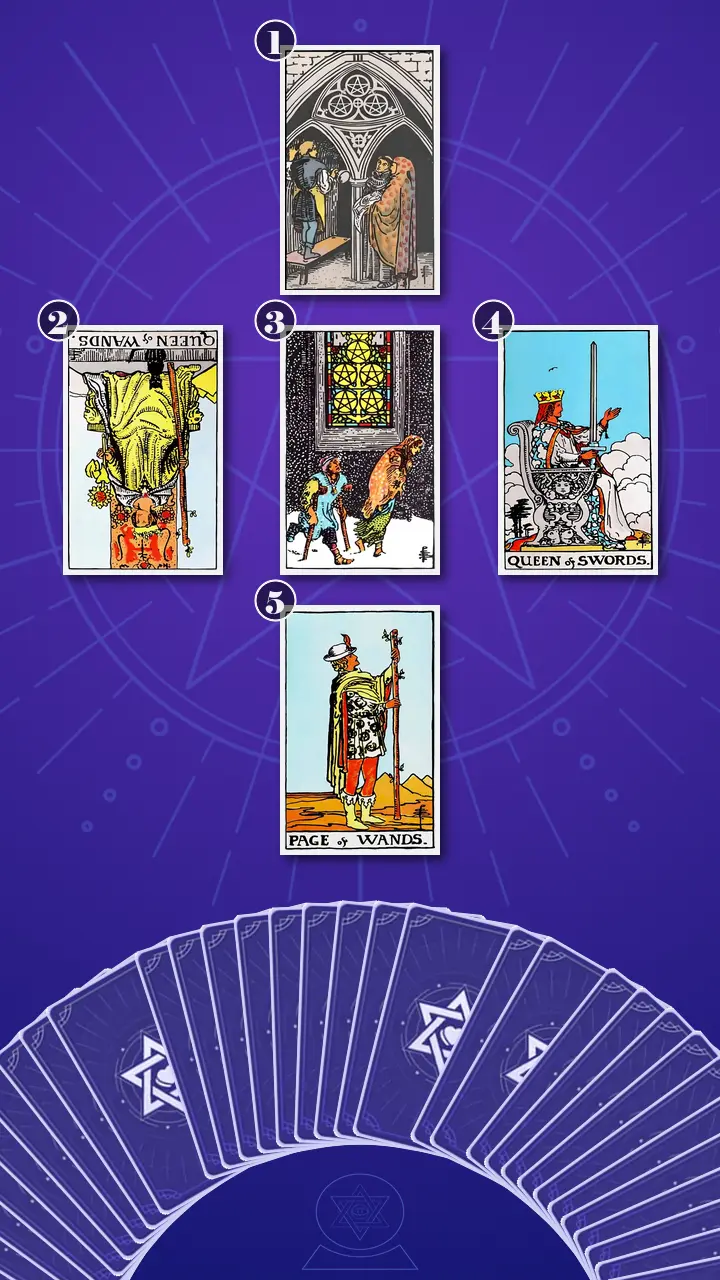
The Shadow Spread suited Maya's question because she was not choosing between two job offers or asking for a promotion forecast. We were excavating an apparently sensible teamwork strategy. The first position would show the professional mask she treated as normal. The second would reveal its hidden career cost. The centre would expose the fear keeping the pattern alive. The fourth would recover a usable resource, and the final card would turn insight into a small workplace experiment.
I placed the cards in a cross. The public mask sat above the central fear, the integration practice below it, and two Queens faced each other from either side. Looking at the shape, I saw a workplace badge becoming a compass: Maya could keep her social identity and her collaborative strengths without letting either replace personal direction.
The Craft Hidden Inside the Team Deck
Position One: The Professionalism That Conceals Its Author
I began with the card representing the behaviour Maya treated as normal professionalism: smooth teamwork and visible agreeableness used to conceal the removal of her own point of view.
I turned over the Three of Pentacles, upright.
I pointed to the craftsperson standing above two collaborators while architectural plans passed between them. “This card respects teamwork,” I said. “It shows real competence inside a shared structure. You build the analysis, organise the launch deck, align product and sales, and make the final presentation usable. That is genuine craft.”
Then I placed one finger beside the plans. “But I want to know whether your colleagues can identify the judgment behind the structure. Are they recognising your expertise, or only benefiting from your compliance?”
In Maya's working life, the Three of Pentacles looked like a polished Google Slides file in which every strong conclusion had been converted into group language. The project moved forward, and Maya received sincere praise for helping everyone align, but nobody left the meeting knowing which recommendation came from her analysis.
The card's Earth energy was fundamentally balanced: contribution, skill, and cooperation. The distortion appeared when Maya demanded that collaboration provide complete protection from disagreement. Balance became excess accommodation. Teamwork stopped being a place where her craft could be recognised and became camouflage for it.
“When you prepare a shared document,” I asked, “are you making the work stronger through your judgment, or making your judgment harder to detect?”
Maya gave a short, bitter laugh. Her fingers tightened around the cup before she put it down. “That's so accurate it's almost cruel,” she said. “My last review literally said ‘reliable and collaborative’ and then asked for more strategic ownership.”
“The card is not accusing you,” I replied. “It is showing us why that feedback feels contradictory. Your reliability is real. The question is whether the way you demonstrate it leaves enough visible evidence of strategic thought.”
Position Two: The Queen Whose Fire Went Into Room-Scanning
I moved to the card representing the hidden career cost of Maya's protective strategy: muted confidence, reduced authorship, and ambition that remained invisible to colleagues.
I turned over the Queen of Wands, reversed.
Upright, this Queen holds a sunflower and a living wand. She is warm, socially engaged, creative, and visibly at home in her authority. Reversed, her Fire had not vanished. It had turned inward.
“This is not a lack of ambition,” I said. “It is ambition being redirected into monitoring the room.”
I connected the sunflower to the boldest line in Maya's launch presentation. She opened the deck with a strong campaign recommendation, noticed that a senior colleague preferred the safer route, and quietly turned her point of view into a vague suggestion. The idea was still present in her speaker notes, but not where anyone could evaluate or credit it. Later, when a senior colleague introduced a similar direction, visible authorship followed the person who had spoken.
“The private line beneath this card is: ‘I have the idea; I just do not want the room to know it came from me.’”
The Queen's reversed energy was a Blockage. Maya had initiative, originality, and a clear read on the audience, but the energy meant for expression was being spent on predicting whether confidence from her might look “difficult.” The immediate nods and Slack reactions brought relief. The delayed result was resentment, because the room encountered a polished facilitator while Maya's sharper professional judgment appeared only in conversations with friends after work.
Maya looked away from the card. I saw her thumb rub the side of her index finger, stop, and begin again. “I have absolutely watched someone else say my idea and then acted fine,” she said. “I was angry with them, but I also knew I had made it easy.”
“Both can be true,” I said. “A workplace can be unfair about status and credit, and self-editing can make the imbalance harder to challenge. We are looking for your available agency without pretending the whole ecosystem is under your control.”
Agreement may keep the room comfortable; it does not automatically make your judgment visible. I also cautioned Maya against swinging from silence to performative dominance. The recovered Queen of Wands would not need to take over a meeting or present an untested opinion as certainty. She would let one well-supported idea remain in the light.
Position Three: The Two-Second Pause That Felt Like Exile
I turned to the central card, representing the psychological mechanism beneath fitting in: Maya's fear that visible disagreement could lead to exclusion, lost access, or reduced career safety.
I revealed the Five of Pentacles, upright.
Two figures moved through snow beside an illuminated window. I showed Maya how the architecture echoed the Three of Pentacles. In the first card, the craftsperson worked inside an institution. In this one, the figures perceived themselves as outside its shelter.
“This card does not predict rejection,” I said. “It shows how quickly an ordinary workplace discomfort can feel like proof that you have already been rejected.”
In Maya's life, the lit window was a meeting invitation, her manager's trust, a stable salary, and continued access to influential conversations. The snow arrived when she said the proposed audience was too broad and the room paused for two seconds. Before anyone had done anything exclusionary, her mind had already jumped to: “They heard me being difficult. What if I stop getting invited?”
The card's scarcity signal was operating in Excess. A small social interruption triggered a response sized for material abandonment. I did not tell Maya the response was irrational. Her income mattered, hierarchy mattered, and some workplaces do punish dissent. I asked for a more precise distinction: which consequences were observable, and which had been supplied by the alarm before the meeting continued?
“A pause is a sensation,” I told her. “It is not yet proof that you have been pushed outside the room.”
I asked her to remember the 2:06 p.m. campaign review. “What happened immediately after the pause?”
Her lips parted, but no answer came at first. I watched her gaze lose focus as if the project room had replaced my studio around her. Then her fingers flattened against the table.
“Someone asked which segment I would prioritise,” she said. “I treated the question like a warning, but it was just a question. I gave them a watered-down answer.”
“That distinction matters,” I said. “A request for more evidence can be engagement with your judgment. Your apprehension may still tighten your throat, but you do not have to let it write the meeting minutes before the conversation has happened.”
When the Queen of Swords Drew a Clear Line
Position Four: Clear Without Hostile, Open Without Erased
The radiator in my room clicked once and went quiet as I reached for the card representing Maya's recovered resource: evidence-based discernment, clear boundaries, and a professional voice that could participate without disappearing.
I turned over the Queen of Swords, upright.
The Queen held her sword vertically while extending her other hand toward the horizon. I read those gestures together. The sword drew a clean line around what she could presently support; the open hand allowed dialogue, questions, and new evidence to enter.
“Her sentence is simple,” I said. “‘My recommendation is to focus on retention because the current data shows the largest drop there. I am open to evidence that changes it.’ The sword names the judgment. The open hand prevents clarity from becoming control.”
At 9:47 p.m., Maya had deleted the slide that named her recommendation, checked Slack for approval, and called the safer version diplomacy. The next morning, the room saw a competent team deck but not the judgment that had shaped it. She had been trying to secure a place in the production by cutting her own speaking role.
This was where I used what I call Workplace Typecasting Analysis. As an artist, I have watched productions settle quickly into a cast: the visionary, the sceptic, the decision-maker, the fixer. In Maya's office ecosystem, repeated coordination work had gradually typecast her as the dependable supporting character. The company benefited from that casting, and Maya reinforced it whenever she handed over the line containing her original judgment. The point was not to blame her for the whole production. It was to identify the one part of the casting process she could interrupt.
That insight also opened the door to Leadership Narrative Construction. Maya did not need to announce a new identity or imitate someone else's executive persona. She needed a sequence of observable scenes in which colleagues could connect her name with a decision, its evidence, and her willingness to remain accountable for it.
I let the card settle between us before I spoke again.
You do not create durable belonging by erasing your judgment; state one clear, evidence-based view, and let the Queen of Swords' raised blade separate collaboration from compliance.
I left a few seconds of silence around the sentence.
Maya did not relax immediately. I watched her inhale and stop halfway, her fingers suspended above the table as if she had forgotten where to place them. Her pupils widened, then her gaze moved toward the rain-darkened window while, I suspected, she replayed every deck she had softened. Her jaw set before her eyes began to shine. “But doesn't that mean I've been wrong this whole time?” she asked. The words came out sharper than anything she had said all evening. Then her fist loosened, one finger at a time. Her shoulders dropped, but the release did not look comfortable; it carried the slight disorientation of putting down a weight and discovering that an empty hand is now responsible for choosing what to pick up. A low “Oh” left her chest. She breathed again, longer this time, and looked directly at the Queen.
“No,” I said. “It means you developed a strategy that protected connection in the short term. It worked well enough to become automatic. We are now asking whether the same strategy still serves the career you are trying to build. Adaptation is not a moral failure, and changing it does not require you to condemn your past self.”
I leaned slightly closer. “Now, with this new perspective, think back to last week. Was there a moment when this insight could have made you feel different?”
“The planning meeting,” Maya said. “I could have said, ‘My recommendation is to test the retention message first because it is the only direction supported by the churn data.’ I could have let them disagree with the recommendation instead of deciding in advance that they were disagreeing with me as a person.”
I nodded. “That is the shift. Clear without hostile. Open without erased. You can let them respond without deciding in advance what their response means.”
I gave her a few quiet minutes to open the notes app on her phone. She typed one sentence beginning, “My recommendation is,” added one evidence point, and wrote one condition that could change her mind. I asked her to read it aloud once and notice her throat and shoulders. I also reminded her that the experiment was optional. If the context felt materially unsafe or punitive, she could pause, choose a lower-risk topic, or use a written agenda instead.
This was not an instant leap from apprehension to fearlessness. It was a smaller and more credible crossing: from constant social self-monitoring toward grounded confidence, beginning with the manageable discomfort of letting one distinct view remain visible.
Position Five: A Beta Release of Her Professional Voice
The final card represented the integration practice: one manageable workplace experiment that could test whether belonging truly required self-erasure.
I turned over the Page of Wands, upright.
The Page studied a sprouting staff in an open landscape. I described the card as emerging Fire held in Balance: enough initiative to act, enough curiosity to avoid turning one action into a permanent verdict.
In Maya's next campaign deck, this could look like one heading labelled “Recommendation,” followed by a clearly attributed, testable idea: “Based on the retention data, I recommend testing audience A first.” She could invite substantive feedback, revise the proposal if the evidence changed, and still keep the original reasoning visible in the version history.
“The Page is not asking you to become a fearless leader by Friday,” I said. “This is a small beta release of your professional voice. The response is user research, not a verdict on whether you belong.”
Maya smiled, although I could still see tension held at the corners of her mouth. “A beta release I can do,” she said. “A total personality transplant was not going to happen.”
“Good,” I replied. “You do not need a new personality; you need one visible experiment.”
The One-Trace Career Practice
I gathered the five cards into one story. Repeated praise for Maya's reliability had taught her that smooth collaboration was both useful and socially rewarded. The Three of Pentacles showed that genuine strength, but the reversed Queen of Wands revealed the hidden cost: her initiative was redirected into polishing other people's ideas and monitoring the room. The Five of Pentacles explained why the pattern had such force. Disagreement was not merely uncomfortable; it had become symbolically linked to losing access, income security, and professional shelter.
The Queen of Swords recovered the missing distinction. Maya could name a conclusion and its evidence without demanding agreement. The Page of Wands then reduced that clarity to a reversible experiment. The movement through the spread was not from “quiet person” to “dominant person.” It was from sanding every edge off an idea to leaving one identifiable trace of judgment in the work.
I named Maya's cognitive blind spot plainly: she had been treating agreement as evidence of belonging and discomfort as evidence of exclusion. That assumption hid the career cost because social approval arrived immediately, while invisible authorship accumulated slowly. It also created a false binary between compliance and confrontation. The Queen of Swords offered a third position: boundary-based workplace communication that was precise, relational, and revisable.
“Your direction is specific,” I told her. “Move from editing out disagreement to stating one concise, evidence-based perspective in each consequential discussion. Not every discussion, and not at any cost. You choose the room, the topic, and the level of exposure.”
I turned the insight into two practical next steps. Both were deliberately small enough to produce information before Maya made any larger career decision.
- The Protagonist Reframe Directive Before one low- or medium-stakes cross-departmental meeting this week, write a recommendation of fewer than twenty words in a Google Doc or notes app. Add one evidence point and one condition that could change your view. Say, “My recommendation is X because of Y, and I am open to evidence that changes it,” within the first ten minutes, before offering caveats or several neutral options. This micro-script interrupts the familiar supporting-role casting by letting the room encounter Maya's judgment before it encounters her accommodation. Tip: Name the recommendation before you negotiate its edges. If speaking live feels too exposed, place it in the agenda or a follow-up message. Choose another experiment or stop entirely if the setting feels unsafe or materially punitive.
- The Evidence-Not-Reassurance Log For that same meeting, create two columns in Notion or a notes app: “What I predicted would happen” and “What actually happened.” Before speaking, record the feared consequence, such as, “They will stop seeing me as easy to work with.” The next day, spend five minutes recording observable facts and summarise the response in three words, such as “asked useful questions,” “requested more data,” or “no visible change.” Then close the note instead of repeatedly rereading Slack. Tip: Start with one factual observation before interpreting tone. Use a ten-minute timer if post-meeting analysis begins to loop, and choose a disagreement about evidence, scope, or sequencing when hierarchy makes broader challenge risky.
I did not promise that one sentence would earn Maya a promotion, correct status bias, or make every colleague generous with credit. The purpose of the experiment was more grounded: to replace an imagined consequence with observable information and begin building visible evidence of professional judgment. Maya, not the spread, would decide what to do with that evidence.

A Week Later: The Sentence That Stayed
A week later, I received a message from Maya. “I said it in minute six,” she wrote. “They asked where the churn figure came from, so I showed them. My manager asked me to own the test. I still checked Slack twice afterward, but not twenty times.”
She had also left the “Recommendation” slide in the deck. Nothing cinematic happened when she spoke. Nobody applauded, and no promotion announcement appeared on LinkedIn. Her voice shook slightly, one colleague preferred a different sequence, and the meeting continued. That ordinariness was part of the proof.
She told me she slept through the night. Her first thought the next morning was still, “What if I got it wrong?” She laughed, opened the deck, and left the recommendation where it was.
I recognised that as the first real evidence of her Journey to Clarity. The five-card Shadow Spread had organised the pattern, but tarot had not authored the change. Maya had. She had allowed apprehension and authorship to occupy the same room, then taken one small action before certainty arrived.
When your throat tightens before you speak, you can hold both truths at once: you want your judgment to shape your career, and part of you is still bracing for the moment that being distinct might put you outside the room. Noticing both truths means the old script is no longer running entirely unseen.
So, when the next shared deck invites you to sand down one more edge, what single, evidence-based sentence could you leave visible, not as your whole reputation, but as the first honest line of your next scene?