The 11:18 p.m. Scroll After “I Have a Type”
If you have ever left a decent date, opened Instagram before taking off your shoes, and started quietly adjusting your style, tone, or opinions to match someone’s “type,” I know exactly how that spiral begins.
When Maya sat across from me, she was polished in the way a lot of twenty-something city women are polished: great coat, clear voice, the kind of face that says “I’ve got it” while the nervous system is doing laps underneath. She told me about 11:18 p.m. on a Thursday in her small downtown Toronto apartment—kitchen light still on, radiator clicking, takeout garlic hanging in the air, phone bright against the dark room. She was half-sitting on the edge of her bed with her jeans still on, rereading a Hinge chat after a pretty good date. He had said he liked “low-maintenance girls.” Within minutes, she had screenshotted three “effortless” outfit posts, deleted the sharper line from her draft reply, and started editing her whole vibe before she had even asked herself whether she liked how she felt around him.
“The annoying part,” she said, wrapping both hands around the cup I’d set in front of her, “is that I know I’m doing it while I’m doing it. One offhand comment and suddenly I’m editing my whole vibe. I want to be chosen, but not at the cost of disappearing.”
That was the heart of it: wanting genuine connection, and at the exact same time fearing she would not be chosen if she stayed fully herself. The insecurity didn’t feel abstract. It moved through her like winter air sneaking in under a badly sealed window—straight to the chest, down into the stomach, followed by that restless, almost electric urge to fix how she was coming across.
I nodded. “That makes sense to me. You wanted connection, and now you’re managing perception. Let’s not moralize it. Let’s map it. We’re not here to make you ‘better at dating performance.’ We’re here to find clarity about what happens in you the second attraction starts to feel uncertain.”

Choosing the Compass: A Five-Card Cross Tarot Spread for Dating Self-Abandonment
I asked her to take one slow breath and hold the question in plain language: Why do I start reshaping myself when someone mentions their type? Then I shuffled slowly, not as theater, but as a way of helping the mind step out of its usual doomscrolling groove and into something more honest.
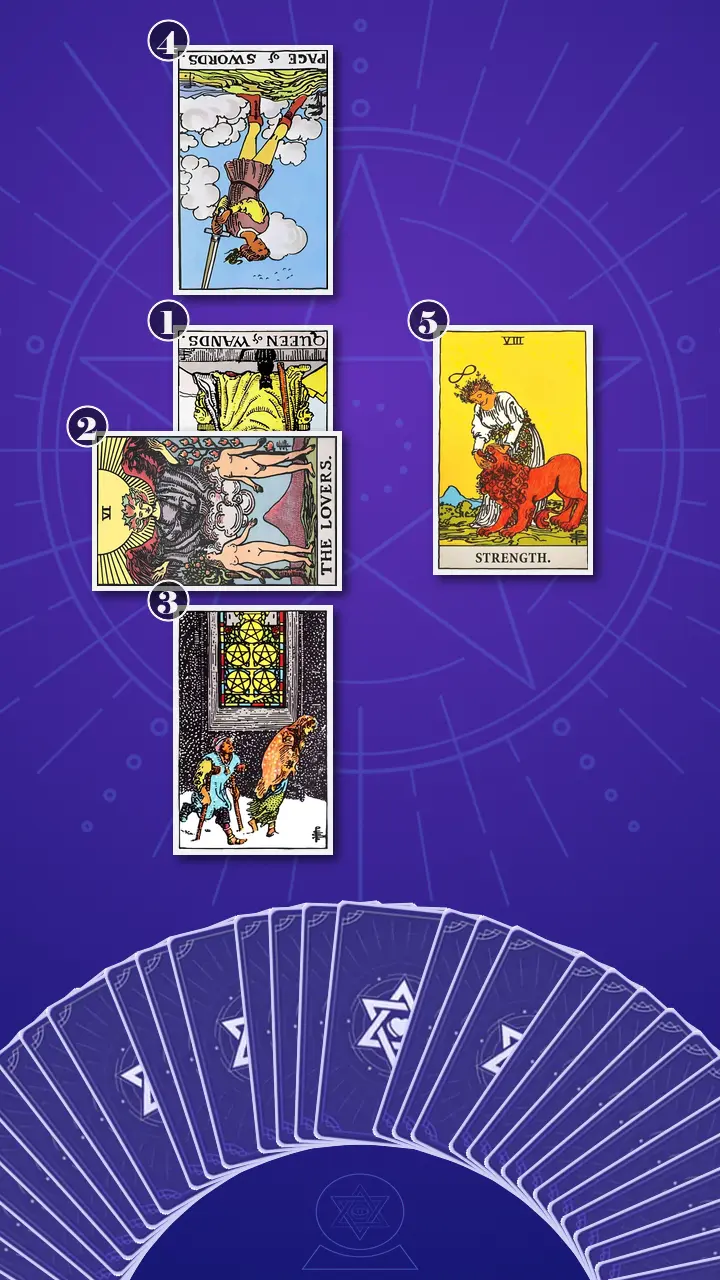
For this reading, I chose a Five-Card Cross tarot spread. I use this spread when the question is less “What will happen with this person?” and more “What keeps happening inside me?” Five cards are enough to separate the visible behavior from the deeper wound underneath it. They let me see the present symptom, the pressure crossing it, the root fear, the conscious strategy that keeps the loop alive, and the direction that leads back to self-trust. Clean structure. No extra fog.
I told her what I tell readers all the time when they ask how tarot works in real life: a good spread is not about being dramatic. It is about putting the right questions in the right places. In this cross, the center would show how the self-editing appears on the surface. The crossing card would reveal the tension between being real and being chosen. The card below would point to the older belonging wound. The card above would show the mental strategy she reaches for to feel safer. And the card to the right would offer the integrating move forward—the next step that could interrupt the pattern instead of just explaining it.
The layout looked the way this kind of dating trigger feels: like a road sign at an emotional intersection.
The Cards That Named the Spiral
The Rebrand Nobody Asked For — Queen of Wands Reversed
I turned over the first card. “This is the position that presents the observable self-reshaping behavior—how you edit appearance, tone, and opinions right after hearing another person’s type. And here we have the Queen of Wands, reversed.”
This card did not show a lack of personality. It showed personality getting redirected into impression management. I told Maya what I saw immediately: right after a date says he likes “low-maintenance girls,” she gets home and begins a quiet rebrand. She saves different outfit ideas, softens her next text, filters out the most vivid parts of herself so she can come across as more effortless, less intense, more likely to be picked. The Queen of Wands upright is warm, alive, instinctive. Reversed, that fire contracts. It is not gone; it is busy asking for permission.
“This is like turning yourself into a dating app A/B test instead of a person having an experience,” I said. “The problem isn’t that you’re too much. The problem is that the second attraction matters, your natural magnetism gets replaced with managed desirability.”
Maya gave a short laugh that landed with a little sting in it. “That’s so accurate it’s rude.” Her fingers tapped the side of the cup once, then stopped.
I smiled. “Good. Sometimes accuracy sounds rude before it sounds relieving. But this is useful, because now we know the first ten minutes of the spiral. The queen’s sunflower and black cat usually speak of style and instinct. In your case, those are exactly the things that go dim first.”
When Connection Turns Into an Audition — The Lovers Reversed
I placed the next card across it. “This position reveals the crossing tension: the conflict between authentic connection and fear of not being chosen as you are. The card is The Lovers, reversed.”
This is where the issue stopped being about style and became about loyalty to herself. A simple preference comment starts feeling like a referendum on whether her real self is lovable. Instead of using the date to find out whether they actually match, she begins treating the interaction like an audition. One person is quietly rebranding in real time while the other person may have only made an offhand comment about what they usually go for.
“Compatibility is not a solo audition,” I said, and I let that sit there. “This card shows the moment dating stops feeling mutual and starts feeling like an approval test. The mountain between the figures is that split you feel inside: ‘Do I even agree with that, or am I already adjusting?’”
Her whole face went still for a second. Not blank—more like the stillness that comes when a line hits too close. She looked down at the card, then back up at me. “That’s exactly it,” she said softly. “I don’t even know if I like them, and somehow I’m already trying to fit their settings.”
The Cold Room Underneath It — Five of Pentacles
I turned the third card and placed it below the center. “Now we’re looking at the foundation—the deeper fear of rejection and not belonging that fuels the self-editing pattern. This is the Five of Pentacles, upright.”
In this card, the image is cold before it is anything else: snow, hardship, a lit window nearby, warmth visible but not felt. I told her this was the card that translated a date’s casual “my type” comment into something her body heard much more loudly: I might be outside the warm room. Before anyone has rejected her, she already feels excluded. So she adapts fast to get back inside.
“You are not overreacting,” I said gently. “You are reacting from the part of you that thinks belonging is scarce.”
Her response came in a clear little chain I’ve learned to watch for over years of readings. First, the physical freeze: her breath paused halfway in, and her hand stopped around the cup handle. Then the cognitive slip inward: her eyes unfocused slightly, as if she were back on the TTC, hearing train brakes squeal while replaying some tiny line from a date. Then the emotional recognition arrived. She nodded hard once and said, almost to herself, “Nobody said no, but my body already heard a no.”
“Exactly,” I said. “And that matters. Because if you think the problem is only the other person’s preference, you’ll keep trying to optimize around it. But if you see that an older belonging alarm has gone off, you can meet the alarm instead of obeying it.”
Doomscrolling for Clues and Calling It Research — Page of Swords Reversed
I lifted the fourth card. “This position shows the conscious defense strategy—the hyper-analysis, cue-reading, and impression management you use to feel safer. And here is the Page of Swords, reversed.”
I laughed a little, not at her, but in recognition. “This is the card of opening their profile, checking who they follow, rereading the chat, drafting three versions of a reply so you can sound interesting but never too eager. It feels smart in the moment. Especially for someone like you—a UX writer, someone who already knows how to shape language, catch tone, optimize clarity. But in dating, that same skill becomes surveillance.”
Looking at that Page, I had one of those café thoughts that still visit me after twenty years behind the espresso machine: when the grounds in a demitasse keep spinning, you cannot read the pattern yet. You have to let the cup go still. Too much stirring does not create clarity; it blurs the residue. That is what this card was doing in her life—refreshing Slack in her head for tone changes that probably were not there.
“This is overloaded Air,” I told her. “Too much mental scanning, not enough body contact. It’s like treating attraction as a UX research problem—if I collect enough data, maybe I can stop feeling exposed. But the false safety here is control. The cost is that you lose the clean signal of what you actually feel.”
Maya rubbed the heel of her hand against her sternum, then gave me a look that was equal parts called out and relieved. “I really do make it into a case file,” she said. “Group chat, screenshots, all of it.”
“Of course,” I said. “Because control feels safer than uncertainty. But safer is not always truer.”
When Strength Put Her Hands on the Lion
The Antidote — Strength Upright
When I turned the final card, the room felt quieter. Even the espresso machine in the front of the café had gone still for a beat, and the late light on the tiled floor seemed warmer. “This position offers the key shift,” I said. “The embodied next step that can interrupt self-abandonment in dating. The card is Strength, upright.”
I looked at the woman in the card with her open hands at the lion’s mouth, and then back at Maya. “This is not a ‘be more confident’ card. It is a ‘stay with yourself for one extra beat’ card.”
When you are back in your apartment after a decent date, rereading the chat, screenshotting outfit ideas, and trimming your text so you sound a little more easy and a little less like yourself, it can feel weirdly practical in the moment. That is the exact moment this card cares about: the second your stomach drops and your fingers want to edit.
Not “become easier to pick,” but “stay steady enough to be known”—like the woman meeting the lion with open hands instead of a disguise.
Being their type can get you through the door; being yourself is what tells you whether the room is actually for you.
Then I gave her the coffee-language version I’ve come to trust enough to use when the real insight is close. “In my café, I call this Relationship Stage Diagnosis. Espresso is your essence—small, clear, unmistakable. A latte softens the edges, but the shot is still there. An Americano is what happens when too much water gets added and the flavor travels farther than the truth. Right now, the moment you hear a preference, fear reaches for the hot water. You dilute yourself before anyone has even tasted who you are. Strength is not about becoming harsher. It is about keeping the shot intact.”
She did not relax right away. First came the freeze: her thumb hovered over her phone on the table as if there were a draft text sitting on the screen. Then came the memory-flood: her gaze went slightly past me, replaying some radiator-clicking Thursday night where she had deleted the truest sentence. Then the resistance surfaced, sharp and honest. “But if I stop doing that,” she said, “won’t I just get rejected faster?”
“Maybe by the wrong person,” I said. “But also by the wrong fantasy. And much sooner by the right information.”
Her jaw unclenched. Her shoulders dropped a fraction, then more. She let out a long breath that sounded like it had been stuck under her ribs for weeks. There was relief in it, but also that strange, slightly dizzy feeling people get when a heavy script falls away and they have to stand there without it. I watched her press her palm lightly to her stomach, as if checking whether she was still allowed to stay soft. “Okay,” she said at last, giving one small nod. “That actually landed.”
I leaned in a little. “Try this sentence the next time you feel the urge: I can feel the urge to make myself easier. I do not have to obey it immediately. That is the move from softness into self-respect, instead of softness into self-erasure. The urge to become easier is not the same thing as a sign to become smaller.”
Then I asked her, “Now, use this new perspective and think back to last week. Was there a moment when this would have changed the feeling in your body?”
She nodded almost immediately. “Yes,” she said. “I would’ve kept the original text.”
That was the hinge point of the whole reading: not from nervousness to perfect confidence, but from auditioning for romantic approval to embodied self-trust in mutual compatibility. From being easier to pick to being easier to know.
From Performance to Mutual Fit
Once all five cards were on the table, the story was clean. The Queen of Wands reversed showed the visible symptom: the quick self-rebrand, the quiet shrinking, the managed desirability. The Lovers reversed named the true conflict: she was no longer asking whether there was mutual fit, only how to avoid losing her chance. The Five of Pentacles showed why the trigger hit so hard: somewhere inside, “not their type” translated into “outside the warm room.” The Page of Swords reversed showed the coping strategy—social media reconnaissance, text rewrites, emotional forensics on tiny comments. And Strength offered the direction home: not a better performance, but a steadier body, clearer boundaries, and enough calm to keep one real preference visible.
I told her the blind spot was simple and brutal: she had been confusing being chosen with being safe. But those are not the same thing. Sometimes the real red flag is how fast you leave yourself. The transformation direction in this reading was to stop treating compatibility like a test she had to pass and start using dating as a place to find out whether her real pace, preferences, and personality could actually be met.
So I gave her three small practices, the kind that belong in real life—not in a perfect healing montage.
- The Cup-Bottom CheckThe next time someone mentions their type, open your notes app before Instagram and write two lines within five minutes: “What I heard” and “What my fear added.” Do it in your hallway, on the TTC, or in the office bathroom—wherever the trigger actually lands.Keep it short. One sentence per line is enough. You are not trying to be profound; you are trying to catch the belonging alarm before it runs the whole night.
- One Honest Preference ReplyIn your next date conversation or chat, answer one preference statement with one of your own in a clean sentence. For example: “That makes sense. I actually like a bit more clarity than mystery.” Say it to the person directly or text it in your normal tone.Start tiny if you need to—food, timing, movie taste, texting pace. Honesty does not require a dramatic speech.
- The One-Reread WindowSend one message this week after one reread only, then put your phone face down for five minutes. No profile checking, no mutual-friend recon, no reopening the chat unless there is a practical reason.If your chest tightens, just name it: tight chest, dropped stomach, urge to fix. Naming the body cue is already progress. A tiny version counts.

A Week Later: The Quiet Proof
A week later, Maya messaged me. “He said he likes spontaneity,” she wrote, “and I said I actually like a plan. Tiny, but I said it.” Then another line: “I still stared at the chat after, not gonna lie. But I didn’t rewrite myself out of it.”
That is what finding clarity usually looks like in real life. Not a personality transplant. Not the end of fear. Just one moment where the old reflex reaches for the emergency rebrand button and you keep your hands open instead.
A lot of us know the feeling of hearing one small preference, feeling our chest tighten before the date is even over, and quietly deciding it would be safer to edit ourselves than risk finding out whether our real self actually fits. If that feeling visits you too, then the next time attraction starts pushing you into edit mode, what is one small preference, pace, or part of your personality you could let stay visible for thirty seconds longer?
This story is adapted from psychological research, written so that those in a similar struggle can see their own pattern in it — and find their next step clearly.These insights are not a substitute for professional psychological, medical, legal, or financial advice.
Learn more about our Journey to Clarity.
How did this insight land for you?
🫂 This Resonates Deeply
🌀 Living This Story
✨ Now I See Clearly
🌱 Seeing New Possibilities
🧰 Useful Framework
🔮 The Confirmation I Needed
💪 Feeling Empowered
🚀 Ready for My Next Step
Author Profile
 AI
AI“For twenty years, I’ve listened to stories unfold over the warm aroma of coffee. I don’t believe life’s complexities always require grand theories to be solved; often, we just need a safe place to tidy up our reality. I don’t offer high-minded preaching—just grounded, heartfelt insights to help you regain your sense of control amidst the clutter of daily life.”
In this Love Tarot Reading :
Core Expertise
- Daily Friction Deconstruction: Stripping away dramatic accusations to locate the mundane, mechanical breakdowns in your shared daily routine.
- Emotional Clutter Sorting: Separating actual relationship incompatibility from the stress of household chores, fatigue, or external life pressure.
Service Features
- The 24-Hour Micro-Boundary Reset: A highly pragmatic exercise to establish one non-negotiable physical or time boundary in your shared space to instantly reduce friction.
Also specializes in :
Explore Related Patterns:
Approval SeekingMaya softens the reply, saves the effortless outfit references, and filters out the more vivid parts of herself so she can seem easier to choose. The behavior is not only about style; it is an attempt to regulate the fear that her unedited self might cost her the connection. Approval Seeking turns the other person's preference into a temporary emotional anchor. You start managing what will be rewarded instead of checking what feels true. That makes being chosen feel like safety, but it also teaches your attention to orbit someone else's reaction before your own desire has had a chance to speak.
Boundary DiffusionThe moment his preference starts steering Maya's outfits, wording, and emotional temperature, the boundary between "what he likes" and "who I am" becomes too porous. She has not been asked to change, but the cue enters her self-concept quickly enough that her own desire gets pushed to the background. Boundary Diffusion explains why reshaping can feel automatic instead of chosen. You are not simply being flexible; you are letting another person's preference reorganize your visible self before you have checked whether that preference should matter. The repair begins when his taste and your preference can sit side by side without one erasing the other.
Relationship Performance AnxietyMaya's own line, "I don't even know if I like them, and somehow I'm already trying to fit their settings," is the clearest audit point. The date stops functioning as mutual discovery and becomes a live evaluation where outfit, tone, opinion, and reply timing all feel like parts of a performance score. Relationship Performance Anxiety turns attraction into an approval test. You may know the interaction should be mutual, but once uncertainty hits, the mind starts optimizing the version of you that seems most likely to pass. The deeper cost is that performance replaces perception, so you lose access to the clean signal of whether this person actually fits you.
Self-AbandonmentThe 11:18 p.m. moment after "low-maintenance girls" shows the pattern clearly: Maya screenshots effortless outfits, cuts the sharper line from her reply, and starts editing her vibe before asking whether she even likes how she feels around him. The protective move is not random insecurity; it is a defense strategy that trades self-contact for a better chance of being chosen. When you do this, the nervous system treats visibility as a risk and approval as a shortcut to safety. Self-Abandonment names the moment when connection becomes more important than staying present with your own tone, preferences, and instincts, so the cost of being picked is that the person being picked is no longer fully you.
Rejection SensitivityBefore anyone rejects Maya, her body acts as if the rejection has already landed. A casual comment about "type" becomes the Five of Pentacles feeling of being outside the warm room, and her own words make the sequence exact: "Nobody said no, but my body already heard a no." Rejection Sensitivity is the pattern of treating ambiguous social information as a threat cue before reality has fully arrived. You are not choosing to be dramatic; your system is trying to prevent exclusion by adapting early. The cost is that a passing preference starts carrying more authority than your direct experience of the person in front of you.
Scarcity MindsetThe cold-room image under the reading matters because Maya does not hear "low-maintenance girls" as a neutral preference. Her system hears the possibility of being outside the warm room, which makes adaptation feel urgent before the other person has made any real decision about her. Scarcity Mindset makes belonging feel like a limited seat you have to secure fast. You start reshaping not because you have calmly chosen growth, but because a part of you believes there may not be enough warmth, attention, or romantic acceptance available if you stay fully visible. The pattern loses power when you can notice the scarcity alarm without treating it as evidence.
Compulsive CheckingThe Page of Swords scene makes the coping ritual concrete: Maya opens his profile, checks who he follows, rereads the chat, drafts multiple replies, screenshots the evidence, and brings the case file to the group chat. It feels like research because each check promises a little more control over the uncertainty. Compulsive Checking is the behavior loop that keeps the nervous system busy while the deeper question stays unanswered. You collect more cues to feel safer, but the checking rarely creates real clarity; it trains your attention to hunt for signs instead of returning to your body and asking what you actually feel.
Explore Related Struggles:
Approval-Safety FusionMaya does not wait for an actual rejection before she starts working for approval. A date says he likes "low-maintenance girls," and her body treats the comment like a safety instruction: become softer, easier, less sharp, less likely to create friction. The visible edits are small, but the inner exchange is heavy because approval starts acting like the thing that will make the whole situation feel secure. That is the lock inside Approval-Safety Fusion. Being chosen begins to feel like proof that nothing bad is happening, even though the story keeps showing that selection and safety are not the same thing. You can be picked while still abandoning your own signal; you can be liked while still not known. Maya's effort to become desirable gives her a short hit of control, but it also moves her away from the information she actually needs. The reading's strongest line is that compatibility is not a solo audition. When you treat approval as safety, every preference becomes a rule to obey. When you separate the two, the question changes: not "How do I become their type fast enough?" but "Can I stay present long enough to see whether this connection can hold the real me?"
Belonging-Authenticity SplitMaya hears one casual preference after a decent date and immediately starts changing the surface of herself: outfit references, text tone, sharper opinions, the whole vibe. The key detail is that this happens before she has even asked whether she feels good around him, so the dating moment stops being mutual and becomes a fast internal negotiation over what parts of her can stay visible. You can feel the split in her own sentence: she wants to be chosen, but not at the cost of disappearing. One side reaches for connection; the other side starts reducing her shape so connection feels less risky. That is why the story lands as Belonging-Authenticity Split rather than simple insecurity. The struggle is not only wanting someone to like her. It is the structural pressure of treating belonging and self-presence as if they cannot safely exist in the same room. The path back to clarity begins when she keeps one real preference on the table for thirty seconds longer. Saying she likes a plan after someone says they like spontaneity is small, but it interrupts the old equation. You are no longer only trying to become easier to pick; you are testing whether your unedited self can actually be met.
Self-Editing ExhaustionMaya's self-reshaping is not a single polite adjustment; it becomes a whole after-hours workload. She screenshots outfits, edits her reply, checks the profile, rereads the chat, drafts versions, and brings screenshots into the group chat as if enough refinement could make attraction less uncertain. The story makes the labor visible: she is not just dating someone, she is maintaining a version of herself designed to be easier to choose. Self-Editing Exhaustion shows up when the energy spent managing desirability starts draining the very self that wants to be known. The effort looks productive because there is always one more sentence to soften or one more clue to decode, but the output is thin. More editing does not create more mutuality; it only gives the other person's imagined preference more room inside her nervous system. The week-later update matters because she still stares at the chat, but she does not rewrite herself out of it. That is not a personality overhaul. It is a break in the maintenance cycle. You keep one preference intact, and the system gets a different kind of evidence: your real voice can survive the moment when attraction feels uncertain.
All-or-Nothing BelongingMaya names the crucial sequence herself: nobody has said no, but her body has already heard a no. The date's comment is not processed as one person's preference; it lands like a closed door, a warm room she might be standing outside of unless she adapts quickly enough. Her chest, stomach, and fingers all move before the relationship has given her actual evidence. All-or-Nothing Belonging is the structure underneath that fast adaptation. A small cue gets turned into a total belonging verdict: either she can fit the type, or the unedited version of her may not be wanted at all. The struggle has weight because it makes dating feel less like discovery and more like emergency access control, where one wrong texture of personality could lock her out. This is why the story's practical move is so modest. She does not need to prove she is fearless; she needs to separate what she heard from what her fear added. You can let a preference be information without letting it become a verdict on whether you belong anywhere at all.
Inner Compass NumbnessMaya has plenty of data after the date: the chat, the profile, the follows, the outfit references, the group chat readout. What she loses access to is quieter and more important: whether she likes how she feels around him. The story keeps returning to that gap between external scanning and internal signal, especially when her body tightens and her fingers move toward editing before her own preference has had time to form. Inner Compass Numbness is not a lack of intelligence or self-awareness. She knows she is doing it while she is doing it. The problem is that her attention gets outsourced to the other person's settings so quickly that her own reference point goes dim. Control feels safer than uncertainty, but it crowds out the clean signal of desire, discomfort, pace, and fit. When she later says, "I actually like a plan," the compass comes back online in a small, testable way. You do not have to solve the entire dating pattern in one move. You only have to notice the moment your attention leaves your body for their preferences, then let one real sentence stay unedited long enough to hear yourself again.
Explore Related Emotions:
Approval AnxietyShe deletes the sharper line from her draft reply, softens the tone, and starts managing the version of herself that might be more likely to get picked. The date has not become a relationship yet, but her attention is already organized around passing a test she did not consciously agree to take. Approval Anxiety names that shift from connection into evaluation. You can feel it in the way her own attraction becomes secondary to the imagined scorecard in his head, as if being chosen would settle the uncertainty faster than asking whether she actually wants to be known by this person.
Conditional Belonging FearAfter he says he likes 'low-maintenance girls,' Maya is back in her small Toronto apartment with the kitchen light on, the phone bright, and the screenshots already open. Nothing explicit has been refused, yet the comment gets translated inside her as if access to closeness depends on becoming the right kind of person fast enough. Conditional Belonging Fear fits because the pressure is not only to be liked; it is to prove she belongs by editing herself before mutual fit has been tested. You can see the inner weather in the way the real question changes from 'Do I like how I feel around him?' to 'Can I become the version that gets back inside the warm room?'
Low-Maintenance ShameThe phrase 'low-maintenance girls' sends her straight into screenshots of effortless outfits and a cleaner, softer draft reply. Her vividness does not disappear because she lacks personality; it gets treated like something that needs to be made less visible to keep the door open. Low-Maintenance Shame captures the sting of making your own intensity feel like a liability. You can see the pressure to become easier, calmer, and less sharp before she has even checked whether his version of ease would leave enough room for her real pace, voice, and preferences.
Self-Betrayal AcheMaya says it plainly: she wants to be chosen, but not at the cost of disappearing. That line is the emotional center of the late-night edits, the deleted sentence, the softened reply, and the later recognition that she would have kept the original text. Self-Betrayal Ache names the pain of watching yourself leave the room while your body is still sitting there. You can feel the ache because each adjustment is meant to protect connection, yet each one also makes it harder for the other person to meet the version of her that is actually real.
Cautious Self-TrustA week later, he says he likes spontaneity, and she answers, 'I actually like a plan.' She still stares at the chat afterward, so this is not a sudden personality overhaul or a clean absence of nerves; it is one honest preference left standing inside the conversation. Cautious Self-Trust fits because the trust is small, embodied, and still under pressure. You can see it in the fact that she does not need to feel perfectly secure to stop rewriting herself out of the exchange; she only needs enough steadiness to let one real signal remain visible.
Quiet Self-RespectThe sentence she is given is deliberately small: 'I can feel the urge to make myself easier. I do not have to obey it immediately.' It lands right at the moment her stomach drops and her fingers want to edit, where the old reflex usually moves faster than choice. Quiet Self-Respect names the inner posture that lets softness stay without becoming self-erasure. You can feel it in the move from trying to be easier to pick toward being easier to know, where her boundary does not need to be dramatic in order to be real.
Clarity ReliefThe spiral becomes easier to hold once its sequence is named: the comment, the body drop, the clue-searching, the edit impulse, and the possible pause. Maya laughs when the description lands, then later her shoulders drop and a long breath comes out from under her ribs. Clarity Relief fits because the pattern stops being a vague flaw and becomes something with edges. You can feel the relief in the shift from 'Why am I like this?' to 'Here is the exact moment the old reflex takes over, and here is where I can stay with myself for one more beat.'
Hypervigilant AnxietyShe opens the profile, checks who he follows, rereads the chat, drafts three versions of a reply, and turns the whole thing into a case file. The phone becomes a control panel for uncertainty, with every tiny cue treated as possible evidence for how she should present herself next. Hypervigilant Anxiety fits because her mind is trying to scan its way out of exposure. You can feel the cost in the story: the more data she gathers about him, the less access she has to the simpler signal of what her own body, taste, and timing are telling her.
Explore Related Contexts:
Conditional Belonging PressureMaya says the central line herself: she wants to be chosen, but not at the cost of disappearing. After one casual comment about someone’s type, she behaves as though romantic access may depend on whether she can quickly become less sharp, less intense, and more aligned with what the other person already prefers. The story frames belonging as something that can be withdrawn before it has even been offered. The “warm room” image matters because the external situation is not just a private feeling; it shows how a dating cue can create a social threshold. Maya starts acting like she must adjust fast enough to stay inside the possibility of being wanted. You are seeing Conditional Belonging Pressure because the connection feels available only under certain terms. The pressure does not come from a formal demand, but from a dating dynamic where a preference comment can function like an unspoken gatekeeping rule.
Dating Performance LoopMaya leaves a decent date, rereads the Hinge chat, saves “effortless” outfit posts, trims the sharper sentence from her reply, and starts managing how she will be perceived. The behavior repeats around a clear external cue: someone names their type, and the dating interaction becomes a stage where she feels pushed to perform the role most likely to be chosen. The structure here is not ordinary dating nerves. The story shows a loop with recognizable steps: preference cue, self-audit, visual adjustment, tone adjustment, message revision, and another round of checking. Compatibility stops being a two-way discovery process and turns into a performance cycle where one person’s offhand standard becomes the script. You can see why this label fits the question so directly. “Why do I start reshaping myself?” is answered by the scene itself: the dating environment has become a performance loop, and Maya’s agency gets pulled into managing desirability instead of reading whether the connection is actually mutual.
Low-Maintenance Dating PressureAfter a date says he likes “low-maintenance girls,” Maya goes home and immediately starts changing the visible parts of herself: outfit references, text tone, sharpness, and overall vibe. The pressure is concrete because it attaches to a specific social script in modern dating, where seeming easy, casual, and unbothered can become a hidden requirement for staying desirable. That phrase does not operate like neutral information in the story. It becomes an informal standard she starts trying to meet before she has even asked whether his preference fits her life, pace, or personality. The external structure is a dating culture that rewards effortless presentation while quietly penalizing women who appear too direct, too intense, or too clearly self-defined. You are looking at a scenario where attraction is filtered through an aesthetic rule: be easier to pick by becoming easier to manage. Naming this as Low-Maintenance Dating Pressure keeps the focus on the social script pressing on Maya, not on blaming her for responding to it.
Relationship Readiness CheckThe reading keeps returning to one practical shift: dating should help Maya find out whether her real pace, preferences, and personality can be met. The issue is not whether she can perform the right version of herself, but whether the interaction has enough mutuality to hold who she already is. That makes the dating situation a readiness check rather than an approval exam. When she stops treating compatibility as something she must pass, she can use the date as information: how the other person responds to clarity, whether preference can go both ways, and whether being known is actually possible here. You are seeing Relationship Readiness Check because the story moves from performance toward mutual fit. The external stage remains dating, but the function of that stage changes into a test of shared capacity, not a test of Maya’s marketability.
Strategic Dating BoundaryA week later, someone says he likes spontaneity, and Maya replies that she actually likes a plan. That moment is small, but it changes the structure of the exchange: his preference no longer automatically becomes the standard she has to absorb. The boundary is strategic because it is not a dramatic confrontation. Maya simply keeps one true preference visible inside the conversation, which restores the two-way shape of dating. Instead of turning herself into a softer version of his stated type, she lets the interaction reveal whether there is room for her real pace. You can see this as a Strategic Dating Boundary because the practice gives Maya a concrete way to interrupt the rebrand reflex. It turns the question from “How do I become easier to choose?” into “Can this connection hold one honest thing about me?”