Finding Clarity in the 6:18 Northern Line Scroll
I’ve heard many versions of the same question over coffee, but when Jordan sat across from me at my usual back table, damp umbrella folded by her chair and espresso warmth rising between us, I knew this one belonged very specifically to late-20s city life. This was catch-up dread. What’s new with you anxiety. The kind of comparison fatigue that starts before the first drink is even poured.
She was 29, a content strategist at a London startup, sharp enough to run a deck review at work and still end up doing crisis comms for her own life on the Tube to dinner. She told me about 6:18 p.m. on the Northern line into Soho: Instagram Stories serving a promotion post, then an airport gate, then a holiday photo dump; the carriage buzzing, brakes screeching at each stop, her phone hot in her palm. Then, without thinking, her thumb jumped to Notes so she could draft three acceptable answers for when someone inevitably asked, “What’s new with you?” She wanted to see her friends, but her body was already packaging her before she had even arrived.
“I’m fine until the spotlight lands on me,” she said, wrapping both hands around her cup. “I never know how to answer that without sounding behind.”
What I heard immediately was the real contradiction: she wanted to feel connected and seen at catch-ups, but the second the question turned toward her, she feared being judged as if a casual dinner were a tiny performance review. The feeling sat in her like swallowing a coat hanger — throat tight, stomach dropping, every ordinary sentence suddenly needing legal review. I told her, gently, “That makes sense. We’re not here to build you a better script. We’re here to map the pattern, so you can find clarity without having to perform for it.”

Choosing the Ladder for Catch-Up Dread
I asked Jordan to take one slow breath, keep the question in mind, and shuffle until the noise in her head dropped by even half a notch. I never treat this part like theatre. The ritual matters because it gives the mind somewhere to stand while the nervous system comes down from bracing.
For her, I chose the Four-Layer Insight Ladder · Context Edition. When people ask me how tarot works in a situation like this, this is what I mean: I’m not using the cards to tell her whether her friends secretly judge her. I’m using a clean structure to follow the exact chain of the problem — from the visible symptom, to the belonging wound underneath it, to the shift that can loosen it, to one practical next step.
A bigger spread, like the Celtic Cross, would have given us too much weather and not enough signal. Jordan didn’t need ten abstract angles. She needed a ladder with four clear rungs: what happens when the room starts to feel like an audition, what fear is driving that feeling, what inner reframe restores self-trust, and what conversational experiment can help her practice something different in real life.
I told her the structure before I turned the first card. The top rung would show the visible social symptom. The next would reveal the deeper fear of exclusion. The third — the hinge of the whole reading — would name the medicine. The final card would bring it back down to earth with a low-stakes action she could actually use over chips and wine, not just admire in theory.
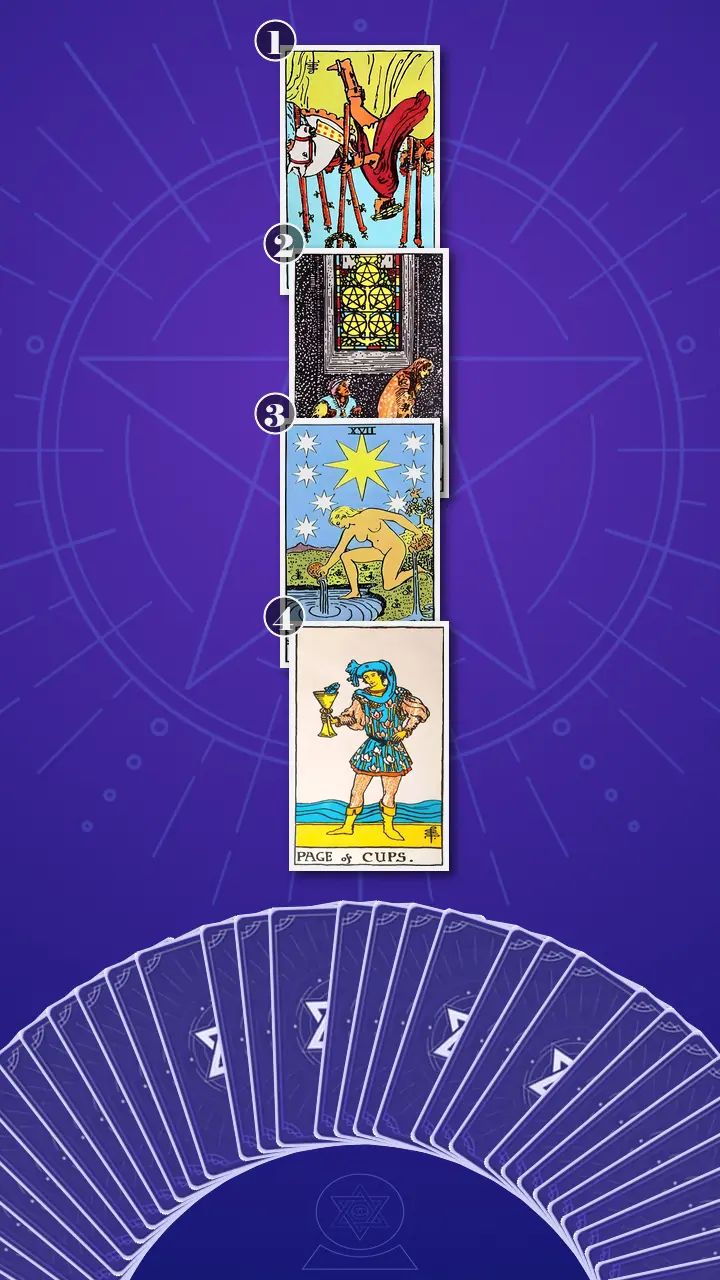
The Friendly Table That Turned Into a Scoreboard
Position 1: When Visibility Started Feeling Risky
I turned over the card representing the visible social symptom from the diagnosis: the self-conscious performance that appears when the catch-up round reaches her. It was the Six of Wands, reversed.
It fit immediately. In modern life, this is that candlelit Shoreditch table where someone says, “Okay, quick round, what’s everyone been up to?” and a perfectly friendly dinner suddenly feels like a tiny public ranking. The moment it reaches Jordan, she scans faces for reactions, gives a vague but defensible update, then flips the spotlight back to someone else before anybody can test how solid her life really feels.
Upright, the Six of Wands carries healthy recognition. Reversed, that fire gets blocked and turns into hyper-awareness of the audience. Visibility stops meaning connection and starts meaning evaluation. It’s like walking into a wine bar as if it were a surprise performance review. I told her, “You’re not struggling because you have nothing to say. You’re struggling because your system is treating a room of friends like a crowd you have to win.”
She let out a short laugh that had no real humor in it. First her breath caught. Then her gaze slid off to the side, like she was replaying half a dozen dinners at once. Then one shoulder lifted in a small, bitter shrug. “That’s painfully accurate,” she said. “Like… too accurate.”
Position 2: The Warm Window You Thought You Had to Earn
Then I turned over the card representing the psychological mechanics underneath the symptom: the fear of exclusion and lack of belonging driving the urge to self-edit. It was the Five of Pentacles, upright.
This card always changes the temperature of a reading. Outside the café window, a bus hissed through the rain, and for a second even the room seemed to cool with it. Jordan wasn’t really afraid of conversation. She was afraid of ending up outside warmth. This was the deeper scene: same dinner, same people she loved, same clink of glasses and fried food in the air — but internally she felt as if everyone else belonged more easily than she did, as if she were looking in through a bright window she had not yet earned the right to enter.
The Five of Pentacles is earth in scarcity mode. Solid, heavy, contracted. It says the hidden belief is not “I’m bad at small talk.” It is “If my answer isn’t substantial enough, I become less real here. Less adult. Less interesting. Less worth staying connected to.” I said, very plainly, “An update is not a worth report.”
Her fingers loosened around the cup. She frowned, and when she spoke, her voice had dropped. “I honestly thought I was just bad at talking about myself.”
I shook my head. “No. This is a belonging wound wearing a social mask. You’ve fused being seen with being measured. That’s why you can leave a catch-up with lovely people and still feel lonely after it.”
After twenty years of listening to people tell the truth over coffee, I know this silence well. It’s the one that arrives when someone realizes the problem is not lack of charisma. It’s the exhausting belief that they need a better version of themselves before they can show up honestly. I leaned in a little and added, “You don’t need a headline to stay in the conversation.”
When the Star Replaced the Headline
Position 3: The Medicine Beneath the Script
When I turned over the third card, the air changed. Even the espresso machine behind us went quiet for a beat, and the dark café window reflected our table back at us like a pane of water. This was the key card, the transformation layer — the card that names the shift from proving visible progress to sharing what is true and meaningful now. It was The Star, upright.
I started in ordinary language. The Star was not asking Jordan to become more impressive. It was asking her to become less armored. Not the most impressive thing. The truest thing. In her life, this looked like closing the personal-brand tab and speaking more like she was leaving a real voice note: naming what she was actually learning, tending, questioning, or recovering instead of hunting for the cleanest headline.
This was also the exact moment for one of my own frameworks, because I could see the part of her that still assumed every social room had equal access to her rawness. “I call this Social Clutter Sorting,” I told her. “Not every person in your orbit is the same audience. Some are core nourishing. Some are energy-draining. The Star does not ask for unarmored honesty in every room. It asks you to stop assuming every table is a tribunal. Honest doesn’t have to mean overexposed.”
She went very still, so I named the pattern as directly as I could. On the Tube to dinner, after the promotion post, the holiday carousel, and the automatic switch into your Notes app, your throat is already tight before you've even seen your friends. Your body has mistaken a catch-up for a test.
Stop treating the room like a scoreboard and offer one honest star-point from your real life instead, because the Star heals through presence rather than performance.
I let the sentence sit between us.
Jordan’s jaw locked first. Then her eyes went slightly unfocused, as if some private replay had started behind them. Then the feeling finally broke through: her hand moved to her throat, her eyes brightened, and the breath she let out sounded almost startled by its own softness. But right behind the release came resistance. “But if I do that,” she said, voice thinner now, “doesn’t that basically mean I made it worse by hiding?”
I answered carefully, because this is where insight can turn cruel if nobody catches it. “No. It means you built a smart protection around a tender place. That protection got you through the room. It just can’t create the connection you actually want.”
Then I grounded the card in practice, because The Star heals best when it becomes something the body can actually do. “Before your next catch-up, type one sentence that begins, ‘Honestly, what’s been real for me lately is...’ Read it once out loud, then put your phone away. If your body spikes, make it lighter. You never owe the room your deepest material just to be real.”
Her shoulders dropped a fraction. Then more. She nodded once, slowly, and I could see that familiar post-insight wobble — the relief of having a clearer path, and the faint dizziness of realizing she would now have to walk it. So I asked, “Using this new lens, can you think of a moment last week when one honest sentence would have changed how the night felt?”
“Tuesday,” she said immediately. “My friend asked what was going on with work, and I made some joke about becoming one with Slack. The real answer was that I’ve been figuring out what I want next.”
That was the real turn. Not toward perfect confidence, but toward gentle visibility. From anticipatory shame and defensive self-editing into the first workable form of self-trust. The room was not a scoreboard anymore. It was just a room.
Position 4: The Honest Beginner at the Table
Finally, I turned over the card representing the grounded experiment that could help her integrate this shift in behavior. It was the Page of Cups, upright.
This was exactly right. In modern life, the Page of Cups is a beta-version answer instead of a polished product release. It sounds like, “Honestly, I’ve been figuring out what I want next at work,” or, “Lately I’ve been trying not to make uncertainty mean I’m failing.” Small. Real. Slightly awkward on purpose.
The Page’s energy isn’t mastery; it’s beginner sincerity. The cup is held forward, and something surprising rises out of it. That is what happens when Jordan stops over-editing: a small true sentence appears, and suddenly there is something alive for the other person to meet. Drafts deserve airtime too.
This time she smiled properly. “That,” she said, “I can maybe do.”
From Catch-Up Dread to a Belonging-First Answer
When I laid the reading back out for her, the story was clean. The Six of Wands reversed showed the surface pattern: a friendly question turning into an audition. The Five of Pentacles showed the deeper wound: the cold belief that belonging depends on proof of progress. The Star broke that spell by offering a different job description for an update — not a highlight reel, but one honest star-point. And the Page of Cups translated that insight into actual behavior: a short, human answer that invites connection instead of dodging it.
Jordan’s blind spot was not that she had nothing interesting to say. It was that she kept reading thin conversations as proof she was forgettable, without seeing how hard she had worked to stay unreadable. The transformation direction was simple and not easy: move from headline mode to signal mode. Share what is true instead of what is impressive. That is how a catch-up stops feeling like evidence you have to submit and starts becoming what it was supposed to be in the first place — contact.
- The Star-Point NoteBefore your next dinner or coffee, open Notes and write one sentence that begins, ‘Honestly, what’s been taking my attention lately is...’ Keep it true, brief, and medium-vulnerability. Use it with one trusted friend or in a low-stakes setting first.If the sentence starts sounding like a press release, cut it back to one plain line. Honest doesn’t have to mean overexposed.
- The 90-Second Tube ResetOn the train or bus before the plan, put both feet on the floor for ninety seconds, lower your shoulders, keep your phone face-down, and exhale longer than you inhale. Then do a quick body check: throat, jaw, stomach.Do not wait to feel zen. Thirty seconds still counts. The goal is simply to stop comparison fatigue from taking the wheel before you arrive.
- The VIP Section WeekFor the next seven days, use my VIP Section Strategy. Sort upcoming invites into core nourishing and energy-draining. Only book reservation-only time with the first group, and practice one Page of Cups reply there first — in person or as a voice note under thirty seconds.If guilt spikes when you skip a draining plan, I call that obligation decoupling. Let the guilt be noise, not instructions.

A Week Later, the Proof Was Quiet
A week later, Jordan sent me a voice note. She had used the VIP Section Strategy and skipped a sprawling dinner she already knew would turn her into a polished version of herself. Instead, she met one close friend for coffee after work. On the Tube there, she did the ninety-second reset, kept Instagram closed, and typed just one line: ‘Honestly, I’ve been figuring out what I want next at work.’
When the question came, she said it exactly like that. Then — this mattered — she stopped. Her friend did not grade it, rescue it, or treat it like a confession. She just said, “That makes sense. Want to tell me more?” Jordan told me the strangest part was how ordinary it felt.
She slept properly that night, though the first thought next morning was, What if I sounded messy? This time she smiled, put the kettle on, and let the thought pass.
That is the version of clarity I trust most. Not a solved life. Not a perfect answer. Just enough inner safety to stop marketing yourself every time somebody asks how you are.
That is also why I use the Four-Layer Insight Ladder · Context Edition for catch-up dread, comparison fatigue, and belonging wounds: it helps me tidy the social clutter until the real next step becomes visible.
If a simple “what’s new with you?” makes your throat tighten, it’s often not because you have nothing to say; it’s because some part of you learned that being unfinished might cost you your place in the room.
So at the next catch-up, if you didn’t need a headline, what is one small honest thing from your real life you might actually want to name?
This story is adapted from psychological research, written so that those in a similar struggle can see their own pattern in it — and find their next step clearly.These insights are not a substitute for professional psychological, medical, legal, or financial advice.
Learn more about our Journey to Clarity.
How did this insight land for you?
🫂 This Resonates Deeply
🌀 Living This Story
✨ Now I See Clearly
🌱 Seeing New Possibilities
🧰 Useful Framework
🔮 The Confirmation I Needed
💪 Feeling Empowered
🚀 Ready for My Next Step
Author Profile
 AI
AI“For twenty years, I’ve listened to stories unfold over the warm aroma of coffee. I don’t believe life’s complexities always require grand theories to be solved; often, we just need a safe place to tidy up our reality. I don’t offer high-minded preaching—just grounded, heartfelt insights to help you regain your sense of control amidst the clutter of daily life.”
In this Social Tarot Reading :
Core Expertise
- Social Clutter Sorting: Objectively classifying your broad network into 'core nourishing' versus 'energy draining' categories.
- Obligation Decoupling: Dismantling the guilt associated with declining invitations from low-value, high-maintenance acquaintances.
Service Features
- The VIP Section Strategy: A pragmatic 1-week rule to enforce a strict 'reservation only' policy for your personal time, eliminating casual energetic vampires.
Also specializes in :
Explore Related Patterns:
Relationship Performance AnxietyOn the Northern line into Soho, your phone is already full of other people's milestone posts before the catch-up even begins. By the time 'What's new with you?' lands, it no longer feels like curiosity; it feels like a live performance review, which is why your system starts scanning faces and drafting a safer answer before you speak. That is the core of the dread. The conversation has stopped being about contact and started feeling like an evaluation of whether you can present a respectable self, so even a friendly dinner gets processed as an audition rather than a place to relax.
Social MaskingYour thumb jumping to Notes so you can draft three acceptable answers is a clean picture of social masking. Instead of arriving with an unfinished, ordinary update, you pre-edit yourself into something safer because being readable feels riskier than being polished. That protection works just enough to get you through the room, but it also blocks contact. The version of you people meet is curated for safety, while the part that actually wants to be seen stays behind the screen.
Conditional Self-WorthThe line about not wanting to sound behind shows that the update is carrying your worth, not just your news. When a substantial answer starts to feel like the thing that keeps you real, adult, interesting, and worth staying connected to, the catch-up stops being a simple social exchange and turns into a test. That is why the dread feels heavier than the moment itself. You are trying to secure belonging in real time by producing evidence on demand, and that makes the question feel like a verdict rather than an invitation.
Comparison TrapThe comparison starts on the feed: promotion post, airport gate, holiday photo dump, and your attention is already benchmarking before the first drink is poured. Other people's visible milestones become the measuring stick, so 'What's new with you?' stops sounding neutral and starts sounding like a request for proof that you are keeping up. That is why the dread arrives as comparison fatigue. You are not just answering a question; you are trying to protect your own timeline from being ranked against everyone else's highlight reel.
Explore Related Struggles:
Belonging-Authenticity SplitYou keep drafting safer answers in Notes because the honest version feels like it might cost you your place in the room. Even the line about sounding behind shows how quickly staying connected gets tied to sounding polished enough.\n\nThat leaves you split between the self that would answer plainly and the self that tries to stay acceptable first. The pressure is not to be fake for its own sake; it is the fear that honesty, left unbuffered, could make connection feel less available.
Catch-Up ParalysisYou are already rehearsing acceptable answers on the Northern line before the table is even in view, so the catch-up round starts as a braced event rather than a casual one. The question does not just arrive; it lands on a system that has been tightening all the way there.\n\nThat is why the round feels like a checkpoint. You are not trying to be interesting enough for fun, you are trying to clear the moment without exposing the part of you that still feels unfinished.
Performance-Worth FusionA casual dinner gets promoted in your head into a tiny performance review, and that changes what an answer is allowed to do. It stops being a simple update and starts carrying proof of whether you are keeping up.\n\nWhen a reply has to defend your place in the room, even a short sentence can feel expensive. The pressure comes from tying worth to presentation so tightly that ordinary conversation starts to feel like evidence handling.
Visibility-Connection SplitYou want to feel connected and seen, but the moment the question turns toward you, the room stops feeling mutual and starts feeling evaluative. The same table that should carry warmth begins to behave like a spotlight.\n\nThat split is what drains the exchange: visibility should create contact, yet here it produces self-monitoring and retreat. You stay at the table, but part of you is already bracing against being measured instead of met.
Explore Related Emotions:
Anticipatory ShameOn the 6:18 Northern line, Jordan has not seen her friends yet, but her answer is already under construction. The shame arrives early, in the gap between the life she is living and the version she thinks will sound acceptable at the table. That early rehearsal matters because it shows the feeling is not created by one rude comment or one bad dinner. Your system can start apologizing for your unfinished life before anyone has asked you to justify it. Anticipatory Shame names the pre-emptive shrinking that happens when a harmless question starts to feel like proof that you are behind.
Conditional Belonging FearJordan imagines the same dinner, the same people she loves, and the same warm room, but internally she is outside the window looking in. The question is no longer about what happened this week; it becomes a test of whether she has earned her place in the warmth. Conditional Belonging Fear names the hidden bargain underneath the social dread. If the update sounds impressive enough, you get to stay real in the room; if it sounds unfinished, something in you expects distance, disinterest, or quiet downgrading. Seeing that bargain clearly gives you a way to challenge it instead of building a better mask around it.
Micro-Performance ShameA candlelit table in Shoreditch turns into a tiny public ranking the second someone suggests a quick round of updates. Nothing dramatic has happened, yet Jordan's inner experience reorganizes around whether her answer will sound substantial enough. Micro-Performance Shame lives in exactly that small scale. It is the sting of turning a low-stakes social moment into a mini audition for adulthood, relevance, or progress. For you, the useful clue is the disproportion: when the question is casual but the internal stakes feel huge, the pain is not about the wording of the answer. It is about the part of you that expects to be measured.
Social Exposure DreadJordan's Notes app opens before she has reached Soho, with three acceptable answers drafted for a question that has not been asked yet. When your body starts preparing for friends as if it is preparing for scrutiny, visibility stops being contact and becomes a live assessment. The dread comes from that shift in the room's function. A casual catch-up round becomes a spotlight, every face becomes potential feedback, and the safest move is to offer a defensible update before throwing attention elsewhere. Naming Social Exposure Dread helps separate the real wish for connection from the bracing that arrives when being seen starts to feel like being scored.
Identity PR FatigueJordan can run a deck review at work, then finds herself doing crisis comms for her own life on the way to dinner. The skill that helps her manage narratives professionally has leaked into the private space where she wants to be known. Identity PR Fatigue captures the exhaustion of turning your personhood into a press release. You start treating a simple update like brand maintenance, choosing the headline that sounds safest instead of the sentence that is true. The fatigue is not from having nothing to say; it is from constantly translating a real life into acceptable copy.
Performance FreezeJordan describes the moment the spotlight lands on her through her throat, stomach, breath, and gaze. The body tightens first, then language follows, until even an ordinary sentence feels as if it has to pass legal review. Performance Freeze names the shutdown that happens when social presence becomes a stage cue. You still know your life, and you still want connection, but access to a natural answer narrows under imagined evaluation. The goal is not to force confidence; it is to notice when your body has mistaken a friendly question for a test.
Cautious VulnerabilityJordan's next answer is not a confession and not a polished product release. It is one small sentence about figuring out what she wants next at work, offered to one close friend in a low-stakes setting. Cautious Vulnerability is the feeling of letting something true enter the room while still keeping a boundary around how much of yourself you hand over. You do not have to choose between being fully armored and being overexposed. The middle ground is a brief, honest signal that gives connection something real to meet.
Defensive LonelinessJordan wants to feel connected and seen, yet when the opening appears, she gives a vague update and moves the spotlight away. The protection works in the short term because nobody gets close enough to judge the tender material, but it also means nobody gets close enough to meet it. Defensive Loneliness is the ache that follows a social plan where you were present but unreadable. You can leave lovely people and still feel alone because the version of you that needed contact never really entered the conversation. Naming this emotion helps locate the cost of the defense without shaming the reason it formed.
Grounded BelongingJordan's friend does not grade the honest sentence, rescue it, or treat it like a confession. She simply says it makes sense and asks whether Jordan wants to tell her more. Grounded Belonging is the ordinary warmth that arrives when connection does not require a headline. You get to experience the table as a place of contact rather than a scoreboard. In the context of this story, that ordinary response matters because it gives the body new evidence: being unfinished does not automatically cost you your place in the room.
Quiet Self-TrustAt coffee with one close friend, Jordan says the line exactly as written and then stops. She does not over-explain, rescue the moment, or turn the answer into a full campaign for being understood. Quiet Self-Trust appears in that pause. It is not loud confidence or a solved life; it is the ability to let one true sentence stand without immediately chasing approval. When the next morning's thought asks whether she sounded messy, she lets it pass, which shows the beginning of a sturdier internal witness.
Comparison FatigueInstagram serves Jordan a promotion post, an airport gate, and a holiday photo dump before she reaches the dinner table. By the time someone asks what's new, the question has already been loaded with other people's curated momentum. Comparison Fatigue is the tiredness of having your own timeline crowded by everyone else's highlight reel. You are not just answering a friend; you are answering after your nervous system has been shown a stack of progress signals and asked to place yourself somewhere inside them. That makes the catch-up round feel heavier than the words themselves should be.
Explore Related Contexts:
Conditional Belonging PressureJordan wants to see her friends, but when attention turns toward her she starts acting as if her place in the room depends on the quality of her update. The fear is not ordinary small talk; it is the sense that an answer that sounds too unfinished could make her less adult, less interesting, or less worth staying connected to. The pressure becomes conditional because belonging is treated like something earned through visible progress. Same dinner, same people, same warmth in the room, but the social structure feels like a bright window she has to qualify for before she can step fully inside. You can reclaim agency here by separating connection from proof. A catch-up can include uncertainty without becoming a referendum on whether you still deserve the table.
Personal Brand PerformanceJordan is sharp enough to run a deck review at work, yet on the Northern line she starts drafting acceptable answers for her own life as if she were preparing crisis comms. The same skill set that helps her package work starts being applied to friendship, turning a casual update into something that must be edited, defended, and made presentable before it reaches the table. The structural pressure here is not that she has nothing to say. It is that city social life, startup language, and platform visibility have trained ordinary self-disclosure to resemble brand management. Promotion posts, airport gates, and holiday photo dumps set a public standard before she even arrives, so her answer has to compete with a stream of curated progress. You can read the dread as a signal that the catch-up has stopped feeling like contact and started feeling like personal PR. The useful edge is that a brand performance can be interrupted: not by producing a better headline, but by choosing one honest, medium-vulnerability sentence that does not ask your life to become a campaign.
Social Performance LoopThe moment someone says, “Okay, quick round, what’s everyone been up to?” Jordan stops being simply one friend at dinner and starts acting like a person under review. She scans faces, gives a vague but defensible update, and redirects attention before anyone can inspect whether her life sounds solid enough. That sequence is what makes the context a loop rather than a one-off awkward moment. Anticipation begins on the Tube, editing starts in Notes, monitoring happens at the table, and escape comes through flipping the spotlight away. Each step protects her from exposure while also reinforcing the idea that visibility is something she has to survive. You are looking at a social setting that has been quietly converted into performance infrastructure. The path out is not to master the round more perfectly, but to change the terms of participation so one small true answer can replace the reflex to audition.
Status Anxiety CirclePromotion posts, airport gates, and holiday carousels appear before Jordan reaches the table, so the social field is already arranged around visible markers of progress. The question “what’s new with you?” then lands inside a status economy that has been warmed up by the feed. This is not simply envy of one person's good news. It is a circle: public milestones create a ranking atmosphere, the catch-up invites a personal update, and the personal update starts to feel like evidence of whether she is keeping pace with late-20s city adulthood. You can break the circle by refusing to let the most displayable parts of other people's lives define the scale for your own answer. A real update does not have to compete with a promotion tile or a boarding gate to be socially valid.
Unspoken Table Rule PressureNo one at the table hands Jordan a rubric, yet she behaves as if the question comes with one. Her answer has to be acceptable, not too unfinished, not too thin, not too exposed, and she watches the room for signs that she has passed the invisible test. That is the force of an unspoken table rule: the group may be friendly, but the ritual carries hidden expectations about what counts as a proper adult update. The rule is powerful because it does not need to be stated. It lives in pauses, reaction scans, quick jokes, and the pressure to turn real uncertainty into something smoother. You do not have to treat every unspoken rule as law. Naming the rule lets you decide whether the table is actually asking for a polished progress report, or whether one plain sentence about what has been real lately would be enough to stay in contact.
Algorithmic Comparison LoopOn the 6:18 Northern line, Jordan sees a promotion post, an airport gate, and a holiday photo dump before she has even reached Soho. By the time she opens Notes, the catch-up has already been framed by a feed that makes other people's lives look like clean evidence of motion. The external pressure is algorithmic as much as social. The platform does not ask her directly, “What’s new with you?” but it supplies the comparison material that makes the question feel loaded. Promotions, travel, and polished leisure become a visible ladder of adulthood, even when nobody at dinner has formally introduced that ladder. You can treat the dread as partly a pre-arrival environment problem. Closing Instagram on the way to the coffee did not solve her life; it removed one comparison engine from the room before the room began.
Friendship Spotlight TestThe spotlight that worries Jordan is not a stage light or a manager's stare; it is the friendly turn-taking of a catch-up round. When the question lands on her, she reads the room, delivers something defensible, and exits attention before anyone can press further. That makes the friendship context unusually sharp. The people around her are not described as hostile, but the ritual still places her under visible evaluation. Because the audience matters to her, the question carries more risk than a stranger's opinion would. You are not dealing with a lack of social skill. You are dealing with a friendship ritual that has become a test of legibility, and the first repair is to choose a smaller, trusted version of the spotlight before trying to stay visible in a larger room.