Moving Thursday Dinner Twice: From Imagined Access to a Life That Fits

The Sunday Night Calendar Slot
If you are a hybrid product designer in London who moves a confirmed dinner because someone might be free, even though they have not mentioned seeing you, this is the Sunday Scaries version of keeping a relationship slot open.
I met Maya (name changed for privacy) at 11:40 p.m. on a Sunday in her shared-flat bedroom in Dalston. She had the person’s last warm message open beside Google Calendar and dragged Thursday dinner with a friend for the second time. Blue screen light lay across the unmade duvet, and the washing machine thudded through the wall while her thumb hovered over the calendar.
She said, ‘I know this sounds disproportionate, but I keep leaving room for them. We have barely discussed the future, yet I am already editing mine.’ The contradiction was plain: she wanted to build a shared future with this person, but she had very little real knowledge about who they were, what they wanted, or whether they were making room for her too.
I could see how longing had taken physical form in her. It sat beneath her ribs like a clenched fist, sending her restless hands back to the phone whenever uncertainty became too loud. Each imagined weekend brought a brief rush of relief, then left the rest of her life feeling like furniture pushed against a door.
I told her I would not treat that longing as something embarrassing or make a prediction about another person’s intentions. We would use the cards as an objective way to examine the pattern already in front of us, and to begin a Journey to Clarity from urgent longing and fantasy-based control toward evidence-based discernment, independent stability, and openness to genuine reciprocity.

Choosing a Ladder Out of Fog
I asked Maya to put her phone face down, take one slow breath, and hold the question without trying to answer it in advance. I shuffled slowly, explaining that the ritual was a form of attention and transition, not a supernatural test she could fail.
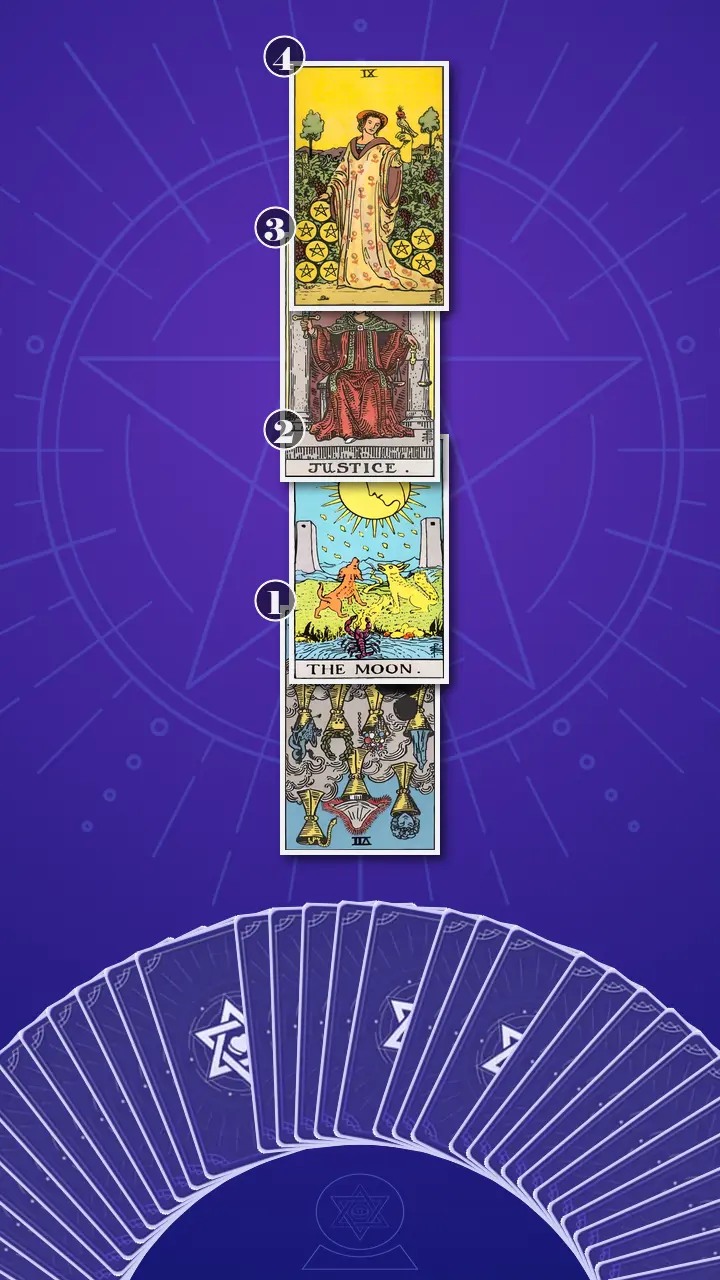
For anyone wondering how tarot works in relationship uncertainty, I chose the Four-Layer Insight Ladder. Maya’s question was about a self-repeating pattern, not about extracting private thoughts from someone else or predicting what would happen between them. This spread is deliberately compact: it moves from visible behaviour, to the hidden mechanism beneath it, to a transforming perspective, and finally to an ordinary action that can make the insight real.
In this reading, the first position would reveal the observable pattern, the way imagined future access was entering Maya’s actual calendar. The second would reveal the root mechanism, the uncertainty being filled with projection. The third would be the transformation layer, the place where evidence, fairness, and self-trust could interrupt the loop. The fourth would translate that shift into a grounded next step that remained worthwhile even if the connection never developed.
I arranged the four cards in a vertical column, like a staircase rising out of fog. We would read upward, pause at the third card where the perspective changed, and continue to the place where clarity could become a choice.
Reading the Map of an Unconfirmed Future
I turned the first card at the bottom of the ladder, where the visible pattern begins. Then I let the image sit between us before I translated its symbols into Maya’s very practical London life.
The Calendar That Became a Forecast
Now turned face-up was the card representing the observable pattern from the diagnosis: Maya drafts and delays real plans around an imagined future with someone she barely knows.
It was the Seven of Cups, in reversed position. In the Rider-Waite-Smith tradition, the card speaks to multiple possibilities, fantasy, wishful thinking, and difficulty choosing. Reversed here, its discernment is blocked and the possibilities have narrowed around one untested relationship storyline. The issue is not that Maya can imagine a beautiful future. The issue is that one attractive possibility has become the default filter for several decisions that already belong to her.
I brought her back to the scene she had described. At 11:40 p.m., one warm message had sent her into Google Calendar. She moved a friend’s dinner, left Saturday deliberately uncommitted, saved an East London exhibition, and began imagining which neighbourhood might suit both of them. The silhouetted figure facing seven cloud-borne cups mirrored her exactly: physically still, phone in hand, while floating future scenes organised the week. The distant castle was not a destination she had reached. It was an imagined shared life being treated as a usable address.
In energy terms, this was a blockage of discernment and an excess of private simulation. Her personal algorithm had treated one promising data point as if it were a complete user-research sample. Each new scenario made uncertainty feel briefly manageable, but the planning did not create one additional piece of mutual knowledge. It only made the possibility more detailed.
I asked her to hear the thought that appeared before each calendar change: ‘If I leave Thursday open, I am prepared. If I confirm it, I might lose the chance.’ Then I placed it beside the factual counterweight: the person had not asked to see her that week.
Maya gave a quick laugh, all edge and no amusement. ‘I have literally done this with my calendar,’ she said. Her shoulders lifted as if she had been caught doing something ridiculous, so I answered before the shame could take over. ‘The pattern is not proof that you are foolish. It is proof that hope has been asked to perform the work of information. A warm message can be real without being a blueprint.’ She looked down at the displaced dinner, then nodded once, with a small wince that told me the recognition had landed.
The Moonlit Route Between Two Towers
Now turned face-up was the card representing the underlying mechanism: uncertainty about the connection is being filled with projection so that future planning can temporarily provide control.
The Moon, in upright position, occupied the root layer. Its traditional meanings include ambiguity, projection, intuition mixed with fear, and movement through incomplete information. It did not tell us what the other person felt. It showed what happens when the available facts are sparse and Maya’s hopes and fears rush in to complete the picture.
I asked her to picture 8:47 p.m. on the Jubilee line toward Canada Water. She had told me that the train brakes shrieked as she scrolled backward through the person’s Instagram Stories. A metal pole felt cold against her hand, the carriage smelled of wet coats, and her phone warmed her palm. She paused on a photograph from a coastal walk and said, ‘Maybe I can work out what this means if I look one more time.’
The Moon’s path between the two towers offered only enough light for the next careful step. Maya was trying to plan the destination, the weekends, and even a possible housing move from a handful of messages and aesthetic fragments. The dog and wolf became two responses I could hear in her story: one part wanted reassurance, while another reacted to the threat of not knowing. The crayfish rising from the dark water was the fear beneath the facts, the fear that an independent plan might close a door she could not reopen.
I used Gatsby’s distant green light as a cultural parallel, carefully rather than romantically. A signal can be real and still become a screen for an entire imagined future when the person behind it remains partly unknown. Maya had enough information for hope, but not enough for the certainty her body was trying to manufacture.
Her thumb stopped moving. She looked through the window of my office instead of at the screen, and her breathing became shallow. After a moment she said, ‘I keep calling it research, but I am really trying to make the quiet spell explain itself.’ I told her that gradual discovery was not a failure of planning. It was the only way a real connection could become known.
When Justice Drew the Line Between Hope and Evidence
The room seemed to grow quieter as I reached for the third card. This was the conceptual focal point of the Four-Layer Insight Ladder, the place where the reading stopped describing the loop and offered Maya a way to step out of it.
The Sword That Asked for Fairness
Now turned face-up was the card representing the key cognitive transformation: separating explicit evidence from inference and evaluating whether Maya was treating her own time, needs, and priorities fairly.
Justice, in upright position, was the antidote. Its scales ask for balance, its upright double-edged sword makes a clean distinction, and its seated figure refuses to let a strong feeling become a substitute for a fair assessment. In card meanings in context, Justice was not coldness and it was not a command to stop hoping. It was an invitation to give direct words, consistent behaviour, mutual initiative, and Maya’s own needs appropriate weight.
I brought her to another ordinary moment: 9:12 a.m. on a Monday in a glass meeting room near Old Street. She had a draft message to her manager asking to swap an office day. The room smelled faintly of coffee and dry-erase marker, and the air-conditioning had pulled her shoulders toward her ears. There was no confirmed invitation, no agreed plan, and no practical reason to move the office day beyond the possibility that the person might be free. Her private line was, ‘I need to be easy to fit into their life,’ before she had asked whether they were making room in hers.
I asked her to open a Notes page and make two columns: What happened and What I added. Under the first, she wrote direct words, confirmed invitations, and repeated mutual initiative. Under the second, she wrote response-time theories, profile-based compatibility, imagined weekends, and the idea that one coastal photograph proved they wanted the same kind of life.
‘I feel strongly about this,’ she said, reading the first column. I placed my finger lightly beside the other one. ‘And here is what you have evidence for.’
This is where I used my signature diagnostic lens, Historical Crossroad Matching. At Cambridge and on archaeological digs, I learned to look at a fracture in context. A broken wall does not tell me that an entire civilisation is doomed; it tells me to inspect which structure was carrying the weight and whether it can be rebuilt on honest ground. When I brought that bird’s-eye view to Maya’s dilemma, the question shifted from How do I preserve access to this person? to Which parts of my life deserve to remain standing even if this possibility never becomes shared?
I also applied my Enduring Value Assessment. A confirmed dinner with a friend, a housing choice based on Maya’s actual commute and budget, or a project she genuinely valued could survive the test of time even if this connection changed shape. A speculative calendar slot might provide short-term relief, but it had not yet earned authority over a real decision.
At 11:40 p.m. on Sunday, with the washing machine thudding through the wall and her phone warming her palm, Maya dragged her friend’s dinner again. Nothing had been cancelled. She was trying to protect a possibility that had never asked for the space, while the fear of closing a door made the gesture feel necessary.
You do not need to put your life on trial for a future that has never been discussed; weigh what is real, choose your next independent step, and let Justice's scales separate reciprocity from projection.
Her fingers stopped above the screen. For a beat, she did not blink; the air conditioner seemed suddenly loud. Then her gaze lost focus as she replayed the postponed dinner, the Rightmove tabs, and the coastal-walk photo. Her jaw tightened. ‘But does that mean I was wrong about all of it?’ she asked, anger flaring briefly before fear took its place.
I answered, ‘No. The feeling was real. The future story was doing a job the conversation had not done yet. We are not putting your hope on trial; we are giving it the right category.’ I set a ten-minute timer. Maya placed direct words and repeated actions in one column, assumptions and imagined scenes in the other. Her shoulders lowered; one hand unclenched, then the other. She released a trembling breath, eyes bright with relief rather than predicted loss. Reflected window light lay across the upright sword. The crossing was small but real: from urgent longing to evidence-based discernment, with a brief dizziness because choice now belonged to her.
I asked, ‘Now, use this new perspective to recall whether there was a moment last week when this insight might have made you feel differently?’
Justice had not told Maya whether the person would return, commit, or disappear. It had changed the status of hope from evidence to possibility. That was the key emotional crossing from fantasy-based control toward independent stability and a present-tense openness in which reciprocity could be seen rather than imagined.
The Garden That Did Not Need a Guest
Now turned face-up was the card representing integration: translating the shift into one personally worthwhile plan that does not depend on the connection developing.
The Nine of Pentacles, in upright position, brought the reading down into earth. Its cultivated vineyard, ripe pentacles, and hooded falcon show autonomy as something tended over time, not isolation as a punishment. The card asked Maya to make a plan because it improved her actual life, not because it preserved a theoretical opening.
I connected the image to a postponed Saturday invitation in her flat’s WhatsApp group. Maya could confirm dinner, book the class she wanted to try, accept a work opportunity that fit her real schedule, or choose a neighbourhood because it served her commute and budget. If the person later offered a clear plan, she could answer from a full calendar rather than an empty slot. Independence would not reject connection. It would give mutuality somewhere solid to appear.
The energy had moved from the water-heavy cups and moonlit path to Justice’s clarifying air and the Nine of Pentacles’ grounded earth. Fire was still absent from the spread, which told me that Maya did not need another dramatic declaration. She needed one modest present-tense action to replace rehearsal.
I returned to the Saturday message. Maya pulled on her coat, confirmed the time, and walked toward the bus through rain that smelled metallic on the pavement. She told me, ‘This evening is still mine even if nothing else is decided.’ Her posture softened, though she kept one hand around her phone. That detail mattered. She was not pretending uncertainty had vanished. She was refusing to let uncertainty empty the evening.
I said, ‘Your life does not need to stay on hold to stay open.’ She gave me a steadier smile this time, one that held both hope and the relief of no longer having to prove hope through sacrifice.
The Calendar That Could Stand on Its Own
When I gathered the cards into one story, the sequence was clear. The reversed Seven of Cups showed the visible pattern: one imagined relationship had become the organising principle for confirmed dinners, work decisions, leisure, and even housing research. The Moon revealed why the pattern persisted: incomplete information created a physical pressure to fill the blank space, and planning provided a short-lived sense of control. Justice introduced the needed distinction between explicit words and private inference. The Nine of Pentacles gave that distinction a physical form through a life cultivated for Maya’s own reasons.
The cognitive blind spot was not simply that Maya imagined too much. It was that she believed keeping every opening available was protecting the connection. In practice, it was protecting her from having to feel how undefined the connection remained. The cost was quieter but real: keeping every door open had begun to close her out of her own week.
The transformation direction was therefore not from romance to rejection. It was from urgent longing and fantasy-based control to evidence-based discernment, self-directed stability, and openness to reciprocal connection. The practical question became simple: before changing a plan for this person, could Maya separate what had explicitly happened from what she had added, then choose an option that still served her if the connection did not develop?
These were the next steps I gave her as actionable advice, small enough to begin without turning self-observation into another exhausting research project.
- The Two-Column Reality AuditAfter the next warm or ambiguous message, open a phone note titled What happened / What I added. Spend no more than ten minutes writing three plain facts in the first column and every prediction, compatibility story, response-time theory, or imagined future scene in the second. Before changing any calendar plan, wait ten minutes and make sure the decision is not based only on the second column.If writing feels clinical, treat it like a product-design field note, not a verdict about your feelings. Use the minimum version of one fact and one wish. For a non-urgent cancellation or schedule swap, place it in a 24-hour Maybe Hold.
- The Time Stratigraphy ExerciseWhen a message tempts you to move an office day, delay dinner, or filter a Rightmove search around this person, spend three minutes evaluating the choice strictly from the perspective of your ten-year future self. Ask which option would still look valuable if the connection never became mutual, and which option is only offering short-term relief from uncertainty.Keep the exercise brief and concrete. Write one sentence beginning, Ten years from now, I am glad I protected... Use it to dissolve trivial anxiety, not to make a dramatic life decision or pretend the future is knowable.
- The One Plan That StaysBy Wednesday, confirm one two-hour plan that would improve your real week without the connection: send your friend a specific Thursday time and place, book the museum ticket, attend the pilates class, or accept the work opportunity that fits your actual schedule. Give the plan a physical footprint by making the reservation, buying the ticket, or laying out what you need.If guilt says commitment makes you unavailable, remember that availability is not a debt owed to a possibility. If the person later makes a direct invitation, answer from your real calendar. Let direct communication, consistency, and mutual initiative earn their place.
I reminded Maya that this was not a rule for what she must feel or a test of whether the relationship was worth pursuing. It was a fair threshold for what gets to reorganise her life. The Four-Layer Insight Ladder had turned a vague romantic question into a sequence she could observe: fact, projection, fairness, and choice.
A Week Later, the Small Proof
Three days after the reading, I received a WhatsApp message from Maya. She had made the two columns after another warm exchange, left Thursday dinner where it was, and sent her friend a concrete time instead of another maybe. She wrote, ‘Nothing became magically certain. I just noticed that the person had sent one nice message, while my friend had actually made a plan with me.’
She slept through the night, but her first waking thought was still, ‘What if I am wrong?’ This time she smiled, kept the dinner, and made coffee before checking her phone.
That was the proof I wanted, not a romantic outcome but a small return of authorship. Maya had not solved the relationship. She had made one independent choice, allowed the connection to reveal itself through present-tense information, and discovered that staying open did not require staying empty.
I did not give Maya a future. I helped her see the difference between furnishing a home that existed only on a floor plan and tending the rooms she already lived in. Finding clarity was not the disappearance of uncertainty. It was the moment uncertainty stopped being allowed to write every line of her calendar.
When a warm message leaves your chest buzzing and your thumb hovering over the calendar, it can feel safer to hold your life open than to face how little of the future has actually been shared. Noticing that difference is already a gentle unhooking.
If you gave one plan this week the same care you have been saving for the possibility, what might you let belong to you first?