Three Question Marks in a Job Spreadsheet, Then a 30-Minute Task Test

The Golden-Handcuff Career Drift at 11:40 p.m.
I met Jordan (name changed for privacy) through a late-evening video call from their Toronto apartment. On the desk beside them, three job tabs glowed next to a colour-coded Google Sheet. The radiator clicked. A half-finished coffee sat cold near the keyboard. Under salary, health coverage, RRSP matching, title, and remote days, every cell had been filled to the last dollar. Under Would I want to do this on a Tuesday?, there were three question marks.
"I can explain why the package is good more easily than why I want the job," Jordan told me. "The offer looks right until I picture an ordinary Tuesday."
I watched their jaw tighten as they moved their cursor back to the benefits column, as if one more adjustment to the spreadsheet could settle the question. Their shoulders were raised almost to their ears. The tension had the physical weight of carrying a packed suitcase through a subway station after the last train has already left: not dramatic enough for anyone else to notice, but exhausting when it is yours.
I said, "It is not that perks do not matter. Toronto rent, health support, savings, and breathing room are real. But measurable safety has received a full investigation while interest has been left as an untested hunch. You can explain the package; you still have to live the Tuesday."
Jordan looked down at the three question marks. "I keep treating interest like a luxury instead of information."
I let that land before I answered. "Then our journey is not about forcing you to choose meaning over security. It is about making a map for career fit versus salary, so you can distinguish a real need from the fear that every less-polished package is a mistake."

Choosing a Compass for Career Fit
I asked Jordan to take one slow breath, hold the question in plain language, and let their hands shuffle the deck. I use that small ritual as a transition into attention, not as a promise that cards will dictate a future.
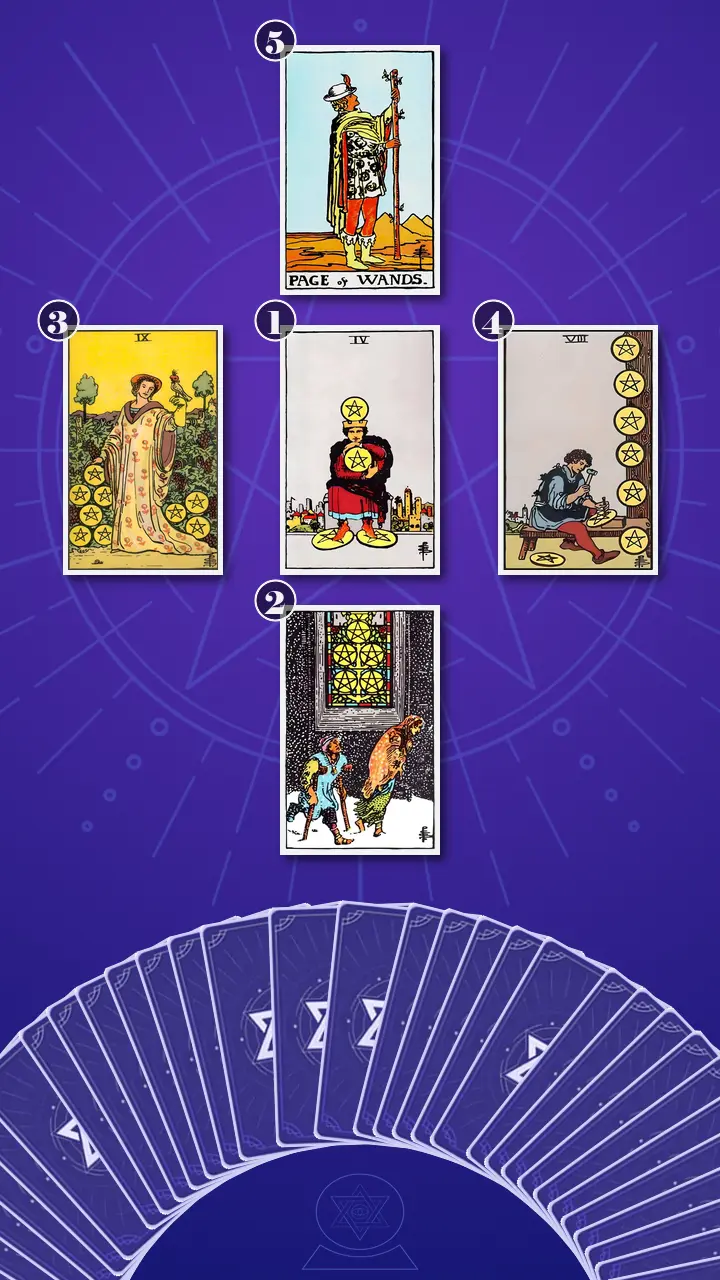
I chose the Five-card Shadow Spread, a focused career tarot spread for golden-handcuff career drift. It fit because Jordan was not choosing between two final offers; they were asking why the same compensation-over-fit pattern kept repeating. This layout traces the visible habit, the fear beneath it, the protection it provides, the neglected quality that can be reclaimed, and one grounded next step.
In this reading, the centre card would show the package-driven career choice in everyday life. The card beneath it would name the scarcity fear supplying that pattern. The card to the right would show how daily work, skill development, and lived engagement could become real evidence. The top card would point us toward a reversible experiment, not a resignation letter.
The Coins Held Too Close
The Pattern That Looks Like Good Research
I turned the first card. "This is the card representing the observable pattern of assigning decisive weight to salary, benefits, title, and flexibility while leaving interest in recurring work underexamined." It was the Four of Pentacles, upright.
I pointed to the figure gripping one pentacle against their chest, balancing another on their crown, and standing with two more beneath their feet. "This is Earth energy in excess. Compensation is pressed against the heart as reassurance. Title sits on the head as proof of progress. Benefits pin the feet in place, so movement begins to feel unsafe."
I connected the image to the scene Jordan had shown me: at 11:40 p.m., the compensation sheet stays in the foreground while the writing-heavy application and sample task wait untouched in another tab. The spreadsheet offers control, but it also makes the actual responsibilities background detail. I could almost hear the private rule underneath it: If I can defend this choice in numbers, I will not have to defend wanting it.
Jordan gave a short, bitter laugh and rubbed a thumb along the edge of their mug. "That is so accurate it is almost rude."
"It is not a criticism," I said. "The Four is showing a protection strategy. The question is whether protection has become restriction. You have been buying the comfortable seat on the train before checking whether that train goes where you want to spend your weekdays."
The Forecast Beneath the Numbers
I turned the card directly below it. "Now I am looking at the card that reveals the underlying fear that choosing fewer perks could create material exposure, lost progress, or regret that would undermine your sense of safety." It was the Five of Pentacles, upright.
The two figures move through snow beneath a lit window. I told Jordan, "This card does not say that a lower salary or thinner benefits package will leave you stranded. It shows the mind rehearsing that outcome so vividly that its forecast starts to feel like current fact."
I asked them to remember the research-focused role they had recently bookmarked. Jordan described seeing the lower range, then immediately opening a cost-of-living calculator and their banking app before reading the duties. Toronto rent, TTC costs, savings, insurance, lost momentum, and imagined disappointment had arrived in one breath. The unspoken sentence was clear: If I take less and the work still disappoints me, then I gave up security for nothing.
The Five of Pentacles showed a blockage, not a verdict. Its energy was contracted around an anticipated loss. I said, "A realistic budget may tell you that a role does not meet your needs. That is useful evidence. But a scarcity forecast that treats every reduction as exposure before you have checked the numbers is not the same thing. Practical needs deserve a floor, not unlimited veto power."
The Freedom Jordan Was Trying to Protect
I moved to the left-hand card. "This position clarifies the legitimate protective payoff of the pattern: preserving autonomy, comfort, professional credibility, and relief from uncertainty." The card was the Nine of Pentacles, upright.
The garden on the card was cultivated, not accidental. The falcon rested on a gloved hand: freedom was present, but carefully managed. I could see Jordan's shoulders lower slightly when I named what the perks actually meant. When a recruiter offered comprehensive coverage, flexible remote days, a clear promotion path, and a polished title, Jordan was not chasing luxury. They were protecting health support, independence, and the stable adult life they had worked hard to build.
"The answer is not to romanticise a pay cut or pretend that meaningful work should cost you your wellbeing," I said. "The Nine of Pentacles validates enough. What it questions is over-control: allowing only desires that can be contained inside a perfect-looking package."
I thought of my former life on Wall Street, where people often mistook a high number for a complete answer. A strong package can feel like the polished exterior of The Devil Wears Prada: impressive from a distance, yet unable on its own to tell you what it is like to organise your ordinary days around the work inside it. LinkedIn's "Thrilled to announce" posts make that external scorecard even louder.
When the Workbench Took the Lead
The Craft Jordan Could Actually Test
The room seemed to quiet as I turned the fourth card. "This is the card representing the quality you can reclaim by evaluating opportunities through recurring tasks, skill development, and lived engagement rather than package strength alone." It was the Eight of Pentacles, upright, the bridge card in this reading.
I held the contrast beside the Four of Pentacles. In the Four, coins immobilise the body. In the Eight, an artisan uses their hands to make them. "This is Earth energy in balance," I said. "Value is no longer something you clutch around a job. It is something you develop through the work. Perks describe the conditions around the work, not your relationship with the work."
I asked Jordan to picture a bookmarked research-and-writing role at 10:30 on an ordinary Tuesday: extracting sources, synthesising a short argument, writing a draft, revising it after feedback. Instead of scoring the title, they could spend thirty-five minutes on a private mock brief and notice what happened to their attention, their energy afterward, and their willingness to improve the skill once more.
In my mind, I saw the old decision matrices I had once trusted too much. I call this Sunk Cost Neutralization: separating what has already been invested in a stable identity, a respected title, or a well-earned package from what a future workday will actually require. Jordan did not need to make their past choices wrong in order to collect new evidence. The Eight of Pentacles gave them permission to stop asking a future role to repay every past sacrifice before they had even tried its central task.
At 11:40 p.m., Jordan's spreadsheet had every dollar and remote day scored while the Tuesday-work column still held three question marks. With every recalculation, the package had looked clearer; the life inside it had not. I could see how exhausting it was to demand a complete answer before allowing a first experiment.
You do not need to prove a role is valuable by stacking its benefits; let the Eight of Pentacles' workbench show whether you want to practice the work itself.
Once your material floor is covered, perks tell you what surrounds a job; practice tells you whether you want the life inside it.
Jordan's inhale stopped halfway. Their fingers hovered above the desk, then went still. For a few seconds, their eyes lost focus, as though they were replaying every Monday task list they had dismissed because the package was objectively good. Their brow pulled tight. "But does that mean I was wrong before?" they asked, with a flash of anger that surprised neither of us.
I kept my voice level. "No. It means you used the information and protection available to you. The question now is whether that information is sufficient for the next choice." Their eyes brightened at the edges. Their hands slowly unclenched. A long breath left their chest, and their shoulders dropped, though the openness seemed to leave them briefly unsteady, as if setting down a heavy bag had revealed how much space their arms no longer knew what to do with.
I asked, "Now, with this new view, can you think back to a moment last week when this insight might have let you feel differently?"
Jordan looked at the unfinished application tab. "I might have tried the research task before deciding the salary made it irresponsible."
That was the shift I wanted them to hear in their own voice: not from financial caution to recklessness, but from perk-led security and analysis paralysis toward grounded career choice based on lived practice. Once the floor is covered, practice becomes evidence.
The Small Flame Above the Spreadsheet
I turned the final card. "This card turns the shift into a reversible next step by inviting a realistic trial of the desired work before another package-led decision." It was the Page of Wands, upright.
The Page studies a sprouting wand in an open landscape. After four Pentacles cards, this was the first Fire in the spread. Its energy was not a demand for certainty or a command to quit. It was a small, mobile spark of curiosity.
"This is like putting a twenty-five-minute task test between two ordinary calendar events," I told Jordan. "You do not have to know whether this is your next career. You only need to notice what happens when you try the work."
The Page's invitation was simple: schedule one evening to simulate a representative task, ask a trusted practitioner what fills a normal Tuesday, and record the result without treating the experiment as a career declaration. Curiosity can be a test without becoming a resignation letter.
A Floor, a Workbench, and a Third Option
I gathered the spread into one clear story. The Four of Pentacles showed Jordan using package data as a protective grip. The Five showed why: a lower range was being translated into a full forecast of exposure and regret. The Nine reminded us that the wish for autonomy, health coverage, and breathing room was legitimate. Then the Eight changed the relationship with value itself, and the Page made exploration small enough to begin.
The cognitive blind spot was not caring too much about security. It was treating all desirable perks as safety requirements, while treating direct evidence about daily work as optional. I offered a Floor-Then-Fit Decision Rule: define the material baseline first; only then compare qualifying roles by the tasks, learning, and sustainable attention they ask of you.
I also used my 3rd-Option Leverage Test. Jordan had been trapped between two false choices: keep the strongest package and feel flat, or take a frightening leap toward interesting work. Over seventy-two hours, I asked them to look for a third path: maintain the current stability while gathering specific, bounded practice evidence. It converted an all-or-nothing career story into a decision process with leverage.
- Set the material floor.This week, I asked Jordan to take twenty minutes at their kitchen table with bank statements or a budgeting app and write two lists: required-for-stability income and benefits, and valuable-above-the-floor extras. I asked them to include essential costs, debt, health needs, accessibility needs, dependants, and the buffer that genuinely matters.Treat this as a current planning boundary, not a permanent vow. If twenty minutes feels heavy, start with take-home pay, essential monthly costs, and benefits you actually use.
- Run an Ordinary Tuesday Test.At home or in a library this week, I asked Jordan to open one bookmarked role, extract three recurring-task verbs such as research, interview, synthesise, write, analyse, or edit, and run one private twenty-five-to-forty-five-minute simulation using public information.When the timer ends, log four things in your phone: attention held, energy after, frustration type, and whether you would willingly improve the skill once more. A fifteen-minute version still counts.
- Map the third option for seventy-two hours.I asked Jordan to write Option A, keep the current well-packaged role, and Option B, pursue the interesting role as an immediate irreversible leap. Then I asked them to design a third path: keep the current role while completing one task test, sending one low-pressure message to a trusted practitioner, and using the evidence in the next job comparison.Put an exit line in the calendar event: "This ends when the timer ends; no career decision follows today." The purpose is information, not a dramatic announcement.

A Week Later, the Quiet Proof
Six days later, I received a message from Jordan. They had completed a thirty-minute research memo after dinner, between a grocery order and a call with a friend. They had also checked their actual baseline. The role was still less lucrative than their current job, and the uncertainty had not vanished, but it no longer filled the whole screen.
"I still opened the salary calculator afterward," they wrote. "But I also noticed I wanted another pass at the brief. That feels like data."
I read that line and thought of the Eight of Pentacles again: hands at a workbench, making rather than gripping. Jordan had not solved their career in a week. They had made the first small move from defensible security toward lived fit, with enough material clarity to let curiosity breathe.
I did not hand Jordan a destiny. I helped them build a more honest decision process, and they supplied the evidence. That is how tarot works at its most useful: not as a verdict about what must happen, but as a structured way to notice what your own habits, body, values, and choices have been trying to tell you.
I want to leave you with this: when a strong package makes your shoulders drop for a moment but the Tuesday tasks make your whole body feel heavy, it can seem safer to call the perks proof of progress than to risk wanting work that may not justify the trade.
If your material floor could stay intact while curiosity remained only an experiment, which ordinary task would you be interested to try once and notice for yourself?