The 9:18 p.m. LinkedIn Spiral
When Jordan sat down with me, I recognized the pattern immediately: if you keep opening a fresh life-plan document after birthday dinners, reunion drinks, or group chat announcements because everyone else suddenly sounds more certain than you do, that is comparison fatigue, not random overthinking.
She told me about 9:18 p.m. on a Tuesday in her small downtown Toronto apartment: she was sitting cross-legged on the couch with LinkedIn open, a Notes app titled ‘maybe next steps,’ and a half-finished slide deck abandoned on her laptop. The room was washed in cold blue phone light, the fridge hummed in the background, and leftover takeout on the coffee table smelled faintly sweet and oily. One friend’s relocation post had sent her tapping from her own profile to job listings, then to course pages, then to a private mental tribunal where every choice she had made suddenly looked flimsy.
“I was fine until I saw that post,” she said. “Why does everyone else sound so certain?”
What she described was not vague anxiety. It was a body-level jolt: a stomach-drop like an elevator missing its floor, a chest pulled tight as laces, and hands that kept reaching for the phone as if the screen might issue a more flattering sentence. The contradiction was painfully clear. She wanted to stay committed to her own path, but every friend’s big update felt like proof she had chosen wrong.
I told her gently, “You were fine until the post because the post hit a wound, not because your path disappeared.” Then I leaned in a little and added, “We are not here to put your life on trial. We are here to draw a map through the fog and find some clarity.”

Choosing the Bent Bridge: A Horseshoe Spread for Comparison Anxiety
I asked her to put both feet on the floor, take one slow breath, and hold a single question in mind: how do I stop questioning my path after every friend’s big update? Then I shuffled the cards slowly. For me, this is how tarot works best in moments like this—not as a machine for prediction, but as a way to sort signal from noise and give shape to what is already happening in the psyche.
I chose a seven-card Horseshoe tarot spread for comparison anxiety and life path doubt because it holds exactly the right amount of complexity. It separates the old conditioning from the present symptom, the hidden wound from the blind spot, the social trigger from the remedy, and then shows the direction that becomes possible once the remedy is practiced. In other words, it lets the reading travel in the same arc as the problem itself: milestone comparison spiral, then deeper belonging pain, then a way back to self-authored standards.
As I laid the cards in a gentle arc, like a bent bridge settling into place, I told her what mattered most in this layout. The first card would show the earlier validation script that taught her to read visible milestones as proof of being on track. The third would uncover the deeper fear underneath the planning frenzy. The sixth—the key card—would offer the actual corrective, the attitude that could interrupt the spiral before it took over. The seventh would show what finding clarity might look like when it stopped depending on public timing.
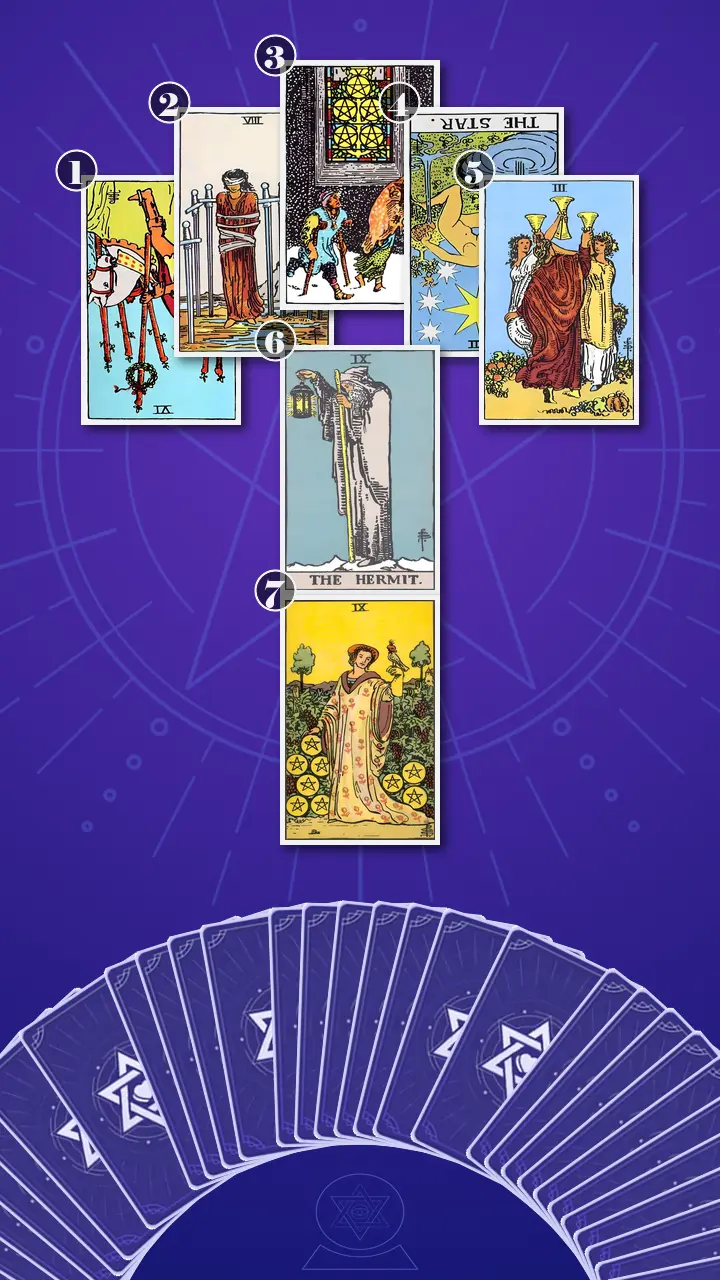
Reading the Arc of Feeling Behind After Friends’ Updates
Position 1: The Applause Script You Inherited
I turned over the card representing the earlier validation script that taught Jordan to read visible milestones as proof of being on track. It was the Six of Wands, reversed.
This card could not have been plainer. In modern life, it looks exactly like treating a polished LinkedIn headline, an engagement carousel, or a big announcement post as stronger evidence than the quiet work already happening in your real days. Jordan had learned, somewhere along the line, to trust the laurel wreath more than the road beneath her feet. In energetic terms, this was a deficiency of steady self-recognition and an excess of dependence on applause. Progress only felt real when it looked legible to a crowd.
Years spent around ruins have taught me that history over-preserves spectacle. We find the triumphal arch, the inscription, the victory coin. Much of the patient, sustaining labor that actually held a civilization together leaves subtler traces. Looking at this card, I found myself thinking exactly that: Jordan was ranking her life by what would survive as a headline, not by what was quietly working.
I told her, “This is what happens when someone else’s public billboard starts functioning like a report card for your private life.” She gave a short laugh with a bitter edge to it and said, “That feels accurate enough to be rude.” Her fingers tightened around her mug, then loosened.
Position 2: The Cage That Calls Itself Strategy
I turned over the card representing the current symptom from her diagnosis: the immediate comparison spiral and path-questioning that followed a friend’s big update. The card was the Eight of Swords, upright.
This was the Tuesday-night couch scene almost frame for frame: LinkedIn open, Instagram open, job tabs multiplying, a Notes app filling with drastic options, while the original task lay untouched. No external emergency had happened. Nothing in her actual life had changed. But the mind had built a ring of swords and then mistaken the cage for a command center. This is blocked air—thought circling so fast it feels like motion, while real movement stops.
I said, “This is having twenty-seven browser tabs open and calling it clarity. It is doomscrolling crossed with panic-planning. Research can feel like control when what you actually need is contact with your own evidence.”
She winced first, then nodded. “I tell myself I’m being strategic,” she said. “But really I’m trying not to feel left behind.” Her gaze dropped to the table, and one restless thumb moved against the edge of her phone case exactly as if the card had caught her in the act.
Position 3: The Warm Room You Fear You Missed
I turned over the card representing the deeper fear beneath the psychological mechanics: the wound around worth and belonging that comparison activates. It was the Five of Pentacles, upright.
Here the reading went colder. Beneath the overanalysis was not merely ambition, nor indecision, nor even classic career pivot anxiety. It was the fear of being the one without a believable proof-of-life update. In modern terms, this card is the TTC ride home after a birthday dinner when everyone else’s promotions, engagements, relocations, and grad school news start sounding less like facts and more like invitations to a warm room you did not get into first. Energetically, this is a deficiency of felt belonging. The scarcity is emotional before it is practical.
I told her, “This is not even about the promotion anymore. It is the feeling that adulthood came with a lit window and everyone else seems to have reached it before you.”
Her whole posture changed in three small steps. First, she went still. Then her eyes unfocused, as though she were replaying an old train ride home in her head. Then her mouth softened and she let out a quiet breath through her nose. “Yes,” she said, barely above a whisper. “That’s the part I don’t usually say out loud.” There was a brief shine in her eyes that she did not try to hide.
Position 4: When Quiet Evidence Gets Thrown Out
I turned over the card representing the blind spot that keeps the cycle going: losing faith in Jordan’s own pace and evidence when comparison hits. The card was The Star, reversed.
This is one of the most painful blocks in readings like this because it hides inside the language of self-improvement. Nothing was wrong until something louder appeared. The routine that was helping, the meaningful work, the growing skill, the steadier energy, the better boundaries—none of it suddenly became false. But in the shockwave of comparison, Jordan stopped trusting quiet evidence because it was not dramatic enough to serve as proof. The energy here is blocked replenishment. Hope leaks out; spectacle takes over.
I said, “If one post can erase your sense of progress, the problem is not that your path vanished. The problem is the measuring tool. Not every urge to reinvent yourself is intuition; sometimes it is comparison in a blazer.”
That line landed. She gave one long exhale and leaned back for the first time since we began. “I’ve done that,” she admitted. “Built a whole new five-year plan at midnight just because somebody else made their life sound cleaner.” There was shame in the sentence, but less of it than before—more recognition than self-attack.
Position 5: The Toast, the Group Chat, the Trigger
I turned over the card representing the external influence: social celebrations, announcements, and peer visibility. It was the Three of Cups, upright.
I was glad to see this card upright, because it reminds people that the social world is not the villain. This is the ordinary scene that lights the fuse: the engagement post, the birthday dinner catch-up, the relocation announcement, the launch party, the group chat full of congratulations that somehow leaves you feeling lonelier. The card is balanced in itself—friendship, shared joy, community—but it becomes a catalyst when an old wound hears celebration as evidence against the self.
I told her, “Your friends’ joy is not the problem. This card simply shows where your unfinished questions get amplified. It is that moment of, ‘I’m happy for them, so why am I suddenly auditing my whole life?’”
She nodded at once. “Group chats,” she said. “Especially when everyone piles on with heart emojis and ‘so proud of you.’ I’m genuinely happy, and then five seconds later I’m wondering what I would even say if someone asked what’s new with me.” The defensiveness in her face softened after that. There is relief in realizing you do not have to blame your friends to name the trigger honestly.
When the Hermit’s Lantern Outshone the Feed
Position 6: The Antidote
When I turned the sixth card, the room seemed to change temperature. Outside, the late light had thinned into a soft Toronto grey, and the small lamp on my table suddenly mattered more than the city beyond the window. This was the card representing the key shift from the transformation framework: returning to an inner measure before reacting. The card was The Hermit, upright.
The Hermit is often misunderstood as withdrawal for its own sake. Here, it was something far more practical. In modern life, it looks like closing the apps, taking a solo walk, standing in an office stairwell, or sitting with one notebook and asking what your actual evidence says about fit, energy, growth, and the next true step. The lantern is small on purpose. It does not promise the next five years. It shows one honest step. In energetic terms, this is balance restored through reflective distance, discernment, and self-trust. It is airplane mode for your self-trust. It is closing the algorithm and reopening your own dashboard.
The Core Artifact Beneath the Feed
At this point, I used one of the lenses I rely on most from my life in archaeology. I call it Core Artifact Excavation. On a dig, the top layer is always the noisiest—recent footprints, loose debris, weather, whatever the last crowd left behind. That layer tells me what just happened, but not what endures. Social media is exactly like that: all surface layer, all fresh dust. The Hermit asks a different question. Beneath the noise, what artifact of self is still intact and worth building from—your values, your real stamina, your meaningful work, your slowly grown competence?
I looked at Jordan and said, “You know that moment when you were doing fine, then one polished update lands, your chest tightens, your hand reaches for the phone again, and suddenly you are acting like your whole life needs a same-night review?”
I let the question hang for a beat, then continued, “A public milestone can trigger you without telling the truth about you. Your path stops collapsing under other people’s timing when you stop using visibility as the test of worth.”
You do not need the crowd’s applause to prove you are on track; step out of the noise and let the Hermit’s lantern show your next honest step.
Jordan did not melt into relief immediately. Her reaction came in a full chain. First, her breathing caught. Then her eyes drifted past me, unfocused, as if she were watching half a dozen scenes replay—the startup kitchen, the couch, the watery oat latte, the Notes app graveyard. Then the resistance arrived, quick and hot. “But if that’s true,” she said, “doesn’t that mean I’ve been letting random posts grade my life?”
I answered her the only way I know how: plainly, and without shame. “Not random posts. An old wound with very modern packaging. A public update is not a verdict on your private worth. And this does not mean you were foolish. It means you were borrowing the crowd’s measuring stick because you were scared your own might not count.”
Something in her face gave way after that. Her shoulders dropped a full inch. One hand came off her phone and settled in her lap. She let out a breath that sounded almost like surprise, the kind that follows release but carries a flicker of dizziness with it. Clear paths can be unnerving too; they hand responsibility back.
I asked her, “Now, with this in mind, think back over the past week. Was there a moment when this would have changed the temperature of the room for you?”
She nodded slowly. “Sunday,” she said. “Coffee shop. I was okay until I saw three updates in a row. Nothing was wrong until something louder appeared.”
That was the real threshold. Not perfect certainty. Not a cured nervous system. Just the first living inch of movement from comparison-triggered path doubt to grounded self-trust in her own pace.
I made the insight concrete before the moment could evaporate. I had her place her phone face down and open one private note called ‘evidence that still counts offline.’ I asked for three lines only: one thing she was building, one thing that had grown, and one thing that felt more solid than it did six months ago. Then I told her to place a 24-hour hold on any plan that had been born inside the trigger window. Even one line, I reminded her, still counted.
Position 7: The Garden After the Noise
I turned over the final card, the one showing the integrated direction that could emerge if Jordan practiced this stance consistently. It was the Nine of Pentacles, upright.
This card is what happens when success stops needing a reveal post. In modern life, it looks like being able to name what you have actually built—skills, discernment, savings habits, creative range, better boundaries, stronger judgment—without needing a dramatic headline to convert any of it into reality. The energy here is grounded balance. Self-worth becomes cultivated rather than crowd-certified.
I told her, “This is quiet career capital. This is a garden you can actually live in, not just a reveal post for the internet. Let satisfaction come from what is sustainable, not just what is announceable.”
She smiled then, small but real. Not triumphant. More like someone recognizing a room she had been standing beside all along.
The Stratigraphic Review and the Next 48 Hours
When I looked at the full Horseshoe spread, the story it told was remarkably coherent. Jordan was not failing to choose a path. She was living inside an old validation empire that had taught her to confuse visibility with value. A friend’s milestone lit up that old script, the mind sprinted into an Eight of Swords spiral, the deeper Five of Pentacles wound whispered that she might be the one left outside, and The Star reversed made her discard quiet evidence the moment something louder appeared. The blind spot was not lack of ambition. It was the habit of treating public timing as stronger evidence than lived fit.
From where I sat, this looked less like a broken life and more like a historical transition. Entire eras collapse because the old measures stop telling the truth, yet people keep obeying them for a while out of habit. Jordan’s transformation direction was exactly that kind of epoch shift: away from public-proof anxiety and toward a values-based measure of fit, energy, and steady growth. The Hermit did not ask her to become less ambitious. It asked her to stop outsourcing vision to other people’s visibility.
So I gave her a practical framework, including a stripped-down version of my own Stratigraphic Review—a way to separate passing cultural pressure from foundational values before she made any move.
- The Lantern PauseThe next time a promotion, engagement, move, or launch post hits, put your phone on Do Not Disturb for 7 minutes before opening LinkedIn, Instagram, a Notes doc, or any planning app. Walk one block, pace the hallway, or stand in the office stairwell and ask: ‘What changed in my life, and what only changed on my screen?’If 7 minutes feels dramatic, do 2. The goal is interruption, not enlightenment. No major decisions in the first trigger window if you can help it.
- The 24-Hour No-Rewrite RuleIf the urge to edit your résumé, sign up for a course, apply for a job, or declare a life pivot begins right after someone else’s post, wait 24 hours. During that hold, list three quiet signs your current path is still teaching you something real: one skill growing, one source of energy, one point of stability.This is not a ban on change. It is a filter for separating signal from adrenaline. If the idea still feels true tomorrow, revisit it with a clearer head.
- The Stratigraphic ReviewOn Friday evening or Sunday afternoon, spend 20 minutes with a private note split into two columns: ‘Surface Noise’ and ‘Foundation.’ In Surface Noise, write the timelines, titles, apartments, cities, and milestones currently pressing on you. In Foundation, write five wins nobody saw: one skill, one boundary, one work contribution, one financial or practical win, and one thing you handled with more maturity than last year.Keep it offline-facing on purpose. Private progress becomes more believable when your nervous system learns that recognition does not have to become content to become real.

A Week Later: Quiet Proof
A week later, Jordan sent me a message from a coffee shop in Queen West. A friend’s engagement carousel had appeared, and yes, the old body response still arrived right on schedule—the dropped stomach, the tightening chest, the hand moving toward the phone. But this time she caught it. She did the Lantern Pause, wrote two lines in ‘My Actual Evidence,’ and returned to the strategy deck she had meant to finish. Clear, but still vulnerable: she told me the next morning her first thought was, “What if I’m still getting it wrong?” and then, for the first time, she smiled at the question instead of obeying it.
I thought then what I often think when a foundation line finally emerges from the soil of a dig: clarity is rarely a trumpet blast. More often, it is the quiet recognition of what still stands once the loose debris is brushed away. That was the gift of this Horseshoe tarot spread for comparison anxiety and life path doubt. It did not hand Jordan a better performance. It handed her back her authorship.
When one polished update can make your chest tighten and your whole path suddenly feel flimsy, what hurts is rarely just envy. More often, it is the fear that if your progress is not easy to announce, maybe it does not count. If you gave yourself one Hermit-sized pause before turning someone else’s news into a verdict on your life, what quiet piece of evidence about your own path would you want your lantern to notice first?
This story is adapted from psychological research, written so that those in a similar struggle can see their own pattern in it — and find their next step clearly.These insights are not a substitute for professional psychological, medical, legal, or financial advice.
Learn more about our Journey to Clarity.
How did this insight land for you?
🫂 This Resonates Deeply
🌀 Living This Story
✨ Now I See Clearly
🌱 Seeing New Possibilities
🧰 Useful Framework
🔮 The Confirmation I Needed
💪 Feeling Empowered
🚀 Ready for My Next Step
Author Profile
 AI
AI“Having spent a lifetime at Cambridge and on archaeological digs, I’ve witnessed the rise and fall of countless civilizations. Please know that your current struggles are not a permanent fate, but merely a necessary fracture before rebuilding. I won't lecture you; instead, I invite you to sit with me in the ruins, using a patient, historical perspective to gently dust off the true, enduring value hidden beneath your temporary doubts.”
In this Direction Tarot Reading :
Core Expertise
- Historical Epoch Analogies: Comparing your current life transition to macro-historical shifts, contextualizing your profound loss of meaning.
- Core Artifact Excavation: Identifying the immutable principles and core values that must survive the collapse of your old trajectory to guide the new one.
Service Features
- The Stratigraphic Review: A structured weekend exercise separating passing societal trends from your foundational life values, establishing a robust anchor for your future.
Also specializes in :
Explore Related Patterns:
Comparison TrapJordan's 9:18 p.m. LinkedIn spiral starts with one relocation post and turns into profile checking, job tabs, course pages, and a private trial of every choice she has made. The same path that felt workable minutes earlier becomes suspect because the reference point has shifted from lived evidence to a friend's public milestone. That is the mechanics of Comparison Trap: someone else's visible update becomes the measuring device for your private life. You are not simply noticing a friend's news; you are letting visibility, timing, and group applause override the quieter data of your own growth. The useful audit is not whether your friend's milestone is good or bad. It is whether your mind is using their update as information about their life, or as a verdict on yours.
Milestone IdealizationJordan keeps treating the polished update, the engagement carousel, the relocation post, and the public headline as if they carry more proof than the work happening in her ordinary days. Her attention moves toward what can be announced, displayed, and congratulated, while slower forms of competence become easy to dismiss. Milestone Idealization works by inflating visible life markers into evidence of correctness. You start reading other people's announcements as if they prove certainty, maturity, or arrival, even when they only show one edited surface layer of a much larger life. In Jordan's case, the distortion is not envy by itself. It is the cognitive bias that makes announceable progress feel more real than sustainable progress, which is why her own path starts looking flimsy every time someone else's looks clean.
Purpose OutsourcingJordan's path starts collapsing when other people's visibility becomes the thing that defines what direction should mean. A relocation post, a group chat update, or a clean-sounding milestone does not merely make her curious; it hands her a borrowed measuring stick and asks her to grade her life with it. Purpose Outsourcing happens when your inner compass gets replaced by external timing, status cues, and other people's certainty. You may still be making plans, but the agenda is being drafted by comparison rather than by fit, stamina, values, or actual evidence. The key detail is that Jordan does have evidence of growth. The pattern begins when she stops treating that evidence as authoritative and lets the feed become the boardroom for her future.
Conditional Self-WorthJordan's private progress loses authority the moment a louder public update appears. The routine that was helping, the meaningful work, the growing skill, the steadier energy, and the better boundaries do not disappear; they simply stop feeling like enough because they are not formatted as public proof. Conditional Self-Worth is the belief structure underneath that shift. You begin to feel that your progress counts only when it can be seen, named, applauded, or translated into a headline other people understand. The pattern is especially painful because it can hide inside ambition. It tells you to keep improving, but the real contract is stricter: if the progress cannot be displayed, it starts to feel unreal.
Reflective DistanceJordan's repair begins when the phone is placed face down and the trigger window is interrupted before it becomes a life review. The pause is small, but it changes the psychological sequence: body jolt first, then distance, then evidence, instead of body jolt, feed, panic-planning, and self-trial. Reflective Distance is the skill of stepping far enough back from a trigger to see what it is doing to your perception. You are not denying the emotional hit; you are refusing to let the first nervous-system surge become the project manager for your future. The week-later coffee shop moment shows the pattern becoming usable. The old response still arrives, but Jordan catches it, writes down evidence, and returns to the deck, which means clarity is being practiced rather than performed.
Values-Based Decision MakingJordan's corrective framework asks her to measure fit, energy, growth, stamina, and steady competence before she makes any move. That shifts the question away from whether her life looks impressive enough and toward whether her choices are actually aligned with what is working. Values-Based Decision Making gives the mind a different standard under social pressure. You still get to change, grow, apply, pivot, or build, but the decision has to survive contact with your own evidence rather than being born from someone else's announcement. The deeper shift is authorship. Your path stops being graded by public timing when your next step is chosen from values, lived data, and sustainable direction, not from the fear that silence means failure.
Deficit FixationJordan's quiet evidence gets thrown out the moment something louder appears. The meaningful work, the growing skill, the steadier energy, and the better boundaries do not become false, but her attention stops granting them weight. Deficit Fixation narrows perception around what is missing, delayed, unannounced, or less impressive than someone else's update. You can have real evidence of progress and still feel empty-handed if your attention is trained to scan for the one thing that would make you look caught up. The corrective move is not forced positivity. It is evidence repair: naming what still counts offline before the deficit story gets to rewrite the whole case.
Analysis ParalysisJordan's abandoned slide deck matters because it shows the behavioral cost of the spiral. The moment comparison hits, the work in front of her stops, while tabs, apps, job listings, course pages, and possible next steps multiply around her. Analysis Paralysis turns thinking into a defensive ritual. You feel busy because the mind is generating options, but the option-generating itself becomes a way to avoid the discomfort of not feeling far enough along. In this case, the research is not neutral strategy. It is control coping under social pressure, which is why the practical next step is not another tab but a return to the evidence that existed before the trigger.
Reactive OvercorrectionJordan's midnight five-year plan is not described as a calm strategic review. It appears after someone else's life sounds cleaner, which turns a social trigger into an urgent demand to revise everything at once. Reactive Overcorrection is the move from discomfort to drastic repair. You do not simply ask what the update stirred in you; you try to neutralize the feeling by changing the plan, changing the timeline, or changing the identity fast enough to feel safe again. The 24-hour no-rewrite rule matters because it protects action from adrenaline. It gives your actual desire a chance to separate from the temporary panic of feeling behind.
Explore Related Struggles:
Milestone-Foundation SplitJordan keeps encountering milestones that are easy to announce: relocations, engagements, promotions, launches, and polished updates that can be understood in one scroll. Against that noise, her own foundation is quieter: a deck to finish, skills growing, steadier energy, better boundaries, and signs of fit that do not arrive with a reveal post. Milestone-Foundation Split captures the fracture between what can be displayed and what can actually hold a life. You can be building something real and still feel briefly unmoored when someone else's progress arrives in a cleaner public shape. The pressure comes from treating visibility as proof and sustainability as secondary. Jordan's path starts to feel flimsy not because the foundation disappears, but because the milestone layer gets mistaken for the whole structure.
Peer Validation LockJordan is fine until a friend's relocation post turns a Tuesday night into a review of her entire life: LinkedIn open, job tabs multiplying, and a note called maybe next steps waiting beside an unfinished slide deck. The public update does not add new evidence about her path, yet it suddenly feels more authoritative than the work, skill, and stability already present offscreen. Peer Validation Lock names the moment when visible approval becomes the measuring stick for private direction. You are not only comparing timelines; you are letting other people's legible milestones decide whether your quieter progress counts. The strain is sharp because social approval starts masquerading as clarity. When applause becomes the test of being on track, your own evidence has to fight for permission to matter, and every friend update can reopen the case.
Evidence DisconnectionJordan's actual life does not change when the post appears. The routine that was helping, the meaningful work, the growing skill, the steadier energy, and the better boundaries are still there, but the comparison shock makes them harder to believe. Evidence Disconnection names the break between lived proof and felt proof. You may have real signs that your path is developing, but in the trigger window the loudest public signal can temporarily cut you off from the quieter facts that were sustaining you. That is why the story keeps returning to private notes and offline evidence. The repair is not pretending the trigger is harmless; it is rebuilding contact with what still counts when nobody is watching.
Inner Tribunal LockOne relocation post sends Jordan from her own profile to job listings, then to course pages, then into a private courtroom where every choice she has made suddenly looks unstable. Nothing external has required a verdict, but the evening begins to behave as if her whole path is on trial. Inner Tribunal Lock names that closed internal hearing where reflection turns into prosecution. You do not just ask whether a change might be useful; every past decision gets called as evidence, and the standard of proof keeps moving. The lock is exhausting because the trial feels urgent while its rules are unfair. A friend's update becomes the trigger, but the deeper struggle is the loss of a neutral place from which to review your own life without turning it into a case against yourself.
Urgency-Compass FusionAfter the update, Jordan's attention starts sprinting: profile checks, job listings, course pages, possible resume edits, and drastic Notes-app options all appear while the original slide deck sits unfinished. The movement looks strategic, but it begins inside a body-level jolt rather than inside fresh evidence. Urgency-Compass Fusion captures the moment when pressure starts pretending to be direction. You feel a push to decide, apply, rewrite, or pivot, and the speed of that push makes it seem more truthful than it is. The 24-hour no-rewrite rule matters because it separates signal from trigger-window momentum. Jordan is not being asked to reject change; she is being asked to stop treating the first surge after someone else's news as the most reliable voice in the room.
Status-Belonging FusionAt birthday dinners, in group chats, and after engagement carousels, Jordan is not only looking at other people's success. She is also imagining the moment someone asks what is new with her, and suddenly the room feels warmer for everyone who has a cleaner answer. Status-Belonging Fusion names the place where a public milestone starts functioning like a membership signal. You can be genuinely happy for your friends and still feel the hidden sting of wondering whether your own life is presentable enough to belong beside theirs. The deeper ache is not envy by itself. It is the fear that if your progress is not easy to announce, it may not count as a valid adult life in the social room you still want to be part of.
Explore Related Emotions:
Comparison FatigueJordan is fine until the relocation post lands, and then the whole room changes: LinkedIn opens, job listings multiply, course pages appear, and the slide deck she meant to finish gets abandoned. The body reacts before the mind has a clean explanation, with the dropped stomach, tight chest, and hand reaching back toward the phone as if the screen might produce a better version of her life. That sequence points to Comparison Fatigue because the trigger is not one isolated update. Birthday dinners, reunion drinks, group chat announcements, engagement carousels, and relocation posts all seem to restart the same inner audit. You are watching a nervous system get worn down by repeatedly measuring a private path against public milestones. The emotional logic is precise: other people's visibility keeps stealing credibility from Jordan's quieter evidence. Comparison Fatigue names the drained, destabilized feeling of having to re-prove your own life to yourself every time someone else's progress becomes more legible than yours.
Timeline PanicPromotions, engagements, relocations, launches, and grad school news do not land for Jordan as separate facts. They stack into a timeline, and the timeline starts to feel like a deadline she missed without being directly told it existed. Timeline Panic is the inner rush that follows that compression of time. One update can make her move through job listings, course pages, and drastic next-step notes because the emotional body has translated someone else's timing into evidence that she is late. The image of the lit window makes the feeling especially clear. Jordan is not only asking what she wants next; she is afraid that adulthood has already opened somewhere else and that everyone else found the entrance first.
Verdict DreadThe relocation post does not stay outside Jordan as neutral information. It becomes a private tribunal, a report card, and eventually the uncomfortable realization that random posts have been grading her life. The language of the story keeps returning to judgment, measurement, and proof. Verdict Dread names the feeling that someone else's milestone has silently become evidence against you. You are not just comparing outcomes; you are bracing for an invisible ruling on whether your private pace, choices, and unfinished work are valid enough. This dread has a specific texture in Jordan's story: the crowd's measuring stick starts to feel more official than her own. When visibility becomes the test of worth, every update can feel less like news and more like a sentence being handed down.
Evidence AnxietyJordan has quiet evidence: meaningful work, growing skill, steadier energy, better boundaries, and a strategy deck she meant to finish. Then something louder appears, and those private signs stop feeling persuasive enough to hold her in place. Evidence Anxiety captures the distress of no longer knowing what counts as proof. Public milestones feel solid, searchable, and crowd-certified, while private growth starts to feel too subtle to trust. You are not lacking evidence; you are doubting whether your own evidence has enough authority. That is why the offline note matters so much. Writing down what is growing outside the feed gives Jordan a different standard to return to, one that does not require applause before it can be real.
Grounded Self-TrustA week later, the engagement carousel still brings the old body response: the dropped stomach, the tightening chest, and the hand moving toward the phone. This time Jordan catches the sequence, does the Lantern Pause, writes two lines in her evidence note, and returns to the strategy deck she meant to finish. Grounded Self-Trust fits because the progress is not loud or absolute. She still wonders whether she is getting it wrong, but she smiles at the question instead of obeying it. That shift shows a self-trust that is embodied through interruption, evidence, and returning to her own work. The feeling here is steady rather than triumphant. You are watching Jordan reclaim enough inner authority to let a public update trigger sensation without letting it rewrite her path.
Quiet Self-TrustThe corrective is deliberately small: closing the apps, taking a solo walk, sitting with one notebook, and asking what the actual evidence says about fit, energy, growth, and the next true step. The lantern does not give Jordan a five-year guarantee; it gives her one honest point of contact with herself. Quiet Self-Trust names the emotional state that becomes possible when private evidence starts to feel real again. It is not the dramatic confidence of never doubting. It is the quieter capacity to hear the doubt, recognize the trigger, and choose not to hand the wheel to it. That is why success no longer needs a reveal post in the final movement of the story. Jordan begins to feel that skills, discernment, better boundaries, and steady judgment can count before they become content.
Wrong Choice PanicOne friend's relocation post sends Jordan from her own profile to job listings, then to course pages, then into a private mental tribunal where every choice she has made suddenly looks flimsy. Nothing in her actual life has changed at 9:18 p.m., but her body reacts as if a verdict has arrived. Wrong Choice Panic fits because the spiral is not simple curiosity about options. It is the sudden, urgent fear that her current path has been exposed as the wrong one, followed by drastic planning that tries to erase the feeling before it can be understood. The abandoned slide deck matters here: real movement stops while imaginary exits multiply. You can see the panic most clearly when she admits she has built whole new five-year plans at midnight because somebody else made their life sound cleaner. The emotion is not ambition; it is the alarmed belief that if someone else looks certain, your own route must be failing.
Belonging ShameThe group chat fills with congratulations, heart emojis, and pride, yet Jordan feels lonelier five seconds later. She is genuinely happy for her friends, but the social warmth starts to feel like a room she can see through the window without knowing whether she belongs inside it. Belonging Shame is the quieter layer beneath the career spiral. The painful question is not only whether Jordan is on the right path; it is whether she has a credible enough proof-of-life update to remain included in the version of adulthood everyone else seems to be performing. That shame shows up when she wonders what she would even say if someone asked what is new with her. You can feel the emotional contraction: not having a polished milestone becomes tangled with the fear of being less visible, less impressive, and somehow less admitted into the shared story.
Explore Related Contexts:
Algorithmic Comparison LoopJordan is sitting in her downtown Toronto apartment with LinkedIn open, a half-finished slide deck abandoned, and a Notes app titled “maybe next steps” filling up after one friend's relocation post. The sequence matters: one public update becomes a chain reaction from profile-checking to job listings to course pages, even though nothing concrete in her own life has changed that night. That is the structure of an algorithmic comparison loop. The feed does not simply show information; it arranges other people's milestones into a bright, searchable, endlessly clickable scoreboard. You are not only seeing a friend's news. You are being placed inside a system where visibility, timing, and polish can start to feel like stronger evidence than your own lived progress. This context directly answers why every big update makes the path feel questionable. The external trigger keeps converting public social proof into private self-audit, so the real work is not proving your life is impressive enough for the feed. It is recognizing when the feed has taken over the measuring tool before you let it rewrite your next step.
External Scorecard PressureJordan keeps opening fresh life-plan documents after birthday dinners, reunion drinks, and group chat announcements because other people suddenly sound more certain than she does. The polished headline, the engagement carousel, and the relocation post begin acting like public report cards for a private life. External scorecard pressure appears when recognition systems outside you start defining what counts as real progress. In the story, quiet evidence is repeatedly thrown out the moment something louder appears. The strategy deck, the skills being built, the steadier boundaries, and the work already happening in daily life lose status because they are not as immediately legible to a crowd. This label fits because Jordan is not simply comparing outcomes. She is letting public readability become the scoring system for private direction. The path stops feeling stable whenever the external scorecard changes, so the work is to separate genuine evidence from achievements that only feel more valid because they are easier to announce.
Social Clock PressureFriends' promotions, engagements, relocations, and grad school updates keep arriving around Jordan through dinners, reunion drinks, group chats, and social media posts. Each update is ordinary on its own, but together they build a public timeline of what adulthood is supposed to look like and when it is supposed to become visible. Social clock pressure turns peers' life events into an informal rulebook. The problem is not that Jordan lacks a path; the problem is that the surrounding social field keeps presenting certain milestones as proof of arrival. When everyone else seems to have a clean announcement, your quieter progress can start to look late, unfinished, or less legitimate. For your question, this context is central because the doubt is activated by timing, not just achievement. Every friend's big update feels like evidence because it appears to locate them on a shared adulthood map. Reclaiming clarity means noticing when the map itself is being drawn by public milestones rather than by fit, stamina, values, and the work that is actually taking shape in your life.
Strategic Pause WindowJordan is given a concrete pause between the trigger and the rewrite: put the phone on Do Not Disturb, wait before opening LinkedIn or a planning app, and ask what changed in her actual life versus what only changed on her screen. The 24-hour no-rewrite rule then blocks the jump from someone else's post to an immediate résumé edit, course signup, job application, or life pivot. Strategic pause window is an external structure, not a mood. It creates a decision buffer around the moment when public milestones usually hijack her planning system. The rule does not forbid change; it stops reactive change from wearing the costume of strategy. This directly answers the question of how to stop questioning the path after every update. The goal is not instant certainty. The goal is to build a repeatable threshold between social input and major self-revision, so your next step can be chosen after the pressure spike rather than inside it.
LinkedIn Performance LoopThe Tuesday-night spiral begins with LinkedIn open and a friend's relocation post. From there, Jordan taps through her own profile, job listings, and course pages while the slide deck she meant to finish sits untouched beside her. LinkedIn performance loop names the professional version of the comparison trap. The platform packages career movement as polished proof: titles, relocations, launches, clean summaries, and visible momentum. Inside that environment, your own work can start to feel unfinished simply because it has not been converted into a headline. This context is especially relevant because Jordan's doubt is not triggered by a private conversation alone. It is intensified by a professional visibility system where career updates are designed to look coherent and successful. The loop breaks when you stop treating a feed built for public presentation as the authority on your private direction.