Rushing Into New Closeness After a Breakup: Letting Trust Build

Finding Clarity in the 11:38 p.m. Hinge Spiral
When I met Jordan, a 28-year-old non-binary junior product designer in London, they had just closed Figma and reopened Hinge because the flat felt too quiet. It was 11:38 p.m. on a Tuesday. Blue phone light lay across their face; the kettle had clicked off in the kitchen, and the radiator answered with a dry tick. They sent a new match a soft goodnight text after only two days of messages, then kept the chat open as if the screen could hold the room together.
'I do not know if I miss them or just miss being chosen,' Jordan said. After a breakup, they reopened dating apps within days, accepted dates before checking whether they felt genuine interest, shared private history early, and read every pause in a WhatsApp conversation as a referendum. The contradiction was plain: they wanted real closeness with someone new, yet feared the aloneness that followed the previous ending. Their longing moved through the chest like a phone vibrating on a table no one could reach, demanding an answer even when no message had arrived.
I did not treat this as a failure of judgment or proof that Jordan was incapable of healthy love. I said, 'You are not rushing because closeness means nothing; you may be rushing because the silence means too much.' Then I named our shared purpose: we would not decide whether the new person was the answer. We would draw a map of the loop, make room for what the breakup had left behind, and find clarity without asking a stranger to carry it.

The Four-Card Map Beneath the Warm Reply
I invited Jordan to put the phone face down, take one slow breath, and hold the question in its simplest form: why do I keep rushing into closeness with someone new after a breakup? I shuffled slowly. The movement was a psychological transition, a way to gather attention from the blue-lit screen and return it to the room, not a test of fate.
'Today, I am using a classic four-card structure called The Shadow Spread,' I explained. 'This is how tarot works here: the images give us a disciplined way to examine a repeated pattern, not a prediction about who you will date or how a relationship must end.'
The Shadow Spread suited this question because Jordan was investigating an internal defense rather than choosing between external outcomes. A Celtic Cross would have added outside influences and outcome framing that were not necessary. This smaller spread follows a clear chain: the visible behavior, the fear beneath it, the quality that can interrupt the cycle, and the daily practice that makes insight usable.
The first position would show the presenting pattern, the conscious behavior that accelerates contact. The second would move beneath it to the underlying fear: what an empty evening seems to prove about safety and worth. The third would be the transforming resource, the bridge between solitude and connection. The fourth would turn that bridge into a grounded relational practice: a boundary, a sentence, or a slower choice.
Reading the Map: When Intensity Outruns Reality
Position 1: The Cup Sent Before the Road Is Known
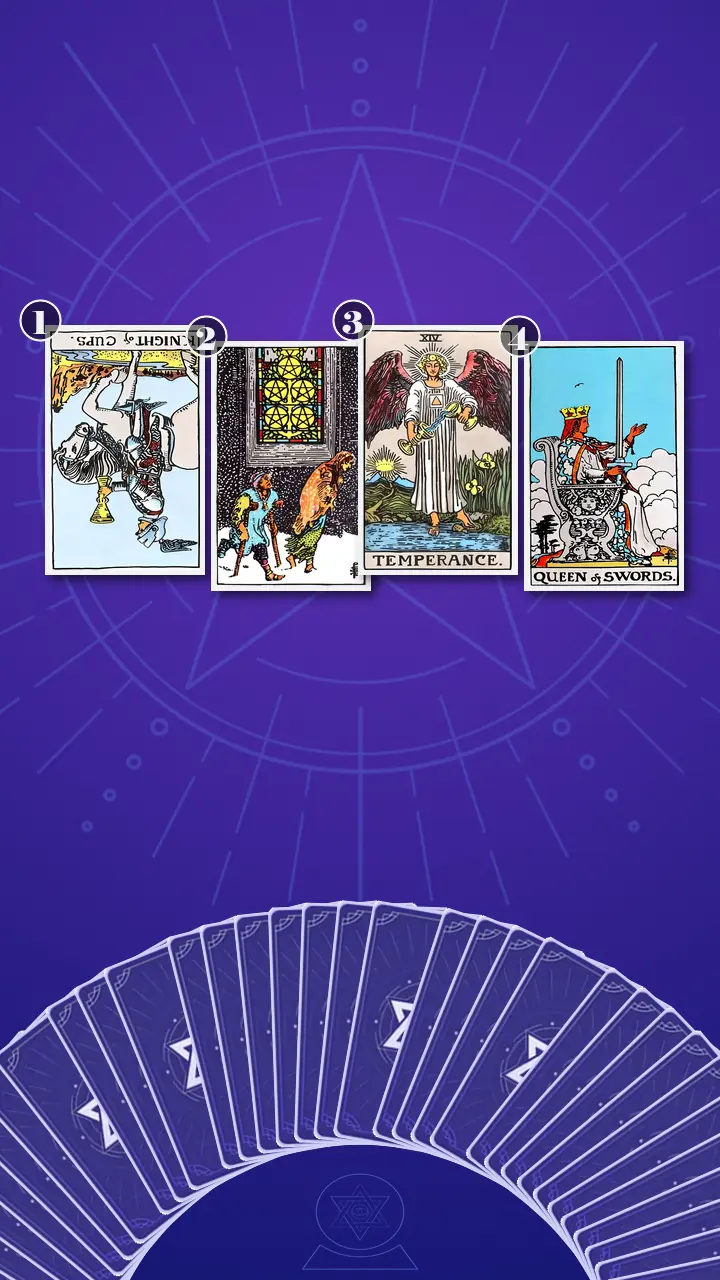
Now I turned over the card for the position called Presenting pattern: the observable way Jordan rushes toward new closeness after a breakup, the shadow pattern currently operating in conscious behavior. It was The Knight of Cups, reversed.
In the Rider-Waite-Smith image, the knight extends a cup while his white horse moves through open country. Reversed, the emotional offer has become faster than the road can be read. This is not a lack of feeling. It is Water in excess, romantic momentum spilling past discernment. The cup reaches outward before Jordan has checked whether the impulse comes from curiosity about this person or relief that someone is paying attention.
I connected the card to the familiar modern scene: an affectionate Hinge conversation becomes the emotional centre of the day before the match has shown consistency. Jordan sends a good-morning text, shares a vulnerable story, checks for a reply during a Figma meeting, and begins imagining a future because the intensity briefly quiets the breakup. It resembles an algorithm recommending an entire relationship from three clicks: compelling, personalised, and built on very little data.
I gave the inner monologue its own short, escalating rhythm. 'They replied warmly. I should keep it going. If I slow down, they might disappear.' The next message, the voice note, and the Wednesday drinks plan were not meaningless. They were simply being asked to perform too much emotional work too soon.
Jordan's thumb stopped above the screen. First, their breath caught. Then their eyes lost focus, as if replaying the last affectionate exchange in real time. Finally, they gave a small, bitter laugh. 'That is too accurate. Almost rude.'
I let the laugh land without defending the card. 'I hear the recognition in that,' I said. 'I am not asking you to distrust warmth or impose a rigid no-dating rule. I am asking you to notice the moment when a warm reply becomes evidence that the whole breakup is already over.' Jordan's fingers moved away from the phone, though their shoulders stayed high. The defense had loosened without being shamed.
Position 2: The Lit Window Jordan Could Not Feel
Now I turned over the card for the position called Underlying fear: the emotional insecurity beneath the rush toward immediate closeness, the hidden wound or unmet need beneath the visible pattern. It was The Five of Pentacles, upright.
The card's Earth is cold and exposed. Two figures move through snow beneath an illuminated stained-glass window, one carrying a crutch, one with a bandaged foot. The energy is a deficiency in perceived access to warmth: when Jordan is alone, the body reads the quiet as exclusion. A Sunday evening with one portion of pasta, an old photo notification, and a delayed reply can feel like standing outside a lit room while everyone else has been let in.
I told Jordan that the fear underneath the rush was not simply missing a partner. It was the thought that being without immediate closeness might prove they were unsafe on their own. Friends could be active in a group chat and still feel physically far away. A friend could have offered a plan for later in the week, yet the silence at 6:20 p.m. could narrow Jordan's attention to one person who was not replying.
'A quiet night can hurt without becoming proof that you are unsafe alone,' I said. 'The window is still lit. It can represent a friend, a familiar kitchen, a run, an episode watched for yourself, or the ability to stay with one difficult feeling for ten minutes without making it decide your worth.'
I asked, 'On the first quiet evening when a new person is unavailable, what is the most frightening story your mind tells you about what being alone means?' Jordan looked down at the card. Their hand closed around the edge of the cushion, their eyes went to the phone, and then they placed it farther away. 'That I need someone to want me immediately,' they said. The sentence sounded less like a verdict than a fact finally brought into the light.
When Temperance Kept Both Cups in the Room
When I reached the third card, the room became unusually quiet. Outside, a bus sighed at the kerb; inside, the radiator's tick left clean spaces between sounds. This was the bridge in the spread, not a verdict about whether Jordan should date.
Position 3: The Space Between Two Cups
Now I turned over the card for the position called Transforming resource: the quality that can interrupt the cycle and allow paced curiosity. It was Temperance, upright.
The angel stands with one foot on land and one in water, pouring water between two cups. The upright energy is balance rather than suppression: paced emotional integration, self-trust, tolerance for ambiguity, and reciprocal closeness. Jordan did not have to choose immediate fusion or complete isolation. They could keep a new conversation warm while preserving a solo routine, waiting until the next day before escalating disclosure, and observing whether interest remained mutual between messages.
The Northern line scene returned to me: 8:47 p.m., wet coats and metal in the carriage, fluorescent lights buzzing while a colleague's rooftop-bar soft launch played across Jordan's screen. Their shoulders had tightened because the new match had not replied for two hours. Temperance asked for a different visual rhythm: not one phone screen drowning out the old relationship, but two lives bringing their own schedules, feelings, and uncertainties into contact.
For fifteen years as a perfumer, I have used what I call Intimacy Distance Calibration. A scent needs enough air to diffuse; held too close, it becomes dense and loses its separate notes, while too much distance makes the encounter disappear. I use the same metaphor to ask whether a relationship is suffering from emotional suffocation or detached coldness. Jordan was not detached. The new connection was being asked to diffuse grief so quickly that warmth was becoming flooding. The adjustment was not to become guarded. It was to create enough space for both people to remain perceptible.
Intensity can be real and still be too fast to read clearly.
Jordan was still trying to make one decision carry three jobs: tell them this person was right, prove the breakup had not damaged them, and keep the empty evening away. The new message looked like a doorway, but it could not yet tell them what they actually needed.
Do not treat immediate closeness as proof that the breakup is over; practice measured connection that lets the two cups blend without abandoning your own pace, as Temperance does.
For a second, Jordan's breath stopped halfway in, and their fingertips hovered above the phone as if the message were suddenly hot. Their eyes widened; then their gaze slipped past the card and replayed the Sunday pasta, the old photo notification, and the Northern line ride where a delayed reply had made the carriage feel airless. Their mouth opened, but no answer came. A small sound finally rose from the chest: 'Ah.' Their shoulders dropped by a fraction, the hand holding the phone loosened, and a longer exhale moved through them. The relief was real, but it carried a thin edge of vertigo: if closeness did not have to rescue them, they would have to choose it deliberately. They looked frightened by that responsibility and steadied by it at the same time. The streetlight slid across the window, briefly brightening the two cups on the card. I let the silence stay long enough to feel like space rather than abandonment.
I asked, 'Now, use this new perspective to think back to last week: was there a moment when this insight might have let you feel differently?'
Jordan described the first evening they had sent three messages simply because the typing indicator had disappeared. They could see, for the first time, that the urge had contained genuine interest and breakup relief at once. Temperance did not ask them to separate those feelings perfectly. It gave them a container large enough for both. This was the first crossing from breakup-driven urgency toward grounded openness, paced reciprocity, and clearer judgment.
Position 4: The Sword With an Open Hand
Now I turned over the card for the position called Grounded practice: the action that turns shadow awareness into daily relationship behavior. It was The Queen of Swords, upright.
The Queen holds her sword upright while her other hand remains open. The Air of the card brings clarity, truthful communication, independence, and boundaries shaped by experience. Her energy is balanced because the sword does not close the hand. Clear perception does not require emotional shutdown.
I brought Jordan to the modern scene shown by the card's meaning: after a promising first date, they draft a long 11:05 p.m. message about an unusually strong connection. Instead of sending it immediately, they leave it in Notes, sleep, and read it in daylight. The facts become simpler: the person was attentive, asked good questions, and Jordan enjoyed the date. The urge to make the connection carry the breakup has softened.
'Slow is not the same as shut down; it is how you keep your judgment in the room,' I said. 'You can tell someone you are interested and still let trust build gradually. Then you can watch what happens when you do not fill every pause with another message.'
Jordan's jaw tightened at the word boundary. Their first thought was that a slower pace might make the new person lose interest. Then they opened their Notes app and typed: 'I am interested in getting to know you, and I want to let trust build gradually.' They read it twice, looked uneasy, and then sat a little straighter. The sentence did not guarantee a good response. It gave Jordan a way to learn from the response without abandoning themselves.
The Two-Cup Pace: Small Next Steps
The four cards formed a practical story. The reversed Knight of Cups showed the first handhold being grabbed before the last one had been released: emotional momentum became a shortcut to reassurance. The Five of Pentacles showed why the shortcut felt necessary: a quiet evening could be interpreted as a locked door, even while friends, routines, and self-directed care remained available. Temperance offered the missing exchange, and the Queen of Swords gave that exchange language.
My Boundary Permeability Assessment helped me name the blind spot. Jordan was not simply asking whether they liked the new person. They were allowing the new person's replies, availability, and imagined future to cross the boundary between present curiosity and old grief, until the other person was carrying the job of proving that Jordan was safe and wanted. The transformation direction was therefore not less intimacy. It was a clearer line between what Jordan felt, what the new person had actually done, and what the breakup still needed time to reveal.
I asked Jordan to choose small experiments rather than make a permanent rule about dating. These were the next steps we wrote down together:
- The Two-Cup Pace CheckFor one week, create a note in Notion or Apple Notes for each new person. Before the next planned conversation or date, record one observable fact about their behaviour, one feeling Jordan noticed, and whether the next impulse comes from curiosity or relief. Keep new contact to one planned conversation or date at a time, while leaving one ordinary solo routine on the calendar.Tip: If a full week feels too rigid, use a thirty-minute pause before sending a second message or keep one evening free from dating-app contact. The pace can be revised.
- The Blank Space ProtocolWhen the urge to check Hinge or reply instantly appears after work or during a quiet evening, put the phone face down, take three slow breaths, and write two words: curiosity or relief. Set a ten-minute timer, finish one concrete task in the flat, such as making tea or washing a mug, and then decide whether to respond.Tip: This is not punishment or a demand to ignore the feeling all night. Start with ten minutes of comfortable distance so the emotional oxygen can return.
- The Clear-Pace SentenceBefore escalating personal disclosure, wait until the next day and ask what Jordan actually wants the new person to know. If the connection continues, send: 'I am interested in getting to know you, and I want to let trust build gradually.' Then observe the next few interactions for respect, reciprocal questions, pressure, or inconsistency.Tip: Draft the sentence in Notes first if saying it aloud feels exposed. A boundary can protect openness, and a dismissive or coercive response is useful information rather than a reason to over-explain.
I reminded Jordan that the goal was not to turn every message into an analytical exercise. It was to create enough room for facts and feelings to coexist. Let the connection be warm without making it responsible for ending the breakup. That was actionable advice, not a promise of perfect certainty.

A Week Later, the Quiet Had Edges
A week later, I received a message from Jordan while I was preparing a new fragrance blend. They had kept one ordinary dinner and one gym session on the calendar, used the curiosity-or-relief check before replying, and left an intimate draft in Notes overnight. The new person was still interested. More importantly, Jordan could describe what they actually knew instead of turning three warm conversations into a full imagined future.
They slept a full night, but the first morning thought was still, 'What if they lose interest?' This time, Jordan made tea, smiled at the question, and went to work without demanding an answer before breakfast. The quiet had not vanished. It had acquired edges, which meant Jordan could feel where it ended and where their own life began.
I told Jordan that this was the first small proof of the Journey to Clarity. The cards had not chosen a person, erased the breakup, or guaranteed a relationship result. They had helped Jordan see a repeatable mechanism and return the decision to the person living it: paced connection, reciprocal curiosity, and boundaries that keep the heart open without handing away the steering wheel.
When a breakup leaves your chest buzzing and your thumb hovering over a new chat, it can feel safer to be wanted immediately than to sit with the fear that being alone says something about your ability to feel safe on your own. Noticing that fear does not solve everything, but it creates the first clear breath around it.
If one new connection could stay warm without having to silence the breakup, what small pace would let you notice both the other person and yourself this week?