The Typing Bubble and the Warm Rush
When I meet a late-twenties Toronto tech worker who can spot a broken product flow in minutes but starts granting trust when a Hinge match sends good-morning texts after date two, I know the conversation may be about more than dating chemistry. Jordan (name changed for privacy) sits across from me at 12:18 a.m. in the bedroom of their rented apartment, the old radiator clicking while blue phone light washes over the duvet. Their roommate is asleep down the hall. Jordan scrolls upward through ten days of affectionate messages and replays a three-minute voice note; the phone is warm in their palm, but their thumb keeps moving as if the right sentence might restore the beginning.
“I know attention is not proof,” they tell me. “But when the typing bubble appears, my body believes I am safe again. Then the replies slow down, and I start explaining everything.”
I hear the contradiction clearly: Jordan wants to trust the rush of being pursued and fears that the rush may not be trust at all. They have answered immediately, moved an existing dinner, shared private history early, and treated fast emotional access as evidence that someone is dependable before seeing how that person handles a no, an ordinary week, or a small misunderstanding. Their longing seems to sit in the body like a hand closing around a warm cup, followed by a sudden draft whenever the phone goes quiet.
“You are not wrong for enjoying the attention,” I say. “We are going to separate what feels good from what has actually been observed. Let us give this confusion a map, so you can choose the pace and the access instead of letting the typing bubble choose for you.”

Choosing a Map for the Early Dating Fog
I ask Jordan to place both feet on the floor, take one unforced breath, and name the question without trying to solve it. I shuffle slowly while the radiator clicks behind us. This is not a test of fate; it is a way to move attention from the most vivid message to the whole pattern.
Today I use the Relationship Spread · Context Edition, a six-card relationship tarot spread designed for how attention, belonging, interpretation, and boundaries interact in an emerging connection. A broad Celtic Cross would bring in more life domains than Jordan's question needs. This contextualized relationship reading keeps the lens narrow enough to distinguish intense early dating attention from earned trust.
The first two positions show the presenting pattern and the felt impact of being intensely pursued. The middle row brings the underlying belonging fear beside the interpretive loop that fills gaps with hope or fear. The final two positions offer a trust criterion and a self-directed boundary experiment. I want the cards to move us from the attention-to-trust shortcut, through uncertainty, toward paced discernment and grounded, evidence-based trust.
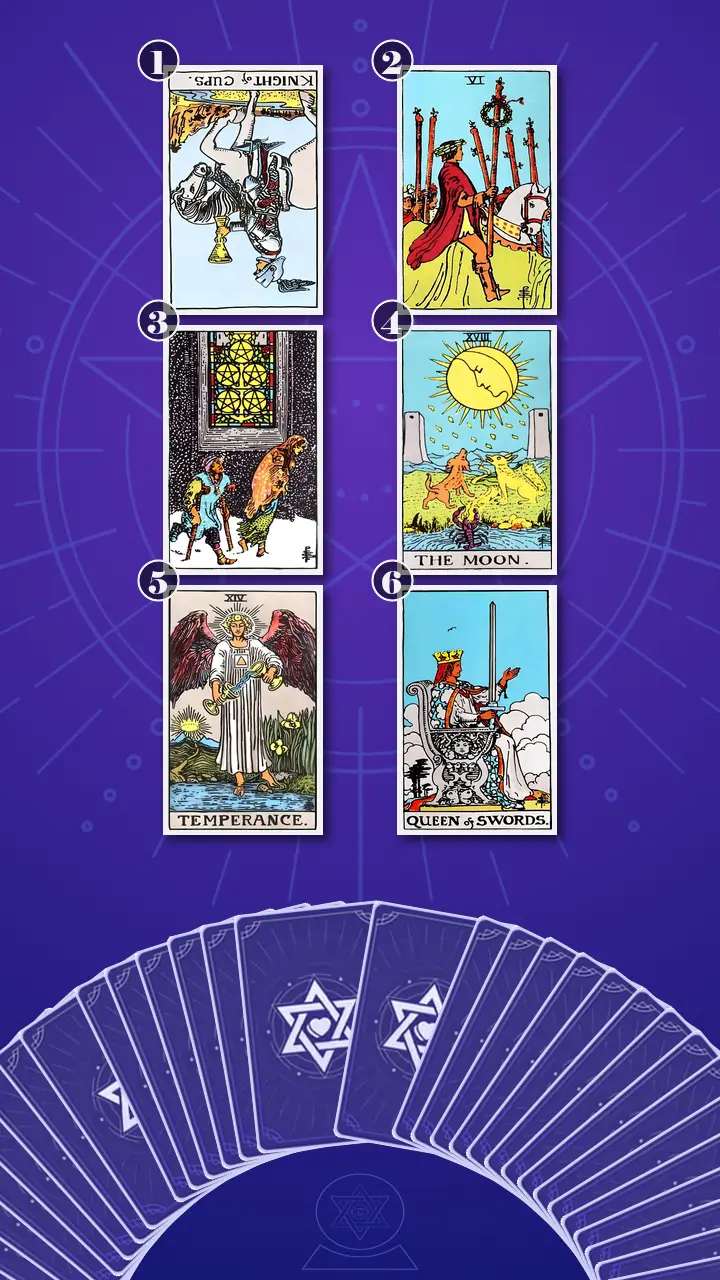
What the First Six Cards Could Actually Prove
Position 1: The Cup That Arrived Before the Evidence
“Now I am turning over the card for the presenting pattern: the way rapid early attention becomes evidence of trust, including accelerated disclosure and quick emotional investment.”
I reveal the Knight of Cups, reversed. The offered cup immediately makes me think of the long Hinge voice notes Jordan described: intimate disclosure, flattering language, and “I have never connected like this so quickly.” The attention can be sincere and still be incomplete information. The reversed energy shows an emotional offer whose story has travelled faster than the terrain has been tested.
I ask Jordan to hold two sentences apart: “Because they are giving me constant contact, I assume we already have trust, even though I have not seen how they respond to a delay, a no, or an ordinary week.” That is not a judgment of the other person. It is a precise description of Jordan's speed of inference. Warmth is being welcomed, but access is increasing before reliability has had time to become observable.
Jordan gives a small, bitter laugh rather than nodding. “That is almost rude,” they say. “They give me something real, and I turn it into the whole story.” I let the discomfort remain without making it shame. I want Jordan to recognize the pattern without learning to distrust every beautiful beginning.
Being wanted is a feeling. Being trustworthy is a pattern.
Position 2: The Wreath of Being Chosen
“Now I am turning over the card for the felt impact of intense early attention: what the rapid messages, compliments, and immediate availability seem to promise to you.”
I reveal the Six of Wands, upright. In the card's public recognition, I see the notification stream that makes Jordan feel singled out: the quick reply during a Monday design critique, the “You are different from anyone I have met” message, the sense of being visibly chosen. The energy is not false. It is simply narrow. It confirms engagement right now; it does not yet confirm reliability, repair, or respect for limits.
I tell Jordan, “Attention tells you they are engaged right now; consistency shows what the connection can hold.” Then I ask, “When the messages arrive, does your body hear attraction, priority, safety, exclusivity, or lasting commitment?” Jordan looks down at the phone and rubs one thumb across its edge. Their shoulders loosen at the thought of being noticed, then lift again when I name what has not yet been tested.
Position 3: The Window That Looks Like Shelter
“Now I am turning over the card for the underlying belonging fear: what feels threatened when intense attention fades or becomes inconsistent.”
I reveal the Five of Pentacles, upright. I describe the snowy Toronto pavement and the illuminated window in the card. When a phone goes quiet, I tell Jordan, the change can register as being outside again rather than as one piece of information. The next warm message then feels like shelter, and relief can make it easier to excuse what has not been steady.
I ask, “When the attention stops, what is the private sentence underneath the reaction: ‘I misread everything,’ ‘I am no longer chosen,’ or ‘I am outside this connection again’?” Jordan's breath catches. Their fingers tighten around the phone, pause, and slowly release. They tell me, “If I can restore the attention, maybe I still belong.”
I answer carefully: “The desire for connection is honest. But one person's attention cannot be asked to certify your worth.” I do not read this card as a verdict about Jordan or the person they are dating. I read it as the emotional weight being placed on contact, and as a place where self-compassion can interrupt the cycle.
Position 4: The Moonlit Thread
“Now I am turning over the card for the interpretive loop: the way hope, fear, and incomplete information become a story that is treated as evidence.”
I reveal The Moon, upright. The room seems to narrow around the blue screen and the clicking radiator. I ask Jordan to remember the message, “Sorry, wild week,” after two quieter days. I name three separate lines: what happened, what they hoped it meant, and what they feared it meant.
“The fact is that contact changed,” I say. “The hopeful story is that work became intense and they are protecting you from stress. The fearful story is that they lost interest and are letting you down gently. Which one have you been treating as confirmed?”
Jordan goes still. First, their breathing pauses and their thumb hovers above the old thread. Then their eyes lose focus as if the vague message, the drafted understanding reply, and the earlier voice note are replaying in sequence. Finally, they exhale from somewhere low in the chest and look toward the window. I can see the recognition land: the chat thread keeps extending beyond what the available light can show.
“Uncertainty is a gap in the information, not an invitation to grade your worth,” I say. I have spent fifteen years reading boundaries through scent, and I know the difference between a room with no air and a room whose window is simply closed. Jordan has been trying to perfume a missing fact with reassurance. The Moon asks for a pause before the mind fills the room.
When Temperance Made Room for Trust
The Measured Cups
The room grows quiet before I turn the fifth card. I place it where the lower-left window of the grid completes the path from impression to fear to practice.
“Now I am turning over the card for the trust criterion: the slower quality that can distinguish emotional intensity from reliability through pacing, follow-through, boundary respect, and repair.”
I reveal Temperance, upright. Its two cups give me the exact image I need: one stream for feeling, one for evidence. I do not ask Jordan to pour feeling away. I ask them to stop making it swallow the evidence.
At 12:18 a.m., Jordan is trapped inside the demand to decide whether the beginning was real. The radiator clicks. Their thumb searches upward for proof that the warmth still means what it meant. Then I say the sentence I want them to keep:
Attention can arrive all at once. Trust cannot; it becomes visible in what repeats after the rush.
For several seconds, Jordan does not move. Their breath stops halfway in, and their eyes remain on the two cups. A thought seems to travel through the old thread: the compliment was real as attention, the warmth was real as feeling, and neither had promised what only repeated actions could show. Their mouth tightens, not with panic but with the effort of releasing a conclusion they had been carrying.
Then their shoulders lower by a small, visible degree. The hand holding the phone opens. Jordan breathes out with a faint tremor and gives a quiet “Oh.” Relief arrives, but it is not perfectly smooth. For one moment they look almost dizzy in the new space, as if the responsibility of choosing a pace has appeared where the old urgency used to stand.
“I can like this without knowing everything yet,” they say. “I can let warmth be real without making it proof.”
I ask, “Can you picture an ordinary week? You receive a warm message, enjoy it, and keep the dinner you already planned. You let the next plan be made and kept, you notice whether a no is respected, and you watch what happens after a small misunderstanding. What changes when access does not have to rise at the same speed as feeling?”
This is where I use my Intimacy Distance Calibration: I imagine scent diffusion between two people. If a fragrance fills the entire room immediately, I ask whether there is room left to breathe, not whether the fragrance is bad. Jordan's connection has been assessed by volume instead of range. The skill gives us a neutral diagnostic: emotional suffocation is not the same as emotional closeness, and a measured distance is not detached coldness.
Temperance marks the emotional transformation from fast fusion and reassurance-seeking to paced discernment and grounded, evidence-based trust. It is not a promise that the other person will stay. It is a way for Jordan to remain warm while allowing consistency to reveal itself over time.
The Sword Held in an Open Hand
“Now I am turning over the card for the self-directed boundary experiment: one clear communication or observation practice that lets you gather information without deciding for another person.”
I reveal the Queen of Swords, upright. Her sword is direct, but her open hand keeps the clarity receptive rather than punitive. I suggest this sentence: “I am enjoying getting to know you, and I want to keep the pace mutual. I have noticed our contact changed this week; has your availability or interest shifted?”
Jordan sits a little straighter. I watch them type the first half into a Notes draft, then place the phone face down. “I can say what is true for me, ask one clean question, and let the response become information,” they say.
“Exactly,” I answer. “A boundary is not a test for them to pass; it is something true about you that lets a real response become visible.” The upright Queen asks for clarity, not an interrogation. It protects self-respect without turning vulnerability into a crime or another person's answer into a verdict on Jordan's value.
The Attention-Evidence Split
When I connect the six cards, I see a clean sequence. The reversed Knight of Cups shows an attractive emotional offer arriving before its reliability is known. The Six of Wands shows how recognition soothes the fear of being peripheral. The Five of Pentacles reveals why a quiet phone can feel like exclusion, while The Moon shows hope and fear completing the missing information. Temperance introduces chosen pacing, and the Queen of Swords turns that insight into language and observable boundaries.
The blind spot is not that Jordan is too open. It is that they have been using the volume of attention to measure the safety of the connection. My Boundary Permeability Assessment asks where Jordan's identity ends and the other person's availability begins. Right now, a gap in texting is crossing that boundary and becoming a judgment about belonging. The new direction is simple: separate attention from evidence, slow disclosure without playing games, and let ordinary behavior carry more weight than the opening rush.
- Make the two-column note.After the next three interactions with one new connection, set a seven-minute timer in Apple Notes. Write one factual bullet under “Attention I received” and one under “Evidence I observed,” such as “sent a long compliment” beside “made a plan and followed through.”Keep it private and use facts only. The minimum version is one line in each column; no score, verdict, or delayed reply is required.
- Keep one existing plan.When a new person offers a last-minute alternative this week, keep one friend, rest, exercise, or solo plan and offer a genuine time that works instead: “I cannot do tonight, but Thursday after 7 works for me.”Before changing a non-urgent plan, put the phone down for ten minutes and ask, “Would I choose this if I were not afraid the energy might disappear?”
- Make the pace visible.Draft, and send when it feels appropriate, “I am enjoying this, and I want to keep getting to know each other at a pace that feels mutual.” If contact has changed, ask one observable question rather than writing the answer yourself.Record the actual response in one sentence before interpreting it. A clear boundary is information, not a manufactured test, and Jordan remains free to pause or leave.

A Week Later, the Quiet Proof
Six days later, I receive a message from Jordan while I am blotting a new fragrance strip in my studio. They tell me that a warm late-night message arrived, and they let themselves enjoy it without cancelling the dinner already on their calendar. In the Attention column they wrote “long compliment.” In the Evidence column they later wrote “kept Saturday plan, accepted not tonight, asked how to repair a small misunderstanding.”
Nothing became magically certain. Jordan still woke the next morning with the familiar question, “What if I am wrong?” But they sent the mutual-pace message, put the phone face down, and waited for the reply instead of composing it in advance. They felt lighter and a little lonely at the same time. That bittersweet space mattered: they had not solved a whole relationship; they had made one deliberate choice before urgency could make it for them.
I tell Jordan that this is the first visible proof of their own change. The relationship has not been handed a guaranteed future by the cards. Jordan has begun moving from decoding messages to observing patterns, from quick fusion to grounded self-trust. The cards offered a structure; Jordan chose what to notice, what to disclose, and where to place the boundary.
When the typing bubble disappears after days of constant contact, many of us know the tight-chested urge to become easier, faster, or more understanding, as if keeping someone's attention could keep us inside belonging. If you could enjoy the next warm message without making it carry the whole future, what small piece of consistency would you be curious to notice next?
Every reading at AceTarot is a journey to connect with inner wisdom and empower the path ahead. This reading shared here is a psychological mirror, not a private record—crafted to reflect universal emotional loops and help restore personal clarity. Please note that these insights do not replace professional psychological, medical, legal, or financial advice, and should not serve as the sole basis for major life decisions.
Learn more about our Journey to Clarity.
How did this insight land for you?
🫂 This Resonates Deeply
🌀 Living This Story
✨ Now I See Clearly
🌱 Seeing New Possibilities
🧰 Useful Framework
🔮 The Confirmation I Needed
💪 Feeling Empowered
🚀 Ready for My Next Step
Author Profile
 AI
AI Luca Moreau
835 readings | 512 reviews
“As a perfumer for fifteen years, I’ve learned to perceive human boundaries through the delicate metaphor of scent. Relationships need the right amount of space to breathe, and I've seen too many kind souls exhaust themselves trying to please everyone. I’m here with warmth and understanding—not to teach you to be guarded, but to help you gently clear the air and rediscover the comforting, safe boundaries that are rightfully yours.”
In this Love Tarot Reading :
Core Expertise
- Intimacy Distance Calibration: Using the metaphor of scent diffusion to diagnose whether your relationship suffers from emotional suffocation or detached coldness.
- Boundary Permeability Assessment: Objectively evaluating where your personal identity ends and your partner's begins, identifying unhealthy enmeshment.
Service Features
- The Blank Space Protocol: A behavioral challenge to intentionally create comfortable emotional or physical distance, allowing the 'oxygen' needed to reignite mutual attraction.
Also specializes in :
Explore Related Patterns:
Anxious AttachmentJordan's body reads the typing bubble as safety, while slower replies trigger an urge to explain everything and restore attention. When a quiet phone feels like being outside the connection, the relationship is being asked to settle a belonging alarm before enough reliability has been observed. You can let early pursuit feel good without requiring it to function as earned security. Watching whether someone follows through, respects a no, and repairs ordinary friction moves safety away from momentary contact and toward patterns you can actually see.
Boundary DiffusionJordan answers immediately, moves an existing dinner, and shares private history early as the new connection becomes intense. The other person's availability begins to set the pace of access, while a change in texting crosses the line from information about them into a judgment about Jordan's place in the relationship. You regain clarity when your schedule, privacy, and pace remain yours even while you are interested. Keeping one plan and naming a mutual pace does not reduce intimacy; it makes room to see whether closeness can coexist with respect for your separate life.
Emotional ReasoningJordan knows attention is not proof, yet the warmth of a typing bubble makes their body conclude that they are safe. The feeling is real, but it is quietly taking over the job of evidence by turning present engagement into a prediction of trustworthiness. You do not have to deny the rush to stop it from making decisions for you. Separating what feels reassuring from what has been observed gives your attraction room to exist without asking it to guarantee the future.
Intermittent ReinforcementJordan experiences the quiet after intense contact as exclusion, so the next warm message lands with the force of shelter. That relief can make an inconsistent connection feel more compelling than a consistently available one, because the nervous system starts tracking the return of reassurance. You can interrupt this loop by giving repeated conduct more weight than the relief of one renewed message. A plan kept, a no respected, and a misunderstanding repaired each provide information that a spike of contact cannot supply on its own.
Conditional Self-WorthJordan's thought that restored attention could restore belonging reveals how quickly another person's availability becomes a measure of personal value. When the phone goes quiet, the impulse to become easier, faster, or more understanding is an attempt to regain worth through relational access. You can care about a connection without making its current intensity a verdict on your place in the world. Treating a change in contact as data rather than a grade protects your self-respect while leaving room for the other person's actual behavior to speak.
Premature VulnerabilityJordan shares private history and makes quick emotional investments before seeing how the match handles a no, an ordinary week, or a small misunderstanding. The disclosure is not a mistake in itself, but its pace turns emotional access into evidence of dependability before dependability has had time to show up. You can be open without giving every new connection immediate access to your most private material. Pacing disclosure lets your warmth remain voluntary and gives consistency, repair, and mutual care time to become visible.
Reality TestingJordan separates the fact that contact changed from the hopeful and fearful stories built around it, then records attention and observable evidence in separate columns. This creates a pause between a vivid signal and the conclusion that the signal must carry. You are not being asked to distrust warmth or become emotionally distant. You are learning to let plans kept, limits respected, and repair after friction carry the kind of information that a compelling message cannot provide alone.
Reassurance SeekingJordan scrolls through old messages, replays the voice note, and searches for a sentence that might restore the beginning. When replies slow, explaining everything offers a short-term sense of action against uncertainty, even though it cannot establish what the other person actually feels or intends. You can notice the urge to secure the connection before acting on it. Letting a direct question or a pause replace a reassurance-seeking move allows the response itself to become information rather than something you must manage into existence.
Boundary DiscernmentJordan enjoys a warm late-night message without cancelling the dinner already on the calendar, then names a desire for a mutual pace. The boundary does not demand a particular outcome; it makes Jordan's availability clear and gives the other person's response a chance to become visible. You can choose access, pace, and disclosure without turning those choices into a test or a withdrawal. A clear boundary keeps your life intact while helping you distinguish real reciprocity from the temporary volume of early attention.
Mind ReadingJordan receives "Sorry, wild week" and the mind immediately creates two explanations, one hopeful and one fearful. Replaying the vague message beside the earlier voice note can make either story feel confirmed even though neither explanation has been directly established. You do not need to solve another person's inner world from a chat thread. Holding the gap open long enough to ask one clean question turns imagined motives into something that can be clarified, observed, or left uncertain without becoming a judgment of your worth.
Explore Related Struggles:
Accelerated Intimacy TrapYou answer immediately, move an existing dinner, share private history early, and treat fast emotional access as evidence that someone is dependable before you have seen how they handle a no, an ordinary week, or a small misunderstanding. The early offer may be sincere, but its emotional story has travelled faster than the relationship has been tested, so access rises before reliability becomes observable. When replies slow, you scroll through the affectionate messages and start explaining everything, trying to restore the beginning instead of letting the next behavior add information. The central bind is that warmth feels like a reason to move closer while the evidence needed for trust requires time, limits, and repetition. You can keep the warmth real without allowing the first rush to decide how much access the connection has earned.
Evidence DisconnectionYou notice a factual change in contact, such as two quieter days and a message saying "Sorry, wild week," but the hopeful explanation and the fearful explanation begin to compete with the fact itself. The earlier stream of messages remains more vivid than the missing observations, so attention volume starts functioning as a substitute for follow-through. The evidence is not the strongest feeling in the room; it is what repeats after the rush, including whether a plan is kept, a no is accepted, and a misunderstanding can be repaired. You can let the actual response stay incomplete without turning the gap into a verdict about your worth, then decide what the pattern supports when more behavior is visible.
Approval-Safety FusionWhen the typing bubble appears, your body reads the contact as safety, and the quick replies, compliments, and "You are different from anyone I have met" message make you feel visibly chosen. When the phone goes quiet, the connection can feel like a window you have been left outside, so the next warm message brings shelter and is asked to restore more than current engagement. That is how attention begins carrying the jobs of belonging, safety, and dependability at the same time. You are not required to dismiss the relief of being noticed; the clearer move is to let being chosen remain one fact while consistency, respect for limits, and repair answer the larger question of whether the connection is safe to trust.
Explore Related Emotions:
Ambiguity DreadAfter two quieter days, Jordan studies the message 'Sorry, wild week' while their thumb hovers above the old thread. One possible story protects the connection, another predicts rejection, and neither has been confirmed by what actually happened. With no clear explanation available, the information gap becomes pressure to settle the entire meaning of the relationship. Ambiguity Dread names the oppressive feeling that not knowing is itself dangerous. Holding fact, hope, and fear on separate lines gives you room to wait for evidence without turning uncertainty into a judgment about your worth.
Borrowed Warmth AcheAt 12:18 a.m., the phone is warm in Jordan's palm while their thumb moves through ten days of affectionate messages, searching for a sentence that might restore the beginning. The typing bubble briefly makes the body believe it is sheltered, so its disappearance lands like a draft through the room. When another person's availability is carrying belonging, reassurance, and safety all at once, its warmth can feel temporarily borrowed rather than securely held. Borrowed Warmth Ache names the sting of having steadiness lent by someone else's attention. Naming that dependence restores the option to enjoy contact without giving it sole authority over your inner shelter.
Cautious Self-TrustSix days later, Jordan enjoys a warm late-night message without cancelling the dinner already on their calendar. They send the mutual-pace message, put the phone face down, and wait for the actual reply instead of composing it for the other person. Keeping the plan and asking one clean question return authorship to Jordan without requiring certainty about the relationship. Cautious Self-Trust is the emerging sense that you can stay open, tolerate an unknown outcome, and still rely on your own ability to notice, choose, and respond.
Cautious TrustIn the Evidence column, Jordan records that the other person kept a Saturday plan, accepted 'not tonight,' and asked how to repair a small misunderstanding. These ordinary actions carry less dramatic volume than the opening compliments, but they reveal more about what the connection can hold. Trust shifts from a warm prediction into a measured openness supported by repetition, limits, and repair. Cautious Trust lets you remain receptive without surrendering your pace; the relationship can become more meaningful as evidence accumulates, while your access remains yours to choose.
Certainty HungerJordan scrolls upward through ten days of affectionate messages and replays a three-minute voice note, as though the correct sentence might recover what the quieter present no longer confirms. The old thread becomes the place where a definitive answer is expected to be hiding. The search promises that enough review could turn incomplete information into certainty and settle whether the beginning was safe to trust. Certainty Hunger names the craving for a final answer before repeated behavior can provide one. Recognizing that hunger lets you stop asking old words to resolve a current unknown and return attention to what happens next.
Conditional Belonging FearWhen the phone goes quiet, Jordan does not experience the change as one piece of information. It registers as being outside the connection again, and restoring the attention begins to feel like the route back inside. The texting gap crosses an internal boundary and becomes a verdict about whether you still matter. Conditional Belonging Fear captures the feeling that your place is secure only while another person is actively choosing you. Separating contact from worth makes it possible to observe the relationship without requiring every message to renew your right to belong.
Limerent RushGood-morning texts after date two, long voice notes, and instant compliments make Jordan loosen at the shoulders and grant access before an ordinary week has passed. The speed of recognition turns attraction into a full-body surge of being chosen. When attention becomes this vivid, you can enjoy a real spark while also feeling pulled to let that spark answer questions only time can answer. Limerent Rush names the intensity of that inner lift without treating it as evidence about the other person's reliability.
Relational WhiplashJordan's shoulders loosen at the thought of being singled out, then rise again when the untested parts of the connection are named. Ten days of concentrated affection create a warm rush, while two quieter days pull the body toward an entirely different conclusion. The sharp contrast between pursuit and reduced contact creates an internal swing from closeness to exclusion before the relationship itself has become clear. Relational Whiplash captures that destabilizing emotional movement. Once the swing is visible, you can treat the change in contact as information rather than allowing each shift to redefine the entire bond.
Clarity ReliefJordan's hand opens, their shoulders lower, and a quiet 'Oh' arrives when feeling and evidence are allowed to occupy separate cups. The compliment remains real as attention, while reliability is returned to the realm of repeated action. Once those two kinds of information stop competing, you no longer have to discredit the warmth or make it prove too much. Clarity Relief is the release that comes from seeing the pattern precisely enough to regain choice over pace, access, and interpretation.
Explore Related Contexts:
Accelerated Intimacy PressureGood-morning texts begin after date two, followed by ten days of affectionate messages, intimate disclosure, and long voice notes. Jordan answers immediately and moves an existing dinner, so the pace of the new connection starts reorganizing real commitments before the relationship has passed through ordinary situations. That speed compresses distinct stages of dating into one intense opening. Attraction, recognition, disclosure, access, and assumed dependability begin arriving as a single package, even though plans, limits, misunderstandings, and repair require time to become observable. You do not have to dismiss a warm beginning in order to resist its acceleration. Keeping your existing plans and allowing disclosure to develop at a chosen pace gives the connection room to show range, not only opening intensity.
Access as Proof PressureJordan answers immediately, moves an existing dinner, and shares private history before seeing how the Hinge match responds to a no, an ordinary week, or a small misunderstanding. Continuous attention is therefore doing more than communicating attraction: it is functioning as permission for deeper access before reliability has become observable. The pressure comes from an exchange in which message frequency is easy to measure while trust remains slow and incomplete. Good-morning texts, typing bubbles, and long voice notes create visible evidence of present engagement, but they cannot yet establish whether the connection can support boundaries, follow-through, or repair. You can enjoy the access being offered without allowing its speed to define what the relationship has earned. Once attention and reliability are treated as separate forms of information, you retain control over your schedule, disclosure, and pace while the other person's repeated behavior becomes visible.
Digital Intimacy Boundary ConfusionAt 12:18 a.m., Jordan scrolls through ten days of messages, replays a voice note, and watches the signals around the Hinge conversation. The same stream of contact has already contributed to immediate replies, a moved dinner, and early disclosure of private history. The app makes intimacy cues continuously available and highly visible: a typing bubble signals presence, message length signals investment, and response speed appears to quantify priority. Offline reliability remains harder to see because it depends on less immediate evidence such as respecting a limit, keeping a plan, and addressing a misunderstanding. You can decide which digital signals deserve attention without letting them automatically alter your calendar or disclosure boundary. Treating the phone as one channel of information, rather than the location where the relationship's status is decided, restores a practical separation between contact and earned access.
Measured Reciprocity TrialSix days later, Jordan has kept the dinner already on the calendar, while the new match has kept a Saturday plan, accepted 'not tonight,' and asked how to repair a small misunderstanding. The Attention and Evidence columns preserve these as separate observations rather than combining them into a single verdict. Those exchanges create a live reciprocity trial. Trust is no longer being inferred from the volume of an opening message stream; it is being assessed through several ordinary points of contact where each person can demonstrate availability, flexibility, boundary respect, and follow-through. You can let each repeated action carry only the weight it has earned. This approach leaves room for warmth while allowing reciprocity to accumulate across situations, giving you a clearer basis for deciding whether deeper access fits what the connection can actually hold.