Three Honest Sentences Were Deleted; One Boundary Came Before Yes

Finding Clarity in the 11:47 p.m. WhatsApp Edit
I often meet people who can smooth over a tense client call before lunch, then spend midnight rewriting “I’m still angry” into “No worries.” Sophie, a 28-year-old junior account manager in London, recognised herself before I had even finished describing that pattern.
She showed me the message on her warm phone and took me back to 11:47 the previous night. She had been sitting on the edge of her bed while the radiator clicked and wet tyres hissed along the street below. Three honest sentences had disappeared from WhatsApp into Notes. What she finally sent was: “I miss you too. Maybe we should just reset.” Her jaw had remained locked after she pressed send.
“I know exactly why I’m angry,” she told me, pressing her tongue against her teeth. “I just don’t want one argument to ruin everything. I can bring it up later, when we’re okay again.” I heard longing in that sentence like a cold hand reaching for the nearest source of heat: automatic, urgent, and willing to overlook the burn.
“So the question isn’t only why you’re angry,” I said. “It’s why getting them back feels safer than discovering whether the relationship can hold your anger.”
I named the pattern carefully: reconciliation-driven self-silencing. It was not proof that Sophie was weak, dramatic, or incapable of forgiveness. It was a strategy for restoring belonging quickly, but the relief came before the resolution. “You are not over it,” I told her. “You have only regained access to them. Let’s use the cards to slow the sequence down and draw a map through it.”

Choosing the Compass: A Six-Card Relationship Spread
I invited Sophie to place both feet on the floor and take one ordinary breath while holding the question in mind. I shuffled slowly, not to create suspense or invoke fate, but to mark a transition from replaying the argument to observing its structure.
I chose a six-card Relationship Spread. This question concerned a relational cycle involving conflict, boundaries, emotional reciprocity, and the fear of losing connection. A broad predictive spread would have added noise. This layout gave me six focused lenses: Sophie’s contribution to the cycle, the visible reunion cue, the familiar bond, the available resource, the central imbalance, and a self-directed path forward.
For anyone wondering how tarot works in a relationship reading, I treat the cards as a structured reflection tool, not a verdict on another person’s motives and not a prediction of whether a couple will reunite. The first card would show where Sophie moved the conflict inside herself. The fourth would identify the emotional capacity she could use differently. The final two would expose the accountability problem and translate insight into a boundary she could choose for herself.
I arranged the cards in two columns and three rows, like two sides of a conversation descending toward a threshold. The central space between the third and fourth cards would become the hinge: remembered tenderness on one side, the courage to speak on the other.
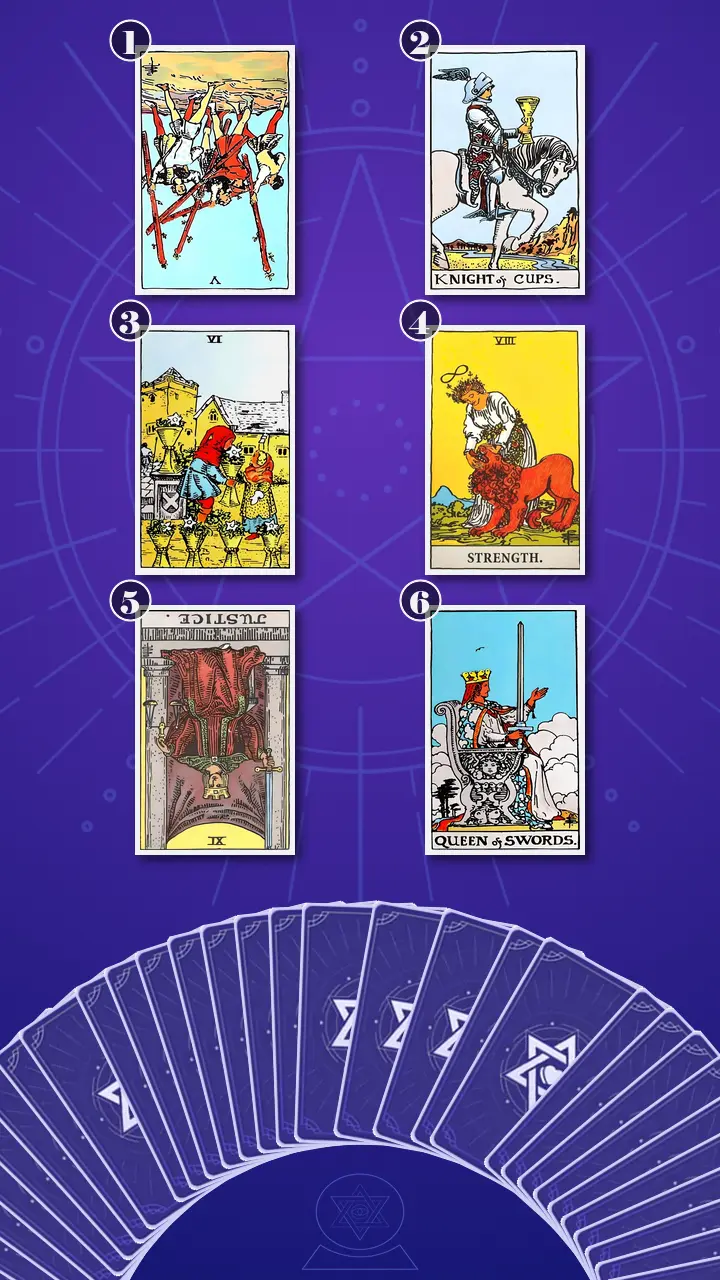
Five Drafts and One False Peace
Position 1: The Conflict Sophie Carried Alone
I turned over the card representing Sophie’s current contribution to the cycle: turning anger inward, editing her words, and consenting to reconciliation before the grievance was expressed. It was the Five of Wands, reversed.
In the Rider-Waite-Smith image, five figures raise crossing staves without creating a shared structure. Reversed, that scattered fire can become blocked conflict: plenty of argument exists, but all of it happens inside one person. The energy was not absent. It was trapped and consuming power in the background.
I connected the card directly to Sophie’s night. At 11:47 p.m., she had typed several versions of the same grievance, moved the sharpest lines into Notes, and sent the version that made reunion easiest. The conflict had not vanished. It had been transferred into her clenched jaw, shallow breathing, private rehearsals, and the resentment waiting behind the affectionate reply.
“It’s like having five competing Slack threads open in your head while the only message anyone else receives is ‘All good,’” I said. “The screen looks calm, but the device is hot because every unsaid argument is still running.”
I asked her to complete the cycle aloud. She looked at the reversed card and said, “I want to say exactly what hurt me, but if I say it, they might decide I’m too difficult, so I’ll send something warm instead.”
She gave a short, bitter laugh. “That’s painfully accurate. Almost a bit brutal.” Her fingers tightened around her coffee cup, then released. I did not rush to turn the card into a positive slogan. “Accuracy can sting when it describes a survival strategy,” I said. “We’re not blaming you for using it. We’re finding the moment where you can have another option.”
The Message That Looked Like an Answer
Position 2: The Knight’s Affectionate Offer
I turned over the card representing the observable reunion cues Sophie responded to and the emotional appeal she experienced, without claiming access to the other person’s hidden motives. It was the Knight of Cups, upright.
The knight extends one cup while the white horse advances at a measured pace. The card showed an emotional offer: the affectionate late-night message, the shared joke, the invitation to meet after four quiet days. Sophie told me her shoulders had dropped as soon as “I keep thinking about you” appeared on her screen. Her body registered restored contact before her mind checked whether the original hurt had been acknowledged.
The Knight’s emotional energy was available and moving, but in this spread it carried a risk of excess influence. A beautiful invitation could become more vivid than the unresolved conflict. I could not use the card to determine whether the message was sincere or what would happen next. I could use it to help Sophie separate what was observable from what she hoped it meant.
“The observable fact is that they offered contact,” I said. “The unanswered practical question is: what, specifically, has changed?”
She exhaled, then pressed a hand briefly against her chest. “I skip that question,” she admitted. “I go straight from ‘they miss me’ to ‘maybe we can fix everything.’”
Position 3: The Relationship’s Highlight Reel
I turned over the card representing the familiar bond, remembered comfort, and shared history that made returning feel safer than sustaining distance. It was the Six of Cups, upright.
The card showed one child offering another a cup filled with flowers inside an old courtyard. I saw the tenderness in it, and I did not ask Sophie to dismiss that tenderness as fake. She described opening Google Photos, replaying saved voice notes, and imagining takeaway nights and Sunday walks. Those memories answered “Why do I miss this?” far more clearly than they answered “What has changed around the conflict?”
The Six of Cups held balanced affection, but nostalgia had gained too much decision-making weight in Sophie’s cycle. It behaved like an algorithm trained on her most replayed memories, serving the relationship’s highlight reel precisely when she needed current information. The repeated emotional return reminded her of Normal People: deep recognition remained compelling even when communication failed to become dependable.
“Maybe this message means they finally understand,” she said, tracing the edge of the card. “Maybe what we had proves the argument isn’t worth losing everything over. Maybe I can raise it later.”
“The memories are real,” I replied. “So is the longing. Neither is evidence that the present problem has been repaired. An invitation to reconnect is not evidence of repair.”
Her eyes stayed on the flower-filled cup. I watched affection cross her face first, followed by the small catch of grief that came when she realised she had been asking the safest version of the past to testify about the present.
Holding the Lion Without Hitting Mute
Position 4: Strength at a Steady Volume
I turned over the card representing the available relational resource: the capacity to remain compassionate and regulated while allowing anger to be spoken rather than erased. It was Strength, upright.
The woman in the card rests her hands near the lion’s jaws. She does not attack the animal, run from it, or pretend it is not there. Her calm contact creates balance between instinct and conscious choice. For Sophie, this was the difference between expressing anger deliberately and letting either anger or fear control the conversation.
I asked her to imagine a difficult call. Heat rises into her face; pressure gathers behind her sternum; the central sentence appears. In the old cycle, she deletes it or apologises before finishing it. Strength offers a different action: she keeps her pace steady and says, “I am still angry about what happened, and I need us to address it before we talk about getting back together.”
“Regulation turns the volume down; self-silencing removes the track,” I said. “You can feel how angry you are without making anger run the whole conversation, and you can speak without shrinking its meaning.”
Her shoulders lowered by a fraction. She tried the sentence once, so quietly that the last words almost disappeared. I asked her to repeat it at the same volume she would use to explain an account problem to a client. The second version was still gentle, but it reached the end intact.
I noticed her surprise. Sophie already possessed the relevant skill: clarity under pressure. Strength was not asking her to become a different person. It was asking her to stop reserving that competence for people whose approval did not determine whether she felt lovable.
The Fair Sentence That Hid the Cost
Position 5: Justice Reversed and the Unequal Peace
I turned over the card representing the central challenge: unresolved accountability and the unequal cost created when Sophie performed fairness by minimising her own grievance. It was Justice, reversed.
The upright card holds scales in one hand and a vertical sword in the other. Reversed, that stable evaluation becomes distorted. Sophie immediately recognised the kitchen-table version: the kettle clicks off, her tea goes cold, and she says, “We both made mistakes,” before describing the event that hurt her. The conversation becomes calm enough to restart the relationship but too vague to establish accountability.
The card showed a blockage in evaluative energy. Sophie was trying so hard to avoid sounding prosecutorial that she overcorrected into false symmetry. “We both made mistakes” could function like splitting a bill evenly when only one person ordered the expensive item: neat on paper, inaccurate in context.
This was where I used Emotional Clutter Sorting, one of the lenses I rely on when relationship conflict arrives tangled with the rest of daily life. I separated the Sunday-night loneliness, the pressure of work, the exhaustion of sharing a rented flat, and the Instagram engagement carousels from the actual unresolved event. Those pressures intensified the urgency to reconnect, but they did not prove the grievance was trivial. Nor did the grievance automatically prove that the relationship was incompatible. Sorting prevented emotional clutter from deciding the case in either direction.
My mind flashed across years of coffee-table conversations in which the phrase “we both” produced visible relief before either person had established what the word “both” contained. A tidy sentence can close the discussion while leaving the factual record incomplete.
Sophie’s breathing stopped for a beat. Her fingers hovered above her phone, her gaze moved past the card as if replaying the last reunion conversation, and then her stomach visibly tightened beneath her folded arms. “I said exactly that,” she murmured. “I thought it made me sound mature.” A long breath left her chest. “But it also made what happened disappear.”
“Fair wording is not fair if your experience has been edited out,” I said. “The alternative isn’t an exhaustive prosecution of every past conflict. It is one factual description and one concrete request.”
When the Queen Kept Her Voice
Position 6: The Boundary Before Yes
The radiator gave one final click and fell silent. Outside, the rain had thinned enough for individual tyres to sound distinct on the road. I turned over the reading’s key card.
This position represented Sophie’s self-led integration path: the communication and boundary she could practise before deciding whether reconciliation reflected meaningful repair rather than temporary relief. The card was the Queen of Swords, upright.
The Queen holds a single sword vertically while her other hand remains open. One symbol establishes a clear standard; the other keeps dialogue possible. Her energy was balanced discernment: direct without cruelty, receptive without automatic consent. She did not require Sophie to choose reunion or separation in that room. She required complete information before Sophie made the choice.
I showed Sophie how the image reversed The Little Mermaid bargain. The Queen did not exchange her voice for the possibility of closeness. She kept both her sword and her open hand. In modern terms, that meant reading two lines from her phone before restoring daily texts, dates, or the relationship label: “What remains unresolved for me is ___.” and “Before I agree to restart, I need ___.”
I then used Daily Friction Deconstruction to strip the cycle of its dramatic labels and examine its mechanics. A notification arrived. Sophie’s shoulders released. Longing surged. She deleted the grievance. Affectionate contact resumed. Familiar routines returned. Resentment appeared days later. The decisive point was not the entire relationship; it was the short interval between relief and reply. That was where a boundary could become practical.
I asked her to return mentally to 11:47 p.m.: the reunion message open, her jaw tight, and three honest sentences disappearing. The screen said, “I miss you too.” Relief had arrived first, while the original hurt was still sitting beside her.
Reconnection that requires you to delete the grievance is relief, not repair; your anger can be information, and your boundary can arrive before your yes.
I let the sentence settle, then gave her the Queen’s sharper distinction.
Silencing anger is not peace; choose clear, bounded truth, and let the Queen's upright sword separate the wish for reunion from the evidence of repair.
For a beat, Sophie did not exhale. Her index finger froze above the Notes app, her pupils widened, and her gaze lost focus as if the previous reunions were replaying behind my shoulder. Her mouth tightened before her eyes began to shine. “But doesn’t that mean I did all of those resets wrong?” she asked, with a quick flash of anger in her voice. I told her no. The earlier choices had protected connection when she did not yet trust that her anger could survive in the room. Understanding the cost now did not make her past self foolish; it gave her present self more information. Her fist slowly opened against her knee. Then her shoulders dropped, and a trembling breath came out almost as a laugh. Relief followed, but so did a brief, unsteady blankness: if silence was no longer the automatic price of belonging, she would have to tolerate not knowing how the other person might respond. I stayed quiet long enough for that responsibility to feel real without turning it into a threat.
“Now, using this new perspective, think back to last week,” I said. “Was there a moment when this insight could have made you feel different?”
She looked at the unsent paragraph. “When they wrote ‘I keep thinking about you,’ I could have let that be an invitation instead of treating it as the answer. I could have wanted them back and still waited before saying yes.”
That was the key crossing in her Journey to Clarity: from contracted longing and fear-based message editing toward grounded self-respect. It did not remove her anger or settle the relationship outcome. It allowed longing, anger, and discernment to occupy the same conversation. Connection and truth were no longer being treated as mutually exclusive.
From Six Cards to One Usable Path
I gathered the spread into a single story. The Five of Wands reversed showed the original fire being moved into Sophie’s body and Notes app. The Knight and Six of Cups showed why an affectionate invitation and remembered safety brought such immediate relief. Strength revealed that she could regulate anger without deleting its information. Justice reversed exposed the point where fair-sounding language made the cost of peace unequal. The Queen of Swords turned five tangled internal arguments into one clear standard and one open invitation to dialogue.
The pattern resembled muting a fire alarm so a meeting could continue. The silence made conversation easier, but it did not identify the source of the smoke. Sophie’s cognitive blind spot was the belief that calm wording automatically created fairness and that renewed access automatically meant repair. The shift was simpler and more demanding: before agreeing to reunite, she could name one unresolved hurt, state one condition for repair, and observe whether the conversation could hold both connection and truth.
I also pointed out the absence of Pentacles. The spread contained emotion, memory, courage, and language, but no earth. That did not predict failure. It highlighted missing practical evidence. Affectionate words still needed to become observable agreements and repeated behaviour before Sophie treated reunion as completed repair.
The Two-Line Repair Check
I offered three small experiments. None required Sophie to contact anyone, reconcile, separate, forgive, or decide the whole future. Tarot had clarified the decision points; the choices remained hers.
- Write the eight-minute unsent draft.On one evening this week, sit somewhere private, set an eight-minute phone timer, and complete only two lines in Notes: “I am still angry about ___.” and “Before we reset, I need ___.” Keep the scope to one event and one request. Do not send the draft unless and until you choose to.If eight minutes feels activating, use the minimum version: write three words about what remains unresolved, then stop.
- Use the 24-Hour Micro-Boundary Reset.When the next affectionate reunion message arrives, create one non-negotiable time boundary: no answer to the restart question for 24 hours. Put both feet on the floor, unclench your jaw once, and read the unsent sentence aloud at a normal volume. Contact may be available; an immediate relationship decision is not owed.Send a holding line if needed: “I want to keep talking, and I need time before I answer the reset question.” A pause is a boundary, not a punishment.
- Define one observable repair.Before restoring daily texts, dates, shared plans, or the relationship label, ask the other person: “What are we each agreeing to do differently around this specific issue?” Write down one behaviour that can actually be noticed over time.Treat the answer and subsequent behaviour as information, not as a trap or a promise you must believe immediately. Postpone the conversation if it becomes pressuring, dismissive, or too intense to continue by choice.
This was the practical meaning of the Queen’s sword and open hand. The sword separated missing someone from evidence of change. The hand left room for an honest response. A boundary defined the conditions under which Sophie was willing to continue; it did not control the other person’s reaction. Her boundary could arrive before her yes.

A Week Later: The Quiet Proof
Six days later, Sophie sent me a message: “I read the two lines before I answered. I didn’t agree to reset yet.” That night she slept through. In the morning, “What if I’m wrong?” still came first. She noticed it, smiled, and kept the boundary anyway.
I did not read that as a promise about where the relationship would go. I read it as the first concrete evidence of her emotional transformation: swallowed anger had become usable information, and fear-based editing had given way to cautious, self-respecting speech.
The cards did not rescue Sophie, make the decision for her, or reveal someone else’s hidden intentions. They helped her organise what she already knew, distinguish relief from repair, and locate the next action she could control. She remained the author of every message, every pause, every boundary, and every choice about reconnection.
I know how easily the throat can tighten when reconnection feels one honest sentence away from disappearing. Many of us call that silence “being calm” while the need to belong quietly asks us to abandon our own account of what happened. Noticing that bargain does not settle the future, but it means the bargain is no longer invisible.
If your wish for closeness sat beside the Queen’s open hand, and your truth stood beside her upright sword, what is the one sentence you would want heard before you decide anything?