Productive Procrastination at 8:47 p.m.
When Taylor came to me, I already knew the shape of the loop. If you’re a late-20s startup worker in Toronto who keeps saying your portfolio or side offer is almost ready, but every Sunday night turns into course reviews the second the work might be seen, this is probably your brand of productive procrastination.
Taylor sat across from me and described a Tuesday night in her condo so clearly I could practically hear the laptop fan. It was 8:47 p.m. The overhead light had that flat condo brightness that makes everything feel more official than it is. Her Google Doc was open. The cursor had been blinking long enough to feel aggressive. Her hands kept tapping the trackpad with that restless scrolling energy, her shoulders climbed toward her ears, and her chest tightened the way it does right before an elevator drops.
She worked as a marketing coordinator at a startup. She could build launch plans for other people all day. But the second her own portfolio piece needed one honest paragraph, three course tabs appeared like muscle memory. Wanting to start kept colliding with fear of not knowing enough yet. Buying the course felt responsible. Starting felt exposing.
When she finally looked up at me, she said, ‘I know this already, so why can’t I just do it?’
I answered as gently and directly as I could. Preparation can become a hiding place. What she had been calling self-improvement was starting to behave like a safety ritual. Her self-doubt looked, to me, like trying to write while someone quietly pulled a drawstring tighter around her ribs and filled her hands with bright, buzzing tabs. ‘So tonight,’ I told her, ‘I’m not here to shame the pattern. I’m here to map it with you, and then help you find the first real step toward clarity.’
Choosing the Four-Layer Insight Ladder
I asked her to put both feet on the floor, take one full breath without trying to optimize it, and hold the question in its plainest form: why do I buy another course when I already know enough to start? Then I shuffled slowly. Not as performance. Just as a way to help both of us move from noise into focus.
For this reading, I used the Four-Layer Insight Ladder · Context Edition. It’s a four-card spread I reach for when the real issue is not lack of options, but a layered loop. For anyone who has ever wondered how tarot works in a moment like this, this is how I use it: not to predict doom, and not to sell certainty, but to make a pattern visible enough that you can choose differently inside it.
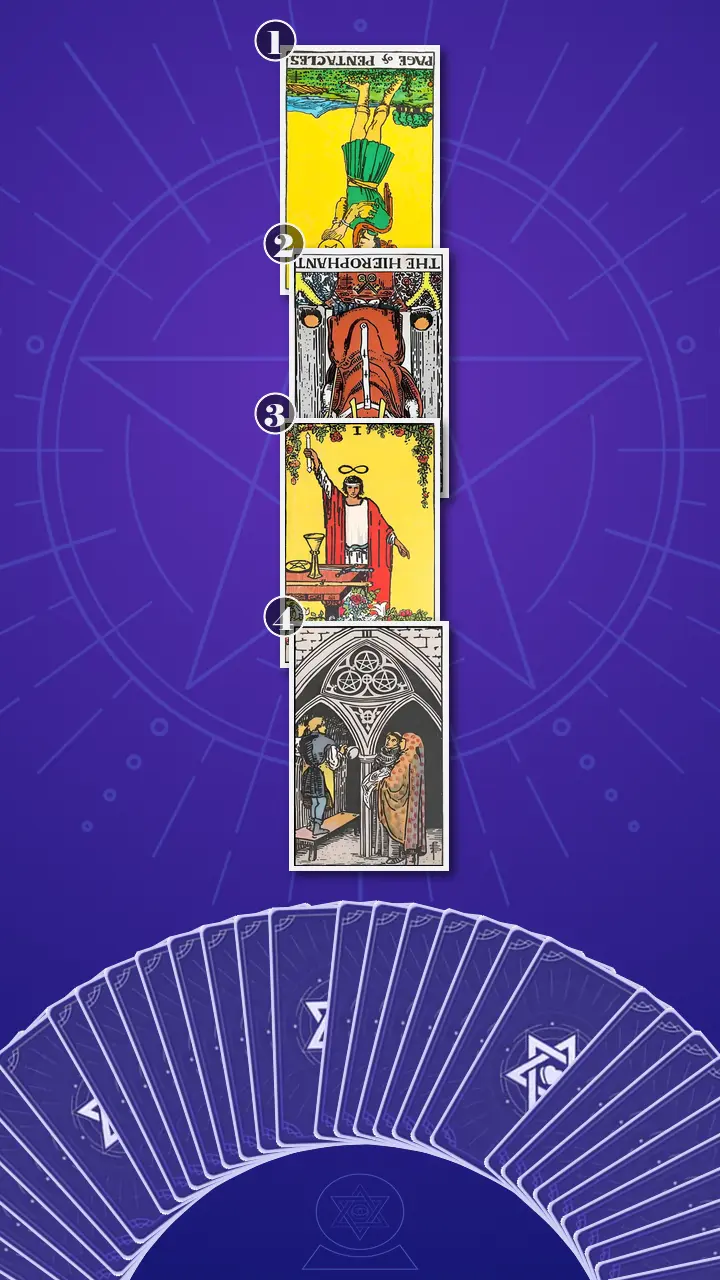
This spread fit her situation because Taylor did not need a dramatic past-present-future story. She needed a structure that could hold the whole logic chain. The first card would show the surface symptom: buying, studying, organizing, and researching instead of starting. The second would reveal the hidden fear and authority pattern making learning feel safer than action. The third card, the key card, would show the core shift that could restore self-trust. The fourth would ground all of it into a practical next step she could actually do this week.
I laid the cards in a straight line like a narrow staircase. That visual mattered. Her way out was never going to be a giant leap. It was going to be one honest step after another, down from mental overpreparation and onto solid ground.
Reading the Narrow Staircase Out of Overthinking
The Student Who Never Gets to Begin
I turned over the card representing the surface symptom: the concrete loop of buying, studying, and organizing instead of starting. Page of Pentacles, reversed.
I always notice the Page’s fixed stare first. In Taylor’s life, it looked exactly like a weeknight after work: she opens the portfolio draft she keeps saying she will finish, reaches the section where her real skill has to show, and immediately detours into comparing course outlines, bonus templates, and student testimonials until checkout feels easier than writing one imperfect paragraph. The card was not describing laziness. It was describing productive procrastination disguised as self-improvement, the Notion-second-brain effect where the system gets more polished while the actual work stays untouched.
Reversed, this Page turns healthy beginner energy into blocked earth. The desire to learn is real, but the energy gets stuck in stillness. Hours of effort happen, yet nothing becomes visible. I asked her the question this position always asks in real life: ‘The last time you opened the file that matters to you, what exact click pulled you out of making and into researching?’
She let out a short laugh, the kind that has a bruise under it. ‘The reviews,’ she said. ‘Always the reviews. That’s so accurate it’s almost mean.’ Her fingers stopped on the edge of her mug, then pressed against it again. That bitter little laugh was useful. It meant the card had found the loop where it actually lived.
The Altar of Permission
Next I turned over the card representing the mechanism beneath the symptom: the deeper fear and authority pattern that kept learning safer than action. The Hierophant, reversed.
This is where the reading went from familiar to surgical. In modern life, this card looks like hunting for the official method every time action gets close enough to expose your actual level: a mentor thread, a certification, a creator roadmap on TikTok, a LinkedIn post announcing a launch, or some polished promise that everything will make sense if you just follow the right order. The Hierophant usually deals with teachers, systems, and approved knowledge. Reversed, it asks a sharper question: am I actually seeking education, or am I seeking permission?
The crowned teacher and the kneeling students on the card made me think of algorithmic guru culture, the whole internet packaging every wobble as proof that you just need a better framework. Because I came to tarot through art, my mind flashed to an edit suite: the moment in a film where the protagonist keeps asking for one more note because stepping into the next scene would make the story real. In my Hero’s Journey Alignment lens, that is the classic Refusal of the Call. Not because the hero is weak, and not because she lacks talent. Because the threshold would make her visible.
‘When you feel shaky,’ I asked her, ‘whose framework suddenly sounds more trustworthy than your own lived skill?’
She went very still. First her breath paused. Then her eyes slipped off the cards and unfocused, as if she were replaying a TTC commute, a hot phone in her hand, another certification post, another search for the best portfolio format. Then I watched the thought land. ‘Honestly,’ she said, ‘anyone who sounds certain online.’ She exhaled and looked back at me. ‘I think I keep outsourcing permission.’
‘Exactly,’ I said. ‘Guidance offers tools. Permission makes you kneel.’ That was the first crack in the old logic.
When The Magician Cleared the Tabs
The Table Was Already Full
I turned over the card representing the core shift: the mindset and energy that could interrupt the loop and restore self-trust. The Magician, upright. The room went noticeably quieter when this card appeared; even the soft radiator hiss seemed to pull back for a second.
The Magician is the opposite of course-hoarding. Instead of staring at one missing thing, he stands at a table that is already full: cup, sword, wand, pentacle. In Taylor’s life, that image translated with almost absurd clarity. Close the learning tabs. Open one Google Doc, one old campaign result, one Canva file. Use the skills, notes, and job experience already on the laptop. More input versus one directed act. That was the whole hinge of the reading.
This is where I brought in another lens I trust deeply, what I call Vision Actualization. I told her that the story insisting she was not ready was just an old draft of her life, one that kept casting her as the student in act one so she would never have to play the practitioner in act two. Then I said the sentence her nervous system most needed to hear: readiness is not a certificate.
After a day of work, the blank document is open, the cursor is blinking, and your hand is already halfway to another course tab because buying still feels safer than being seen unfinished. I told her the real ache was not a lack of intelligence. It was the fear that one clumsy attempt might feel like a verdict on her worth.
Stop treating readiness as a certificate; use the tools already on your table and let action become the proof.
I let that line stay in the air for a beat. Then I added, more softly, ‘You are not missing the final piece of knowledge. You are missing the kind of proof only a real attempt can create. Action creates the proof learning keeps promising.’
Her reaction did not arrive as instant relief. First, she froze so completely that even her thumb stopped worrying the edge of her sleeve. Then her face changed in layers: one blink, a tiny flinch, eyes going glassy as if half a dozen private scenes had started replaying at once—the Apple Pay confirmation, the saved folders, the course launch emails, the cursor blinking in an untouched document. Then came the resistance. ‘But if that’s true,’ she said, and there was a brief spark of anger in it, ‘doesn’t that mean I’ve been waiting for permission I was supposed to give myself?’ Her shoulders lifted, then dropped a fraction. Her jaw unclenched. By the time she took her next breath, it sounded different—less like bracing, more like arriving. There was even a slight dizziness to it, the kind that comes when you set down a heavy box you forgot you were carrying. I told her no, it did not mean she had been foolish. It meant she had been protecting herself with the only strategy that looked respectable. Then I asked, ‘With this new angle, can you think of a moment last week when this would have changed how you felt?’
She nodded slowly. ‘Tuesday. The portfolio doc was open. I switched tabs because I thought I needed a better framework.’ She looked back at the card. ‘I probably just needed to write the bad first paragraph.’ That was the real turn—not from confusion to certainty, but from private rehearsal and contracted self-doubt to the first grounded inch of self-trust through visible action.
The Draft That Learns in Public
Finally, I turned over the card representing the embodied next step: the practical move that turns insight into lived change. Three of Pentacles, upright.
This card is craftsmanship in the real world. Not another private notebook. Not one more saved podcast episode filed under I should optimize this first. In Taylor’s life, it looked like sending a rough version to one trusted coworker or friend, asking one precise question, and letting comment bubbles teach her what anxiety never could. The scene on the card—plans in hand, work being discussed, skill shaped in view of others—was the antidote to solitary overpreparation.
Upright, the energy here is balanced earth: steady, practical, collaborative. Growth returns when the work exits the sealed chamber of her own head and enters a low-stakes feedback loop. ‘Feedback is data, not a verdict,’ I told her. ‘You do not need the whole internet. You need one pair of eyes and one honest question.’
This time she didn’t laugh. She just nodded, and I watched a small looseness return to her shoulders. ‘I could send one section to my coworker,’ she said. ‘Not the whole thing. Just the intro and ask what’s clear and what feels fuzzy.’ That was exactly the kind of sentence I want to hear in a reading—specific, modest, and real.
From Browser Tabs to Draft
When I stepped back from the spread, the story was clean. First came the visible loop: the stalled student, genuinely capable, turning learning into a shield. Beneath that sat the real knot: a distorted relationship with authority, where experts, certifications, and step-by-step roadmaps felt more legitimate than her own years of work. Then the antidote appeared: The Magician, reminding her that the table was already full, that existing knowledge was enough for a first experiment, and that action—not one more module—was what reveals the next learning need. The final card grounded the whole thing in shared craft: visible work, feedback, revision.
The blind spot was not that Taylor lacked information. It was that she had been using the absence of visible proof as if it were proof of absence—no finished draft, therefore no real ability. That is the trap. An unfinished task starts masquerading as a verdict on worth, and another course gets recruited as emotional cover. The transformation direction was far saner: shift from using learning to earn permission to using action to discover the next learning need.
I told her I did not want a grand reinvention. I wanted friction-low, actionable advice she could test in real life. So I gave her three next steps.
- The One-Tab Draft SprintThat night, I asked her to choose one note from an old course and turn it into one concrete output in a single document: a 150-word post draft, a three-slide outline, one portfolio case-study section, or one rough pitch paragraph. She would set a 25-minute timer, close every course tab, put her phone face down, and allow only one document to stay open.If 25 minutes feels too exposed, make it seven minutes or three ugly sentences. Visible does not have to mean public; it just has to exist.
- The Character Bible DirectiveBefore opening any advice content that week, I asked her to write a six-line character bible for the version of herself who ships V1: how she sounds when she feels the wobble, what she does in the first 60 seconds after opening the document, what she does instead of clicking a sales page, and the sentence she uses to choose the day’s next move starting with ‘I already know…’.Keep it on a sticky note or laptop wallpaper. The point is not fantasy; it is behavioral casting. Write the future self as someone you can audition for today.
- Send-the-Rough-Version PracticeBy Friday, I asked her to send one rough section to one trusted coworker in Google Docs or Slack and ask one narrow question: what feels clear, and what feels fuzzy? Then she would save the file into a simple folder structure called v1, feedback, and revise so the process had somewhere to go after first contact.Choose a low-stakes person on purpose. A screenshot, outline, or opening section counts. Feedback-before-framework is enough for this week.
I also suggested one gentle boundary around the permission spiral: if a sales email arrived right when motivation started wobbling, she could save the link and wait 72 hours before deciding. Not as punishment. Just long enough to find out whether the urge was hunger for knowledge or hunger for relief.
A Week Later, the Quiet Proof
A week later, Taylor sent me a message just after lunch. She had not bought the course. She had done the one-tab draft sprint, written a painfully rough portfolio intro, and sent it to a coworker. The reply she got back was simple: the strategy was strong, and the intro was fuzzy but fixable. I could feel the whole reading inside that update. Not a new identity. Not a perfect launch. Just one real piece of contact with reality.
She added something I loved because it was honest. The next morning, her first thought had still been what if I’m not actually good enough? But this time she laughed, opened the doc, and revised instead of researching. Clear, but still tender. Lighter, but not magically fearless. Exactly the kind of change I trust.
That is why I keep returning to the Four-Layer Insight Ladder when someone asks me why they keep buying courses and not starting. It turns symptom into fear, fear into resource, and resource into one embodied next step. The cards did not hand Taylor a destiny. They helped her see where she was outsourcing authorship, and once she saw it, the pen was back in her hand.
If tonight the blank document is open and your hand still reaches for another course tab, I hope you remember that what hurts there is not laziness. It is the fear that one awkward first try might make your worth feel measurable.
And if one small piece of visible work could teach you more than one more module, what would you let exist in one-tab, version-one form this week?
This story is adapted from psychological research, written so that those in a similar struggle can see their own pattern in it — and find their next step clearly.These insights are not a substitute for professional psychological, medical, legal, or financial advice.
Learn more about our Journey to Clarity.
How did this insight land for you?
🫂 This Resonates Deeply
🌀 Living This Story
✨ Now I See Clearly
🌱 Seeing New Possibilities
🧰 Useful Framework
🔮 The Confirmation I Needed
💪 Feeling Empowered
🚀 Ready for My Next Step
Author Profile
 AI
AI“I’ve always felt our lives are films currently in production. As an artist, I know that when you feel stuck, it’s often because you’ve bravely stayed in a painful scene for just a little too long. I’m not here to coldly analyze you. I want to sit closely with you, look at those difficult moments with profound empathy, and gently hand you the pen so you have the courage to write your next beautiful act.”
In this Personal Growth Tarot Reading :
Core Expertise
- Hero's Journey Alignment: Identifying your current stagnation as the classic 'Refusal of the Call' before a major character evolution.
- Vision Actualization: Rewriting the limiting narrative that insists you are not ready for the next stage of your life's plotline.
Service Features
- The Character Bible Directive: A creative visualization protocol to write the exact psychological and behavioral specs of your 'future self' to begin embodying today.
Also specializes in :
Explore Related Patterns:
Permission SeekingTaylor names the mechanism when she says anyone who sounds certain online becomes more trustworthy than her own lived skill. The mentor thread, certification, creator roadmap, and polished launch post all become authority objects that seem to hold the right to begin. Permission Seeking turns guidance into a gate. You are not only looking for information; you are trying to borrow the right to act from someone who sounds more official than your own experience. Buying the course feels responsible because it lets the decision to start remain suspended under someone else's framework. The important distinction is that guidance offers tools, while permission quietly moves authorship outside of you. Taylor's shift begins when she stops treating readiness as a certificate and starts using action as the proof that external authority kept promising.
Compulsive Self-ImprovementTaylor's self-improvement system is full of recognizable artifacts: course tabs, saved folders, launch emails, podcast episodes, bonus templates, and another promise that the right framework will make everything click. The visible pattern is not laziness; it is learning recruited as a safety ritual. Compulsive Self-Improvement appears when every wobble gets translated into a new upgrade before a real attempt is allowed. You are not refusing growth; growth has been rerouted into consumption because buying offers immediate relief and a temporary identity as someone doing the responsible thing. The story turns when Taylor uses one old note and one existing skill to make one concrete output. That matters because it moves self-improvement out of endless intake and back into evidence, revision, and contact with the work itself.
Perfectionism-Driven AvoidanceTaylor can build launch plans for other people all day, but one honest paragraph for her own portfolio sends her straight into course tabs. The issue is not that she lacks the skill to begin; it is that the first visible version feels too revealing before it has been polished. Perfectionism-Driven Avoidance uses improvement as an insurance policy against shame. You keep preparing because a flawed draft feels too final, even though it is only a draft. The mind treats imperfection as evidence, so it delays the evidence-gathering moment by calling another course the responsible next step. Taylor's breakthrough is small but exact: she probably just needed to write the bad first paragraph. That sentence breaks the perfectionistic spell because it separates a rough artifact from a final judgement of ability.
Productive ProcrastinationTaylor's Google Doc is open, the cursor is blinking, and the exact moment one honest paragraph has to exist, course tabs, reviews, templates, and checkout logic fill the screen. The behavior is not an absence of effort; it is effort redirected into a task that feels legitimate while protecting the draft from being seen. Productive Procrastination is the clean mechanism here: motion that relieves exposure without creating contact with reality. You get the moral cover of working on it, the short-term relief of a responsible-looking purchase, and the temporary identity of someone preparing well, while the risky deliverable stays untouched. The loop starts to loosen when visible output replaces preparation as the unit of progress. Taylor's one-tab draft sprint works because it removes the respectable detour and asks for one concrete artifact before another round of learning can become emotional cover.
Visibility AvoidanceEvery time Taylor's portfolio work moves close to being seen, the night turns into reviews, frameworks, and course tabs. Starting feels exposing because the draft would move her from private rehearsal into a visible practitioner role. Visibility Avoidance is not avoidance of effort. It is avoidance of contact: with a reader, a coworker, a public-facing artifact, or the reality that a first version will be incomplete. You can keep working endlessly in private because private effort cannot be judged the way visible work can. Taylor's low-stakes send to one trusted coworker is the corrective dose. It shows that visibility does not have to mean the whole internet or a final verdict; it can mean one pair of eyes, one narrow question, and one next revision.
Conditional Self-WorthTaylor's sharpest fear is not that the course content is missing; it is that one clumsy attempt might feel like a verdict on her worth. The unfinished portfolio draft starts masquerading as evidence that she has no real ability, even though she already uses related skills at work. Conditional Self-Worth binds self-evaluation to performance proof. You buy another course because it protects the fragile equation: if you are still learning, you do not have to find out what your current work says about you. The course keeps the self in a state of potential instead of exposure. The coworker's feedback interrupts that equation. Strong strategy and fuzzy but fixable intro gives Taylor a more accurate reality test: the work can need revision without making the self defective.
Feedback IntegrationTaylor sends a rough portfolio intro to one trusted coworker and receives a response that is plain enough to be usable: the strategy is strong, and the intro is fuzzy but fixable. That feedback gives her something no course review could provide, which is contact with the actual work. Feedback Integration turns external response into information instead of an identity verdict. You stop using courses as emotional cover when feedback becomes something your system can metabolize. The point is not to become fearless; it is to let a small piece of reality teach you what the next learning need actually is. The next morning, Taylor still has the thought that she might not be good enough, but she opens the document and revises instead of researching. That is the psychological shift: the feeling remains, but the behavior no longer obeys it.
Explore Related Struggles:
Permission ParalysisWhen the page feels exposed, you reach for a more official voice. The story makes that plain when she says she keeps outsourcing permission and trusts anyone who sounds certain online more than her own lived skill. That is why the next purchase feels useful even when it does not move the work forward. It gives you a temporary stamp of approval, a way to borrow authority before you have to stand behind the first imperfect version yourself.
Knowledge-Output GapYou can do the strategic thinking all day for other people, but your own portfolio still stalls at the point where one honest paragraph has to be written. The story keeps showing the same mismatch: more reviews, more templates, more course tabs, but the actual draft stays untouched. That gap matters because the extra input is not the missing piece. The missing piece is turning what you already know into something visible enough to get feedback from reality.
Perfect Readiness TrapYou keep opening the portfolio file at the exact point where it would have to become visible, and each time the work gets close to being seen, one more course review steps in. Not knowing enough yet becomes the reason the draft stays one step away from becoming real. Buying another course feels responsible because it promises a future version of readiness without forcing the present one to show up. The real tension is not a lack of intelligence. It is the way preparation keeps moving the finish line just far enough away to keep the first rough attempt out of view.
Explore Related Emotions:
Certainty HungerWhen Taylor feels shaky, anyone who sounds certain online becomes magnetic: a mentor thread, a certification, a creator roadmap, a clean promise that the right order will make everything make sense. The internet offers a loud substitute for the quieter evidence of lived skill. Certainty Hunger fits the craving underneath the course tab. You are not simply looking for information; you are reaching for the sensation of a solid floor, and certainty sold by someone else can feel steadier than the unfinished authority of your own first draft.
Permission AnxietyThree course tabs appear the second Taylor's own portfolio needs one honest paragraph, and later she says anyone who sounds certain online can feel more trustworthy than her own lived skill. You can see the emotional logic: the course is not only information; it becomes a substitute doorway someone else gets to unlock. Permission Anxiety fits because the pressure gathers around authorization, not curiosity. The body wants a credential, framework, or polished roadmap to make action feel allowed, so buying another course briefly quiets the exposed feeling while postponing the moment where you claim your own judgment.
Evidence AnxietyThe story names the trap directly: no finished draft, therefore no real ability. Taylor treats the absence of visible proof as if it proves absence itself, even though her job experience and existing tools are already on the table. Evidence Anxiety is the pressure to produce proof before you allow yourself to act. You keep trying to buy evidence in advance through courses and frameworks, but the only proof that can actually settle the question has to come from one real attempt.
Exposure DreadStarting felt exposing while buying felt responsible, and the story keeps returning to the same threshold: the exact section where her real skill has to show. The trackpad tapping, tight chest, and sudden course tabs all gather around the moment the work might become visible. Exposure Dread is the inner weather of being close enough to begin that the self feels lit up too brightly. You are not avoiding effort in that moment; you are avoiding the rawness of being seen in an unfinished state, where the first paragraph can no longer hide behind preparation.
Performance FreezeAt 8:47 p.m., Taylor's Google Doc is open, the cursor keeps blinking, her shoulders climb, and her chest tightens as her hand drifts into restless scrolling. The body is doing work, but the work is bracing, monitoring, and escaping the first visible sentence. Performance Freeze fits because the stuckness is physical before it is intellectual. You can know the next step and still feel your system clamp around it, turning a simple paragraph into a high-stakes performance where researching becomes the only movement that feels safe.
Self-Improvement ShameWhat Taylor had been calling self-improvement starts behaving like a safety ritual: more course tabs, more saved folders, more polished systems while the portfolio stays untouched. The respectable surface of learning makes the avoidance harder to call out. Self-Improvement Shame names the bruise under the productive disguise. For you, buying another course can feel responsible in the moment and quietly humiliating afterward, because the action promises growth while leaving the visible work exactly where it was.
Verdict DreadThe unfinished portfolio draft starts masquerading as evidence that Taylor has no real ability, and one clumsy attempt begins to feel like it could measure her worth. A blank Google Doc stops being a workspace and turns into a quiet courtroom. Verdict Dread captures the way an ordinary draft can feel loaded with final judgment. For you, the course purchase offers temporary shelter because it delays the imagined verdict; no visible attempt means no visible ruling, even when the delay itself keeps hurting.
Beginner ShameTaylor can run launch plans at work, yet her own portfolio asks for one imperfect paragraph and she reaches for course reviews. The sentence she finally lands on, that she probably just needed to write the bad first paragraph, exposes how much weight the rough beginning was carrying. Beginner Shame lives in that collision between competence and first-draft mess. For you, the hard part is not being new to the subject; it is letting your own work look unpolished long enough to become real, without reading that roughness as personal failure.
Cautious Self-TrustWhen The Magician reframes the table as already full, Taylor can name the smaller truth: she probably just needed to write the bad first paragraph. Her shoulders drop a fraction, her jaw unclenches, and the next breath sounds less like bracing. Cautious Self-Trust is not instant confidence. It is the tender return of enough inner permission to use the tools already in front of you, letting one imperfect action become a more reliable mirror than another promise of readiness.
Visibility ReliefTaylor sends one rough section to a trusted coworker and receives a response that the strategy is strong and the intro is fuzzy but fixable. The work meets another person's eyes and does not collapse. Visibility Relief fits because the feared contact becomes usable data instead of a verdict. For you, being seen in a low-stakes way can loosen the sealed chamber around the work, giving the draft a path forward that private preparation could never create.
Cautious MomentumA week later, Taylor has not bought the course; she has done the one-tab draft sprint, written a rough portfolio intro, sent it to a coworker, and revised instead of researching the next morning. The change is modest, specific, and repeatable. Cautious Momentum names that early movement after a long loop. You are still tender, and the what-if thought still arrives, but it no longer gets to take over the whole evening; the next inch of action has become available.
Explore Related Contexts:
Authority Approval BottleneckTaylor names the pattern directly when she says anyone who sounds certain online can feel more trustworthy than her own lived skill. Mentor threads, certifications, creator roadmaps, and LinkedIn launch posts become external checkpoints she consults before she lets herself write. Authority Approval Bottleneck is the pressure point where guidance stops being a tool and starts acting like a gate. You are not simply looking for better instructions; you are moving through a culture where polished expertise can make your own working knowledge feel unofficial. The bottleneck clears only when advice returns to its proper size and action becomes allowed before a credential signs off on it.
Portfolio Launch ParalysisTaylor can build launch plans for other people all day, yet one honest paragraph for her own portfolio sends her into reviews and course outlines. The work is not absent; it is trapped at the exact threshold where her skill would leave the private draft and become evidence. Portfolio Launch Paralysis captures the career stage where the next move is visible but public proof feels costly. You may have enough material to make a first case study, but the external demand for a polished professional signal turns the draft into a gate, so preparation becomes a way to stand beside the launch instead of entering it.
Readiness Mismatch CycleTaylor already has the tools on the table: job experience, campaign results, notes, old courses, a Google Doc, and a Canva file. The mismatch appears when those resources are treated as insufficient unless another course confirms that the start line is officially safe. Readiness Mismatch Cycle describes the gap between actual capacity and the external standard being used to judge capacity. You are not waiting because there is nothing to use; you are waiting because readiness has been defined as a certificate rather than a first experiment. The path back to clarity comes from letting one real attempt reveal what the next learning need actually is.
Algorithmic Self-Help SpiralMentor threads, TikTok roadmaps, LinkedIn launch posts, and certification promises surround Taylor at the exact moment she is trying to move from private learning into visible work. Each piece of content offers a more official sequence, a cleaner method, or a better portfolio format. Algorithmic Self-Help Spiral names the online environment that keeps turning ordinary creative uncertainty into another search. You can enter that spiral looking for clarity and leave with twenty new standards to satisfy before the first draft exists. The issue is not that every resource is useless; it is that the content system profits from keeping the next framework more clickable than the next sentence.
Professional Legitimacy ScrutinyThe portfolio paragraph matters because it would let Taylor's real level be seen outside the safety of her coordinator role. She can execute launch work for other people, but her own case study asks her to turn that competence into a public professional signal. Professional Legitimacy Scrutiny is the external pressure that makes a rough draft feel like a market test before it has had a chance to become craft. You are not only writing; you are stepping into a field where portfolios, certifications, launch posts, and polished proof can decide who appears credible. That scrutiny can make another course feel like protection, even when visible work would give you more useful evidence.
Version 1 Release CycleThe one-tab draft sprint turns a saved note into one concrete output: a rough post, a three-slide outline, a portfolio section, or a pitch paragraph. Taylor tests the cycle within a week by writing the intro, sending it to a coworker, and revising instead of researching. Version 1 Release Cycle is the external workflow that interrupts course-hoarding with contact, feedback, and iteration. You do not have to prove the whole identity at once; you need a first version that can meet reality and come back with information. That is how learning becomes attached to use rather than floating above it.