Three Drafted Paragraphs at 10:40 p.m.—And a Pause That Stayed Open

When a Family Talk Starts Feeling Like an Emergency
If you can manage a client escalation calmly but cannot leave a family group chat alone after one “not tonight,” you may know the feeling Maya brought into our session.
At 10:40 p.m. on a Tuesday, Maya had been sitting in her small Toronto apartment with the family chat open in one hand and an unfinished mug cooling beside her laptop. Blue phone light cut across the sofa. The radiator kept ticking, and an episode of Severance murmured from the TV without either of us pretending she had watched it.
She told me that a relative had written, “Can we do this another day?” Maya had opened Notes, drafted three careful paragraphs about why waiting would make things worse, deleted half, added three possible call times, and sent a longer version anyway. Her chest felt cinched like someone had tightened a drawstring beneath her ribs, while her fingers kept returning to the chat as if the next refresh might release it.
“I know I am pushing,” she said. “But silence makes everything feel worse. Waiting feels like letting the problem win.”
I could hear the real contradiction beneath the question. Maya wanted immediate clarity because the family bond mattered to her, yet waiting for shared readiness left enough uncertainty for her mind to forecast distance, rejection, and a permanent fracture. She was not only waiting for a reply; she was trying to stop the story that the reply's absence had started writing.
Her urgency reminded me of repeatedly pressing an elevator button because the doors have not opened. The extra presses do not move the elevator faster, but they give restless hands somewhere to put the fear. In Maya's case, each follow-up briefly reduced the pressure in her body while making the invitation feel less voluntary to everyone receiving it.
I said, “Wanting repair is not the same as needing it on command. I am not going to use tarot to predict what your relatives secretly think or tell you whether they will agree to talk. I want us to use it as an objective pattern map: what is happening, what keeps the loop running, and what remains within your control. Our journey to clarity is not about making the family move on cue. It is about helping you decide what a clear, respectful next move looks like.”

Choosing the Relationship Spread for Two Different Tempos
I invited Maya to put both feet on the floor and take one unforced breath. I shuffled slowly while she held a single question in mind: “Why do I keep forcing family talks before anyone is ready?” The pause was not mystical theatre. It was a transition from reacting to observing.
I chose a five-card Relationship Spread. I use this tarot spread for family communication when the central issue involves timing, consent, boundaries, or a pressure-and-withdrawal loop. A shorter three-card reading could have blurred together what Maya was doing, what her relatives had actually communicated, and what Maya feared their silence meant. A larger Celtic Cross would have added layers that this focused question did not need.
I arranged the cards in a cross that resembled a conversation table. The first card sat on Maya's side and would reveal her observable contribution to the pattern. The second faced it and would show only the family's observable readiness signals, without claiming access to anyone's private motives. The third occupied the centre, where the competing tempos met. Beneath it sat the internal challenge fuelling the visible conflict. Above it waited the constructive direction.
This is how tarot works best in a relationship question: not as surveillance into another person's mind, and not as a verdict about the future, but as a structured way to separate facts, interpretations, emotional reflexes, and available choices. The cards would not decide whether Maya should preserve closeness at any cost. They would help her see where sincere care had become entangled with pressure, so she could choose differently if she wished.
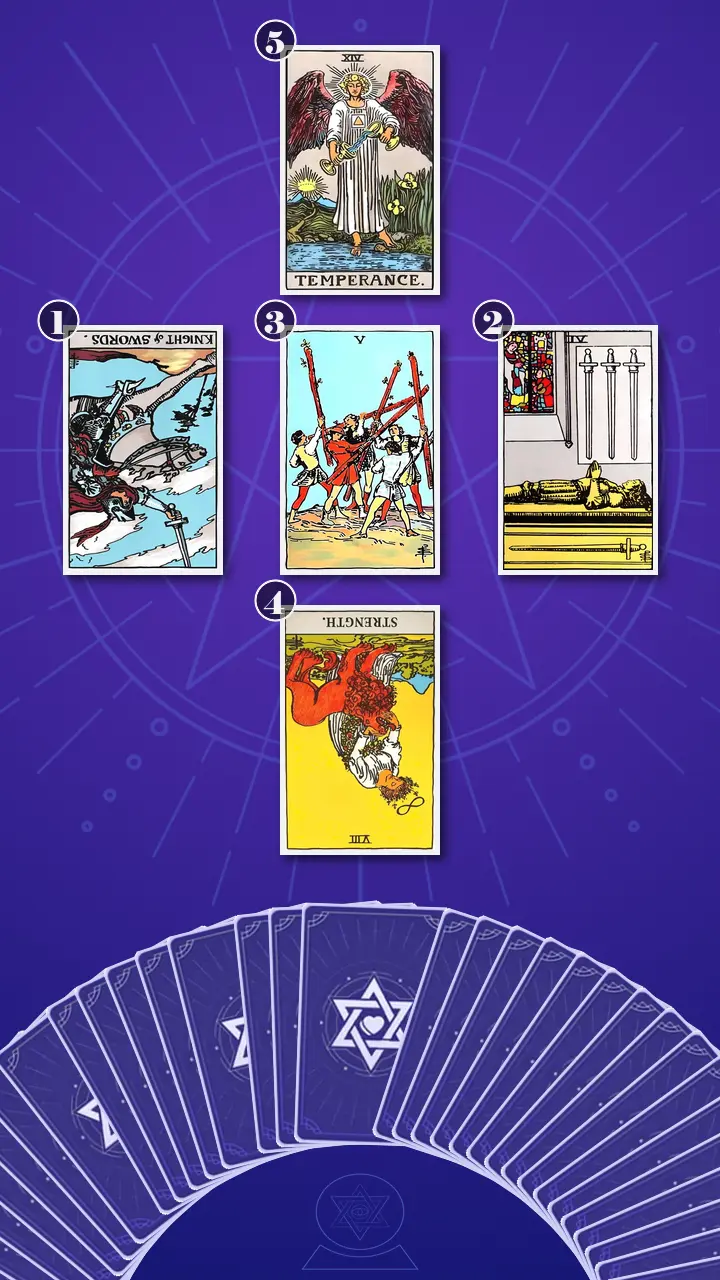
Reading the Split-Tempo Map
Position 1: The Message That Became a Charge
I said, “Now I am turning over the card that represents your observable role in the pattern, especially what happens after tension appears.”
The card was the Knight of Swords, reversed.
I pointed to the raised sword, the charging white horse, and the wind-bent landscape. “The Knight's directness is not the problem. You have the courage to name an issue instead of pretending everything is fine. But reversed, that useful energy is blocked by excessive speed. Sincerity becomes acceleration, and acceleration begins disguising pressure as clarity.”
I brought us back to the Notes draft. A relative had said she could not talk yet. Within ten minutes, Maya had written a case for why delay would worsen the issue, offered multiple call slots, and sent the follow-up before anyone had responded to the first invitation. What began as “I am only explaining” gradually became “I need them to make room for this now.” It had the energy of sending a five-paragraph Slack escalation into a family group chat because silence felt like an unresolved ticket.
“The raised sword becomes the perfectly argued text,” I said. “The charging horse becomes the Google Calendar hold created before anyone has agreed to attend. Your intention says, 'This relationship matters.' The speed can land as, 'Match my nervous system's timetable.'”
I asked, “Think about the last follow-up you sent. Did it create genuine choice, or did it make someone else's 'not yet' harder to maintain?”
Maya's breath caught first. Her fingers stopped against the rim of her mug, and her eyes moved away from the card as if she were replaying the message line by line. Then she gave a short, bitter laugh and let her shoulders drop half an inch.
“That is so accurate it is almost cruel,” she said. “I made a whole agenda and told myself I was being helpful.”
I did not treat the recognition as a confession. “Accuracy is useful only if it gives you more choice, not more shame. The Knight also carries honest directness. We are separating that gift from the speed that overwhelms it. Before the next follow-up, the practical question is simple: does this message leave room for a real no, a later, or a different format?”
Position 2: The Pause That Was Not a Verdict
I said, “Now I am turning over the card that represents the observable pause signals you receive and the assumptions you attach to them.”
The card was the Four of Swords, upright.
The figure rested beneath three suspended swords. Nothing in the image suggested that the issue had vanished. Active engagement had simply stopped long enough for mental space to return. Here the energy was balanced rather than absent: rest, temporary withdrawal, and thought being held without an immediate demand for action.
I was careful about the ethical boundary. “This card does not prove why anyone is quiet. It cannot tell us that your relatives are thoughtfully processing, secretly angry, or definitely coming back next Tuesday. It asks you to notice the information you genuinely have. Someone said, 'I need a few days.' There is no agreement to talk tonight. There is also no evidence that the relationship has ended.”
I asked Maya to revisit a Sunday evening at St. Clair station. She remembered three read receipts, the shriek of train brakes, the smell of wet coats, and the warm phone clenched in her palm. The facts had remained unchanged: three people had read the message, and no one had replied. What changed was the sentence she placed beside those facts.
Instead of “Nobody cares enough to answer,” I offered, “I have no evidence of a goodbye; I have evidence of a pause.”
Maya exhaled through her nose, slowly this time. Her grip loosened around the mug.
“A pause can be a boundary without being a goodbye,” I said. “It can be difficult information without being definitive information. The invitation still exists even while nobody has the capacity to open it properly.”
This Four of Swords became the catalyst in the spread. It did not ask Maya to abandon the subject, minimise her feelings, or wait indefinitely without boundaries of her own. It offered the first loosening in the urgency loop: a request for space could be treated as capacity data before it was interpreted as rejection.
Position 3: Five People Editing the Same Conversation
I said, “Now I am turning over the card that represents the interaction loop created when your wish for immediate repair meets requests for time, space, or another format.”
The card was the Five of Wands, upright.
Five figures raised their staves in different directions without a shared formation. The energy was in excess but uncoordinated: plenty of effort, heat, and investment, with no agreement about how that effort should move.
I described the kitchen-table video call Maya had told me about. Streetcar noise leaked through the window. Her tea went cold beside an open agenda. One relative wanted a few days, another wanted to text first, someone else wanted to wait until after an upcoming birthday dinner, and Maya kept arguing that the issue deserved a “proper” conversation.
“You were trying to solve the subject,” I said. “Everyone became stuck negotiating whether the subject could be discussed yet. The original hurt disappeared underneath a fight about dates, formats, attendance, and duration.”
The card did not divide the family into one person who cared and several who did not. I read it as a mismatch of communication tempos. Maya expressed care through immediacy and full discussion. Other relatives had expressed observable preferences for delay, privacy, text, or a smaller emotional load. Like five people editing the same Google Doc without agreeing what the document was for, every new comment created more friction before anyone reached the actual paragraph.
“The useful question is not who wins the timing argument,” I said. “It is what structure could let disagreement exist without compelling participation. Can the conversation still matter deeply if nobody can have it well tonight?”
Maya rubbed one thumb across the other, then unclenched her jaw. “We have spent more time fighting about having the call than talking about what happened,” she said. The sentence sounded painful, but the knot in her voice had begun to loosen. Naming a tempo mismatch gave her something more workable than the belief that the family bond was failing.
Position 4: When Urgency Becomes a Scheduling Authority
I said, “Now I am turning over the card that represents the central challenge beneath the pressure to talk: what makes waiting feel unsafe and what fear the physical discomfort may be carrying.”
The card was Strength, reversed.
I focused on the relationship between the woman and the lion. Upright, the image shows patient courage and compassionate self-command. Reversed, that capacity is blocked or temporarily deficient. The instinctive surge becomes difficult to hold, so controlling the external timetable can feel easier than remaining present with uncertainty inside the body.
I slowed the reading to the level of Maya's hands and breath. At 11:07 p.m., her phone would lie face-up on her thigh. The radiator would click. Her jaw would stay fixed, her breathing shallow, and her thumb would hover over the keyboard. The thought was not simply “I want to send another message.” It was “I cannot keep feeling this, so I have to do something.”
“That creates a false binary,” I said. “Send another message now, or disappear completely. Push for the talk, or give up on repair. Strength reversed shows a middle capacity that is hard to access under pressure: staying with the feeling long enough to choose a proportionate response.”
My mind went to a studio waveform from my years of sound-energy research: a track could be full of good material and still become exhausting when every element peaked at once. I used what I call a Tempo Misalignment Audit, not as a clinical diagnosis, but as a precise listening tool. I asked Maya to separate three rhythms: the speed of her wish for repair, the speed her body demanded relief, and the pace at which other people had actually consented to engage.
The audit showed the key friction point. Maya's wish for repair was legitimate. Her body's psychological and executive BPM accelerated when the chat went quiet. Her work-trained algorithm then treated the discomfort like a client escalation: clarify, follow up, schedule, close the loop. But a family conversation was not a support ticket, and another person's emotional bandwidth could not be converted into an action item.
“Your urgency is a signal, not a scheduling authority,” I said. “It may signal fear, longing, or the need for reassurance. You can listen to that signal without handing it control of the family calendar.”
Maya looked down at her phone and turned it face-down beside her. The movement was small, but I heard the shift in her next question.
“What if I pause and then overcorrect?” she asked. “I have done that too. I push, feel embarrassed, and stop replying entirely.”
“Then the goal is not silence,” I said. “It is proportion. You can acknowledge that the issue remains open, respect the request for time, and keep living your evening. Self-regulation is not a performance you complete before you are allowed to communicate. It is the space that lets communication remain a choice.”
When Temperance Poured Time Between Two Cups
Position 5: The Conditions for Repair
The room seemed to become quieter before I turned the final card. Even the radiator paused between clicks, and rain on Maya's window gathered into two thin streams before joining near the sill.
I said, “Now I am turning over the card that represents the most constructive, self-led approach: how you can preserve your honest wish for repair while respecting different levels of readiness.”
The card was Temperance, upright.
The angel poured water carefully between two cups, with one foot in water and the other on land. Here the energy was balanced: emotion and practical structure, movement and pause, honesty and consent. Temperance did not erase difference or demand that everyone adopt the same emotional tempo. It organised exchange into a proportion that each person could freely enter.
At 10:40 p.m., with a show playing unwatched and a longer family text open in Notes, Maya's urge had felt almost physical. If she did not send something now, the silence might turn into distance. Her chest tightened, her thumb hovered, and the whole evening began orbiting one unanswered message.
You do not create repair by speeding everyone up; create conditions for repair through measured, consent-based stages, as Temperance pours water carefully between two cups.
I left the sentence in the air.
First, Maya's breathing stopped for a beat. Her fingers remained suspended above the phone she had just turned over. Then her gaze slipped past the card and lost focus, as if the past week were replaying behind her eyes: the calendar hold, the extra paragraph, the video call that became an argument about having a video call. Her pupils widened, and the muscles around her mouth tightened before her shoulders slowly lowered.
The release did not arrive as simple relief. Colour rose around her eyes, and she looked briefly angry.
“But doesn't that mean I have been doing it wrong this whole time?” she said. Her voice began sharp, then thinned into a small tremor. “I thought I was the only one trying to keep us connected.”
I did not rush to take the discomfort away. “It means you used the strategy that gave you the fastest sense of movement. It also means you can now see its cost. That is not proof that your care was false, and it does not make every past attempt a mistake. It gives you responsibility for the next beat, which can feel freeing and exposing at the same time.”
Her hands opened in her lap. A long breath left her chest, followed by the slightly dazed stillness that can come when a familiar burden is set down and choice appears underneath it.
I asked, “Now, using this new perspective, can you think back to last week? Was there a moment when this insight might have let you feel differently?”
“When my sister said she could not talk before the birthday dinner,” Maya said. Her voice was quieter but steadier. “I treated that night like a test of whether she cared. I could have said it mattered to me without making that exact night prove it.”
That was the crossing I wanted the reading to make visible. Maya was moving from treating silence as evidence of rejection and urgency as a command to act toward treating pauses as information about capacity. It was not certainty about the family's outcome. It was the first piece of steadier self-trust inside uncertainty.
I used my second sound-based lens, Execution Rhythm Calibration, to translate Temperance into a communication sequence. I drew five small marks on paper: concern, consent, timing, one topic, pause. Maya did not need to force everyone into the same BPM. She needed a shared measure with enough rests for genuine participation.
I offered a concise example: “I want to talk about what happened because the relationship matters to me. Are people open to a conversation sometime this week or next weekend? A call, voice note, or text is all okay; please suggest what feels workable.”
“That is less 'emergency family summit' and more a well-made calendar invitation,” I said. “Clear purpose, realistic scope, and a real option to decline, delay, or suggest another format. Repair needs consent, not acceleration. One clear invitation leaves room for a real yes.”
I then invited Maya to draft her own four-sentence version within ten minutes. Before sending anything else, she would place her phone face-down for twenty minutes. If twenty felt too activating, she could begin with two minutes, make tea, shower, or walk one Toronto block. The point was not to suppress the issue or earn anyone's approval. It was to let the next message remain an invitation.
“I can say this matters without making tonight the test of whether it matters,” Maya read from the note she had typed for herself.
I nodded. Tarot had not handed her a guaranteed reunion or a perfect script. It had helped her hear the difference between carrying a wish for repair and carrying responsibility for everyone's readiness.
The Three-Day Syncopation Reset
I gathered the spread into one coherent story. Maya's prompt-reply work culture had trained her to equate speed with care and open loops with risk. The reversed Knight showed that habit charging into family communication. The Four of Swords showed observable requests for pause. Their collision ignited the Five of Wands, where everyone fought about the conditions of the conversation. Strength reversed revealed the internal fuel: uncertainty tightened Maya's body until action felt compulsory. Temperance offered the unused resource, a capacity for measured honesty that did not require instant access to anyone else's bandwidth.
The cognitive blind spot was not that Maya wanted too much connection. It was that she treated immediate movement as the primary evidence that connection was secure, while assuming she had to initiate, structure, and sustain every attempt at repair. In sound terms, she had been pushing every channel to maximum volume because she feared a rest would be mistaken for the end of the song.
The transformation direction was specific: make one consent-based invitation with a flexible time window, then stop following up until others respond. A pause could remain uncomfortable without becoming proof that the bond was disappearing. Her part was clarity, proportion, and respect for consent. The reply, timing, format, or refusal belonged to the other people involved.
I turned Temperance into my Syncopation Reset, a three-day tempo adjustment experiment. Syncopation works by changing where emphasis falls. Maya would place emphasis on one deliberate communication beat, then allow a rest instead of filling every gap with another message.
“But honestly,” Maya said, “I do not know if I can leave the phone alone for twenty minutes. I will spend the whole time imagining that the silence is getting worse.”
“Then twenty minutes is not the starting requirement,” I said. “Start with two. The reset is an experiment, not a test of discipline. We are looking for the smallest pause in which you can notice an urge without automatically converting it into a family deadline.”
- Day One: Write the Four-Sentence InvitationChoose one family topic. In no more than four sentences, name what you want to discuss, say why it matters to you, ask whether people are open to talking, and offer a broad window such as “this week or next weekend.” Include a choice of call, voice note, or text. Draft it in ten minutes, wait before sending, and check whether every option is genuinely safe to choose.Treat the word limit as a one-week experiment, not a judgment about how much your feelings matter. A shorter message protects choice; it does not minimise the concern.
- Day Two: Run the Phone-Down Pause-Is-Data CheckWhen the urge to send a second message arrives, timestamp the draft in Notes and place the phone screen-down in another room or a drawer. Set a twenty-minute timer, then write two lines: “What I know” and “What I am guessing.” Add only observable facts to the first line, then wash dishes, make tea, shower, or walk one block until the timer ends.If twenty minutes makes the pressure spike, begin with two minutes. Keep the original invitation visible as evidence that you have already made contact, and stop the writing exercise if it increases activation.
- Day Three: Protect a One-Topic Repair WindowIf someone opts in, ask which format feels workable before creating an agenda. Limit the conversation to one topic and thirty minutes, and begin by saying that anyone may request a pause. If nobody has replied, do not choose a format or time for them; leave the invitation open and return to one plan from your own evening.A fifteen-minute exchange still counts as a real conversation. No participant owes full disclosure, immediate closure, or a next appointment simply because the topic matters.
This was actionable advice, but it was not a strategy for producing a particular family response. The reset changed Maya's side of the rhythm. It allowed her to be honest without turning honesty into leverage, and it returned the rest of the family's choices to them.

A Week Later, the Chat Was Still Open
Six days later, I received a message from Maya. She had sent four sentences. Her sister had suggested exchanging voice notes the following weekend, one relative had said she was not ready, and another had not answered. Maya had not added an agenda, offered three more times, or recruited someone else to persuade the group.
Her message to me ended with, “I finished the episode that was playing. I checked the chat once, not twelve times. Nothing is fixed, but I did not abandon myself while I waited.”
That night she slept through until morning. Her first thought was still, “What if the distance hardens?” She noticed it, smiled tiredly, and did not reach for the phone. The clarity was real, but it remained tender.
I saw that as the quiet proof of our Journey to Clarity. Tarot had not repaired the family for Maya. It had shown her the pressure cycle clearly enough that she could interrupt it. The decisive power remained hers: state the wish, invite consent, respect the pause, and choose what to do with her own evening while the answer remained open.
When the family chat goes quiet and your chest tightens around the belief that waiting could make you easier to leave behind, it makes sense that your thumb reaches for one more message. That reaching may be care tangled with fear. Noticing the tangle means you are already hearing more than one beat.
If you let one clear invitation remain open between Temperance's two cups tonight, what small piece of your evening would you want to return to?