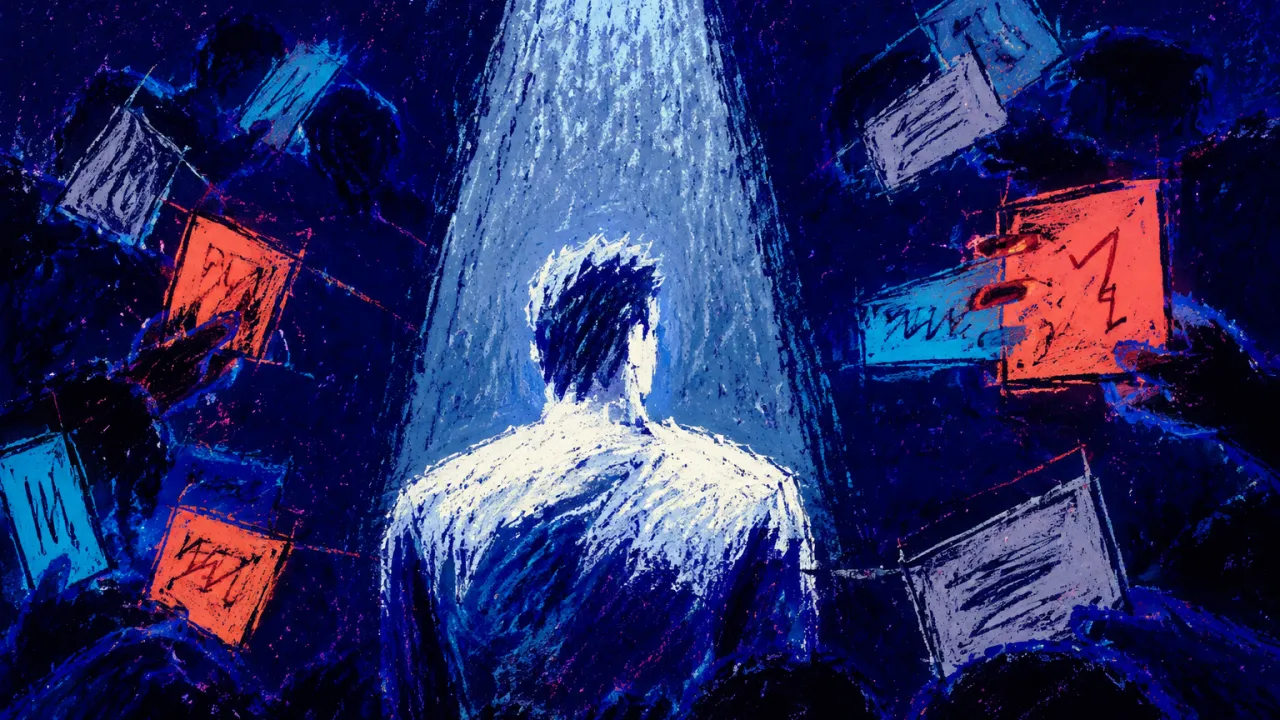
In a Social Performance Loop, the group keeps turning belonging into another demonstration of charm, confidence, usefulness, taste, humor, or availability. The tight chest before opening the group chat is part of how the body registers a social room that keeps asking you to prove your place. This is an environmental, structural dynamic, not a private flaw: the setting rewards presentation more consistently than mutual ease. The Tarot Cards below reflect the shape of that stage and the pressure of having to stay visible inside it.
The Magician ReversedThe raised wand and downward-pointing hand can harden into a frozen presentation pose, while the table turns every tool into visible proof. The scene becomes less like a workspace and more like a stage where competence has to be displayed before it is trusted. In social networks, this maps onto circles where belonging depends on constant charm, usefulness, taste, humor, or curated confidence. You are not only participating in the group; the group environment keeps asking for another demonstration that you deserve the spot. The reversed Magician exposes the exhausting structure behind that loop. The problem is not ordinary social effort; it is a social stage that converts every interaction into an audition and makes rest feel like disappearing.
The Chariot ReversedThe polished armor, crown, emblems, and starry canopy place the driver on display while the vehicle does not move. The image is full of status and composure, but the lack of visible reins and the stationary wheels expose the gap between looking in control and actually connecting. In social life, that gap becomes a loop of performing confidence, success, humor, availability, or ease while the real relational movement stalls. You are not dealing with simple tiredness; the structure shows a public persona that has become a social vehicle you keep standing in because stepping down would change how the group reads you.
Wheel of Fortune ReversedThe Sphinx is balanced above the wheel with a sword held in a composed display, while the outer figures appear as steady witnesses with open books. The scene has the feeling of being watched, read, and placed within a precise code of correct positioning. Social performance loops form in exactly that kind of environment. The group does not merely ask you to show up; it rewards the right tone, references, availability, politics, humor, taste, or confidence display until connection becomes a repeated audition. You are facing a social system that may be measuring presentation more than mutual ease. The card exposes the loop so you can distinguish genuine recognition from the exhausting work of staying legible to people who keep changing the standard.
Temperance ReversedThe pouring action is precise, but when its motion becomes the whole scene, the body is locked into continuous calibration. One hand adjusts to the other, one cup answers the other, and the figure remains suspended between environments without a completed arrival. That is the social performance loop: the constant editing of tone, timing, facial expression, reply speed, availability, and identity so you can remain acceptable to the room. The connection still moves, but it moves through management rather than ease. Temperance in this state exposes the difference between mutual adaptation and endless self-monitoring. The structure asks whether you are participating in a group or performing compatibility for a group that only accepts you while you keep adjusting.
The Devil UprightThe raised hand, the exposed figures, and the inverted sign above them turn the card into a stage of social display. Everyone has a position, and the scene rewards being visible inside the correct role. Social Performance Loop appears when friendship starts to feel like ongoing casting: be fun, desirable, available, unbothered, attractive, interesting, and never too much. The group keeps giving small hits of validation, but only when the performance stays on script. The downward torch shows energy being fed back into the same circuit. The useful audit is not whether you are good at performing, but which social spaces still recognize you when the performance drops.
The Sun ReversedThe child's open arms, red flag, and central placement create a body that is easy for the whole scene to read as cheerful. The visual signal is powerful, but it also places one small figure in charge of carrying the atmosphere. That is the social performance loop: a group learns to meet the bright version of you and then keeps asking for that version. The card gives the role a clear outline, so you can see where genuine warmth ends and where belonging has become dependent on staying entertaining, available, or upbeat.
The World ReversedThe dancer is centered like a living display, framed by a ring and watched from four corners. The scarf, red ties, and laurel loop keep motion circulating inside the same beautiful pattern, so the image can become less like free movement and more like a role that must be repeated. That is the social structure of performance-based belonging. You may be included because you know the timing, jokes, tone, and acceptable version of yourself, but the cost is that every gathering asks the body to keep dancing inside a script that no longer feels reciprocal.
Ace of Cups ReversedThe hand holds the ornate cup in a perfectly visible position, with the dove, disc, and streams arranged around it like a formal presentation. The image can become less like spontaneous feeling and more like the display of the right kind of feeling. A social performance loop forms when You are expected to appear open, healed, supportive, funny, or emotionally fluent while constantly tracking how the group reads You. The pressure is not only to belong, but to perform belonging correctly. The reversed Ace of Cups links to this context because its vessel is public, polished, and centered. The emotional flow becomes something to maintain on display, turning social presence into a repeated act of holding the cup steady for other people's expectations.
Three of Cups ReversedThe bodies are arranged so that every gesture reads socially, from the lifted cups to the colorful robes and synchronized dance. Celebration is not hidden inside the figures; it is staged outward, making the group mood something each person has to help maintain. For you, the pressure point may be the repeated demand to appear easy, fun, healed, or fine in social spaces. The card turns that performance into an auditable structure, showing where your public role keeps borrowing energy from the private work that has not had time to finish.
Seven of Cups ReversedThe mask-like head and covered figure sit among status symbols, desire symbols, and victory symbols, while the person below remains a dark outline. Identity is split into displayable pieces before any direct social exchange happens. That visual arrangement mirrors a group setting where every interaction requires a different version of you. The card reveals the loop beneath the exhaustion: social access is being maintained through performance, and the actual relationship has not been allowed to test whether it can hold a less curated presence.
Nine of Cups ReversedThe row of cups rises behind the seated man like a polished backdrop, while his crossed arms hold the body in a closed, presentable pose. The image is bright and successful, but it also turns satisfaction into something that must be maintained in front of others. Social Performance Loop appears when a circle rewards the look of being fulfilled more than the reality of being connected. You may keep posting, hosting, smiling, curating, or showing up because the group knows the display better than the person behind it. The card exposes the loop by separating the shiny social proof from the guarded body underneath. The more the cups dominate the scene, the more important it becomes to see where visibility has replaced contact.
Page of Cups ReversedThe Page's delicate clothes, poised hip, and raised cup create a charming social presentation around a fragile object. The body is not collapsed, but it is staged; the cup has to be held correctly, the softness has to remain visible, and the living signal has to look manageable. In a social network, that becomes the loop of being rewarded for the pleasant version of yourself. You may be expected to stay sweet, available, emotionally fluent, or easy to invite, even when that persona costs more energy than the connection returns. The card exposes performance as a container, not an identity. Once the role is visible, you can measure which groups welcome your full range and which ones only respond when the cup is held at the perfect angle.
Knight of Cups ReversedThe decorative robe, winged helmet, and careful cup create a polished social surface over armor. In reversal, the body has to maintain charm, control the horse, and keep the offering presentable at the same time, turning grace into a sustained public task. That pressure is the shape of Social Performance Loop. You are inside a social setting where being liked depends on staying warm, attractive, emotionally available, and composed, while the actual cost of that presentation stays hidden under the armor.
Two of Pentacles ReversedThe figure looks like a performer, one foot lifted, hands occupied, bright clothing turning balance into a public act. Nothing in the posture is relaxed; the whole scene depends on keeping the coins moving without revealing how much attention it takes. For you, that becomes a social environment where presence has to be performed. The card exposes the external role pressure underneath the charm: a group may be rewarding the version of you that manages the vibe while leaving very little space for unperformed contact.
Eight of Pentacles ReversedThe repeated pentacles hang like a public record of effort, while the craftsperson bends over the next coin with tools still raised. The body is not resting inside a community; it is staged in visible labor, where the next proof of usefulness is already demanded by the scene. That visual structure fits a social environment where connection depends on performance. Posts, replies, favors, hosting, productivity, competence, or constant availability become the visible coins that keep a person acceptable to the circle. In social life, this can turn belonging into a scoreboard. The card exposes the moment when contribution stops being a natural bridge and becomes a loop of public proof, making it harder for You to tell whether the group values your presence or only your output.
Page of Pentacles ReversedThe Page’s eyes do not scan the field; they stay fixed on the coin. The body becomes organized around maintaining one visible proof of value, as if the whole social world has narrowed to what can be displayed and assessed. In group life, that becomes the loop of performing the acceptable version of yourself before connection is allowed to breathe. You may keep refining the joke, the outfit, the achievement, the taste, or the story, while the actual exchange remains one-way. The card does not reduce this to insecurity. It shows a social structure where visibility has become conditional, and where the path back to real contact begins with noticing what the group keeps making you prove.
Nine of Swords UprightThe row of swords above the bed turns thought, speech, and social memory into a rigid display. The figure's covered face shows a private self trying to disappear after being visible, while the upright posture keeps the body alert instead of released into sleep. In a social performance loop, the group encounter does not end when the conversation ends. You are left auditing tone, timing, facial expression, jokes, replies, and whether your presence matched the role the circle expects from you. Nine of Swords is especially precise here because its pressure is not abstract. The blades sit exactly where social performance lands: in the head that replays, the throat that revises what was said, and the heart that measures belonging through every possible misread.
Knight of Swords ReversedThe knight is not only armed; he is visually styled for public recognition, with plume, cloak, armor, and symbolic markings carried into the charge. The body becomes an image of competence before it becomes a participant in any shared space. In social life, that image can become a loop where every gathering, post, introduction, or group interaction has to prove decisiveness and intensity. You are not simply connecting with people; the social field starts rewarding the version of you that looks most impressive under pressure. The card exposes the cost of that loop without shaming the performance. It asks where visibility has replaced reciprocity, and where the role you show the group is taking up more space than your actual need for belonging.
Ace of Wands ReversedThe wand is lifted in a way that makes vitality visible. Its power is not blunt force; it depends on being recognized as a living signal by the surrounding field. When that signal becomes the whole social contract, the image hardens into performance. The open landscape offers no private backstage, so energy has to keep appearing fresh, confident, and available. For group life, this describes the loop where every reply, outfit, post, joke, or invitation becomes a test of whether you still belong. The card helps separate real connection from the pressure to keep presenting a socially acceptable spark.
Two of Wands ReversedThe figure stands above a prosperous domain in deep red and dark brown, holding the globe like a symbol of range while remaining motionless on the wall. In reversal, the height becomes a display position: status is visible, but contact with the living field below is thin. For you, this maps a social loop where success signals, curated taste, or impressive proximity become the price of being recognized. The card exposes the cost of performing progress for a circle that sees the surface clearly but does not create real exchange.
Six of Wands ReversedThe horse moves slowly through the crowd while the rider keeps the wand raised and the audience keeps its wands lifted in response. In reversal, that movement can become a loop of display and feedback rather than a completed passage. This is the social performance loop: the outer world keeps rewarding the visible version, so the visible version must keep returning to the stage. You may find yourself posting, proving, smiling, updating, explaining, or announcing because the role only feels stable while people are still responding. For introspection, the card makes the loop observable without turning it into a moral failure. It shows where attention has become the fuel source for a self-presentation system that now needs a quieter source of continuity.
Page of Wands ReversedThe Page's raised chin, formal grip, and vivid costume create a body arranged for presentation. The message travels outward, but no receiving crowd is visible, so the performance has to keep proving itself against an empty field. Social Performance Loop is the social structure that forms when visibility replaces reciprocity. You keep supplying the right tone, confidence, aesthetic, or availability because the group rewards the signal more reliably than it recognizes the person holding it.
Queen of Wands ReversedThe Queen faces outward with an open posture, a sunflower in one hand and a wand in the other, while the throne keeps her framed as a figure to be read. The scene is socially legible before it is private; warmth, confidence, desire, and authority are all arranged for contact with the viewer. Reversed, that outward arrangement can become a loop in which every interaction demands a managed version of aliveness. Social Performance Loop describes the external rhythm where you keep reading the room, adjusting the signal, offering warmth, and maintaining charm before the inner self has a chance to register what it actually wants. For introspection, the card exposes how performance can masquerade as connection. It asks you to identify which social environments require constant energetic editing, because those are the places where your inner bandwidth is being spent before real self-contact can begin.
No cards available for this filter.