The 18C Screenshot and the Quiet Shame Spiral
If you’re a late-20s city office worker who sees the first 18C weekend on Thursday and instantly starts texting ‘Anyone doing anything?’ into three group chats, I already know the shape of the panic you’re carrying.
When Maya sat across from me, she didn’t start with a dramatic life crisis. She started with weather. As she described Thursday at 8:47 p.m. in her shared Toronto kitchen, I could almost hear the fridge hum and feel the cool floor under bare feet: The Weather Network open in one tab, Instagram Stories in another, OpenTable half-loaded, three chats blinking at once, her phone hot in her palm while blue screen light made the room feel later than it was.
‘I just do not want to waste the weekend,’ she said. Then, quieter: ‘Why does having no plans feel weirdly embarrassing?’
That was the real hinge. She wanted the first warm weekend to feel easy and alive, but the second there was white space on the calendar, she treated it like a leak she had to patch before anyone noticed. Her panic felt to me like a carbonated storm trapped under the ribs—tight chest, restless hands, thumb moving faster than desire could speak.
I nodded and gave her the first sentence I wanted her nervous system to hear: Warm weather is not a social emergency. Then I said, ‘I’m not here to shame the spiral. I’m here to help you see it clearly. Let’s make a map for this fog so you can stop letting a sunny forecast run your whole interior world.’

Choosing the Compass: A Four-Card Tarot Spread for Warm-Weather FOMO
I asked Maya to take two slow breaths and hold one question in mind: what am I actually trying to secure when I panic-book the first warm weekend? Then I shuffled. For me, that moment is never about theatre. It’s just a clean psychological transition—from reacting, to observing.
For this session, I used the Situation-Obstacle-Advice-Outcome · Context Edition, a four-card tarot spread for warm-weather FOMO and belonging anxiety. I chose it precisely because this issue wasn’t a sprawling life audit. It was a tight trigger-response loop: forecast, panic, overbooking, flat ending. A compact spread let the pattern stay visible instead of getting buried under too much symbolism.
This is how tarot works best in a reading like this: not as fate, but as a mirror with structure. The first card would show me the visible behaviour. The second would reveal the deeper block beneath it. The third would offer the medicine—the reframe that could interrupt the loop. The fourth would show the grounded way forward once the insight was actually lived. I laid the cards left to right like a weather front moving across the city: phone-lit urgency on one end, settled warmth on the other.
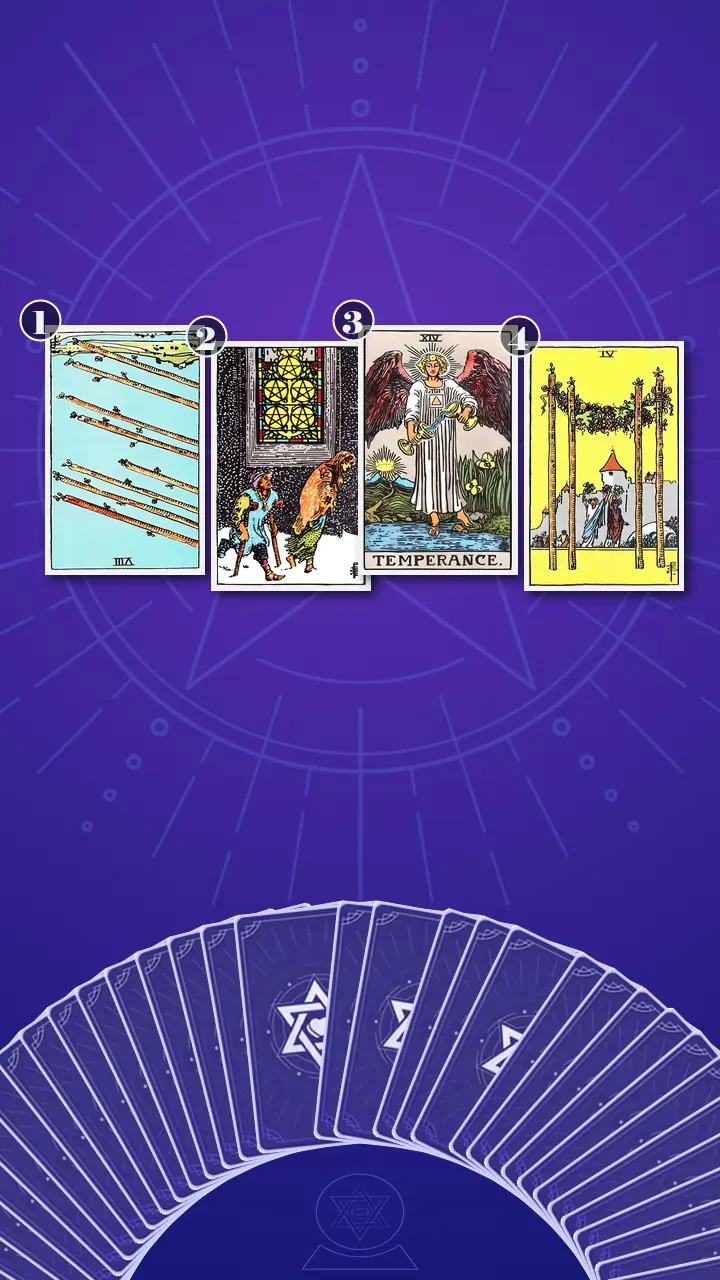
Reading the Weather Front
Position 1: Motion Without Arrival
The first card I turned over represented the visible panic-booking behaviour that appears as soon as the first warm weekend enters the forecast. It was the Eight of Wands, reversed.
Reversed, this is fire in blockage—speed in excess, direction in deficiency. I told Maya I could see Thursday at 9:03 p.m. immediately: the forecast flips sunny and warm, she jumps from The Weather Network to Instagram to OpenTable to three group chats, sends ‘what are people doing Saturday?’ to everyone, tentatively agrees to brunch and a park hang, and keeps browsing anyway because getting something onto the calendar matters more, in that moment, than whether the plan fits her mood, budget, or energy. The flying wands on the card felt to me exactly like notifications, tentative texts, and half-made plans shooting across a screen faster than the body can sort them.
‘This is motion without arrival,’ I said. ‘Like having ten browser tabs open and calling it a plan.’
She laughed once, sharp and a little bitter. ‘Okay,’ she said, wincing right after. ‘That is painfully accurate.’ Her fingers tapped the side of her mug, then went still. I’ve learned to respect that kind of stillness. It usually means the card has landed before the person is ready to admit how far down it goes.
I asked her the question this position always asks in real life: when the warm forecast dropped, what was she actually hoping to stop feeling? She looked at the table for a second too long before answering. ‘Embarrassed,’ she said. ‘And weirdly behind.’
Position 2: The Patio Seen Through Glass
The second card represented the belonging fear and social scarcity story that makes an open weekend feel unsafe or embarrassing. It was the Five of Pentacles, upright.
This card is deprived earth—the energy of lack, or more precisely, the interpretation of lack. I told Maya I could feel the whole scene: Friday at 6:11 p.m. on the TTC ride home, train brakes squealing into the station, damp coats and sweet-salty takeout in the air, two patio Stories and one rooftop post sliding by on her phone while Saturday still has gaps. Suddenly the open calendar stops feeling like freedom and starts feeling like visible proof that she’s on the outside. The lit stained-glass window in the card becomes everybody else’s sunny-day glow online; the figures in the cold become the version of you who reads ordinary uncertainty as exclusion.
‘The panic is real,’ I told her, ‘but it is not about the forecast. It’s about the story blank space starts telling.’
Her reaction came in a clear three-step sequence. First her breath paused. Then her gaze drifted just past the cards, unfocused, the way people look when a memory starts replaying itself without permission. Then her shoulders dropped a fraction and she said, almost annoyed with herself, ‘Why does having no plans feel weirdly embarrassing?’
I answered gently. ‘Because somewhere in the loop, open stopped meaning unchosen and started meaning unwanted. That’s the obstacle. Not your social life. Not your character. The meaning your mind is pasting onto empty space.’
In my own mind, I had one of those quiet inner flashes I often get after years of reading cycles for people: after a long winter, the first warmth can hit like false scarcity. The tide comes in a little, and the nervous system reacts as if it may never return. But urgency is not always truth. Sometimes it is just thaw meeting loneliness.
When Temperance Poured Between Two Cups
Position 3: The Card That Slowed the Whole Room
The third card represented the key reframe that interrupts the rush-to-book pattern and restores self-trust. It was Temperance, upright.
The room changed when I turned it over. This was the hinge card—the antidote. Maya was still caught in that familiar Thursday-night state: warm forecast, lit-up phone, group chats waking up, chest buzzing with the feeling that if she did not secure something immediately, Saturday itself might become evidence that she had been left behind.
In ordinary life, Temperance looked almost disarmingly simple. Before answering the next invite, she opens Notes instead of another booking app and writes three lines: one plan I actually want, one open block I will protect, one honest check-in about my energy and budget. One foot on land and one in water. Logistics and feeling in the same room.
This is where I used one of my own lenses, something I call Macro-Cycle Phase Identification. After a long gray stretch, the first 18C weekend can trick the nervous system into acting as if the whole season has been condensed into forty-eight hours. It hasn’t. This is first thaw, not final chance. Then I ran what I call a Systemic Friction Audit. Toronto spring is full of structural noise: patios flood the feed, friend groups organise late, reservation apps gamify scarcity, and suddenly it looks as if hustling harder should fix the discomfort. But no amount of refreshing can solve a belonging wound by brute force.
The panic is not proof that the weekend must be full; it is the moment belonging gets handed over to the calendar.
You do not need to cram the whole season into forty-eight hours; let Temperance’s steady pouring remind you that warmth lasts longer when you stop treating it like scarcity.
Maya’s hand froze halfway to her phone. Her inhale caught and stayed there. Then her eyes slid away from me, not evasive, just suddenly far off—as if she were watching a dozen Thursdays replay at once: typing bubbles appearing and disappearing, the quick brunch yes, the second invite stacked on top of the first, the low-grade panic hiding under the word spontaneous. When she looked back at me, there was a flash of resistance in it. ‘But if I slow down,’ she said, voice sharper now, ‘won’t I just end up with nothing?’
I shook my head. ‘No. You might end up with one true thing instead of five placeholders. That is not nothing.’ I let the silence do its work. Outside, a streetcar bell sounded faintly through the window, and the quiet after it felt almost medicinal. The anger left her jaw first, then her mouth. Her shoulders loosened. One hand opened flat on the table. The breath she let out sounded like relief mixed with dizziness—the strange lightheaded feeling that comes after putting down a bag you forgot you were carrying. I asked her, ‘Using this lens, can you remember a moment last weekend that would have felt different if you hadn’t let the calendar define belonging for you?’ She nodded slowly. ‘After brunch,’ she said. ‘I was already managing drinks. I wasn’t even there.’
That was the breakthrough: the first real move from weather-triggered social panic to grounded, intentional belonging. Not certainty. Not perfection. Just the first step from visible fullness toward felt warmth. A full weekend is not the same thing as a felt weekend.
Position 4: Inside the Weekend, Not Auditing It
The fourth card represented the grounded way of relating to warm weekends once plans are chosen from desire rather than panic. It was the Four of Wands, upright.
This is steady fire—connection in balance, warmth with a frame around it. I translated it for Maya like this: by Saturday, the weekend has one clear centre. Maybe a park walk with one friend. Maybe a patio lunch she genuinely wanted. Maybe a solo coffee-and-book stop after one social plan. The point is not less aliveness. The point is a hearth instead of a sparkler. Her social energy was never the enemy; it just needed a container.
The symbolism mattered. Five of Pentacles had shown her watching warmth through glass. Four of Wands showed her inside it. ‘This,’ I told her, ‘is what belonging looks like when you stop using invite volume as a self-worth metric. You pin one place in Google Maps and let the day orbit that instead of zigzagging across the city trying to make the weekend look valid.’
She smiled then—small, surprised, real. The kind of smile that reaches the shoulders before it reaches the mouth. Grounded hope usually arrives that way. Quietly.
From Overbooking Weekend Plans to One Chosen Anchor
When I stepped back and read the full line of cards, the story was beautifully direct. The Eight of Wands reversed showed the spark turning chaotic before it had somewhere to land. The Five of Pentacles showed the colder script underneath: if Saturday stays open, maybe I am the one outside the glow. Temperance interrupted that by mixing desire with pacing, feeling with structure. The Four of Wands showed the landing: not a photogenic obstacle course, but a weekend with a doorway.
The blind spot wasn’t that Maya wanted connection too much. It was that she had quietly turned Google Calendar into a popularity scoreboard and invite volume into borrowed proof of belonging. The real shift was this: stop treating an empty sunny weekend as evidence of social failure, and start treating it as neutral space where one thing can be chosen on purpose.
I gave her a version of my Orbital Sync Protocol, a 72-hour reset for the first warm forecast. I use it when someone is trying to hustle past a noisy transition or force a whole season to arrive at once. The goal is not to become less social. The goal is to stop abandoning yourself in the name of seeming plugged in.
- Warm Forecast PauseThe next time the weather app flips warm, set a 30-minute timer before opening OpenTable, Resy, or event listings. In your Notes app, write: ‘What kind of day do I want?’, ‘How much social time do I actually have energy for?’, and ‘What is my max spend this weekend?’ If someone texts during the pause, reply with something simple like, ‘Let me check my Saturday and get back to you in a bit.’Tip: If 30 minutes feels impossible, start with 5. The urgency is part of the loop, not proof that you have to obey it.
- Belonging Story CheckWhen the group chat goes quiet or replies are slow on Friday evening, write one private sentence beginning with ‘The story I’m telling is…’ Then mute Instagram Stories for 20 to 60 minutes and text one trusted friend directly with a real question like, ‘Want to do one simple thing Saturday?’Tip: Naming the story does not make it more real. It separates feeling from fact so comparison cannot write your weekend before you do.
- One-Anchor WeekendBy Friday night, choose one concrete anchor for the weekend—a 12 p.m. brunch, a 3 p.m. park walk, or a solo coffee-and-book hour—and protect it first. Leave one block unscheduled on purpose in Google Calendar and label it ‘open on purpose.’ If a second invite appears, ask yourself: ‘Will this deepen the day, or just make it look fuller?’Tip: If a two-hour open block feels too exposed, make it 45 minutes. Choose one anchor before you chase five possibilities.
I ended that part of the reading with two lines I wanted her to keep: Open on purpose is not the same as left out. And one chosen plan can carry more warmth than a weekend built out of panic.

A Week Later, the Quiet Proof
A week later, Maya sent me a screenshot of her calendar. One green block said ‘park walk with Nina.’ A pale block beside it said ‘open on purpose.’ Her text read: ‘I still had the urge to stack more on top. But I did the pause, muted Stories for a bit, and let one plan be enough.’
A minute later, she sent one more message: ‘I still woke up Saturday with that tiny what-if-I’m-wasting-it thought. I just laughed this time and made coffee.’ I loved that update because it was honest. Clear, but still human. Lighter, but not magically cured. Exactly the kind of real shift I trust.
When I thought back on our reading, that was the whole Journey to Clarity in miniature. Not a transformed personality. Not a perfect social life. Just one moment where self-trust spoke before panic did. That is why this Situation-Obstacle-Advice-Outcome Context Edition reading works so well for warm-weather FOMO: it turns a messy feeling into a pattern you can actually work with, and once the pattern is visible, your agency comes back online.
If the first warm weekend makes your chest tighten before you have even made a plan, the ache is often less about sunshine and more about how fast an open calendar can feel like standing outside the warmth.
So when the next 18C screenshot lands and one sunny block is still open, what threshold would you choose to step into on purpose—and let one chosen thing be enough?
This story is adapted from psychological research, written so that those in a similar struggle can see their own pattern in it — and find their next step clearly.These insights are not a substitute for professional psychological, medical, legal, or financial advice.
Learn more about our Journey to Clarity.
How did this insight land for you?
🫂 This Resonates Deeply
🌀 Living This Story
✨ Now I See Clearly
🌱 Seeing New Possibilities
🧰 Useful Framework
🔮 The Confirmation I Needed
💪 Feeling Empowered
🚀 Ready for My Next Step
Author Profile
 AI
AI“After a decade of guiding people through the stars, I’ve come to see life much like the orbits of planets: everything has its inevitable cycles. When you feel lost, please don't blame yourself; you might just be in a natural low tide. I’m here to sit under the night sky with you, offering a gentle cosmic perspective to distinguish temporary pain from the beautiful breakthroughs just around the corner.”
In this Timing Tarot Reading :
Core Expertise
- Macro-Cycle Phase Identification: Objectively locating your current position within inevitable long-term cycles to explain current resistance.
- Systemic Friction Auditing: Stripping away the illusion that 'hustle' can override a cyclical low tide or structural pause.
Service Features
- The Orbital Sync Protocol: A 72-hour exercise to intentionally pause forced actions, aligning your psychological expectations with your actual cyclical reality.
Also specializes in :
Explore Related Patterns:
Exclusion SpiralThe Friday TTC scene shows the spiral clearly: two patio Stories, one rooftop post, and a Saturday with gaps are enough to make Maya feel as if she is standing outside the warmth. Nothing in the story proves she has been rejected, but the blank space on the calendar starts carrying the emotional weight of exclusion. Exclusion Spiral names the cognitive loop where neutral or incomplete social information gets read through a rejection filter. A quiet group chat, slow replies, or an unplanned block stops being ordinary uncertainty and becomes a signal that everyone else has access to belonging while you have somehow missed the door. This pattern matters because it explains the embarrassment underneath the booking rush. You are not just trying to make plans; you are trying to interrupt the feeling of being visibly left out. The practical shift is not forcing certainty from other people, but separating social facts from the story your nervous system pastes onto empty space.
FOMOMaya's first response to the 18C screenshot is not a calm check-in with herself; it is a fast jump from weather app to Instagram Stories, OpenTable, and three group chats. The forecast becomes a trigger that compresses the whole season into one urgent social window, so booking something quickly feels like the only way to stop the shame from spreading. That is the mechanism of FOMO here: not simply wanting fun, but treating other people's visible plans as evidence that time, belonging, and social proof are running out. Her attention tunnels toward patios, rooftop posts, group replies, and empty calendar blocks until the question shifts from 'What do I want?' to 'How do I make sure I am not missing the thing everyone else is inside?' The pattern explains why panic-booking happens before desire has time to speak. You are not reacting to sunshine alone; you are reacting to a scarcity story that makes the weekend feel like a public test of whether you count. Once that story is named, the calendar can become a tool again instead of a scoreboard.
Relationship Performance AnxietyMaya's loop has a clear sequence: warm forecast, social panic, overbooking, then a flat ending where she is already managing the next thing instead of feeling the current one. The calendar is not just organizing time; it is being asked to prove that her social life is valid. Relationship Performance Anxiety names the pressure to make connection look convincing enough from the outside. In this story, belonging gets converted into visible evidence: invite volume, Google Calendar density, patio access, and whether the weekend appears socially active. The anxiety is not about one brunch; it is about whether the whole social self is passing inspection. This pattern is central to the question because panic-booking is the performance behavior that tries to outrun shame. You are not failing at weekends; you are caught in a metric that cannot deliver what it promises. A full-looking calendar can signal activity, but it cannot create the felt security that comes from choosing one honest form of connection and letting it be enough.
Self-AbandonmentMaya agrees to brunch and a park hang before she has checked whether either plan fits her mood, budget, or energy. The most revealing detail is that she keeps browsing anyway, because the immediate goal is not pleasure; it is making the open space disappear before it can feel embarrassing. Self-Abandonment shows up when the body has information but the social threat feels louder. Her desire, capacity, and budget are available data, yet they get pushed aside so the calendar can perform belonging on her behalf. The defense is understandable: if being full looks safer than being open, overriding yourself can start to feel like strategy. This pattern explains why the weekend can become busy but still feel flat. You may end up with proof that you were invited or occupied, while the part of you that needed an honest rhythm gets left out of the decision. The repair begins when one chosen plan and one protected open block are allowed to matter more than looking socially booked.
Social OverextensionMaya does not stop once brunch and a park hang are tentatively on the table. She keeps scanning, stacking, and managing possibilities, until the weekend starts to look full from the outside while her actual presence inside it gets thinner. Social Overextension is the behavior-level expression of the belonging fear. More plans temporarily reduce the shame of open space, but they also scatter attention, strain energy, and turn connection into calendar management. The plan becomes less about being with people and more about making sure there is no visible gap where insecurity can speak. This is why the line 'I was already managing drinks. I wasn't even there' lands as the breakthrough. You can have a packed weekend and still miss the felt warmth you were trying to secure. The one-anchor approach works because it replaces volume with containment, letting one real point of connection carry the day instead of asking five placeholders to prove you belong.
Boundary DiscernmentMaya's protected block labeled 'open on purpose' is small, but psychologically it is a boundary. The same calendar gap that once felt like a leak becomes a chosen space, which means it no longer has to be defended against as evidence of being left out. Boundary Discernment appears when she can tell the difference between a plan that deepens the day and a plan that merely makes the day look fuller. That question restores separation between social opportunity and self-abandonment. An invitation can be welcome without automatically becoming an obligation, and an open block can be intentional without becoming shameful. This pattern gives the warm weekend a cleaner internal structure. You are not rejecting connection; you are refusing to let panic define every available inch of time. The boundary lets belonging become something you step into on purpose, rather than something you chase by erasing your own needs.
Emotional RegulationMaya's practical reset starts with a pause before opening booking apps or replying to invitations. The weather still triggers the old body response, but the response no longer has to become immediate scheduling behavior. Emotional Regulation is visible in the way she separates feeling from fact. Writing 'the story I am telling is...' gives the shame spiral language before it becomes a plan, and muting Stories reduces the comparison input that keeps the nervous system activated. Texting one trusted friend directly also replaces scattered reassurance-seeking with a grounded relational move. The clearest proof is not that the what-if thought disappears; it is that she can notice it, laugh, and make coffee. You are not trying to eliminate every flicker of FOMO. You are building enough inner space that the first flicker does not get to run the whole weekend.
Timing DiscernmentMaya's shift begins at the exact point where the old loop would normally accelerate: before answering the next invite, she opens Notes instead of another booking app. That tiny pause changes the weekend from a reflexive scramble into a decision she can actually participate in. Timing Discernment is the regulated version of the same trigger. The warm forecast still arrives, the group chats still exist, and the urge to stack more plans still appears, but she inserts a timing boundary before action. By naming one wanted plan, one protected open block, and one honest check-in about energy and budget, she lets the body and the calendar speak in the same room. This pattern does not make her less social; it makes her less governed by the first wave of urgency. You can still choose connection, but the choice lands differently when it comes after a pause. The screenshot a week later matters because it shows discernment becoming behavior: one park walk, one open block, and enough self-trust to let the weekend breathe.
Explore Related Struggles:
Metric-Compass FusionMaya's calendar stops being a practical tool and starts behaving like a scoreboard. Brunch, a park hang, another possible drink, another refresh: each added block seems to promise more certainty, but the story shows her becoming less present as the visible evidence increases. Metric-Compass Fusion is the struggle underneath that trade. The measurable thing begins to steer the meaningful thing. Invite volume, calendar density, and social visibility become easier to read than the quieter signals of mood, budget, energy, and genuine desire. That is why the full weekend can still land flat. A metric can confirm that something is happening, but it cannot confirm that you are actually inside your own life while it happens. The repair is not to reject planning; it is to demote the metric back into a tool so your felt sense of warmth can lead again.
Outsourced BelongingMaya's open calendar does not stay neutral for long. The story shows her looking at a warm weekend and feeling as if the blank space is visible, almost embarrassing, as though an unfilled Saturday could announce that she has not been chosen. Outsourced Belonging names the way her sense of social safety gets handed to external evidence. Group chat replies, calendar density, patio plans, and invite volume start carrying the weight of a deeper question: am I inside the warmth, or watching it through glass? You can feel how heavy that becomes when ordinary uncertainty turns into a verdict about your place among other people. The panic-booking makes sense inside that structure. She is not only trying to schedule brunch; she is trying to borrow proof of belonging from the shape of the weekend. The shift begins when open space can become neutral again, because one chosen plan can hold connection without forcing the whole calendar to testify on your behalf.
Scarcity Compass LockMaya does not respond to the first warm weekend as a simple opening. She responds as if the season has narrowed into one fragile window, and if she fails to secure enough of it quickly, warmth, connection, and aliveness might pass without her. Scarcity Compass Lock names the way fear of missing the window starts deciding what counts as a good choice. Even after tentative plans are in motion, she keeps browsing because one plan cannot satisfy a system that is asking for total proof. You can have something on the calendar and still feel driven to capture more when the compass is calibrated to scarcity. The story's turning point comes when the weekend is allowed to be first thaw, not final chance. That reframes the whole pressure field: the question stops being how to grab enough before it disappears and becomes what one real anchor could let you actually inhabit. Scarcity shrinks time; choice gives it back.
Urgency-Compass FusionMaya sees the first 18C weekend on Thursday night and her attention immediately scatters across the weather app, Instagram Stories, OpenTable, and three group chats. The movement looks like planning, but the story shows her acting before her own preference has had time to form: brunch, park hang, more browsing, more checking, more proof that Saturday will not be empty. That is the core structure of Urgency-Compass Fusion. The faster the trigger arrives, the more her inner compass gets replaced by external speed. You are not simply wanting a good weekend; the forecast becomes a command signal, and the body starts treating delay as danger even when nothing has actually been lost. The struggle deepens because every tool around her rewards immediate action. Apps, posts, and chats give her something to do, but they cannot answer the quieter question underneath: what kind of day would actually feel like mine? Panic-booking becomes the moment agency gets outsourced to urgency, and the work is to let desire speak before the calendar starts driving.
Social Acceleration StrainThe Thursday-night scene is all velocity: blinking chats, half-loaded booking pages, patio Stories, a hot phone in her palm, and a body trying to keep up with every signal at once. Maya is technically standing in her kitchen, but the social field has already pulled her into motion. Social Acceleration Strain appears when the environment starts moving faster than your capacity to choose from inside yourself. Warm weather, late-arriving plans, reservation scarcity, and public-looking social proof compress the weekend before it even begins. You are asked to respond at feed speed while your actual desire still needs human time. That is why the panic feels so convincing. The pressure is not only internal; it is built into a city rhythm where everyone appears to be mobilizing at once. The useful interruption is not withdrawal from connection, but deceleration: enough space to tell the difference between aliveness and being swept along by the speed of other people's plans.
Joy Performance FatigueMaya wants the weekend to feel alive, but the story shows aliveness slowly turning into something she has to demonstrate. After brunch, she is already managing drinks; the next plan begins stealing attention from the one she is physically inside. Joy Performance Fatigue is not about disliking social plans. It is the strain that appears when pleasure has to look convincing from the outside before it is allowed to feel real on the inside. You keep adding proof of a good weekend until the performance of having one starts draining the weekend itself. This is why one anchor matters so much in the reading. A single chosen plan gives warmth a place to land; five placeholder plans can keep the body moving while the self goes missing. The deeper invitation is to stop making joy audition for visibility and let it become inhabitable again.
Explore Related Emotions:
Belonging ShameMaya asks why having no plans feels weirdly embarrassing, and that question becomes the hinge of the whole pattern. She is not describing a lack of options so much as the exposed feeling of blank space, as if a white block on Google Calendar could be seen and judged. Belonging Shame names the moment open time stops feeling neutral and starts feeling like evidence against You. The shame is quiet because nobody has actually rejected You in the scene, yet the calendar is carrying the weight of being unchosen, unwanted, or somehow behind.
Conditional Belonging FearOn the TTC, patio Stories and a rooftop post slide past while Saturday still has gaps. The open calendar stops reading as flexible time and starts reading as proof that everyone else has access to the glow while You are still outside it. Conditional Belonging Fear fits because belonging has been handed over to invite volume. You can feel okay only if the weekend looks occupied enough, social enough, valid enough. Panic-booking becomes a temporary membership card, even though it cannot give the deeper steadiness You are asking the calendar to supply.
Grounded BelongingBy the end, the weekend has one clear centre: a park walk with Nina, plus an open block left on purpose. The image has moved from watching patios through glass to being inside one chosen pocket of warmth. Grounded Belonging fits because connection no longer depends on multiplying plans until the weekend looks impressive. You are building belonging through one real point of contact, a reachable place, and enough space to actually feel the day while You are in it.
Social FOMOThursday at 8:47 p.m., Maya has The Weather Network, Instagram Stories, OpenTable, and three group chats open while the phone heats in her palm. The first warm weekend is no longer just weather; it becomes a public scene that seems to be happening elsewhere, and You start chasing proof that You are inside it. Social FOMO fits because the pressure is not simply wanting plans. It is the body reading slow replies, patio posts, and an open calendar as a signal that the city is moving without You. Panic-booking becomes an attempt to close the gap between seeing the warmth online and feeling connected to it in real life.
Premature Bloom AnxietyThe first 18C screenshot makes the whole season feel compressed into one fragile weekend. Maya treats a single sunny block like a limited opening that has to be secured before warmth, friends, patios, and possibility all move on without her. Premature Bloom Anxiety names that false seasonal countdown. You are responding to first thaw as if it were final chance, so desire gets crowded by rush. The body is not just trying to make Saturday nice; it is trying to prove that life has restarted and You did not miss the reopening.
Quiet Self-TrustBefore answering the next invite, Maya is asked to open Notes and write one plan she actually wants, one open block to protect, and one honest check-in about energy and budget. A week later, she still feels the urge to stack more on top, but she pauses, mutes Stories, and lets one plan be enough. Quiet Self-Trust fits because the shift is small and observable, not dramatic. You do not need total certainty before choosing differently; You need one moment where Your own read of Your energy arrives before the rush to prove You are included.
Directionless UrgencyMaya jumps from weather app to Stories to OpenTable to three chats, says yes to brunch and a park hang, then keeps browsing anyway. Her body is moving faster than her desire can sort itself, so action becomes a way of outrunning the discomfort rather than choosing a weekend. Directionless Urgency fits because the speed has no true landing place. You are not moving toward one wanted plan; You are trying to make the exposed feeling stop. That is why a fuller calendar still feels unfinished, and why ten open tabs can feel like momentum without relief.
Grounded PresenceMaya realizes that after brunch she was already managing drinks, which meant she was not really there. The next version of the weekend is built around one anchor instead of a citywide zigzag of placeholders. Grounded Presence fits because the desired shift is not emptier time, but inhabited time. You move from auditing whether the weekend looks valid to noticing whether it actually feels warm, chosen, and livable from inside Your own body.
Guilt-Free RestThe pale calendar block labeled open on purpose is as important as the green park-walk block. It turns unscheduled time from an accusation into a protected part of the weekend. Guilt-Free Rest fits because the story is not asking You to become less alive or less social. It is asking You to stop treating rest as failed participation. When a solo coffee, a book, or a quiet block can sit beside one social plan without apology, the weekend no longer has to perform productivity or popularity.
Explore Related Contexts:
Conditional Belonging PressureMaya sees white space on the calendar and treats it like a leak she has to patch before anyone notices. On the TTC ride home, two patio Stories and one rooftop post slide by while Saturday still has gaps, and the open space stops reading as freedom. The outside pressure is a conditional version of belonging. Plans become proof, invite volume becomes a receipt, and an ordinary unscheduled block starts to look like evidence that she is not inside the social glow. You are not only deciding what to do; you are being pushed to verify that you count. This is why having no plans feels embarrassing in the story. The calendar has been asked to answer a social question it cannot actually answer. Once that pressure is visible, you can separate belonging from booking volume and let one direct connection carry more weight than a crowded schedule.
Social Performance LoopMaya has quietly turned Google Calendar into a popularity scoreboard and invite volume into borrowed proof of belonging. The story shows her saying yes to brunch, stacking a park hang on top, and still browsing because a full-looking weekend feels more secure than a chosen one. The loop is built through visible metrics. Instagram Stories display the patio version of social life, group chats create public response pressure, and calendar blocks start to function like evidence that the weekend is valid. You get pulled into managing how the weekend appears before you can notice how it actually feels. That makes the issue larger than simple planning. The performance system rewards fullness, speed, and visibility, even when those things disconnect you from the day itself. The exit begins when a plan is allowed to be valuable because it is wanted, not because it raises the weekend's social score.
Social Overcommitment SpiralAt 9:03 p.m., Maya tentatively agrees to brunch and a park hang, then keeps browsing anyway. Getting something onto the calendar matters more in that moment than whether the plan fits her mood, budget, or energy. The spiral works by turning each placeholder into another logistical demand. One plan does not settle the pressure because the real task has become making the weekend look full enough. You can end up coordinating the next thing while sitting inside the thing you already chose. The clearest proof comes after brunch, when Maya is already managing drinks and realizes she was not even there. Overcommitment is not creating more aliveness in this story; it is fragmenting attention across too many social claims. A single chosen anchor interrupts the spiral by giving the weekend somewhere to land.
Algorithmic Comparison LoopOn the TTC ride home, two patio Stories and one rooftop post slide by while Maya's Saturday still has gaps. The feed supplies a fast, edited version of everyone else's warm-weather life at the exact moment her own weekend is still undecided. That sequence creates a comparison loop with an external structure. The platform shows the most photogenic fragments first, then the open calendar supplies the contrast, and the gap starts to feel more meaningful than it is. You are reacting to a curated stream of social evidence, not to the full reality of your relationships. The reset includes muting Stories because the input itself is part of the pressure. Once the feed stops writing the weekend first, the calendar can become a planning tool again rather than a comparison screen. That gives you enough distance to ask what would actually deepen the day.