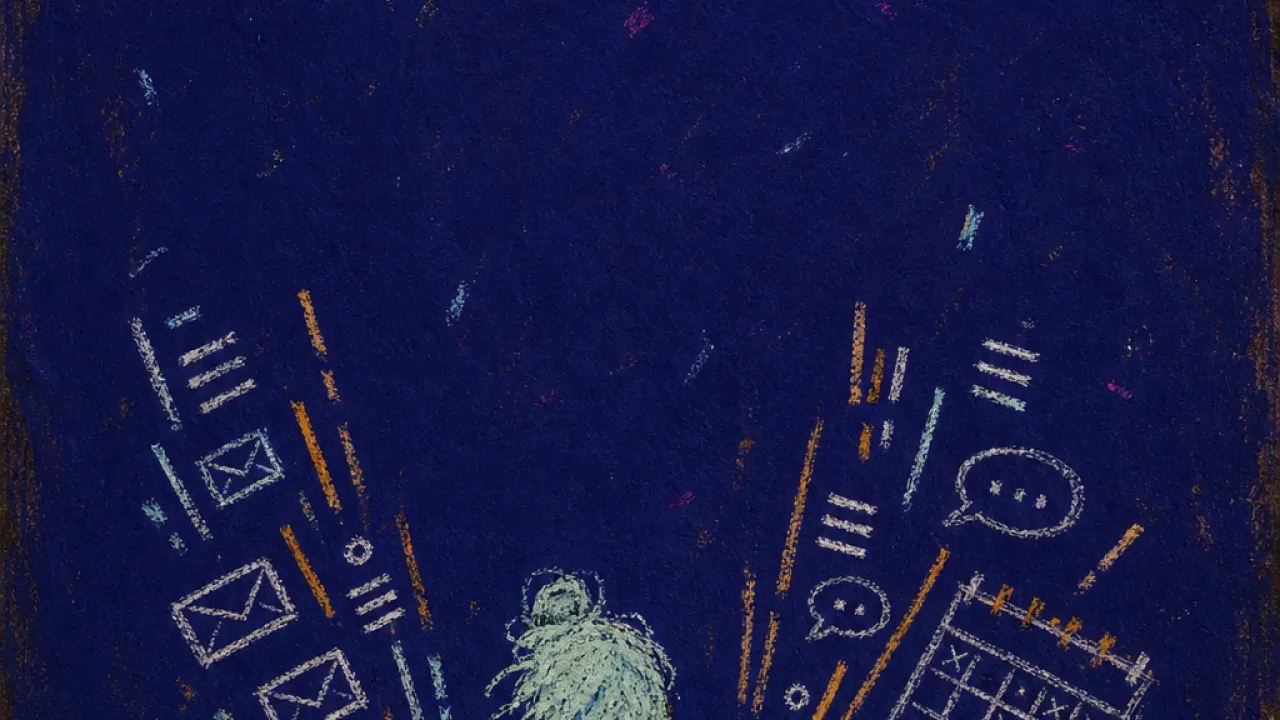
In Timing Signal Overload, the outside field keeps turning messages, deadlines, advice, delays, and openings into cues that all seem to require attention. The raised shoulders and hovering hand over the next reply are not random; they are the body meeting a pace that never gives signals a queue. This is an environmental, structural dynamic: the problem is built into how the inputs arrive, repeat, and compete for authority. The Tarot Cards below mirror that crowded field and the pressure it puts on timing.
Nine of Swords ReversedThe nine swords form a clean row, but the quilt below scatters repeated and incomplete timing symbols. The image pairs excessive order above with broken code underneath, so the timing field becomes both over-structured and unreadable. That is the anatomy of signal overload. Too many inputs can look like clarity from a distance, but when they reach the body they divide decision, voice, and commitment into competing demands. The card’s value is that it does not treat confusion as a lack of intelligence. It shows a system where the signals themselves are overproduced, repeated, and incomplete, making discernment harder until the field is simplified.
Page of Swords ReversedThe Page stands inside a sky full of motion: birds crossing above, wind moving through the body, clouds gathering close, and the sword held upright like another signal. There is no single cue dominating the scene; the pressure comes from too many cues arriving at once. Reversed, that becomes timing signal overload. In introspection, you may be trying to read delays, coincidences, silence, sudden contact, changes in tone, or small external shifts as if one of them will reveal the correct inner move. The card shows the cost of that interpretive climate. The mind becomes sharp but scattered, and the work is no longer to find more signs; it is to identify which signals belong to the real situation and which ones are only keeping the inner system suspended.
Knight of Swords ReversedEvery visible element in the card is moving or pointing with intensity: sword, plume, clouds, trees, horse, and rider all compete to become the dominant signal. The sky is clean enough to see the direction, but the force of the wind makes the whole field feel over-amplified. For timing questions, this creates an environment where every cue can start to look urgent. A message, deadline, trend, social comparison, or sudden opening may feel like it requires instant response because the surrounding atmosphere is already charged with speed. The card shows how signal and noise become difficult to separate when the body is locked into acceleration. Timing Signal Overload names the external condition of too many prompts arriving at once. The value of the card is not to make another loud command, but to map which signal is actually attached to a viable path and which one is only wind pressure.
Ace of Wands ReversedFalling leaves, running water, green banks, grey hills, and a distant fortress all compete for attention around the raised wand. The image contains several kinds of movement at once: immediate ignition, slow terrain, drifting fragments, and a long-range landmark.\n\nTiming signal overload appears when every cue starts to look actionable. A small opening, a delay, someone else's progress, and a sudden burst of energy all become competing data points instead of a coherent rhythm.\n\nYou do not need to obey every signal just because it is visible. The card helps sort live timing from noise by asking which cues actually connect the wand to ground, route, and sustainable motion.
Two of Wands ReversedThe view from the battlement contains too much at once: globe, walls, wands, fertile land, calm sea, mountains, and gray sky. Every symbol offers orientation, yet the body remains suspended between reading the map and entering the terrain. For timing questions, this points to a field crowded with cues that all claim authority. You regain clarity by separating structural signals from noise, so the next move is not dictated by every milestone, warning, trend, or outside opinion at once.
Three of Wands ReversedThe horizon is wide, the sea is active, the hills are faint, and three wands divide the foreground into separate reference points. The scene offers many signals at once rather than one obvious command. That abundance turns into timing noise when every cue seems to demand interpretation. You are trying to read a window while too many external markers compete for authority, making hesitation a response to signal conflict rather than a lack of will.
Five of Wands UprightThe crossed wands do not create one clear arrow through the card. They create a noisy mesh of possible directions, while the sky behind them stays bright enough to suggest that the larger situation is not closed. This is the visual logic of too many timing cues arriving at once. You may be seeing signs to act, reasons to wait, pressure to keep up, and warnings to slow down, all in the same field, until the signal itself becomes difficult to separate from the noise. The card gives the overload a concrete shape. It asks for discernment inside motion, not another louder cue, because the timing problem is not the absence of information but the lack of hierarchy among competing signals.
ReversedThe raised wands create a mesh of signals, all visible in clear daylight but none arranged into a sequence. Motion is everywhere, yet the crossing lines make it difficult to tell which movement is a cue and which is just interference. For a direction reading, that visual noise becomes the experience of watching every event, conversation, and comparison as if it might decide the next long-range move. The card exposes a signal environment that needs sorting before timing can become useful.
Six of Wands ReversedFive raised wands belong to indistinct holders, and the central wand intersects with the angled lines around it. What looks like support can also become a crowded signal field. In timing work, this describes the moment when too many outside markers claim authority over the next move. The card does not reduce the question to more information; it names the need to distinguish a real route from a chorus of signals.
Seven of Wands ReversedThe six lower wands do not form a road; they form a barrage. Each one points upward with urgency, forcing the figure to react to the next incoming line instead of orienting toward the horizon. In a direction question, this becomes the pressure of too many timing signals: move now, wait longer, pivot before it is too late, stay consistent, prove yourself, protect your position. The more signals arrive, the harder it becomes to tell whether any single one deserves authority. The reversed texture of the card shows direction being replaced by reaction. You are not without energy; your energy is being spent intercepting every signal before it has been sorted into real guidance, outside noise, or borrowed urgency.
Eight of Wands ReversedThe sky is full of wands, all moving at once and all angled toward arrival. Their order is clean, but their number matters: eight separate signals enter the same field without any hand, gate, or visible receiving body deciding what should land first. In a personal growth context, this becomes the pressure of simultaneous timing cues. Every course, prompt, goal, notification, and inner deadline can look urgent when it travels in the same direction, even when the system receiving it has no sequencing boundary. The reversed card does not treat the overload as weakness. It shows a real external condition: too many aligned signals can still overwhelm agency when there is no filter between momentum and action.
Nine of Wands ReversedThe figure's gaze is fixed to the side, yet the thing being watched stays outside the frame. A small gap in the wand line turns into the point of maximum attention, and the body braces as if every cue might matter. This is how timing signal overload takes shape: the environment offers fragments instead of a clean threshold. You may be reading delays, pauses, reactions, and partial openings as if each one must decide the whole move, while the card shows that the signal field itself is overcrowded.
Knight of Wands ReversedThe card is crowded with fire signals: red horse, red plume, bright tunic, upright wand, armor, dunes, and distant pyramids all pointing toward movement. In reversal, that density can feel less like clarity and more like too many clocks ringing at once. Timing signal overload appears when every cue starts looking urgent: a peer milestone, a deadline, a social expectation, an opening, a fear of missing the window, a desire to prove readiness. The scene gives that overload a visual form by stacking heat, status, direction, and distance into one compressed field. This context helps separate signal from volume. The card asks which cue actually belongs to the current terrain, because not every bright marker is a command to move now.
Queen of Wands ReversedThe Queen is surrounded by repeated signals: sunflowers, lions, crown points, warm colors, the cat clasp, and the black cat below. The image is rich with cues, but that richness can make attention circle the symbols instead of moving toward one grounded step. Timing Signal Overload appears when every cue starts to look like evidence. You may be reading comments, delays, invitations, coincidences, market shifts, or other people's milestones as if they all deserve equal weight, which turns timing into a crowded interpretive field. The clear sky does not automatically create a clear path. In this card, the work is not to collect more signals, but to separate the few cues that actually change your next move from the decorative noise around them.
King of Wands ReversedLions, salamanders, red cloth, yellow panels, and the live fire lizard repeat the same heat signal across the image. The desert offers no road, shade, buildings, or natural markers, so intensity multiplies while orientation stays thin. You encounter this context when every cue seems urgent but none of them clarifies the right moment. The card shows signal overload as a timing problem: too much heat, too little feedback, and no stable marker that separates readiness from noise.
No cards available for this filter.