The 11:38 p.m. Tab Spiral
If you're in your mid-20s, living in Toronto, on a contract job, and your Sunday Scaries look like LinkedIn, grad portals, and Rentals.ca all open at once because one missing date can stall the other two, I know the shape of that paralysis well. Jordan sat across from me and described 11:38 p.m. on a Tuesday in her apartment near Bloor-Yonge: laptop balanced on the duvet, LinkedIn on one side, a half-written statement of purpose on the other, rental listings tiled underneath like a second shift she hadn't agreed to work. The screen light was hard and blue, the laptop fan warmed her wrists, and her coffee had gone cold before she noticed she was still rewriting the same first sentence.
She said, 'I can't pick a place if I don't know where I'll be working. I can't commit to a job if grad school might change the city. Every option feels like closing three others.' As she spoke, one hand kept miming a trackpad click in the air. Her overwhelm wasn't abstract; it was like standing in a TTC station while three trains are announced at once and the body forgets which foot to move first. She was busy, yes, but busy isn't the same as moving.
I told her gently, 'What you're describing is not laziness and not a lack of ambition. It's a real adult-transition bottleneck, and your nervous system is trying to solve it by keeping every tab alive. Let's not ask the fog to clear itself. Let me help you draw a map through it.'

Choosing the Compass: How This Tarot Spread Works at a Career Crossroads
I asked Jordan to take one full breath before touching the cards and to notice where her body tightened when she imagined choosing one lane first. Jaw, shoulders, chest, hands. Then I shuffled slowly and had her focus on the actual question beneath the admin spiral: why do job tabs, grad apps, and rentals each seem to block the others?
For a crossroads like this, I use a spread I designed called the Energy Diagnostic Map · Context Edition. I chose it because this was not a simple past-present-future problem. Job viability affects rental proof. Rental location affects the job search. Both shape whether grad school feels possible. In other words, this is a networked loop, not a clean timeline. This is how tarot works when it is done well: not as fate, but as a context-based decision spread. Card meanings in context matter more than generic keywords.
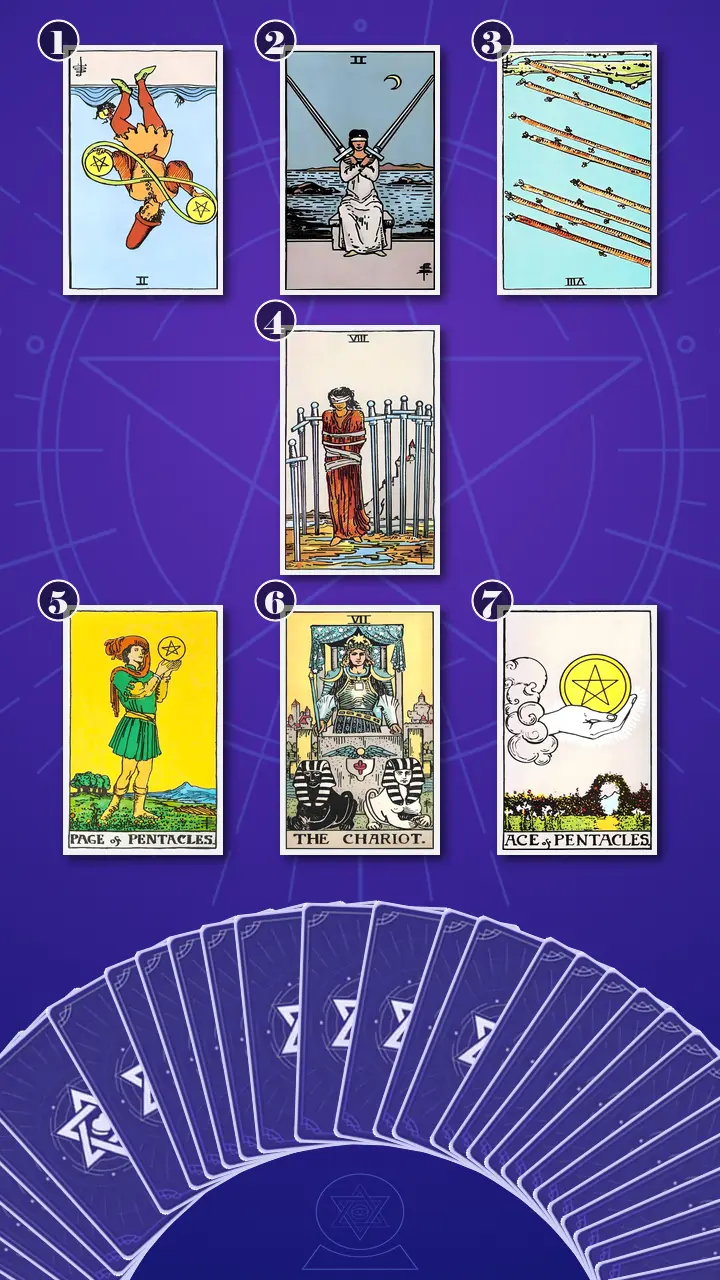
I laid out seven cards in a grid. The top row would show the visible symptom, the inner split, and the outside pressure. The center card would reveal the lock in the system. The bottom row would show the usable resource, the key transformation point, and the next grounded step. The shape of it looked almost like a transit map converging at one jammed hub before opening into a route out, which felt exactly right for a reading about choice paralysis across job search, grad applications, and apartment hunting.
Reading the Top Row of Noise
Position 1: The tab loop that looks like productivity
I turned over the first card and said, 'This position shows the observable symptom from the diagnosis: jumping between job tabs, grad portals, and rental listings without completing one lane.' The card was the Two of Pentacles, reversed.
Immediately I could see Jordan's weekday nights in it. At 10:56 p.m., laptop on the bed, LinkedIn open, a university portal open, rental listings open, windows resized again and again so she can feel she is still handling everything even while nothing gets closed. In the Rider-Waite image, the juggler's looping ribbon suggests motion with skill; reversed, that same motion becomes excess. Too much switching. Too much practical multitasking. Earth energy tipped from adaptive rhythm into overload.
I described the browser-tab montage exactly as she had lived it: save the job, check the rent, rewrite the essay sentence, reopen the job, compare the neighborhood, go back to the essay, whisper to yourself, just one more check. She let out a laugh with no joy in it and said, 'Okay, that's accurate enough to be rude.' I nodded. Recognition mattered here. The pattern had to be seen before it could be interrupted.
Position 2: The stalemate that calls itself being strategic
I moved to the second card. 'This position reveals the core contradiction in action: the inner stalemate between moving forward and keeping all options open.' The card was the Two of Swords, upright.
This one did not speak of ignorance. It spoke of self-protective suspension. In modern life, it looks like every option in Notes or Notion tagged as maybe, because ranking them feels more exposing than researching them. The blindfold is not stupidity. It is emotional armor. The crossed swords over the chest are the body saying, if I don't rank them, I can't regret ranking them wrong.
'So the freeze is serving a function,' I said. 'It protects you from the grief of naming what matters first.' Air energy here was not absent; it was balanced into stillness so perfectly that thought had stopped moving altogether. Jordan's eyes shifted to the window. 'If I say grad school is first,' she said quietly, 'then a job offer I like starts to feel like I'm betraying it. If I say job is first, then grad becomes something I didn't have the nerve to do.' Her fingers tightened around her cup, then loosened. The card had found the nerve of it.
Position 3: When the clocks refuse to line up
I turned the third card. 'This position maps the external timing pressure: mismatched deadlines, market pace, and logistical demands that make the choices feel mutually blocking.' The card was the Eight of Wands, reversed.
In Jordan's life, this was brutally literal: a recruiter asking about start-date flexibility, a landlord wanting proof of income, an admissions portal sending a reminder, all inside the same day. The wands in the image are in motion but not yet landed. Reversed, that motion becomes scattered or delayed. Fire is present, but blocked. Messages are arriving. Deadlines are real. The problem is that none of the clocks line up neatly enough to reassure her.
'This card tells me the outside world is genuinely unsynchronized,' I said. 'But it also asks a very practical question: which deadline is truly fixed this week, and which pressures only feel urgent because they're all living in your head at once?' That landed. She inhaled more deeply than she had since we began. 'The admissions essay date is fixed,' she said after a pause. 'A lot of the rental browsing is... not. It's just loud.' The room steadied a little on that distinction alone.
The Locked Room in the Middle
Position 4: The rule that became a cage
I touched the center card before turning it. 'This position exposes the central psychological bind: the belief that no move is safe until every other move is guaranteed.' The card was the Eight of Swords, upright.
I have spent much of my life in archaeological trenches, where the top layer of soil tells you the most recent disturbance, not the oldest structure holding the site together. In readings, I use a lens of my own called Ancient Reflection: I look for the sentence buried under the panic. Jordan's buried sentence appeared at once. I said it out loud in the boxed-in rhythm the card demanded: 'I can't do housing until I know job. I can't do job until I know city. I can't do school until I know money.'
That is how an invisible rule becomes a locked room. The situation had limits, yes. Toronto rent is not imaginary. Contract work is not imaginary. But the loose bindings on the card mattered more than the fear did. Some bars were facts. Many were assumptions being treated like walls. The tab spiral isn't laziness; it's fear dressed as logistics. Keeping every door open can become its own kind of trap.
Jordan went very still. First her breathing paused, then her shoulders crept toward her ears, then I watched the smallest long exhale leave her like steam off cold glass. 'That,' she said, almost to herself, 'is exactly what it sounds like in my head.' There was no drama in the moment, only the uncomfortable relief of being accurately seen.
The Apprentice and the First Bit of Ground
Position 5: The resource already in the room
I turned the fifth card and felt the energy change immediately. 'This position identifies the usable inner resource that can interrupt the defense strategy and replace abstract over-planning with grounded experimentation.' The card was the Page of Pentacles, upright.
After so much Air pressure and blocked motion, this was the first solid patch of earth in the reading. In real life, it looked like Jordan on a Saturday morning in a café choosing one task only—one essay paragraph, one inquiry email, one viewing request—and treating it as field research rather than a verdict on her worth. The Page studies a single pentacle with full attention. That is balanced Earth. Not grand strategy. Not perfection. One thing held in both hands.
I smiled because this card always reminds me of excavation. No archaeologist uncovers an entire buried city in a day. We open one square meter, define the layer, and let the site answer. 'Your strength is not the master spreadsheet,' I told her. 'It's the part of you that can learn from one completed action.' Her shoulders dropped a fraction. 'That actually feels doable,' she said. And that mattered. The reading had moved from diagnosis to the first sense of traction.
When The Chariot Took the Reins
Position 6: The transformation point
When I reached the sixth card, the room changed. Outside my window, a streetcar bell clanged once and then the sound fell away. I could hear the soft drag of card against cloth as I turned over the key transformation point.
'This position holds the directional shift from total-life solving to a chosen priority and self-trust,' I said. The card was The Chariot, upright. In practical terms, this was the moment Jordan writes, lead priority for the next 30 days: grad applications—or job, or housing—and lets that choice become a filter instead of a prison. The black and white sphinxes at the base of the card are opposing futures. The driver's gift is not making them identical. It is steering anyway.
Through the lens of my Mythic Archetypes practice, The Chariot is the Driver-Strategist. Not a dreamer waiting for unanimous signs. Not a hero who eliminates conflict before departure. A figure who holds tension in both hands and moves with disciplined intent. It is the opposite of an Everything Everywhere All at Once mind chasing every universe at once. It is choosing one plotline long enough to learn from it.
I reminded Jordan of the Tuesday night she had described to me at the beginning: the hot laptop, the half-written statement of purpose, the rental alert arriving at the wrong moment, the jaw tight because every click felt like choosing a future she could not undo.
The sentence that changed the room
Stop waiting for every road to agree with each other; take the reins you can actually hold and let The Chariot turn scattered options into direction.
Said another way, and more plainly: you don't need a perfect plan. You need a lead lane.
Jordan's reaction came in layers. First her breath stopped. Then her fingers froze halfway to the paper cup. Then her eyes lost focus for a moment, as if she were replaying last Thursday in the office kitchenette with the landlord email, the recruiter message, and the admissions reminder all arriving at once. When she looked back at me, relief did not come first. Anger did. 'But if that's true,' she said, voice tight, 'doesn't it mean I've been doing this wrong?'
'No,' I said. 'It means you've been trying to solve a human transition like a closed equation. Most transitions are not equations. They are routes. You don't need certainty before movement. You need orientation before movement.' I let that sit. The line in her jaw eased. Her shoulders lowered slowly, then all at once, and with that release came something subtler than peace: a small dizziness, the vulnerable blankness that follows when a burden comes off and responsibility returns. I asked her, 'Now, using this lens, think back over last week. Was there a moment when naming one lead lane would have changed what you did next?' She closed her eyes. 'Yes,' she said after a beat. 'The recruiter email needed a response. The rental tabs didn't. I turned noise into urgency.' There it was—the first real step from overwhelmed tab-switching and false urgency toward grounded sequencing and cautious confidence.
The Confirmation Email at the End of the Path
Position 7: The next grounded step
I turned the final card. 'This position translates insight into one practical next move that creates traction without requiring total certainty.' The card was the Ace of Pentacles, upright.
I always love this card for people who live in hypotheticals. It refuses abstraction. In Jordan's world, the Ace of Pentacles was not a mystical mood. It was a proof object: a submitted application fee receipt, a booked viewing, a transcript request, a sent message, a calendar event that could not be mistaken for mere intention. After so much mental forecasting, this was balanced Earth returning in a usable form.
'Choose the action that gives you the most real-world feedback,' I told her, 'not the one that feels mentally safest.' The offered coin on the card is something you can actually hold. A week with one confirmation email in it is different from a week full of tabs. Jordan nodded, slower now, as if she could feel the difference between a hypothetical life and a life that had begun to leave receipts.
From Equation to Evidence: Actionable Advice and Next Steps
By then the whole story of the spread was clear to me. The surface problem was not simply poor time management. It was a safety strategy. First came the Two of Pentacles reversed: tab-switching that looked productive. Then the Two of Swords: non-decision used as emotional protection. Then the reversed Eight of Wands: real timing mismatches turned into full-body panic. At the center sat the Eight of Swords, the perfect-equation myth—the belief that nothing can move until everything aligns. The blind spot was not lack of information. It was treating uncertainty like a stop sign and asking one choice to solve career, school, and housing all at once. The transformation direction was just as clear: replace total-life solving with sequencing. Choose the first stabilizing priority. Let the other choices update around reality.
When I said that, Jordan gave me the practical objection I had been expecting. 'But after work,' she said, 'I honestly don't have 25 clean minutes. By the time I open my laptop, my brain is soup.' I nodded. A good reading should survive contact with an actual Tuesday. 'Then we respect the nervous system,' I said. 'Ten minutes counts. Three minutes counts. Small is not fake. Small is how systems unjam.'
I gave her a framework from my own practice called Celestial Tracking. Ancient navigators did not wait for the sea to become simple before they left harbor. They chose one fixed point in the sky and let that orientation guide the next measurable move. For the next month, Jordan did not need destiny. She needed a north star.
- Name the lead laneOn Sunday evening or Monday morning, open your Notes app and write: lead priority for the next 30 days: job, grad, or housing. Under it, make three short lists: supports this lane, can wait, and needs clarification from someone else. Pin that note where you will see it before opening LinkedIn, a university portal, or Rentals.ca.This is sequencing, not a lifetime contract. If 30 days feels too exposed, test seven.
- Run one One-Pentacle ExperimentSet one 25-minute timer and work on only one lane. One essay paragraph. One job application. One rental inquiry. Start the block by titling a note 'Experiment, not verdict' and writing the single task at the top so your brain has one container.If 25 minutes feels impossible, do 10. If 10 feels flooded, do 3. Clarity gets louder after contact with reality.
- Create one proof object within 48 hoursPut one tangible move on your calendar with a time, not just a to-do list entry: request one transcript, submit one finished application, book one viewing, pay one fee, or ask one referee. When it is done, save the confirmation email, receipt, sent message, or booked slot in a visible folder called Evidence.Choose the action that makes your week less hypothetical, not the action that only prolongs comparison.
Jordan wrote them down without trying to optimize them. That, in itself, was a shift. Less forecasting, more footing. Evidence over equation.

A Week Later, the Quiet Proof
A week later, Jordan sent me a screenshot with one line at the top of her Notes app: lead priority for the next 30 days: grad. Underneath were three actions, and beside one of them sat the small, unglamorous miracle of the Ace of Pentacles—a receipt confirming her application fee had been paid. She had also moved her apartment tabs into a parking list and answered one recruiter with a clear timeline instead of spiraling for six hours first.
She told me she submitted the payment from a café on Ossington, then sat there alone for a few minutes afterward watching the streetcar wires tremble in the cold light. The old thought still arrived—what if I'm wrong?—but this time she noticed it, smiled without much ceremony, and kept her shoulders down. That is what real change often looks like: clear, a little fragile, and unmistakably underway.
I was glad, but not surprised. The reading had not given Jordan a magical future. It had returned her authorship. That is what the Energy Diagnostic Map · Context Edition tarot spread is for when job search, grad school, and housing all knot together: not to decide for you, but to show you where agency can re-enter the picture.
When every option feels like a door that slams three others shut, no wonder your body turns a normal admin task into a trap.
If you gave yourself one lead lane on the map for the next 30 days, which choice might make the rest a little more real—even if it does not make everything certain yet?
This story is adapted from psychological research, written so that those in a similar struggle can see their own pattern in it — and find their next step clearly.These insights are not a substitute for professional psychological, medical, legal, or financial advice.
Learn more about our Journey to Clarity.
How did this insight land for you?
🫂 This Resonates Deeply
🌀 Living This Story
✨ Now I See Clearly
🌱 Seeing New Possibilities
🧰 Useful Framework
🔮 The Confirmation I Needed
💪 Feeling Empowered
🚀 Ready for My Next Step
Author Profile
 AI
AI“Having spent a lifetime at Cambridge and on archaeological digs, I’ve witnessed the rise and fall of countless civilizations. Please know that your current struggles are not a permanent fate, but merely a necessary fracture before rebuilding. I won't lecture you; instead, I invite you to sit with me in the ruins, using a patient, historical perspective to gently dust off the true, enduring value hidden beneath your temporary doubts.”
In this Personal Growth Tarot Reading :
Core Expertise
- Cognitive Paradigm Excavation: Treating your current growth bottleneck as the necessary collapse of an obsolete intellectual era.
- Core Philosophy Stratigraphy: Identifying which foundational beliefs must be carried forward to your next life stage and which must be left in the past.
Service Features
- The Paradigm Shift Manifesto: A rigorous intellectual exercise to definitively articulate the new governing laws and core values of your next life chapter.
Also specializes in :
Explore Related Patterns:
Urgency BiasThe recruiter message, landlord proof request, and admissions reminder arriving inside the same day create a real external squeeze. The distortion begins when every input gets treated as equally urgent just because it is emotionally loud. Urgency Bias pulls attention toward the most activated signal, not necessarily the most time-sensitive one. In Jordan's case, rental browsing feels urgent because it touches fear, even when the recruiter email is the action that actually needs a response. Her sentence that she turned noise into urgency is the pattern becoming visible. Once you can separate fixed deadlines from loud-but-optional pressure, the system stops feeling like three trains arriving at once and starts becoming a sequence.
Analysis ParalysisThe 11:38 p.m. screen shows LinkedIn, a grad statement, and rental listings open at the same time while the same first sentence keeps getting rewritten. That is not a lack of effort; it is effort trapped inside too many conditional branches. Analysis Paralysis appears when thinking tries to protect you from regret by demanding one more comparison, one more dependency check, and one more scenario map before action. The mind keeps producing more context, but the body gets less able to move because every new variable makes the next step feel less legitimate. The repeated loop of saving jobs, checking rent, returning to the essay, and reopening the job shows why the options block each other. The analysis is no longer serving the decision; it has become the place where the decision is postponed.
Option HoardingKeeping LinkedIn, grad portals, and Rentals.ca alive on the same screen gives Jordan the felt sense that no future has been lost yet. The tabs become a psychological holding area for every possible version of her next life. Option Hoarding is not simple indecision. It is a protective strategy that keeps possibility available so the grief of prioritizing one lane can be deferred. You can see this in the way ranking feels more exposing than researching, because ranking would make one value visible and put the others into the background. The shift happens when one lead lane is named and the apartment tabs move into a parking list. That does not destroy the other options; it creates a boundary between active choice and stored possibility.
Zero-Sum ThinkingJordan's line that every option feels like closing three others is the cleanest anchor for this pattern. The job, grad school, and rental choices are not just complicated in her mind; they are being processed as if one future can only exist by canceling the others. That zero-sum frame turns sequencing into self-betrayal. When grad school goes first, the job offer starts to feel like a violation of that choice; when the job goes first, grad school starts to feel like proof she lacked nerve. You can see how the mind converts a practical order-of-operations problem into a moral and identity-level trade-off. The pressure eases when she discovers that the recruiter email and the rental tabs do not have equal status. That distinction matters because Zero-Sum Thinking loses power when one lane can lead for a short window without permanently erasing the others.
Certainty SeekingJordan's buried rule is that housing cannot move until the job is known, the job cannot move until the city is known, and school cannot move until money is known. The rule sounds logical, but it turns uncertainty into a locked room. Certainty Seeking works by making guaranteed outcomes a prerequisite for normal movement. You can see the defense mechanism in the way every click feels like choosing a future she cannot undo, so the mind tries to wait for a level of reassurance that the actual situation cannot provide. The story starts to unlock when certainty is replaced with evidence. A submitted fee receipt, a recruiter timeline, or a parked rental list does not solve the whole future, but it gives reality something to answer, which is exactly what the certainty loop had been preventing.
Decision DeferralJordan does not avoid choice because she has no information; the story says the stalemate calls itself being strategic. The more precise issue is that ranking the lanes exposes her to regret, self-judgment, and the feeling that one possible future has been abandoned. Decision Deferral works here as emotional armor. As long as job, grad school, and housing all stay in the maybe zone, none of them can be the wrong choice yet. The cost is that the protective pause becomes a system jam. The pattern softens when she chooses grad as the lead priority for the next 30 days rather than for her whole life. That time-boxed choice gives you a way to move without forcing the decision to carry the weight of forever.
Productive ProcrastinationSaving a job, checking rent, rewriting the essay sentence, reopening the job, and comparing the neighborhood all look productive from the outside. Inside the story, though, the movement is circular and nothing gets closed. Productive Procrastination is the defense that hides delay inside useful-looking effort. You are not avoiding the future by doing nothing; you are avoiding the emotional risk of a completed action by staying busy with adjacent tasks. The proof object at the end matters because it breaks the loop. A receipt, sent message, or booked slot is different from another tab because it forces the nervous system to meet reality instead of staying inside preparation.
Timing DiscernmentJordan's first stabilizing distinction is simple: the admissions essay date is fixed, while much of the rental browsing is loud. That moment shows her attention moving from emotional volume to actual timing. Timing Discernment is the capacity to sort what is fixed, what can wait, and what needs clarification from another person. You can see it when she answers the recruiter with a clear timeline and parks apartment tabs instead of letting them keep interrupting the main lane. This pattern does not require total certainty. It gives you a way to act inside imperfect timing by asking which move creates the most useful real-world feedback now.
Values-Based Decision MakingThe line at the top of Jordan's Notes app, lead priority for the next 30 days: grad, is the point where the system stops asking every option to agree with every other option. One value becomes the temporary compass. Values-Based Decision Making appears when the chosen lane becomes a filter rather than a life sentence. You are not pretending the other options do not matter; you are letting one priority organize the next round of action so the future can start producing evidence. The receipt, the parked rental tabs, and the clear recruiter timeline show the pattern in action. Instead of waiting for a perfect plan, Jordan lets a chosen value create traction and then allows the other decisions to update around reality.
Explore Related Struggles:
Perfect Readiness TrapAt the center of the reading, Jordan's rule is brutally clear: housing waits for job, job waits for city, school waits for money. Some limits are real, but the whole structure tightens when assumptions are treated like walls and every move must be guaranteed by every other move. You get stuck because readiness is being defined as total alignment. That definition sounds responsible on the surface, yet it quietly turns ordinary uncertainty into a locked room where the safest action is always more waiting. Perfect Readiness Trap names the bind where preparation stops serving movement and starts policing it. The shift is not reckless action; it is allowing one bounded, reversible step to count before the entire future has been solved.
Security-Choice SplitJordan says choosing grad first makes a job offer feel like betrayal, while choosing job first makes grad school feel like something she lacked the nerve to do. The practical choice is carrying a second charge: each lane seems to protect one future by threatening another. You are not only sorting tasks. You are trying to preserve income, housing, location, identity, and future possibility without letting any one decision narrow the field too much. Security-Choice Split appears when safety and agency start competing for the same steering wheel. The work is to notice which safety need is factual this week and which one is trying to make every path immune to loss before you choose.
Transition Ambiguity LockJordan's job, grad, and housing lanes do not sit side by side; they feed into one another. A job affects rental proof, rental location affects the search, and grad school might change the city, so one missing date starts to hold the other two in place. You are caught in a transition where the next step keeps asking for information that belongs to a different next step. The struggle is not a lack of ambition; it is a lock created when every option becomes both a doorway and a gatekeeper. The way back into agency is not forcing all three roads to agree before you move. It is naming one temporary lead lane, letting the others update around real information instead of treating uncertainty as proof that nothing can start.
Urgency-Compass FusionThe same day holds a recruiter asking about start-date flexibility, a landlord wanting proof of income, and an admissions portal sending a reminder. Later, Jordan can see that the recruiter email needed a response while the rental tabs were loud but not fixed. You lose your compass when volume and importance collapse into the same signal. Everything that flashes, pings, or implies a possible future starts to feel equally urgent, so your attention obeys the loudest input instead of the most consequential one. Urgency-Compass Fusion is the moment the map gets overwritten by alarms. Clarity returns when you separate fixed deadlines from noisy possibilities, because only then can urgency become information instead of command.
Momentum-Readiness SplitThe reading keeps returning to a simple friction point: Jordan is waiting for certainty before movement, while the situation can only become clearer through movement. The Chariot image turns this into a lead lane, not a perfect plan. You are not asked to pretend the conflict is gone. You are asked to hold enough direction to let one step teach you something, even while job, grad, and housing still disagree. Momentum-Readiness Split shows up when the body will not move until the mind feels fully prepared, but preparedness is exactly what a first grounded action would help build. Orientation comes before total confidence.
Panic Productivity TrapJordan's weekday night has plenty of visible effort: save the job, check the rent, rewrite the essay sentence, reopen the job, compare the neighborhood, return to the essay. The screen keeps changing while the result stays unfinished. You are working, but the work is maintaining access rather than creating contact. Keeping every tab alive feels like control because no door has to close, yet the cost is that no door becomes real enough to walk through. Panic Productivity Trap names the loop where activity protects you from the exposure of choosing. The release begins when one completed action matters more than another hour of switching.
Evidence DisconnectionThe Ace of Pentacles turns Jordan away from more hypotheticals and toward a proof object: a paid application fee, a sent recruiter reply, a transcript request, a booked viewing, a calendar event. A week later, the screenshot matters because it is evidence, not another comparison. You stay stuck when thinking about outcomes replaces contact with the world. Tabs can preserve possibility, but they cannot answer the question that only feedback can answer. Evidence Disconnection names the gap between imagining every version of the future and producing one small fact the future can respond to. The shift is not grand certainty; it is one receipt, one sent message, one real-world marker that makes the week less hypothetical.
Explore Related Emotions:
Certainty HungerJordan's laptop is balanced on the duvet, with work, school, and housing all spilling into the place where her body is supposed to rest. The scene has no clean edge: career tabs, rental proof, admissions timing, contract uncertainty, and cold coffee all occupy the same small square of night. Certainty Hunger shows up when the first move feels unsafe unless the whole system has already confirmed itself. In Jordan's case, facts and assumptions begin to carry the same weight, so a flexible question starts behaving like a wall. The mind keeps asking for one more piece of information, not because information is useless, but because certainty has become the price of permission. You can feel the hunger in the rule beneath the spiral: housing waits for job, job waits for city, school waits for money. The need is for a world where every clock lines up before she has to act, even though the actual route only becomes visible through one grounded move at a time.
Choice Paralysis OverwhelmLinkedIn, grad portals, and rental listings stay open on the same late-night screen while Jordan keeps rewriting the same sentence. Each tab seems to contain a different version of her near future, and none of them can be closed without making the others feel suddenly more exposed. That is the emotional logic of Choice Paralysis Overwhelm: the mind tries to protect every possible path by keeping every path active at once. The result is not freedom; it is a crowded inner field where comparison replaces movement and every practical task starts to feel like a referendum on the whole life plan. You can see the pressure most clearly in her own sentence: she cannot pick housing without work, cannot commit to work if school might move her, and cannot touch one option without feeling the others tighten. The feeling is the overload of needing one choice to solve career, school, location, money, and identity all at the same time.
Directionless UrgencyA recruiter message, a landlord email, and an admissions reminder all arrive inside the same day, and Jordan's screen treats them like one emergency. She saves the job, checks the rent, rewrites the essay sentence, compares the neighbourhood, returns to the job, and tells herself it is just one more check. Directionless Urgency is the feeling of being activated without being oriented. The body receives every open tab as immediate, yet the priorities have not been separated enough for action to know where to land. That is why she can be intensely busy and still not moving. When she realizes the admissions essay date is fixed and the rental browsing is mostly loud, the inner weather changes because urgency finally gets sorted from noise. You are not looking at a lack of effort here; you are looking at effort pulled in too many directions before one direction has been named.
Grounded AgencyA week later, Jordan has one line at the top of her Notes app: lead priority for the next 30 days: grad. The apartment tabs have been moved into a parking list, one recruiter has received a clear timeline, and one unglamorous receipt proves that something left the realm of comparison and entered the real world. Grounded Agency is the feeling that returns when action becomes small enough to hold. It does not require the whole future to be settled. It comes from choosing one lane, making one visible move, and letting the rest of the map update around contact with reality. You can still hear the old question arrive in her afterward, asking whether she might be wrong. What has changed is that the question no longer gets to take over the entire system. Her shoulders stay down, the evidence exists, and authorship has a place to re-enter.
Wrong Choice PanicJordan says that if she names grad school first, a job offer she likes starts to feel like she is betraying it; if she names the job first, grad school starts to feel like something she did not have the nerve to do. The options are no longer just options. They become witnesses against each other. Wrong Choice Panic grows when a decision feels less like sequencing and more like a verdict on the self. The click is small, but the meaning attached to it is huge: choose one lane, and the others might become evidence that you failed, abandoned something, or misunderstood what mattered. This is why every option feels like it closes three others. You are seeing the fear that one practical choice could erase too much of the possible self, so the mind keeps the doors open until the hallway itself becomes hard to breathe in.
Explore Related Contexts:
Life Admin Deadline Pile-UpAt 11:38 p.m., Jordan has LinkedIn, a grad portal, and Rentals.ca open at the same time, with the laptop balanced on the duvet and the cold coffee already forgotten. The scene matters because these are not abstract life questions. They are forms, tabs, dates, emails, receipts, and proof requirements crowding into the same exhausted window. Life admin has become a second shift. Each task looks small by itself, but the pile-up becomes structural when one missing date can stall the other two lanes. The browser is acting like a dashboard for adulthood, except every widget is flashing at once. For you, the core pressure is not poor organization. It is admin work that has turned interdependent, where closing one loop requires another loop to be partly solved first. A grounded path starts by creating one proof object instead of trying to keep the whole dashboard alive.
Timing Signal OverloadThe same day brings a recruiter asking about start-date flexibility, a landlord wanting proof of income, and an admissions portal sending a reminder. Those are not imaginary pressures. They are real external signals arriving from systems that run on different clocks. When those clocks stack on top of each other, urgency stops being informative. The rental tab, the job message, and the application reminder all feel equally loud even though only some of them are truly fixed this week. You lose orientation because every channel behaves as if it deserves first priority. The way back into agency is not to silence every signal at once. It is to sort timing into fixed, negotiable, and noise, then let the most concrete deadline set the next move instead of letting the loudest tab set the whole day.
Triangulated Decision PressureJordan names the lock directly when she says she cannot pick a place without knowing where she will be working, cannot commit to a job if grad school might change the city, and feels every option closing three others. The pressure is not a single hard choice. It is a three-way dependency system where job, school, and housing each demand information the other lanes have not yet produced. That structure turns normal decision-making into a gridlock. A recruiter wants a start-date answer, a landlord wants proof of income, and an admissions portal keeps its own deadline, while none of those systems wait for the others to become convenient. You are dealing with a choice architecture that makes every move feel prematurely binding. The useful clarity comes from separating true dependencies from assumed ones. Once the loop is visible, you can stop asking one decision to solve the whole life map and start choosing which lane should generate the next piece of usable evidence.
Job Search LimboLinkedIn stays open because the job lane has to answer more than the question of employment. A recruiter is asking about start-date flexibility while grad school may change the city and a landlord may need proof of income. The job search becomes the hinge that other systems keep pulling on. Contract work makes that hinge less stable. It does not automatically provide the settled timeline or proof structure that housing decisions often expect, and it does not settle the city question if school is still in play. You are not just choosing a role; you are trying to make the job lane produce certainty for housing, money, and location at the same time. The sharper move is to make the job search disclose concrete constraints rather than asking it to resolve the whole transition. Start date, income proof, remote possibility, contract length, and city expectations become the useful data points that let the other lanes update.
Strategic Academic CrossroadsThe admissions essay date becomes the first fixed point Jordan can actually name, while much of the rental browsing is loud but not immediately binding. That distinction changes the academic lane from another tab in the spiral into a usable coordinate. Grad school stops functioning as an all-or-nothing future verdict once it becomes a 30-day lead priority. One essay paragraph, one transcript request, or one paid application fee produces feedback from reality instead of another round of comparison. For you, this crossroads is constructive because it creates temporary order without pretending the whole life plan is settled. Choosing the academic lane first does not erase job or housing questions; it gives them a clearer sequence to update around.