The 6:18 Streetcar and the Human Buffer Between a Partner and Best Friend
Maya looked into my screen from her Toronto condo and said, “I am tired of managing the vibe all the time. I just want everyone to be normal for one night.” She was twenty-eight, a nonprofit project coordinator, the kind of late-20s city professional whose job already rewarded anticipation, diplomacy, and keeping moving parts on track. Off the clock, that same skill set had turned feral. The second a group chat went quiet after one sharp comment, her evening stopped being hers.
When she described her commute home, I could see it as clearly as if I were standing beside her: 6:18 p.m., the 504 King streetcar, one hand wrapped around the pole, the other around a phone full of half-written texts. The TTC brakes screeched. The overhead lights buzzed. Her screen ran warm against her palm while her jaw stayed locked around sentences she had not even sent yet. She kept toggling between her partner’s thread, her best friend’s last message, and a Notes draft where words like “annoyed” got edited down to “a bit off,” because maybe, if she phrased it perfectly, tonight would not become another whole thing.
By the time she booked my reading, she was exhausted from being trapped as the human buffer between a partner and best friend. She had probably asked the internet every version of the same question: why do I feel responsible when my partner and best friend clash, and how do I stop mediating between partner and friend without choosing sides? The feeling in her body was not abstract anxiety. It was like trying to hold two subway doors open with her own body while her phone kept buzzing in her coat pocket.
I nodded and said, “That makes sense. When two people you love keep clashing, your nervous system starts treating every typing bubble like a weather alert. But you’re not keeping the peace. You’re being used as the route. So let’s not ask your body to do emotional traffic control tonight. Let’s draw a map and find some clarity.”

Choosing the Map: A 7-Card Spread for Three-Way Conflict
I asked Maya to put both feet on the floor and say the question out loud in plain language: why does this keep becoming my job? Then I shuffled slowly at my desk, not as theater, but as focus. For anyone who wonders how tarot works in a situation like this, this is the part that matters most to me: the cards do not replace judgment. They give the pattern a structure strong enough to look at directly.
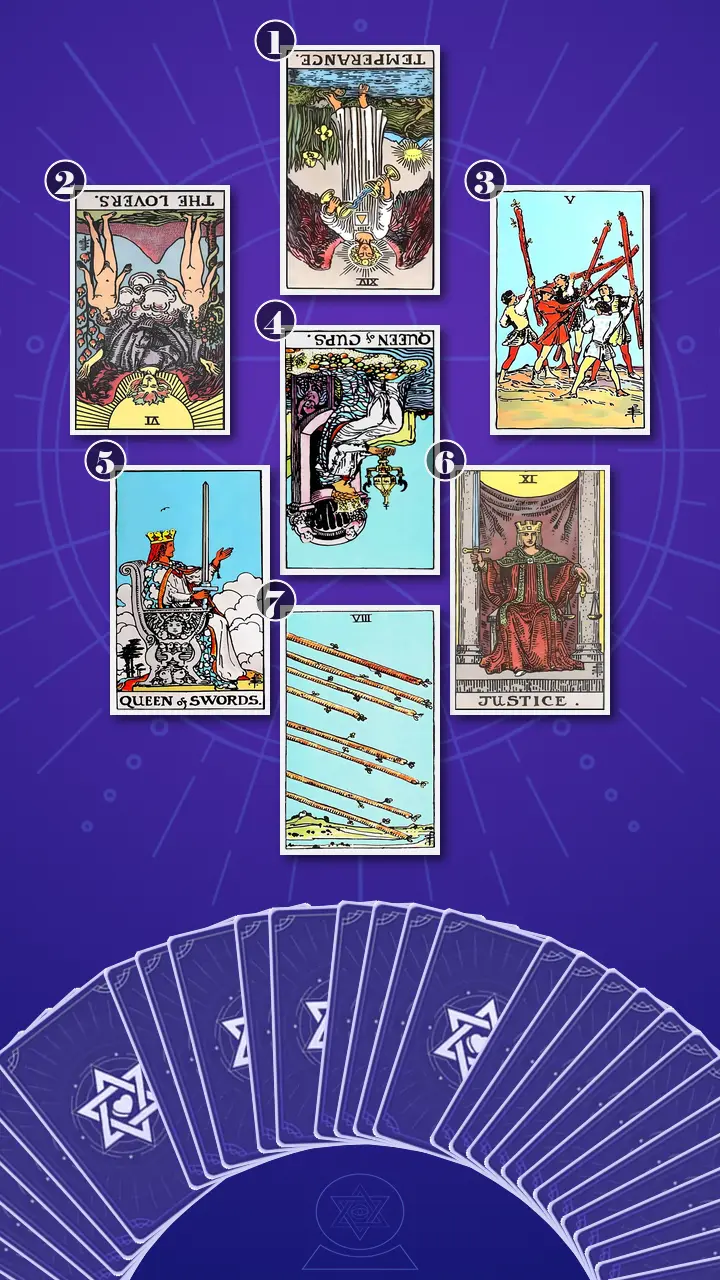
For Maya, I chose the Energy Diagnostic Map · Context Edition, a seven-card tarot spread for triangulation and boundaries that I use when a standard two-person relationship spread would flatten the issue. This was not simply a compatibility question. It was a three-way emotional system with a repeating mediator loop. A lighter spread would have blurred the real mechanics; this one let me track the full chain clearly: surface symptom, inner split, outside pressure, core blockage, resource, transformation, and next step.
I told her what I was watching for. The first card would show the everyday referee behavior already draining her. The second would reveal the loyalty bind underneath it. The third would map the actual relational weather between partner and friend. At the center, one card would expose the belief that kept bottlenecking everything. Then the final line would show her existing boundary capacity, the root shift, and one grounded action that could stop the triangulation pattern from recruiting her again.
Reading the Funnel: Card Meanings in Context
The Angel Who Never Gets Off Shift
Now I turned the card that shows the day-to-day referee behavior named in the diagnosis: smoothing tone, carrying messages, and trying to keep group interactions stable.
Temperance, reversed.
This looked exactly like the commute she had described. Two message threads open. Notes app in the middle. Adjectives shaved down until nobody could accuse anyone of sounding too harsh. One foot on land, one in water: half in her own experience, half submerged in other people’s emotions. In this position, reversed Temperance is energy in excess. Too much blending. Too much regulating. Too much of Maya becoming the emotional mixing bowl for the whole situation.
“This is the unpaid PR team version of care,” I told her. “It looks gentle from the outside, but from the inside it’s exhausting. Peace that needs your constant translation isn’t peace.”
Maya let out a quick laugh with no real humor in it and rubbed the hinge of her jaw. “Okay,” she said. “That is accurate to the point of being rude.” The laugh came first, then the grimace, then the tiny drop in her shoulders that told me the self-recognition had landed.
The Mountain Between Two Loyalties
Then I turned the card that reveals the loyalty bind underneath the surface pattern: wanting the partner and best friend to stop clashing while not wanting the conflict to become her job.
The Lovers, reversed.
This was the split that happened in her condo kitchen after a Friday dinner, when her partner would say, “You saw how your friend was acting, right?” and Maya would offer a careful half-answer that supported everyone and revealed almost nothing true. Reversed, The Lovers is blocked alignment. Not lack of love, but misalignment between values, honesty, and fear. She was keeping two browser tabs open to two different realities and crashing her own system in the process.
I asked, “When you imagine being fully honest with either of them, what exact loss are you bracing for?”
She stared at the card for a second longer than she wanted to. “That one of them will hear it as me choosing,” she said quietly.
That was the mountain in the image. Not just between them. Through the center of her.
The Dinner Reservation With Bear-Level Tension
Next came the card that maps the actual friction between her partner and best friend and the social moments that keep reactivating it.
Five of Wands, upright.
This was the birthday dinner near Queen West, the jagged group chat, the after-event debrief that somehow made a normal night feel like an episode of The Bear. The crossing wands showed noise, mismatched styles, competing egos, and terrible choreography. In this position, the energy was chaotic but external. The conflict was real, yes. But it was not proof that the whole social ecosystem was about to collapse.
“One thing this card does,” I said, “is separate their friction from your reflex to treat it like a full-system threat. Nobody here is a single clear villain. It’s messy. It’s mutual. And it’s not automatically yours to organize.”
Maya looked up at me and nodded slowly. It was a small nod, but I know that expression well. Relief was starting to find hairline cracks in the panic.
When Your Body Answers Before You Do
Then I turned the center card, the one uncovering the underlying fear and self-worth logic behind all the over-functioning.
Queen of Cups, reversed.
The image matched her 11:42 p.m. kitchen almost too precisely: stove light on, dish soap in the air, fridge humming, one debrief already taken from her partner, then a text from her friend asking, “Did I do something wrong?” Before you even read the message, your body has already answered it. Her stomach dropped first. Her shoulders climbed. Her fingers moved toward the keyboard before her own feelings had even formed a sentence. That is Queen of Cups reversed in the blockage position: emotional flooding, porous boundaries, care that slips into self-erasure. A sponge that never gets wrung out.
I leaned toward the screen and pointed to the ornate closed cup in the card. “This is the paradox,” I said. “You are full of feeling, but the feeling is not being filtered clearly enough to become a boundary. You’ve been treating absorption as proof of love. But feeling everyone’s weather first does not make you responsible for the forecast.”
Her reaction moved in a clear chain. First, stillness: even her breath seemed to pause. Then the faraway look: her eyes lost focus as if she were replaying a dozen midnight conversations at once. Then release: one long exhale, shaky and quiet, and her shoulders loosened by degrees. “That part,” she said, almost to herself, “is the one I don’t know how to stop.”
The Queen Who Doesn’t Add Three Paragraphs of Disclaimers
Next I turned the card that identifies the boundary-setting capacity and communication style already available to her.
Queen of Swords, upright.
I always love this card after Queen of Cups reversed because it does not ask someone to feel less. It asks them to sort feeling from responsibility. The modern life version was immediate and almost shockingly simple: same vent, same urge to explain, same loaded room, but this time Maya says one clean sentence instead of three disclaimers. Old script: “I think they were just tired, and maybe nobody meant it that way, and I’m sure this can be smoothed over.” New script: “I care about both of you, but I’m not going to mediate this conversation.”
That is balanced air. Sword up, hand open. Directness without punishment. Care without fusion. The exact medicine here was not more softness. It was discernment.
Maya leaned back from her screen, like she had just discovered an extra inch of space in the room. “Wait,” she said. “I could actually say that.”
“Yes,” I said. “Clarity is not cruelty.” And because I’m incapable of seeing this card without a little cinema in my bloodstream, I had a private flash of an old black-and-white courtroom scene where one clean line of dialogue does more than ten minutes of apologizing. Truth, when it is precise, does not need a swelling soundtrack.
When Justice Spoke, the Room Got Quieter
The Scales, the Sword, and the End of Human Buffer Mode
Then I turned the sixth card, the key card of the whole reading—the one naming the transformation from mediator to boundary-holder. As I set it down, a strip of late light on my studio wall sharpened into two vertical bars so clean they looked like pillars. Even the room seemed to side with the symbolism.
Justice, upright.
I asked Maya to picture that Tuesday streetcar ride again: Notes app open, thumbs moving between two half-written texts, TTC brakes screeching, jaw locking because one weird dinner had somehow become her second shift. She had been standing in the doorway of two closing walls, trying to keep both from touching, confusing fairness with self-division.
Stop splitting yourself in two to keep the scales from shaking; Justice asks you to lift the sword of clarity and return each person’s conflict to its rightful hands.
I let the sentence hang there for a beat.
Then I gave her the deeper lens I was hearing through my own signature frame, what I call my Classic Movie Model. “This card is not Casablanca,” I said. “That film is beautiful, but it runs on noble emotional over-functioning. Somebody carries the ache, manages the triangle, says the elegant line, and tries to hold everyone’s dignity together through sheer sacrifice. You’ve been cast in that role without meaning to. Justice refuses that script. You are not the relationship court, the appeal process, and the PR department. You do not have to earn harmony by carrying everybody’s conflict.”
Maya looked straight at me, and there it was—the first spark of resistance. “But if I stop,” she said, and anger flashed under the fear, “doesn’t that mean I’ve been doing this wrong the whole time?”
Her reaction unfolded in layers. First, a physiological freeze: her fingers stopped moving around the mug in her hands. Then cognitive penetration: her gaze slid off-screen, unfocused, as if old dinners and old texts were replaying against the kitchen tile behind her. Then emotional release: her eyes came back brighter, not quite tearful, more like stung awake, and her shoulders dropped so suddenly she looked briefly dizzy in the space that opened. Relief and grief arrived together. That is what it looks like when a coping strategy stops masquerading as virtue.
“No,” I said gently. “It means you learned to survive tension by becoming useful. And now you’re allowed to outgrow that job. Being fair is not the same as being endlessly available. Peace that depends on your constant translation is not peace; it’s outsourced emotional labor dressed up as harmony.”
While the insight was still warm, I asked her to open her Notes app and type one sentence only: “I care about both of you, and I’m not going to mediate this.” She did not have to send it. Practice counted. Then I asked, “With this new lens, can you think of a moment last week when this would have changed the feeling in your body?”
She gave me a softer laugh this time. “The whole streetcar ride home on Tuesday,” she said. “I would’ve closed Notes.”
That was the real shift: not from caring to not caring, but from hyper-vigilant peacemaking and guilt to self-respecting fairness and calmer boundaries. From carrying the conflict to naming her limit.
One Clean Train Line After the Delay
The Message That Stops Taking the Scenic Route
Finally, I turned the card that points to a concrete next step for stopping triangulation and returning communication to the two people actually involved.
Eight of Wands, upright.
This was the practical relief card. No more relayed summaries. No more translation detours. No more drafting six versions of a sentence because everyone else’s reactions had colonized the message before it was even sent. The wands all moved in one direction, and that mattered. This was no longer the scattered fire of Five of Wands. This was directed momentum—one clean train line after a week of signal delays.
“Here’s what progress looks like,” I told her. “Shorter messages. Cleaner channels. You stop being the filter.”
Right there on the call, I had her draft a second line and save it under the first: “I get why you’re upset. I’m not going to pass messages between you two.” Her breathing stayed a little uneven, but she nodded. The discomfort spike was real. So was the lane opening underneath it.
The No-Triangle Rule and the First 48 Hours
When I looked at the spread as a whole, the story was almost architectural. Temperance reversed showed the surface symptom: over-mixing until Maya became the middle layer in everyone else’s conflict. The Lovers reversed showed the split beneath it: divided loyalty and the fear that honesty would look like betrayal. Five of Wands showed the outside weather: real friction, messy but not apocalyptic. Queen of Cups reversed exposed the bottleneck at the center: she had learned to equate care with emotional absorption. Then Queen of Swords and Justice brought in the missing organizing principle—language, boundary logic, clear accountability—and Eight of Wands showed what happens when the detour ends: movement without rerouting everything through her body.
The blind spot was subtle but expensive. Maya had been acting as though love meant emotional management. It didn’t. Her transformation direction was exact: stop translating and smoothing every clash, name her limit, and return responsibility to the people who actually own the conflict. That is how you stop mediating between a partner and friend without choosing sides. Not by becoming colder, but by becoming more accurately responsible.
Because Maya lives in overlapping lanes—shared apartment, shared social life, shared birthdays—I did not give her a grand reinvention speech. I gave her small next steps. This is where I used one of my favorite strategies, what I call Gallery Communication. In a gallery, you do not step over the rope and repaint two other artists’ canvases. You stand where your body is, name what you actually see, and stay with your own frame. That is boundary work in human language.
- Save the two-line script Tonight, in your Notes app, save one message for the next time your partner or best friend vents about the other: “I get why you’re upset. I’m not going to pass messages between you two.” Use it in text first if saying it live feels too exposed. The first resistance will probably be guilt, not certainty. Keep it short on purpose; over-explaining is the old pattern in nicer clothes.
- Do one boundary-first redirect Pick one active issue this week and answer once with, “That sounds like something to bring to them directly.” Say it when the vent begins, not after twenty minutes of translation. Put both feet on the floor before you send it. A discomfort spike does not prove the boundary is wrong; it may simply mean the usual route is closing.
- Send logistics only on the next group plan For the next dinner, birthday, or low-key hang that is never actually low-key, send time, place, and RSVP only. No emotional commentary. No pre-smoothing. No prediction management. Treat this like focus mode for your emotional bandwidth. Information is enough. You do not need to manage the vibe in advance.
Maya looked at the list and found the real-world obstacle immediately. “But I live with my partner,” she said. “If I stop translating in the moment, I can’t exactly leave the apartment.”
“You don’t have to leave the apartment,” I told her. “You just have to leave the triangle. One empathic sentence. One limit sentence. Then stop. You’re allowed to stay in the room without becoming the route.”

A Week Later, the Quiet Proof
A week later, Maya sent me a message on her lunch break. It was not dramatic. It was not movie-ending material. It was only this: “Used the script. My partner started venting, and I said, ‘I get why you’re upset, but I’m not going to mediate this.’ I felt sick for about three minutes. Then nothing exploded.”
That was the proof I wanted for her. Not that everyone suddenly became easy, and not that the clash disappeared by magic. Just that her body could survive not doing unpaid emotional customer service on demand. She had stopped volunteering to be the human buffer, and the space that opened was enough for self-trust to get its first foothold.
Later, she told me she had slept through the night after that conversation. In the morning, the old thought still arrived—What if I handled it wrong?—but this time she smiled at it instead of obeying it. Clearer, but still human. That is the kind of clarity I trust.
When two people you love stop getting along, it is easy to end up with a tight jaw, a buzzing phone, and the private panic that if you stop managing the mood, you will lose more than just one evening. But the cards never asked Maya to become colder. They asked her to become more accurately responsible. You can care about both people without becoming the bridge between them.
If you gave just one piece of this conflict back to the people who actually own it, what would the gentlest clear line sound like in your voice?
This story is adapted from psychological research, written so that those in a similar struggle can see their own pattern in it — and find their next step clearly.These insights are not a substitute for professional psychological, medical, legal, or financial advice.
Learn more about our Journey to Clarity.
How did this insight land for you?
🫂 This Resonates Deeply
🌀 Living This Story
✨ Now I See Clearly
🌱 Seeing New Possibilities
🧰 Useful Framework
🔮 The Confirmation I Needed
💪 Feeling Empowered
🚀 Ready for My Next Step
Author Profile
 AI
AI“I’ve always felt our lives are films currently in production. As an artist, I know that when you feel stuck, it’s often because you’ve bravely stayed in a painful scene for just a little too long. I’m not here to coldly analyze you. I want to sit closely with you, look at those difficult moments with profound empathy, and gently hand you the pen so you have the courage to write your next beautiful act.”
In this Love Tarot Reading :
Core Expertise
- Toxic Script Identification: Recognizing the repetitive, destructive roles you both automatically play (e.g., the Savior and the Victim) during conflicts.
- Dialogue Loop Auditing: Analyzing the specific triggering phrases that consistently escalate your arguments into dead ends.
Service Features
- The Pattern Interruption Script: A creative role-play directive to consciously change your default response to a known trigger, forcing the relationship dynamic to shift.
Also specializes in :
Explore Related Patterns:
Boundary DiffusionMaya's body starts answering before she does: stomach dropping, shoulders climbing, fingers moving toward the keyboard before her own feelings have formed a sentence. She is full of care, but the care moves through an unfiltered channel, so another person's discomfort becomes her immediate responsibility. Boundary Diffusion is the pattern where empathy loses its edges. You can feel the emotional weather in the room, but without a clear filter it becomes hard to tell what is yours to witness, what is yours to name, and what was never yours to carry. In Maya's case, the blurred line turns love into absorption. The repair is not emotional coldness. It is accurate responsibility. When you can say, 'I care about both of you, and I am not going to mediate this,' you are not shutting down care; you are giving care a boundary strong enough to survive contact with other people's conflict.
Conflict AvoidanceAfter the Friday dinner, Maya's partner asks whether she saw how her friend was acting, and she offers a careful half-answer that supports everyone while revealing almost nothing true. The move is subtle: she does not explode, lie dramatically, or choose a side; she simply removes the risky edges from her own truth. Conflict Avoidance here is not a lack of opinions. It is a protective strategy built around the belief that direct honesty will be interpreted as betrayal. If naming what you see might cost you connection, mediation becomes the safer-looking route: soften, translate, delay, and keep the room from making you choose. The problem is that avoidance often keeps the conflict alive by disguising it as peace. You are not required to make your truth aggressive, but you do need it to be findable. A clean limit gives the relationship system more reality to work with than another careful half-answer.
Defensive OverfunctioningMaya's reflex is not passive worry; it is immediate emotional labor. She edits 'annoyed' into 'a bit off,' drafts careful half-answers, anticipates fallout, and tries to keep group interactions stable before anyone has directly asked her to fix anything. Defensive Overfunctioning names the coping mechanism underneath that competence. When tension rises, you become useful fast: organizing the room, smoothing the language, forecasting reactions, and doing the relational admin that lets everyone else avoid discomfort. The defense works short-term because it creates movement, but it also teaches the system that your bandwidth is always available. The story's turning point is the realization that fairness is not the same as self-division. You can be thoughtful without becoming the relationship court, the appeal process, and the PR department. The pattern loosens when usefulness stops being the price of belonging.
TriangulationMaya's partner and best friend keep clashing, but the actual communication route keeps passing through her: two message threads open, a Notes draft in the middle, and half-written translations designed to keep the night from becoming another whole thing. The conflict is not just happening around her; it is being rerouted through her body, schedule, attention, and emotional labor. That is the mechanics of Triangulation. Two people have tension with each other, yet the third person becomes the stabilizer, translator, witness, and pressure valve. You end up feeling like the referee because the system has learned that your mediation lowers everyone's discomfort faster than direct communication does. The key insight is that being in the middle can feel like fairness when it is actually role capture. You are not choosing sides by refusing the route; you are returning the conflict to the people who own it. The pattern breaks when care stays present but the message-passing channel closes.
Boundary DiscernmentMaya's new sentence is brief enough to feel almost shocking: 'I care about both of you, but I'm not going to mediate this conversation.' There is no punishment in it, but there is a line. It keeps care present while removing her body from the communication route. Boundary Discernment is the adaptive pattern that separates feeling from responsibility. You can understand why someone is upset without becoming the delivery system for their upset. You can love both people without splitting yourself in two to keep the scales from shaking. This is why the story does not ask you to become colder. It asks you to become more accurately responsible. The moment Maya returns the conflict to its rightful hands, she creates enough space for self-trust to begin replacing compulsive emotional management.
Guilt-Driven People-PleasingMaya keeps shaving emotional language down until nobody can accuse anyone of sounding too harsh. 'Annoyed' becomes 'a bit off,' a clean boundary becomes three disclaimers, and the imagined reaction of each person starts shaping the message before she has even sent it. Guilt-Driven People-Pleasing names the loop where your own clarity gets softened to protect other people's comfort and to avoid the guilt of disappointing them. The defense can look kind from the outside, but internally it makes every boundary feel like a possible injury to someone else. The story shows why the first resistance is guilt, not certainty. When Maya uses the script and nothing explodes, her body learns that a limit is not the same as abandonment. You can disappoint someone's expectation of access without doing anything cruel.
Relational HypervigilanceMaya's evening can be hijacked by a quiet group chat, a typing bubble, or one sharp comment after dinner. Her attention locks onto micro-signals because the social field has taught her that small shifts can quickly become her second shift. Relational Hypervigilance is the scanning pattern that develops when connection starts to feel conditionally stable. You monitor tone, timing, silence, and subtext, not because you are dramatic, but because your nervous system has learned to treat relational ambiguity like an early-warning system. The cost is that the room gets inside your body before you have chosen how to respond. This pattern explains why the referee role feels automatic. If every signal feels urgent, mediation looks like prevention. Clarity begins when you stop treating every interpersonal weather change as proof that you must intervene.
Self-AbandonmentMaya's evening stops being hers the second the group chat goes quiet after a sharp comment. Before she has named what she feels, her hand is already moving toward the keyboard, trying to stabilize the room that exists inside her phone. Self-Abandonment is the pattern of leaving your own internal position to preserve connection, peace, or approval. In this story, Maya does not abandon herself through one dramatic sacrifice; she does it through dozens of small exits: editing her tone, delaying her truth, absorbing both people's feelings, and making her own body the route for their tension. The way back is not selfishness. It is contact with your own position before you respond. The clean line matters because it lets you stay connected to both people without disappearing into the job of holding them together.
Emotional FloodingMaya's body reacts before the facts are fully available: stomach dropping, shoulders climbing, fingers moving toward a reply before her own feelings are clear. The message has not been processed, but the pressure to soothe has already started. Emotional Flooding is the state where relational intensity overwhelms reflective distance. You do not get a clean pause between signal and response; your nervous system jumps straight into urgency, repair, and prevention. In Maya's case, that flooding makes mediation feel less like a choice and more like an emergency reflex. The important distinction is that discomfort does not automatically mean danger. When she uses the boundary script and feels sick for three minutes, then nothing explodes, her system receives new data. The body can learn that not mediating is uncomfortable without being unsafe.
Explore Related Struggles:
Boundary CollapseMaya keeps shaving down words before they ever leave her phone, turning 'annoyed' into 'a bit off' as if the right adjective could stop the night from becoming another whole thing. Her own evening disappears into tone management, translation, and pre-emptive emotional cleanup. Boundary Collapse is the point where care loses its edge and becomes a route others can travel through on demand. You can still care deeply, but the story shows what happens when your phone, body, and attention become the shared processing space for a conflict you did not create. The struggle is not that you have feelings for both people; it is that your internal space is being treated like public infrastructure.
Fairness-Agency SplitMaya keeps trying to be fair by splitting herself into equal access for both sides. One part of her listens to the partner, another part anticipates the best friend, and the part that might simply name her own limit gets pushed to the back of the room. Fairness-Agency Split names the moment when being fair starts to cost you your own position. You can care about both people without becoming equally available for every debrief, every interpretation, and every emotional handoff. The deeper movement in the story is from self-division to accurate responsibility: staying compassionate while refusing to make your agency the price of neutrality.
Responsibility-Authority SplitMaya is asked to carry the consequences of a conflict that belongs to two other people. She is expected to hear the vent, soften the message, translate the intent, predict the fallout, and somehow keep the room intact, even though she does not control either person's reaction or repair. Responsibility-Authority Split captures that unfair mechanical load. You are being handed responsibility for peace without authority over the conflict itself. That is why the simple line 'I am not going to pass messages between you two' matters so much: it returns the problem to the hands that can actually act on it, instead of asking your body to keep serving as the control center.
Triangulated BelongingMaya is standing on the 6:18 streetcar with two message threads open and a Notes draft in the middle, trying to make a partner and best friend easier for each other to digest. The clash is not staying between the two people who own it; it is rerouting through her phone, her jaw, and her evening. Triangulated Belonging names the way connection starts to feel dependent on being the middle route. You are not simply avoiding a fight; you are being pulled into a system where staying close to both people seems to require absorbing the shock between them. The strain comes from wanting to belong to both bonds while your own place in the relationship map keeps getting converted into a passageway.
Performative HarmonyMaya wants everyone to be normal for one night, so she starts managing the vibe before the night has even happened. The group chat pause, the softened wording, the extra context, and the careful pre-smoothing all create the appearance of calm while the real tension remains untouched. Performative Harmony is the strain of maintaining a peaceful surface that only stays peaceful because you keep translating it. You are not creating repair; you are holding up the set design around an unresolved conflict. The exhausting part is that the calm has to be performed again and again, because it is built out of your labor rather than their direct accountability.
Truth-Connection SplitAfter the Friday dinner, Maya's partner asks whether she saw how her friend was acting, and Maya answers carefully enough to support everyone while revealing almost nothing true. The answer is technically smooth, but it leaves her standing between two versions of reality without a clean place to put her own perception. Truth-Connection Split lives in that exact pause before honesty. You are not only deciding what to say; you are bracing for the possibility that telling the truth will be read as choosing a side. The struggle is that connection has become attached to careful withholding, so clarity feels risky even when silence is what keeps recruiting you into the same triangle.
Explore Related Emotions:
Boundary GuiltAfter Justice lands, your first question is whether stopping means you have been doing it wrong the whole time. Even the clean line feels loaded, because not mediating can feel like withdrawing care from two people you love. Boundary Guilt fits the exact pressure point in the story: the limit is reasonable, but your body treats it like a moral risk. The guilt is not proof that the boundary is cruel; it is the old route trying to keep you useful inside a conflict that was never fully yours to carry.
Emotional FloodingAt 11:42 p.m., one debrief from your partner is already in the room when your friend texts, 'Did I do something wrong?' Before your own sentence forms, your stomach drops, your shoulders climb, and your fingers move toward the keyboard. Emotional Flooding names that moment when other people's feelings arrive faster than your own filters can organize them. You are full of information, care, and bodily signals, but the overflow has not yet become a boundary, so your first impulse is absorption rather than choice.
Fairness FatigueOn the Tuesday streetcar, you are standing between two closing walls and trying to keep the scales from shaking. Fairness has become a physical job: hold both sides, soften both sides, reveal almost nothing true from your own side. Fairness Fatigue fits because the story is not about a lack of care. It is about care being stretched into self-division until balance costs you your evening, your sleep, and your sense of where you stand.
Grounded AgencyBoth feet go on the floor before the question is said out loud, and later the instruction becomes even simpler: leave the triangle, not the apartment. The room does not have to change before your role inside it can change. Grounded Agency names the feeling of having one available move that belongs to you. Instead of waiting for your partner and best friend to become easy at the same time, you reclaim the specific part of the system you can actually stop feeding.
Hypervigilant AnxietyOn the 6:18 streetcar, the screen is warm in your palm while your jaw holds sentences you have not sent. A quiet group chat, a typing bubble, or one sharp comment starts functioning like a forecast you are expected to read before anyone else admits the weather changed. Hypervigilant Anxiety fits because your attention is not simply on the conflict; it is scanning for the earliest sign that the conflict might recruit you. The phone becomes a relay station for everyone else's mood, and your body starts bracing before there is even a real conversation to answer.
Invisible Labor DreadWhen the group chat goes quiet after one sharp comment, your evening stops being yours. Off the clock, the same anticipation and diplomacy rewarded at work turns into unpaid emotional logistics in your private life. Invisible Labor Dread captures the private weight of being the PR team, route map, and customer service desk for a conflict you did not create. The dread lives in knowing that one more buzz from the phone may quietly assign you another shift.
Messenger GuiltThe old script has you smoothing tone, carrying messages, and adding three paragraphs of disclaimers before anyone can accuse anyone else of being harsh. You become the place where your partner's version and your friend's version both stop before they reach each other. Messenger Guilt names the ache of feeling responsible for delivery, translation, and aftermath. You are not just worried about what they say; you are carrying the charge of how it will land, which makes every unsent text feel like a small ethical test.
Quiet Self-RespectThe new script is short: you care about both of them, and you are not going to mediate the conversation. It does not punish anyone, and it does not abandon the room; it simply stops making your body the route. Quiet Self-Respect fits because the boundary is not loud or theatrical. It is a steadier inner line, the moment you can stay warm without fusing and stay present without volunteering to carry what belongs to them.
Relational Catastrophe DreadAt the birthday dinner, the group chat, and the after-event debrief, the friction is real but your body reads it as if the whole social ecosystem could collapse. One messy exchange starts to feel larger than the actual moment. Relational Catastrophe Dread names the leap from two people clashing to the private sense that everything might break if you do not intervene. The card reading separates their friction from your reflex to treat it as a full-system threat, giving you room to see the clash without becoming its emergency infrastructure.
Self-Betrayal AcheIn the condo kitchen, your partner asks whether you saw how your friend was acting, and your careful half-answer supports everyone while revealing almost nothing true. The answer keeps the room stable, but it also leaves your own experience without a clear place to stand. Self-Betrayal Ache fits the quieter injury underneath the referee role. You are not lying dramatically; you are shaving down your inner reality in tiny, socially acceptable edits, until being fair to everyone else starts to feel like disappearing from your own sentence.
Clarity ReliefWhen the map names the loop, your shoulders drop and the Notes app can close. The problem becomes more visible: you were not keeping the peace so much as letting the conflict reroute through you. Clarity Relief fits the moment the pattern stops being a fog and becomes something with edges. You do not need everyone to be normal for one night before you can see your next clean line; the clearer view itself gives your body a little room back.
Resentful ExhaustionYour first line to the reader is that you are tired of managing the vibe all the time. Later, when the idea of stopping arrives, anger flashes under the fear, because part of you recognizes how much unpaid holding has been treated as normal. Resentful Exhaustion names the drained edge beneath the politeness. The story lets that edge exist without turning it into cruelty: you can be tired of the role, resent the constant translation, and still care about both people.
Cautious Self-TrustA week later, you use the script, feel sick for about three minutes, and nothing explodes. The old thought still shows up in the morning, but this time you smile at it instead of obeying it. Cautious Self-Trust fits because the confidence is not grand or instant. It is a small bodily update: you tested a limit, survived the discomfort spike, and found a first foothold in the space that opened.
Explore Related Contexts:
Designated Peacekeeper BurdenOn the 504 King streetcar, you are already carrying two message threads and a Notes draft while trying to keep one sharp comment from turning the whole evening into a problem. The role is not incidental: you are the person who trims the tone, absorbs the tension, and keeps the room from tipping over. At work, that coordination skill has a real lane. Off the clock, it gets turned into free relational labor, where the cost is measured in attention, timing, and emotional bandwidth. That is why the burden lands on you as the buffer instead of on the two people who actually have the conflict.
Responsibility Without AuthorityYou keep being asked to keep the peace, but the actual conflict never becomes yours to resolve. On the streetcar, in the condo, and across the message threads, you are the person everyone expects to stabilize the room while the two people involved stay in their own lanes. That is why the situation reads as responsibility without authority. You are carrying the cost of the social outcome without getting control over the source of it, so every attempt to help becomes a job without the power to finish it.