The Phone Sliding Across the Counter
When Jordan sat across from me, she gave me the kind of half-laugh I hear from people who are highly competent in public and deeply tired in private. 'I can present a brand deck to a client,' she said, 'but if somebody says your aux in an Uber, I completely blank.'
Then she gave me the scene that had been needling at her. Friday, 11:18 p.m., a Queen West apartment kitchen. The speaker was already thumping low through the cabinets, the counter was sticky with spilled lime soda, the room smelled faintly of vodka and someone's vanilla body spray, and a friend slid the phone across with a cheerful, 'Jordan, your turn.' She unlocked Spotify, scrolled past songs she already knew she loved, made a joke to buy herself a few more seconds, felt her throat pull tight and her face go warm, and finally handed the phone back with, 'You pick.'
'I swear I have taste when I’m alone,' she told me. 'The second people watch me choose, my brain clears out.'
What I heard was not simple indecision. It was a very specific contradiction: wanting to share what she actually enjoys, while fearing that the second her taste becomes visible, it also becomes judgeable. People-pleasing can wear a playlist face. In Jordan, it felt like standing in front of her own record shelf after someone had washed every label off in cold water.
I leaned forward and kept my voice plain. 'You’re not being ridiculous. This is a real pattern. When small social choices start feeling like identity tests, a person can go missing inside her own politeness. Let’s not shame it. Let’s draw a map through it and see where your own signal goes quiet.'

Choosing the Map for Aux Cord Anxiety
I asked Jordan to take one slow breath and hold the question in one clean sentence: why do I forget what I like the moment friends hand me the speaker? Then I shuffled. Not as theatre, and certainly not as fate-performance. I use the opening ritual the way I use a brush on a dig site: to clear loose dust so the shape underneath can actually be seen.
For this session, I chose a four-card Situation-Obstacle-Advice-Outcome spread, in its Context Edition. I like this spread when the issue is psychologically precise. We do not need ten cards and a cloud of drama. We need one card for the visible freeze, one for the hidden block, one for the inner reorientation, and one for the next embodied step. Compared with a larger spread, it keeps the inquiry tight and coherent: symptom, fear, reconnection, experiment.
I told her what I tell all my clients: tarot, at its best, is not a machine for doom or certainty. It is a structured mirror. It lets us see a pattern clearly enough that choice returns to the person living it.
The first position would show the surface symptom: what happens in the first five seconds when attention lands on her and a private preference has to become public. The second would reveal the hidden driver: the approval fear beneath the freeze. The third, and most important, would show the quality needed to reconnect with her own preference before performance. The fourth would show practice in motion: what self-trust looks like once it leaves the realm of insight and becomes behavior.
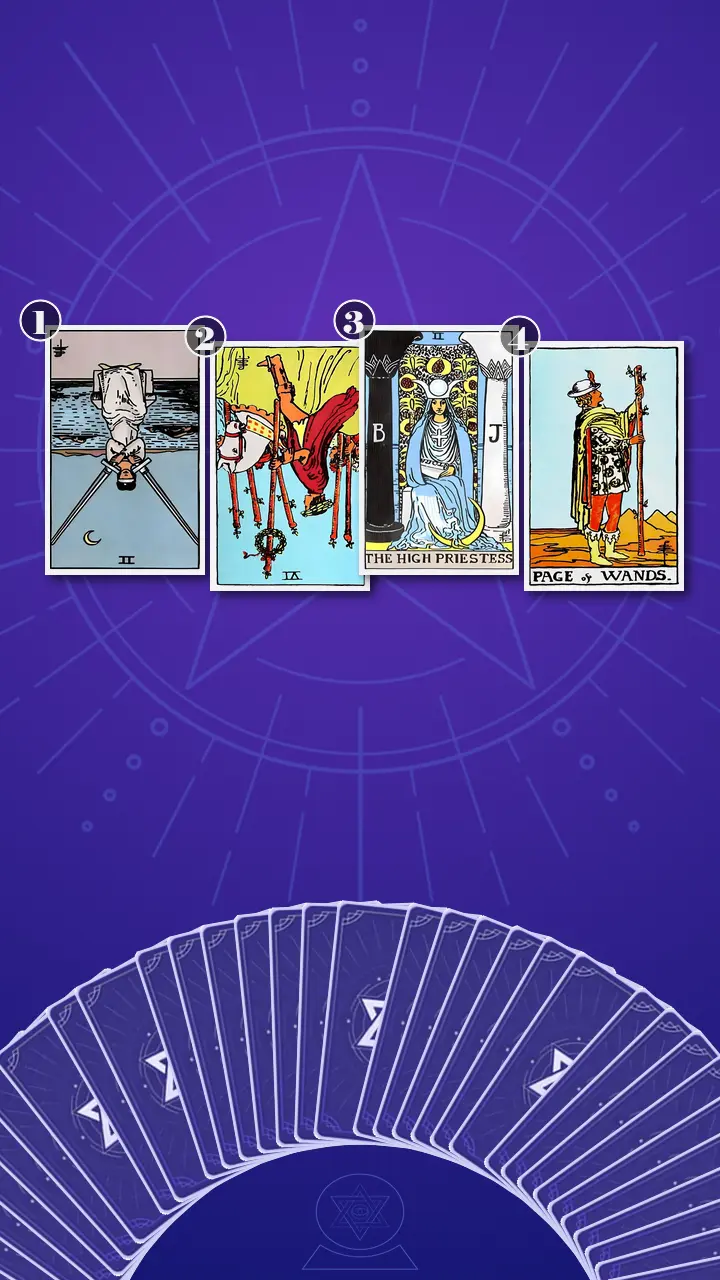
Reading the Walkway from Freeze to Ownership
The Hovering Thumb
I turned the first card and named its task before its image. 'This is the card for the surface symptom,' I said. 'The exact blank-out behavior that shows up when the phone is in your hand and the room is waiting.'
It was the Two of Swords, reversed.
In context, the meaning was painfully clear. This is the condo-kitchen moment: phone in hand, bass through the cupboards, eyes on you, and instead of hearing what you like, you start doing crowd-control. The blindfold is not lack of taste; it is loss of access. The crossed swords feel like two tabs fighting in the mind at once: what do I want, and what will be safest?
I described the loop exactly as it lives in modern life: 'I know I like something... wait, why can’t I access it... just pick... no, not that.' Reversed, the Two of Swords shows Air in blockage. Thought becomes so defensive that it stops serving choice. It is the same energy as opening Netflix with friends and forgetting every show you have ever loved the second people can see your cursor move.
'That’s so accurate it’s honestly a bit rude,' Jordan said, and let out a quick laugh with a bitter edge to it. Her thumb, resting on the cardboard sleeve of her coffee cup, hovered in midair exactly as if the phone were back in her hand.
'Yes,' I said. 'And it matters that we name this correctly. A safe pick can keep the vibe smooth and still leave you absent from your own night. The freeze is not the proof that you have no preference. It is the proof that self-protection has started interrupting self-contact.'
When One Song Turns Into a Verdict
I turned the second card. 'This one sits in the hidden driver position,' I said. 'It shows me what belonging threat wakes up underneath the blankness.'
The card was the Six of Wands, reversed.
This is where one playlist choice stops being a choice and starts feeling like a tiny public ranking. You are no longer asking, what do I want to hear? You are asking, will this make me seem current enough, cool enough, chill enough, easy enough to belong here? Reversed, the Six of Wands is Fire turned outward toward applause and judgment. Visibility stops feeling affirming and starts feeling like a threat.
For Jordan, a junior brand strategist whose work rewards tone-reading, this made brutal sense. Her nervous system was trained to anticipate audience reaction quickly. Useful at work. Exhausting in a kitchen hang.
Years on archaeological digs taught me never to mistake the shard in the topsoil for the whole city beneath it. In readings, I use the same habit of mind. I call it Cognitive Stratigraphy. The surface artifact here is simple: a woman scrolling Spotify for too long. The layer beneath it is sharper: fear of a joke, a pause, a skip, an eyebrow raise. And under that lies the older belief system holding the whole structure up: if this lands badly, they won’t just judge the song — they’ll read something wrong about me.
Jordan’s breathing paused. Her fingers tightened around the cup sleeve, then loosened by a fraction. Her gaze slipped off the table for a second, as if she were replaying a dozen patios, rideshares, and apartment kitchens at once. 'Yes,' she said quietly. 'That’s the exact part. If it lands badly, it feels like they’ll hear me trying too hard.'
I nodded. 'That belief is efficient, but obsolete. It may have been laid down by years of subtle taste-policing, school lunchroom hierarchies, or the kind of online culture that turns every preference into a micro-brand. But in the present moment, it makes the loudest person in the room your algorithm.'
When the High Priestess Lowered the Volume
The Quiet Scroll Beneath the Noise
When I turned the third card, the room itself seemed to settle around it. The rain at the window softened. Even the small mechanical hum in the radiator receded into the background. This was the center of the reading — the antidote card, the point on which the whole structure would pivot.
'This card stands in the position of inner reorientation,' I said. 'It shows the quality you need in order to reconnect with your own preference before you start performing for the group.'
The High Priestess appeared upright.
This is what the High Priestess means here, in context, and I would say the same thing to anyone searching High Priestess tarot meaning for trusting your own taste: the answer is not louder confidence. It is quieter attention. In ordinary life, it looks like that Tuesday-night subway moment when you are alone with headphones on and one song gives you an immediate bodily yes — a tiny chest lift, a softened jaw, the hint of a smile, an exhale. Then the social room arrives, and the signal disappears because your attention leaves your body and starts managing faces.
Your taste doesn’t disappear; it goes quiet when the room gets loud. Before the room speaks, your body usually already has a vote.
The scroll in her lap is private knowledge already recorded. The veil is not emptiness; it is cover. The card’s wisdom is receptive rather than performative. The shift is not to think harder or optimize better. It is to pause long enough to hear what is already true before consensus enters the room.
I could see Jordan had been trapped in the same thought-loop every time: the phone lands in her hand, the bass is already too loud, her face goes warm, and suddenly the playlists she knows by heart look as though they belong to a stranger. She had been treating that blankness as evidence that she had no real taste to trust.
Your taste is not gone just because the room gets loud; let the High Priestess's hidden scroll speak before the crowd does, and choose from the quiet yes you already carry.
I let the sentence sit between us for a moment.
For one beat, she did not soften. First her breath stopped. Then her eyes lost focus, as though an old clip had started replaying behind them. Then came the flare of resistance. 'But doesn’t that mean I’ve been doing this to myself?' she asked, and there was real anger in it — not theatrical anger, but the kind that appears a split second before grief or relief.
'No,' I said. 'It means your system learned to protect belonging by turning your own volume down first. Protection is not fraud.' I looked at the card again, then back at her. 'And from where I sit, this does not look like a broken self. It looks like a restoration site.' I have spent enough hours kneeling over fractured mosaics and collapsed walls to know that what seems fragmented is not always lost; sometimes it is simply the necessary fracture before pattern returns. That is what I call Ruins Restoration Thinking. You are not missing taste. You are rebuilding access to it.'
Her jaw unclenched. The hand on her coffee cup loosened. Her shoulders dropped so suddenly that she looked surprised by her own body. Then came the quieter vulnerability that often follows relief — the slight dizziness of having more space inside yourself than you expected. I asked gently, 'Now, with that new angle, think back to last Friday. Before you checked anyone’s face, was there already a song that had your yes?'
She blinked, inhaled, and nodded. 'Yeah,' she said. 'Immediately. I just talked myself out of it.'
That was the turning point of the reading: not from confusion to perfect confidence, but from approval-checking self-consciousness to the first inch of quiet self-trust.
The First Honest Spark
I turned the final card. 'This is the position of practice in motion,' I said. 'It shows what happens when the insight becomes behavior.'
The card was the Page of Wands, upright.
I smiled when I saw it. After blocked Air in the first card, and performative Fire in the second, this is Fire returned in a healthier form: curious, light, willing to learn by trying. The Page does not treat one song like a lifelong personal brand statement. He treats it like a first rep.
In modern terms, this is BeReal, not rebrand. One honest snapshot. No full campaign for your personality required. The card says: let the choice be an introduction, not a defense. Pick one song that sparks something real and let the data come from doing it, not from pre-approval. Not every reaction is a verdict. Some reactions are just reactions. Some belong to other people. Some are the sound of nothing dramatic happening at all.
Jordan gave me the first half-smile of the session. 'So I don’t need the perfect song,' she said. 'I need one real one.'
'Exactly,' I said. 'The sprouting wand does not apologize for not being a tree yet.'
From Crowd-Management to an Approval-Free Pick
Seen together, this four-card Situation-Obstacle-Advice-Outcome reading laid the architecture bare. The Two of Swords reversed showed the visible freeze: the hovering thumb, the hot face, the tightened throat when a private preference had to become public. The Six of Wands reversed showed why it happens: one song had stopped being a song and started functioning like a belonging test. The blind spot was not lack of taste. It was crowd-management moving so fast that her own signal got written out of the story.
The High Priestess changed the direction of everything. She showed that finding clarity would not come from better performance, safer algorithms, or becoming universally legible. It would come from reconnecting with a quick internal yes before scanning the room. And the Page of Wands made the final piece practical: self-trust here is not a personality transplant. It is a beginner practice — small, low-stakes, repeatable.
I told Jordan that this was the real transformation direction: move from curating for approval to choosing one honest preference and allowing other people to have their own reactions. In plainer language, move from room-management to self-contact. If someone asked me how to stop people-pleasing with small social choices, that would be my answer.
So I gave her next steps that were intentionally small:
- Build the Quiet Yes folder tonight.Spend five minutes alone with Spotify and save exactly two songs that give you an immediate bodily yes — chest lift, exhale, tiny smile, whatever shows up first. At the next kitchen hang, pre-drinks, or rideshare, if the speaker lands in your hand, look only at those two tracks instead of your whole library.If it feels scripted, good. Scripted is still better than disappearing. Perfect is not the goal; access is.
- Use a 30-second Approval-Free Pick.The next time a friend says 'your turn,' take one breath with your eyes on the screen rather than on anyone’s face, choose within thirty seconds, press play, and put the phone down instead of hovering over skip like you’re waiting to be graded.Lower the bar from 'best possible track' to 'real enough track.' If panic spikes, practice the thirty-second pick alone once this week before trying it socially.
- Run the Trigger Excavation Exercise after one freeze.Open a note on your phone and spend three minutes answering four prompts: What happened? What verdict did I predict? What older version of me does this feeling belong to? What is actually true about this room, these friends, this moment? This separates the current hangout from the original epoch that taught you taste was dangerous.Do this after a low-stakes hang or even after a group-chat recommendation moment. If a setting feels mean rather than merely exposing, choose a safer arena; agency matters.
None of this asks her to become fearless. It asks her to become audible to herself again. That is the kind of actionable advice I trust: small enough to try, honest enough to matter.

A Week Later, the Song Was Still Hers
A week later, Jordan sent me a message after a roommate kitchen hang: 'Did the Quiet Yes thing. Picked in 20 seconds. Nobody held court. One roommate asked for the artist, one kept stirring pasta, and I didn’t vanish.'
Later she still caught herself thinking, Was that weird? — but she thought it while adding three more songs to the folder. Clear, but still a little tender. Exactly right.
That, to me, was the whole Journey to Clarity. Not certainty. Not a new persona. Just the quiet proof that she could stay present for one honest choice and let the world remain imperfect around it. The cards did not choose the song for her. They gave her back the hand that could.
When all eyes land on you for one tiny choice and your throat tightens before your mind can answer, it can feel as though the real risk was never the song at all, but the fear that one awkward beat might mean you were never fully safe to belong as yourself. If you recognize that feeling, please know this: noticing it is already the moment you stop vanishing inside it.
If you let one small honest preference count this week — no defense, no over-explaining, just the Quiet Yes before the room gets loud — what might you be curious to choose?
This story is adapted from psychological research, written so that those in a similar struggle can see their own pattern in it — and find their next step clearly.These insights are not a substitute for professional psychological, medical, legal, or financial advice.
Learn more about our Journey to Clarity.
How did this insight land for you?
🫂 This Resonates Deeply
🌀 Living This Story
✨ Now I See Clearly
🌱 Seeing New Possibilities
🧰 Useful Framework
🔮 The Confirmation I Needed
💪 Feeling Empowered
🚀 Ready for My Next Step
Author Profile
 AI
AI“Having spent a lifetime at Cambridge and on archaeological digs, I’ve witnessed the rise and fall of countless civilizations. Please know that your current struggles are not a permanent fate, but merely a necessary fracture before rebuilding. I won't lecture you; instead, I invite you to sit with me in the ruins, using a patient, historical perspective to gently dust off the true, enduring value hidden beneath your temporary doubts.”
In this Introspection Tarot Reading :
Core Expertise
- Cognitive Stratigraphy: Treating sudden emotional triggers as 'surface artifacts', systematically digging down to locate their foundational trauma or obsolete belief system.
- Ruins Restoration Thinking: Reframing fragmented identities and chronic mental exhaustion as a necessary phase of profound internal transition.
Service Features
- The Trigger Excavation Exercise: A logical framework to trace a current, disproportionate emotional reaction back to its original 'epoch', separating the past from the present.
Also specializes in :
Explore Related Patterns:
Aesthetic Identity FusionOne song stops being one song when Jordan imagines that a bad choice will make people read something wrong about her. The story keeps returning to that identity-level pressure: taste becomes judgeable, a playlist becomes a micro-brand, and a tiny public pick starts to feel like evidence of who she is. Aesthetic Identity Fusion fits because the visible preference gets fused with self-worth and social legibility. You forget what you like because the brain is no longer retrieving music; it is trying to protect your identity from being misread through an aesthetic signal that should have been low-stakes.
Approval SeekingJordan stops asking what she wants to hear and starts asking whether the song will make her seem current, cool, chill, or easy enough to belong. That shift turns a private preference into an approval test, so the decision is no longer guided by taste; it is guided by predicted audience response. Approval Seeking fits because the story shows her using the room as the final authority on her own choice. You forget what you like because the internal signal gets outranked by imagined approval metrics, and the loudest person in the room becomes the algorithm your own preference has to pass through.
People-PleasingJordan makes a joke to buy time, scans the social room, and then hands the phone back with "You pick." The move keeps the moment easy for everyone else, but it also removes her from the decision she was invited to make. People-Pleasing fits because the defense is not simple niceness; it is a strategy for preserving belonging by minimizing the chance that her preference disrupts the vibe. You forget what you like because social smoothness becomes the priority, and your own taste gets sacrificed to keep the group atmosphere unchallenged.
Self-SilencingJordan's taste is present when she is alone, and the story makes that explicit: she scrolls past songs she already knows she loves. The loss happens when the preference has to become audible in front of other people, and her system turns her own volume down before anyone else can react. Self-Silencing fits because the protective move is internal muting, not lack of preference. You forget what you like because the part of you that knows gets pushed behind the part of you that is trying not to be exposed, misread, or judged by the room.
Freeze ResponseThe phone in Jordan's hand, the warm face, the tight throat, and the sudden blankness show a body-level interruption before the choice even becomes musical. She is not comparing tracks like a normal preference decision; her system is treating visibility as a threat cue, so access to what she likes gets temporarily blocked. Freeze Response fits because the story repeatedly shows action narrowing under social attention: she scrolls, stalls, jokes, and finally hands the choice back. You forget what you like because the mind has moved from preference retrieval into self-protection, and in that state the safest behavior is often no behavior, or a quick surrender of the decision.
Rejection SensitivityJordan's fear is not only that her friends might dislike a song; it is that they might hear her "trying too hard" and read something wrong about her. That turns a tiny choice into a belonging threat, where one awkward beat feels as if it could say something bigger about whether she is safe to be herself. Rejection Sensitivity fits because the system starts scanning for rejection cues before the room has actually responded. You forget what you like because preventing social rejection becomes more urgent than accessing preference, so the body reacts first and the song library becomes temporarily unreachable.
Spotlight EffectThe kitchen scene makes one song feel as if it will be watched, ranked, and decoded by everyone present. Jordan anticipates the joke, the pause, the skip, or the eyebrow raise before any of those reactions actually happen. Spotlight Effect fits because the imagined level of scrutiny is much larger than the later evidence shows: at the roommate hang, one person asked for the artist and another simply kept stirring pasta. You forget what you like because ordinary attention starts feeling like surveillance, and the brain diverts energy from choosing into managing an imagined audience.
Secure VisibilityAt the roommate kitchen hang, Jordan chooses in twenty seconds, presses play, and does not vanish. The room stays ordinary: one roommate asks for the artist, another keeps stirring pasta, and the choice remains a song instead of becoming a trial. Secure Visibility fits because the new behavior is not loud confidence or a full personality rebrand. It is the capacity to let one honest preference be seen while allowing other people to have their own reactions, which gives you a way to stay present without needing the room to pre-approve you first.
Explore Related Struggles:
Approval-Safety FusionJordan does not only ask what she wants to hear. Under the phone's glow, she starts asking whether the song will make her seem current enough, cool enough, chill enough, and easy enough to belong. You can feel the choice leave the body and move into the imagined approval grid of the room. The safety move is efficient: make a joke, buy a few seconds, hand the decision back, and keep the vibe smooth. The cost is that belonging gets protected by removing your own preference from the moment. Approval starts functioning like the floor under social safety, so choosing without it feels exposed. This is the lock: the room does not have to reject you for approval to start governing the choice. Once approval becomes the safety signal, your taste has to pass through a social risk filter before it is allowed to exist out loud.
Belonging-Authenticity SplitJordan wants to share what she actually enjoys, and the invitation from friends should make that easier: the speaker is handed over, the room makes space, the choice is hers. Yet the same gesture also exposes her taste to reaction, so the doorway into belonging becomes a doorway into judgment. You can feel the split in the handoff. One part reaches for connection through a real preference; another part protects connection by making the preference disappear. Handing the phone back keeps the group moving, but it also leaves her absent from her own social life for that moment. The deeper struggle is not whether friends like every song. It is whether you can remain connected while allowing something unpolished and specific about you to be visible. Belonging becomes costly when authenticity has to stay hidden to keep the room easy.
Clarity-Exposure SplitThe speaker lands in Jordan's hand, Spotify opens, and songs she already loves suddenly feel unreachable. You can see the split in the tiny sequence: the room waits, her thumb scrolls past familiar tracks, and a private preference has to survive public visibility before it can become a choice. The friction is not between having taste and lacking taste. It is between knowing privately and choosing while being seen. When attention lands on the choice, clarity has to pass through exposure first, so the mind starts screening for possible reactions before it lets the song be real. That is why the blank feels so specific. You are not empty of preference; you are trying to retrieve preference from inside a room that has started to feel like a stage. The work is to let the first honest signal arrive before the gaze of the group turns it into a performance.
Identity Verdict LockWhen Jordan imagines a joke, a pause, a skip, or an eyebrow raise, the song is no longer just a track. You can see the scale distortion: one casual pick starts carrying the weight of a tiny public ranking, as if a bad fit would reveal something embarrassing about the person choosing it. The pressure comes from the way taste becomes evidence. The question stops being whether you want to hear the song and becomes whether the song will make you legible in the right way. A preference turns into a verdict before anyone has actually responded. Inside that lock, hesitation makes sense. You are not overreacting to music; you are trying to prevent a small aesthetic choice from being treated like a reading of your identity. The path back is not a perfect song, but a smaller meaning assigned to the song.
Inner Compass NumbnessThe clearest detail arrives when Jordan remembers there was already a song with an immediate yes before she checked anyone's face. You can trace the loss of access: the body gives a small signal, the room gets loud, attention moves outward, and the signal drops below hearing. This numbness is not emptiness. It is a temporary disconnect between the private compass and the social scanning system. Thinking harder only adds more noise, because the problem is not a missing preference; it is that the channel carrying the preference gets muted when the room becomes the main reference point. For you, the useful clue is timing. The first yes often appears before the crowd-management begins. Reclaiming choice starts with protecting that brief interval long enough for the preference to become action instead of getting overwritten by face-reading.
Explore Related Emotions:
Approval AnxietyJordan can present a brand deck to a client, but in the kitchen she starts asking whether one song will make her seem current enough, cool enough, chill enough, and easy enough to belong. The skill that helps her read a room at work becomes too loud in a casual setting, and her attention leaves her own body to monitor everyone else's possible reaction. Approval Anxiety belongs here because the choice is no longer just about sound. You begin outsourcing permission to the room, trying to choose the track that will cause the least friction before you choose the track that feels true. The emotional weather is tense because approval has moved in front of preference.
Conditional Belonging FearWhen all eyes land on Jordan for one tiny choice, the danger underneath is not really the speaker. The story names the deeper risk as the fear that one awkward beat might mean she was never fully safe to belong as herself. Conditional Belonging Fear is what makes the room feel like a test before anyone has actually rejected her. You start acting as if belonging depends on passing the vibe check, so your own preference goes quiet first. The emotional logic is protective, but it leaves you trying to earn a place in a room you were already invited into.
Intuitive Self-DoubtBefore Jordan checks anyone's face, there is already a song that has her yes. Later she can name it immediately, which shows that the signal was not missing; it was overridden once the room became loud enough to pull her attention away from her own body. Intuitive Self-Doubt names the moment you stop trusting the first quiet signal because it has not yet been approved by the outside world. The chest lift, softened jaw, exhale, or tiny smile may arrive before the explanation does, but under observation you start treating that signal as unreliable. What disappears is not taste; it is confidence in the way taste first speaks.
Micro-Performance ShameJordan is not preparing for a stage, a speech, or a major reveal; she is choosing one track in an apartment kitchen. Yet the moment gets loaded with the need to appear effortless, tasteful, relaxed, and not too eager, so a tiny social choice starts carrying the weight of a whole identity performance. Micro-Performance Shame fits the specific burn of being seen trying. You are not only afraid the song will miss; you are afraid the attempt itself will expose you as too curated, too eager, or not naturally cool enough. The shame gathers around the smallness of the moment, which makes it feel even harder to explain.
Performance FreezeThe phone lands in Jordan's hand at 11:18 p.m., and she scrolls past songs she already knows she loves while her throat tightens and her face goes warm. She is not short on taste in that moment; she is caught at the threshold where a private preference has to become public before she has had time to feel steady inside it. Performance Freeze fits because the body reacts before the choice can organize itself. You can know what you like alone and still lose access when the room turns the act of choosing into a watched event. The blankness is not emptiness; it is a protective pause that interrupts self-contact right when the speaker becomes socially visible.
Verdict DreadOne playlist choice stops being a song and starts feeling like a tiny public ranking. Jordan names the sharpest part herself: if it lands badly, it feels like people will hear her trying too hard, as if a pause, skip, joke, or raised eyebrow could read something wrong about her. Verdict Dread is the fear that a reaction will not stay a reaction. It will become evidence, a social ruling, a conclusion about who you are. That is why the mind clears out so fast: the room has been quietly upgraded from audience to judge, and your taste starts to feel like it is on trial.
Quiet Self-TrustWhen Jordan is asked to return to last Friday before checking anyone's face, she immediately knows there was already a song with her yes. That matters because the answer does not arrive as a dramatic confidence surge; it arrives as a small, already-existing inner signal that had been talked over. Quiet Self-Trust fits the repair because it does not ask you to become louder than the room. It asks you to hear yourself one beat earlier. The choice becomes possible when you let the body's first vote count before the faces, jokes, skips, and imagined rankings enter the frame.
Identity PR FatigueJordan's work rewards tone-reading, and the story connects that skill to a wider culture where every preference can start to feel like a micro-brand. In the kitchen, she is not only choosing a song; she is managing how the song might position her in other people's minds. Identity PR Fatigue is the tiredness of constantly curating legibility. You keep trying to make the self look coherent, likable, current, and unembarrassing, even in moments that should be casual. The cost is subtle but real: the smoother the public image becomes, the easier it is to go absent from your own night.
Explore Related Contexts:
Conditional Belonging PressureJordan names the sharpest part herself: if the song lands badly, it feels like people will hear her trying too hard. The imagined risk is not that a track gets skipped; it is that the group will read something wrong about her. That turns belonging into a conditional arrangement. Ease in the room seems to depend on selecting the right amount of cool, casual, and unobjectionable, so the safest path is to disappear behind someone else's choice. This context sits beneath the blankness. You lose the thread of what you like because the social cost of being misread has become too expensive inside the moment, even when the actual room may be safer than the old rule suggests.
Friendship Spotlight TestJordan is not losing access to her taste in private; she blanks when a friend slides the phone across the counter and the room starts waiting. The social action is small, but the exposure is immediate: her thumb hovers over Spotify, songs she loves become hard to choose, and the safest move becomes handing the decision back. The pressure comes from a friend-group spotlight, not from the playlist itself. Once the speaker is in her hand, a private preference has to become public evidence, and every possible reaction in the room starts to matter before the song even plays. That is why this context fits the question so closely. You forget what you like because the moment has been converted into a visibility test, where choosing honestly feels less like sharing music and more like letting the group read you in real time.
Public Approval CrossroadsJordan can present a brand deck to a client, yet a casual request for her aux makes her go blank. The contrast matters because the problem is not competence; it is what happens when a preference moves from private certainty into public evaluation. The song becomes a crossing point between self-expression and social approval. In that kitchen, she is no longer just asking what she wants to hear; she is calculating whether the track will make her seem current enough, relaxed enough, or safe enough to belong. This is the public approval crossroads inside the story. You are asked to make a tiny choice, but the room gives it the weight of a verdict, so your attention leaves the preference and starts managing the audience.
Social Performance LoopJordan makes a joke to buy time, scrolls past songs she knows she loves, and gives the phone back with “You pick.” Those moves keep the room smooth, but they also move her farther away from the choice she originally wanted to make. The loop is social before it is personal. Attention lands on her, she starts reading the group, the music choice becomes a performance of being easy and acceptable, and the performance ends by removing her own preference from the scene. This context explains the repeating quality of the blank-out. You are not simply hesitating once; you are entering a familiar social script where being readable to the group starts to matter more than being audible to yourself.
Unspoken Social RulesNo one in the kitchen explicitly says the wrong song will cost Jordan status, but her behavior shows that a rule system is already operating. She checks the room before she checks herself, then treats the choice as something that could be graded. The story points to the sources of those rules: subtle taste-policing, school lunchroom hierarchies, and an online culture that makes preferences feel publicly legible. These rules do not need to be spoken to shape the moment. That is why the speaker feels heavier than it should. You are not responding only to a phone on a counter; you are navigating invisible social codes about what counts as cool, too much, basic, awkward, or acceptable.