The Queen West Answer That Wasn't True
If you're an early-career city person who can present cleanly in a meeting but suddenly forget how to describe yourself at a friend-of-a-friend dinner, I know this pattern well.
Alex, a 25-year-old junior product designer in Toronto, sat across from me with one knee bouncing under the chair and told me about 7:18 p.m. on a Saturday on Queen West: menus still open, glasses clinking, chili oil and citrus in the air, somebody asking the table for a weekend highlight. Two hours earlier, she had been excited about the climb she finally sent and the roll of film she developed after. In the actual moment, she smiled, pressed her tongue to the roof of her mouth, and heard herself say, 'I don't really do anything that interesting.'
Her throat had stayed tight all the way home. Her body, she said, felt like it had swallowed a coat hanger: shoulders slightly raised, stomach on alert, jaw careful. It was self-consciousness, yes, but more specific than that—like carrying your personality in airplane mode while everyone else seemed to be broadcasting in full signal.
'I can tell a story about myself that sounds normal,' she told me, 'or I can tell the real one.'
I nodded. 'That is exactly the kind of pattern tarot is good at clarifying. Not because the cards decide who you are, but because they show where your energy starts editing you before the room ever does. Let's make a map for the fog.'

Choosing the Compass: a Five-Card Cross for Group Chat Anxiety and New-Group Belonging
I asked Alex to take one slow breath, feel both feet on the floor, and hold the question in plain language: why do I downplay my hobbies when I'm trying to fit into a new group? Then I shuffled slowly enough for the question to stop sounding like a complaint and start sounding like data.
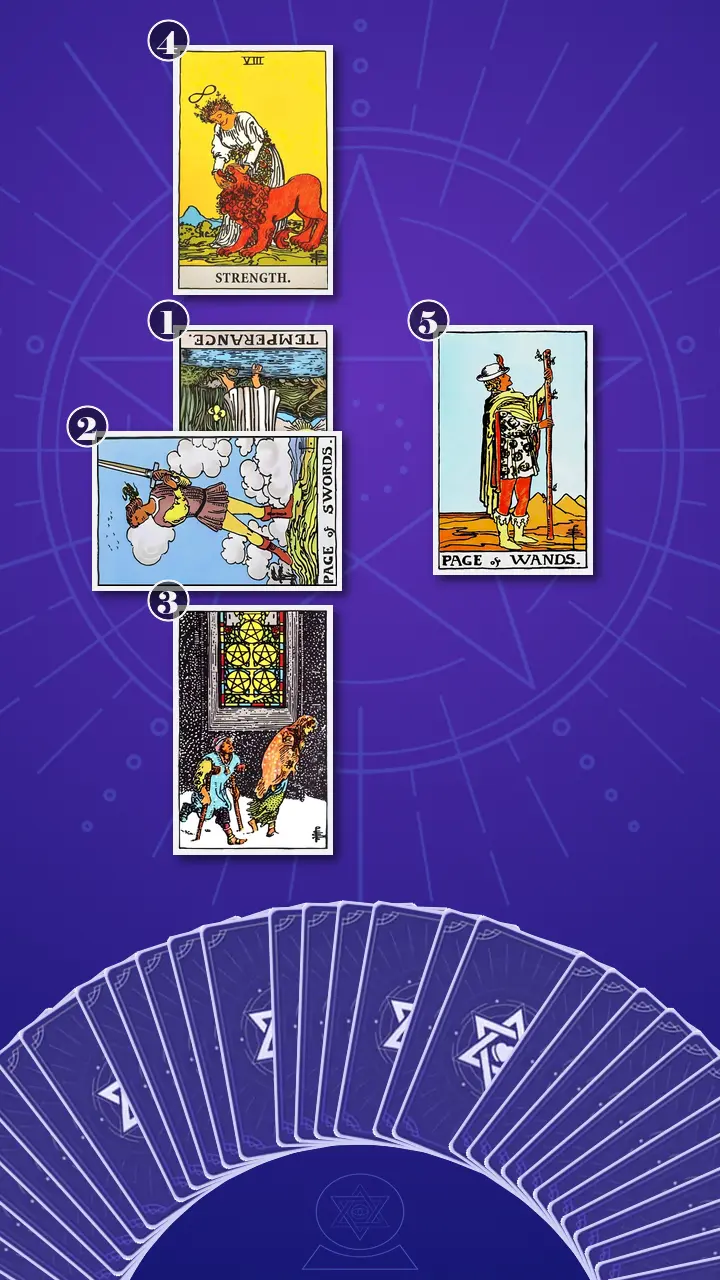
For this session, I used a Five-Card Cross · Context Edition. This is how tarot works best in my practice: card meanings in context, not vague fortune-cookie symbolism. Her issue was not a sprawling life audit. It was a tight, repeating social pattern. So I chose the fewest cards that still covered the problem clearly: the visible symptom, the live trigger, the deeper root fear, the corrective resource, and the next practical step.
I told her what I tell readers every time: the center card would show the pattern as it appears now. The crossing card would expose what hijacks her natural expression in real time. The lower card would take us under the behavior, into the belonging wound. The upper card would show the resource she could consciously use. And the card to the right would not predict her future; it would translate insight into next steps.
Where the Flavor Gets Lost
Position 1: the visible self-editing strategy
Now I turned over the card representing the visible self-editing strategy from the diagnosis, especially the habit of watering down hobbies in new-group settings.
Temperance, reversed.
I always pay attention to the two cups on Temperance. In this card, they looked like the acceptable version of Alex and the real version of Alex, with too much liquid passing between them. I told her this was the exact social moment she had described at that Queen West dinner: a vivid weekend flattened into something beige. Sunday climbing and developing film became 'nothing much.' Not a lie. Just so overmixed it stopped tasting like her. Like adding so much water to cold brew that it no longer tastes like coffee at all.
'Say the normal version,' I said softly, naming the inner script I could feel in the card. 'Keep it light. Don't make this a whole thing.'
Reversed, Temperance showed excess adaptation and blocked authenticity at the same time. Her social intelligence was real, but it was being used to dilute instead of connect. Self-censorship can get you included. It rarely gets you recognized.
Alex let out one short laugh that had no amusement in it. 'Wow,' she said, looking down at the card. 'That's rude in the most accurate way.' Her fingers pinched the edge of her sleeve, then loosened.
Position 2: the immediate social trigger and mental tension
Next I revealed the card for the immediate social trigger and mental tension that kicks in when she tries to fit into a new group.
Page of Swords, reversed.
This was the live surveillance system. I told her that when this energy gets blocked, curiosity turns into monitoring. In real life, it looks like editing a message three times in a new group chat, scrolling someone's Instagram highlights before brunch, or running live QA on every sentence while everyone else seems to be just talking. Too much? Too niche? Say it cleaner. Say it safer.
The Page of Swords is all wind and alertness, but reversed it becomes hypervigilance. Distorted Air. Instead of letting a hobby arrive naturally, she hears herself through a focus group before her own voice even gets a turn. The problem is not that she lacks a personality. It is that social threat detection keeps grabbing the mic.
I saw her jaw set the way people do when a pattern becomes embarrassingly visible. 'That office kitchen version is me,' she said. 'I literally delete the part that sounds like an actual person.'
Position 3: the deeper fear under the behavior
Then I turned over the card for the deeper fear beneath the behavior, the belonging wound and scarcity story holding the whole structure up.
Five of Pentacles, upright.
The room went quieter for me when this card appeared. In my old Wall Street life, I learned that markets make otherwise rational people behave strangely the moment scarcity enters the picture. I have come to see social scarcity do the exact same thing. Five of Pentacles does not say her hobbies are the problem. It says her body has learned to treat belonging like a resource that could be withdrawn.
I traced the image with a finger: the cold street, the bent bodies, the warm stained-glass window glowing nearby. 'This,' I told her, 'is what it feels like when the table is warm but your body acts like one wrong detail could leave you outside it.'
That is why the self-editing feels logical. If some part of you assumes friendship is a guest list you could get bumped from at any moment, then of course you start mirroring the room. Of course you choose the safest possible version of yourself. Belonging built on sameness is expensive.
Alex went very still. First her breath paused. Then her eyes lost focus for half a beat, as if she was replaying a patio dinner frame by frame. When she finally exhaled, it came out slower than before. 'I never think of it as fear of exclusion,' she said. 'But yes. That's exactly what it is. Quiet exclusion.'
When Strength Put Her Hand on the Lion
Position 4: the core resource that changes the pattern
When I reached for the fourth card, the air in the room changed in that unmistakable way it does when a reading stops diagnosing and starts offering an antidote. Outside my window, a streetcar bell rang once and then dropped back into the city noise below.
This position identifies the core resource and transformational quality needed to interrupt the pattern and support a different social stance.
Strength, upright.
I felt my own shoulders drop when I saw it. This card was not asking Alex to become louder, cooler, or more magnetic. It was asking for regulated visibility. The gentle hand on the lion is the opposite of performance. It is what happens when fear is still present, but it is no longer driving the conversation.
I told her that in real life this looked almost absurdly small: saying, 'I've been climbing a lot lately, and I was developing film on Sunday,' and then not rushing to cover it with humor, apology, or a Fleabag-style smoke bomb of self-deprecation. The goal is not to say more. It's to stop erasing what was already true.
This is also where I used a lens from my own practice that I call Network ROI Analytics. I do not bring it in to make people cynical; I bring it in to make the cost visible. If the cost of entry to a group is constant self-dilution, the return is usually polite access, not recognition. A room that only welcomes the beige version of you is offering low-return belonging. Strength asks a cleaner question: are you protecting yourself from rejection, or pre-rejecting yourself so the room never gets a vote?
You know that moment when the room asks for an easy little fact about you, and your body reacts like the wrong answer could quietly cost you warmth, even though two hours earlier your hobby felt joyful and natural?
You do not need to water yourself down to be welcomed; meet the lion of social fear with a steady hand and let one real passion stay visible.
I let the sentence sit between us.
Alex's reaction came in layers. First, a freeze: her hand stopped halfway to her mug. Then the thought landed deeper; her gaze slid past me, unfocused, as if she were suddenly back in that Monday team chat, seeing the deleted sentence about the film lab. Then the emotion showed itself, not as relief at first, but as resistance. Her mouth tightened. 'But if I stop doing that,' she said, voice thinner now, 'doesn't that mean I've basically been excluding myself first?'
'Partly, yes,' I said, keeping my tone steady. 'Not because you're weak. Because you built a smart safety strategy and kept using it after the danger became less certain. Strength doesn't shame that strategy. It just stops letting it run the room.'
Something in her face softened at that. Her shoulders lowered a full inch. She took a deeper breath, then another, and there was that almost dizzy beat I know well—the little internal sway that can come after a heavy truth finally lands and a person realizes they now have more responsibility, not less. I asked her, 'Using this new lens, was there a moment last week when this would have changed how you felt?'
She nodded before she answered. 'The office kitchen. I typed the part about the photo lab, deleted it, and then hated the whole message. If I'd just left it in, maybe nothing dramatic would have happened. But at least I would've been in the chat.'
That was the hinge of the reading for me: not from introvert to extrovert, but from guarded approval management to steadier self-trust in being seen. From watering herself down to holding herself steady.
Position 5: the first honest spark
Finally, I turned over the card that translates insight into a concrete relational experiment: how to show more authentic interest and let connection form from resonance rather than self-erasure.
Page of Wands, upright.
I smiled when I saw it. This was not a demand for a personality rollout. It was a signal flare. In modern life, this card is the simple group-chat message, the real dinner answer, the one live spark: 'Anyone here ever shoot film?' or 'I've been climbing a lot lately—any gym recs?' Offer one real detail. Let resonance do the sorting.
Where Page of Swords reversed had her studying the room from the doorway, Page of Wands asked her to enter it. The energy here is balanced Fire: curiosity, not performance; initiative, not oversharing. The point is not to be broadly palatable. The point is to be specifically recognizable to the people who can actually meet you there.
Alex gave me the first real smile of the session. Small, skeptical, but real. 'That feels weirdly less terrifying than trying to seem universally chill,' she said.
From Polite Access to Real Recognition
When I laid the whole spread back out for her, the story was clean. Temperance reversed showed the symptom: editing yourself to fit in until your answer loses flavor. Page of Swords reversed showed the trigger: social surveillance replacing spontaneity. Five of Pentacles showed the root: a scarcity story that says visible difference could cost you warmth. Strength placed the remedy above that wound: steadiness instead of self-erasure. And Page of Wands opened the right side of the spread like a door: one honest spark, shared lightly, so connection can grow from resonance rather than approval management.
The blind spot was not 'I need better small talk.' It was this: Alex had been treating better editing as the path to belonging, when all it was really buying her was a technically successful but emotionally thin connection. She was trying to solve quiet exclusion by participating in a softer version of it. The transformation direction was clear—move from matching the room before showing yourself to selective honesty: one real detail, no disclaimer, and enough steadiness to let the room respond.
I gave her actionable advice, not because tarot replaces real life, but because clarity is only useful when it changes what you do next. That is the real value of a Five-Card Cross · Context Edition tarot spread for belonging-driven self-editing in new social groups: it turns emotional static into next steps.
- The One True Detail NoteBefore your next dinner, work social, or after-work hang, put one line in your phone: 'One true detail, no disclaimer.' When someone asks what you're into, answer with one hobby and one concrete fact—something like 'I've been climbing a lot lately, and I was developing film on Sunday'—then stop.If your throat tightens, keep the sentence shorter instead of safer. One honest line is enough; you do not owe anyone a full personality reveal to be honest.
- Retire One Dilution Phrase for Seven DaysPick one phrase you use to minimize yourself—'I don't really do much,' 'nothing interesting,' or 'I'm not serious about it'—and remove it for one week in every chat, intro, or casual hangout.Do not replace it with a performance. Replace it with a plain factual sentence. The goal is not rebranding. It is reducing dilution.
- Send the Spark, Then Track the ReturnThis week, send one low-stakes spark message in a group chat or to a new circle: a climbing question, a film-lab recommendation request, a class you're taking, a real interest you're actually spending time on. Then notice who responds with curiosity, follow-up, or shared specificity.This is where my Social Divestment Plan begins quietly. If a circle only engages when you flatten yourself, stay cordial but stop overinvesting there. Reallocate your energy toward the people and spaces that respond to the honest version.
Those were her next steps. Small. Measurable. Human. Not 'be more confident.' Not 'just be yourself.' Just enough structure to take her personality off airplane mode without turning honesty into a performance review.

A Week Later, the Signal Stayed On
A little over a week later, Alex messaged me. She had sent a note in a team chat: 'Anyone know a good place to develop film in the east end? I got back into shooting on weekends.' Two coworkers replied. One had a lab rec. Another said she climbed at the same gym Alex had mentioned once and had been meaning to ask about it. Nothing cinematic happened. No instant soul-friend montage. But the conversation got warmer, and more importantly, it got real.
She told me the strangest part was the two seconds after sending it. Her coffee went cold while she stared at the typing bubbles, and the first thought in her head was still, What if that was weird? Then she laughed at herself a little, because this time the sentence had already left the room intact.
That is what I call a real Journey to Clarity. Not certainty. Not social perfection. Just the first solid proof that belonging becomes more trustworthy when you stop negotiating against yourself before anyone else has spoken.
If tonight you recognize that specific loneliness—being technically included while your throat stays tight because the version of you they met was the edited draft—please know that noticing it is already a form of return. You are no longer only managing the room; you are beginning to see yourself inside it.
So the next time the lion of social fear lifts its head at the table, what is one real detail you might let stay in the room for two whole seconds?
This story is adapted from psychological research, written so that those in a similar struggle can see their own pattern in it — and find their next step clearly.These insights are not a substitute for professional psychological, medical, legal, or financial advice.
Learn more about our Journey to Clarity.
How did this insight land for you?
🫂 This Resonates Deeply
🌀 Living This Story
✨ Now I See Clearly
🌱 Seeing New Possibilities
🧰 Useful Framework
🔮 The Confirmation I Needed
💪 Feeling Empowered
🚀 Ready for My Next Step
Author Profile
 AI
AI“I spent years in the intense, high-stakes world of Wall Street. I know exactly how isolating and heavy the weight of uncertainty can feel in the dead of night. I use strategic, commercial logic not to be cold, but to protect you from unnecessary friction. Think of me as a fellow traveler who has walked the same rocky path—offering sharp but deeply supportive wisdom to help you clear the fog and confidently win your narrative back.”
In this Social Tarot Reading :
Core Expertise
- Network ROI Analytics: Treating social engagements as investments to identify high-drain, zero-return relationships masking as 'networking'.
- Toxic Hierarchy Filtration: Deconstructing subtle power plays and status games within your broader professional or social circles.
Service Features
- The Social Divestment Plan: A cold, calculated protocol to tactfully liquidate your energetic investment in toxic circles without triggering unnecessary drama.
Also specializes in :
Explore Related Patterns:
Emotional Self-CensorshipAlex's Queen West answer flattens a real weekend into 'I don't really do anything that interesting,' even though the climbing send and the developed film were still fresh and exciting two hours earlier. The behavior is not random shyness; it is a precise editing reflex that removes specificity before the group has a chance to respond to it. That reflex works like emotional self-censorship because the room starts to feel like an evaluation panel. You monitor whether the hobby sounds too niche, too much, or too hard to place, then choose the socially safer sentence. The defense reduces immediate exposure, but it also blocks the very recognition you wanted from the group. The key pattern is that You are not downplaying the hobby because it lacks meaning. You are downplaying it because visible interest has become paired with the risk of quiet exclusion. Once that mechanism is visible, the task changes from becoming more impressive to letting one accurate detail survive the moment intact.
Rejection SensitivityThe table at Queen West is warm, social, and ordinary, but Alex's body responds as if one wrong detail could leave her outside it. The throat tightness, raised shoulders, careful jaw, and alert stomach show that the threat is not the hobby itself; it is the imagined loss of warmth after being seen too clearly. Rejection sensitivity turns neutral social uncertainty into a high-stakes belonging test. You start reading the room for signs that a specific interest might make You less acceptable, then minimize the interest before the feared signal can appear. The cognitive bias is subtle: no one has rejected the hobby yet, but the nervous system behaves as if exclusion is already close. That makes downplaying feel logical in the moment. If visible difference feels like a possible trigger for quiet exclusion, then 'nothing much' becomes a protective answer. The pattern becomes easier to change when You can separate real social feedback from the prediction that being specific will automatically cost You connection.
Relational HypervigilanceAlex describes the live moment as if her own voice has to pass through a focus group before it can reach the table. A casual hobby mention becomes a sentence to QA: too much, too niche, too weird, too unsafe, say it cleaner. That is relational hypervigilance in a social-belonging context. Your attention stops tracking the actual pleasure of climbing or film and starts tracking the imagined micro-reactions of the room. The defense is trying to keep You included by catching possible rejection early, but it turns ordinary self-description into constant threat detection. The cost is that spontaneity gets replaced by surveillance. You may look socially composed, but internally the group has become a monitoring environment. Downplaying the hobby is the behavioral output of that scanning system: if nothing specific is exposed, nothing specific can be judged.
Scarcity MindsetAlex's story frames belonging like a limited seat at the table, something she could lose if the wrong detail makes her seem too different. That scarcity story is what turns a harmless weekend highlight into a resource-management problem. Scarcity mindset shows up here as the assumption that acceptance must be protected through sameness. You mirror the room, choose the safest version of yourself, and treat personal specificity as a cost rather than a route to resonance. The defense is understandable: when belonging feels scarce, even small differences can feel financially expensive in emotional terms. The problem is that scarcity-based belonging asks You to keep paying with self-dilution. It may preserve polite access, but it does not build trust in being known. The stronger move is not to overshare; it is to test whether one real detail can stay visible without treating connection as something that disappears the second You stop editing.
Self-SilencingAlex's pattern repeats across the dinner table, the office kitchen version of herself, and the team chat where she deletes the sentence about the film lab. Each time, the real detail is already available, but it gets removed right before it could make her recognizable. Self-silencing is the coping mechanism underneath that sequence. You keep the social surface smooth by withholding the parts of you that might create friction, confusion, curiosity, or judgment. In the short term, that can buy inclusion; in the long term, it creates the specific loneliness of being technically present while the edited draft does all the interacting. This is why the connection feels emotionally thin even when nothing openly goes wrong. You have not been rejected by the group in the visible scene; You have been negotiating against yourself before the group gets a vote. The pattern is not about needing a louder personality, but about interrupting the automatic deletion of what was already true.
Social MaskingAlex can present cleanly in a meeting, yet at a friend-of-a-friend dinner she suddenly cannot describe herself without flattening the details. The contrast matters: competence is available, but the social setting activates a different self-presentation script. Social masking is the mechanism that creates the acceptable version and keeps the real version in airplane mode. You do not erase the hobby because it is false or embarrassing in itself; You erase it because the group is new, the cues are uncertain, and the safest mask is the one that looks easy to place. The mask says, keep it light, keep it normal, do not make this a whole thing. The pattern protects You from standing out before You know whether standing out is safe. But it also means the group can only respond to the version that has been pre-approved for minimal friction. The work is not to drop every filter at once; it is to notice when the filter has stopped serving connection and started preventing it.
Secure VisibilityThe corrective moment is small: Alex lets a real detail stay in the room without covering it with humor, apology, or self-deprecation. She does not need to become louder; she needs enough steadiness to stop erasing what was already accurate. Secure visibility is the adaptive version of this pattern. You regulate the fear of being seen instead of handing it control of the sentence. The room is still allowed to respond, but You stop pre-rejecting yourself by deleting the part that would let people actually recognize You. This matters because the goal is not universal approval. The goal is a more trustworthy kind of belonging, where connection can form around a true signal rather than a polished absence. One honest detail becomes a controlled experiment in being visible without turning authenticity into a performance review.
Explore Related Struggles:
Approval-Safety FusionAt the table, nothing bad has happened yet. No one has mocked the climbing gym, dismissed the film lab, or decided she is too specific to belong. Still, her body acts like the wrong detail could quietly move her from inside the warmth to outside it. That is why the safest answer feels logical in the moment. When approval starts functioning as proof of safety, the goal shifts from being known to being unproblematic enough to keep the room calm. Approval-Safety Fusion names the hidden trade. You downplay the hobby not because the hobby is small, but because the group's positive reception has become tied to the feeling that you are socially safe enough to stay.
Belonging-Authenticity SplitAt the Queen West dinner, Alex has a real weekend in her hands: a climb she finally sent and a roll of film she developed after. When the table asks for a simple highlight, that lived specificity gets converted into 'I don't really do anything that interesting,' even though two hours earlier it felt alive enough to tell. You can see the split in her own sentence: there is a story that sounds normal, and there is the real one. The problem is not that she has no interests or no social intelligence; it is that belonging starts demanding a translation process before her actual life is allowed into the room. Belonging-Authenticity Split names that pressure point. You are not only choosing words in a casual conversation; you are trying to hold social access and self-recognition in the same hand, while the room feels too uncertain to trust with both.
Curated Belonging TrapAlex's edited answers work just enough to be tempting. She can sound normal at dinner, keep a team chat low-risk, and avoid making the hobby a whole thing. The room stays smooth, but the connection that follows is thin because it is built around a version of her with the flavor removed. This is the trap inside curated belonging: access gets mistaken for recognition. You may get included by presenting the beige draft, but the group cannot respond to the climbing, film, curiosity, or spark that never made it into the exchange. Curated Belonging Trap captures the cost of fitting in through controlled self-presentation. The strategy buys a seat at the table while quietly preventing the table from meeting the person who wanted to sit there.
Monitoring-Safety FusionBefore Alex even speaks, the room is already being audited. She edits messages three times, checks Instagram highlights before brunch, and runs live QA on her sentences while other people seem to be simply talking. That monitoring gives her the feeling of control, but it also steals the mic from her own voice. The climbing detail, the film lab question, the actual-person sentence all pass through a safety filter that asks whether they are too niche, too much, or too revealing. Monitoring-Safety Fusion fits because the scan itself has become the safety behavior. You are not just paying attention to the group; you are letting the act of monitoring decide what version of you is allowed to arrive.
Self-Editing ExhaustionThe pattern is not a single awkward answer. Alex edits the group chat, deletes the photo lab detail, smooths the dinner answer, and then carries the tight throat home afterward. Each moment asks her to translate herself into something easier for the room to process. That translation takes energy. It is not loud from the outside, because the answer can still sound casual and socially competent, but inside the cost is visible: careful jaw, raised shoulders, stomach on alert, and the flat frustration of having removed the part that sounded real. Self-Editing Exhaustion names the drain created by repeated internal revision. You are not simply being modest about hobbies; you are spending social energy making yourself less specific, then living with the loneliness of the edited result.
Explore Related Emotions:
Approval AnxietyAt the table, the truthful answer has texture: climbing, film, a weekend that actually mattered to her. What comes out instead is a polished non-answer, the kind that cannot offend anyone because it barely reveals anything. Approval Anxiety lives in that gap between accuracy and acceptability. You can feel the inner calculation: keep it light, make it cleaner, do not make the room work too hard to receive you. The downplaying is not random modesty. It is the emotional cost of making approval the first gate your real interests have to pass through, so the hobby gets edited until it sounds safe enough to belong but too thin to be recognized.
Belonging ShameAlex says she can tell the story that sounds normal, or she can tell the real one. That split matters because it turns ordinary self-description into a private negotiation over which version of her is allowed to be socially usable. Belonging Shame appears when the real version starts to feel like the risky version. You are not just choosing different words; you are quietly treating your actual interests as something that might need to be cleaned up before people can accept them. The shame is not a verdict on the hobbies themselves. It is the tight feeling of wondering whether the specific, alive, unflattened version of you will make the room less warm.
Conditional Belonging FearThe restaurant is warm, loud, and socially open, but Alex's body behaves as if the warmth has conditions attached. One wrong detail, one hobby that sounds too specific, and the table could quietly stop feeling available. That is the emotional logic underneath the self-editing: belonging is treated like a resource that can be withdrawn. You do not simply choose the safest version because it is easier; you choose it because part of you is trying to keep your place inside the room. Conditional Belonging Fear is the clearest answer to the question. The hobbies get downplayed because visible difference feels like it could put the connection at risk, even when no one in the room has actually asked you to disappear.
Hypervigilant AnxietyAt the Queen West dinner, Alex's knee is bouncing under the chair while her tongue presses against the roof of her mouth. The weekend highlight is already there: the climb she sent, the film she developed. But before it can become speech, her body shifts into a careful, braced mode. The same on-watch state shows up when she edits a group-chat message three times, checks Instagram before brunch, and runs live QA on each sentence. You can see the room being scanned before the self is allowed to arrive. Hypervigilant Anxiety names that inner weather: not a lack of personality, but too much internal monitoring at the exact moment connection asks for a simple human detail. The hobby gets downplayed because the alert system grabs the mic before the real sentence can.
Cautious Self-TrustA week later, Alex sends the team-chat message about developing film in the east end. Her coffee goes cold while she watches the typing bubbles, and the old question still appears: what if that was weird? Cautious Self-Trust shows up because the sentence has already left intact. You can feel the shift from trying to guarantee the reaction to letting the real detail stand long enough for reality to answer. The trust here is not glossy confidence. It is the first solid proof that you do not have to pre-edit yourself into a safer shape before anyone else has even spoken.
Performative LonelinessAlex is at the dinner, in the team chat, and inside the social circle, but the version that arrives is the edited draft. Her body stays tight because presence and recognition are not the same thing. Performative Loneliness captures that specific isolation: being socially included while privately absent from what people are actually meeting. You are not alone in the obvious way; you are alone inside the performance of being easy to include. That is why the story keeps returning to thin connection. Downplaying the hobby can buy polite access, but it also leaves the part of you that wanted to be known standing just outside the conversation.
Regulated CourageThe corrective move is deliberately small: say that you have been climbing and developing film, then stop before apology, humor, or self-deprecation can cover the sentence. Nothing in the story asks Alex to become louder or more impressive. Regulated Courage is the steadiness of letting one real detail remain visible while the body is still learning that visibility can be survivable. You are not forcing certainty; you are keeping your hand steady enough that the honest sentence does not get erased. This matters because the alternative to downplaying is not oversharing. It is a calmer relationship to being seen, where the room gets a real point of contact and you do not have to abandon yourself to keep the peace.
Self-Betrayal AcheIn the office kitchen example, Alex types the part about the photo lab, deletes it, and then hates the entire message. The room never rejects the detail; it never gets the chance, because she removes it first. Self-Betrayal Ache is the sting that arrives after the safety move becomes visible. You can see how the strategy protects the social surface while costing her the feeling of having actually participated. This emotion matters because it turns the question inward without blaming her. The pain is not that she failed to perform a better personality; it is that she can feel the gap between being included and letting the real sentence enter the chat.
Grounded BelongingThe team chat does not turn into a dramatic transformation. Two coworkers reply, one with a film-lab recommendation and another with a climbing connection, and that is exactly why the moment is useful. Grounded Belonging is built from specificity instead of broad likability. You give the room one real coordinate, and the people who can meet you there have something concrete to respond to. This emotion links to the story's final shift: belonging becomes more trustworthy when it is not purchased through self-dilution. The group does not need the most palatable version of you; the right connection needs enough of the real signal to recognize.
Explore Related Contexts:
Conditional Belonging PressureAlex arrives at the Queen West dinner with real weekend material: a climb she finally sent and a roll of film she developed afterward. When the table asks for a weekend highlight, that specificity disappears into 'I don't really do anything that interesting,' which shows the social cost she is trying to manage before anyone at the table has actually rejected her. The pressure is not coming from the hobbies themselves. It comes from a room where belonging appears conditional on being easy to place, easy to digest, and not too visibly different. You can be included at the table while still feeling pushed to make your personality less textured, because the social reward seems tied to sameness rather than recognition. That is why this context fits the question so tightly. Downplaying hobbies becomes a way to keep access to the group when the terms of belonging feel fragile. The clearer path is not to perform uniqueness harder, but to notice the condition you have been obeying and test whether one real detail can remain visible without making your whole sense of belonging depend on the room's first reaction.
Soft ExclusionAlex is not barred from the dinner, ignored in the team chat, or openly mocked for her interests. She is present, invited, and socially functional, yet the version of her that enters the room has already been trimmed down to something less recognizable. Soft Exclusion fits because the exclusion here is quiet and partly produced by the conditions of the room. You can be included in the conversation while the real points of connection stay outside it: the climbing gym, the film lab, the specific spark that would let someone actually meet you. Polite access becomes a weak substitute for being known. This matters because downplaying hobbies can feel like a strategy for preventing rejection, while in practice it can create the very distance it is trying to avoid. The useful move is to stop treating inclusion as proof that the connection is working and start checking whether the room can respond to a small, intact piece of who you actually are.
Unspoken Social RulesAlex edits the film-lab sentence in a team chat, checks the room at dinner, and hears herself through an imagined focus group before her own voice gets a clean turn. No one hands her a rulebook saying climbing and film photography are too niche, but she behaves as if the room has one anyway. Unspoken Social Rules captures the external structure around that behavior: new groups often run on invisible acceptability codes, especially in early-career city spaces where people read taste, tone, and social ease very quickly. You are not only answering a simple question about your weekend; you are trying to pass an informal fit check whose criteria have never been made explicit. This context explains why the answer gets safer before it gets honest. When the rule is implied, you start over-managing the signal: too much detail, too much enthusiasm, too much specificity. Naming the hidden rule gives you a place to intervene, because you can test the room with one plain true detail instead of letting an imagined standard edit the whole answer in advance.
Safe Visibility TrialAlex's later group-chat message is small and concrete: she asks for a film-development recommendation and mentions that she has been shooting on weekends. Two coworkers respond, one with a lab recommendation and another with a climbing connection, so the room finally gets a usable signal from the real version of her. Safe Visibility Trial describes the constructive edge of the same social situation. You are not being asked to disclose everything or turn hobbies into a personal brand. The trial is whether a low-stakes, factual piece of your life can remain visible long enough for actual resonance to appear. That makes this context useful because it keeps agency in the frame. The external setting is still a new group with uncertain norms, but the next move is specific: offer one honest spark, pause, and observe the return. This gives you evidence about the room instead of making you negotiate against yourself before anyone else has spoken.