Stuck in Setup Mode? A 7-Day Draft Week to Start Using One Notebook

The Tuesday-Night Setup Mode, Lit by a Laptop Screen
You’re a junior UX designer in Toronto who can ship a solid Figma flow—but somehow you’re still buying another notebook because the first page feels too high-stakes (hello, Sunday Scaries planning).
Jordan (name changed for privacy) said it like a confession and a punchline at the same time. On my screen, they were in their condo kitchen at 9:06 p.m.—microwaved leftovers pushed aside, the last hum of the microwave fading out, the overhead light a little too bright for a brain that’s already spent. Their laptop glow was cool on their cheeks; their phone looked warm, like it had been held too long. Their pens were lined up with a care that felt almost ceremonial, like staging a tiny photoshoot for a life that hadn’t started yet.
Three tabs were open—best notebooks for bullet journaling, a planner review, and a YouTube “Sunday reset” setup video—and their jaw tightened in that specific way that means, I am trying to control something that won’t hold still.
“I keep trying to buy my way into consistency,” they said. “And then when the notebook arrives, I freeze. The first page feels like a test I can fail.”
I could hear the contradiction underneath their words, steady as a bassline: you want a perfect setup because it promises follow-through. But you avoid starting because starting imperfectly risks proving you’re not disciplined—or worse, not capable.
The frustration in Jordan wasn’t loud. It was physical: restless hands, a tight jaw, and that buzzing itch to keep researching instead of beginning. It reminded me of watching a meteor shower through glass—so much motion, so little landing. Like their attention was stuck orbiting the blank page, never touching down.
“You’re not ‘bad at planning,’” I told them, keeping my voice gentle and plain. “You’re stuck in setup mode. And we can work with that. Let’s try to draw a map through the fog—something that helps you find clarity without demanding a perfect version of you first.”

Choosing the Compass: The Four-Layer Insight Ladder · Context Edition
I asked Jordan to take one slow breath—not as a mystical ritual, just a clean transition. Then I shuffled my deck the way I do before a planetarium show: not for drama, but to help the mind stop chasing ten directions at once.
“Today we’ll use a spread called the Four-Layer Insight Ladder · Context Edition,” I said.
For readers who wonder how tarot works in a situation like this: I don’t treat cards like a verdict. I treat them like a structured conversation with your own patterns. This spread is especially useful as a tarot spread for perfectionism and procrastination because it doesn’t get lost in endless options—it traces a loop from the visible behavior to the hidden reward, down to the root belief, and then back up into an actionable interruption point.
Here’s what I told Jordan we’d look for: the first card would show the observable loop—the notebook-shopping and system-hopping as it actually happens. The second would reveal the hook—the payoff that keeps the loop repeating. The third would name the root mechanism—the belief that turns practice into a high-stakes audition. Then we’d climb back up: the fourth card would show an inner resource, the fifth would be the key shift, and the sixth would offer a next step we could test this week.
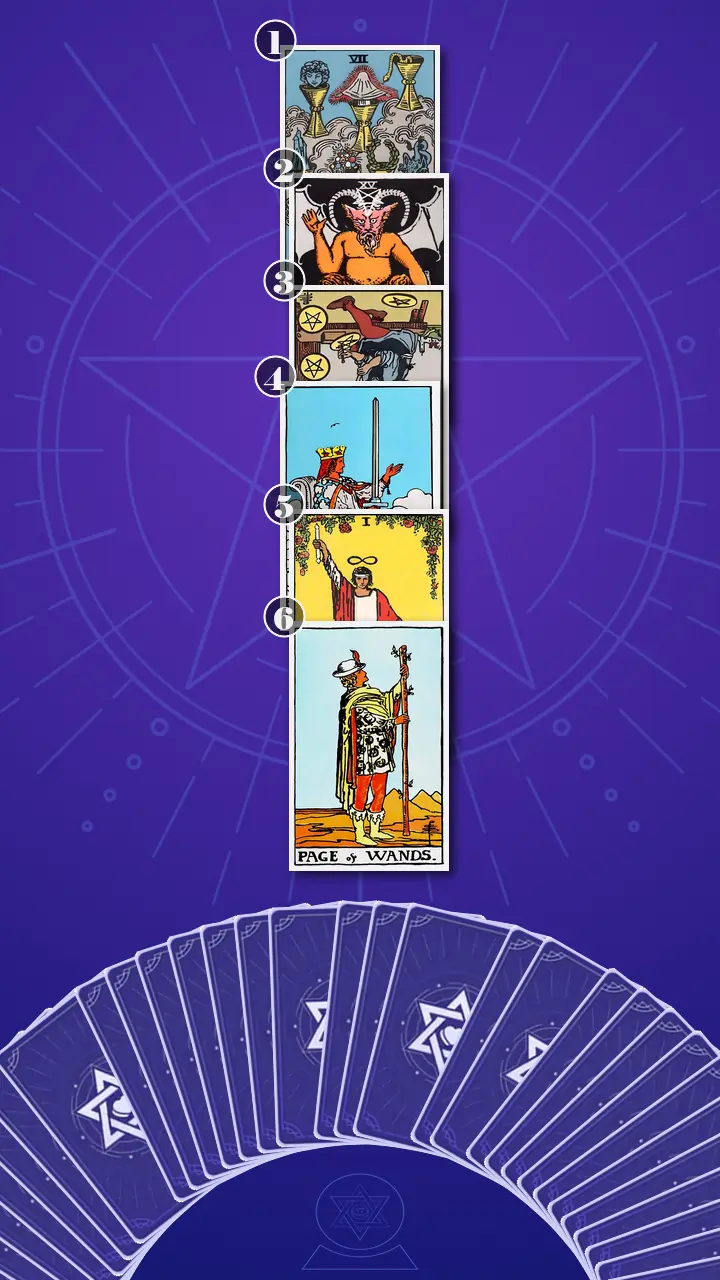
Reading the Map: From Choice Overload to Proof-Through-Action
Position 1 — The observable loop
“Now we turn over the card that represents the observable loop: the specific, repeatable behavior around notebook shopping and system-hopping.”
Seven of Cups, upright.
I angled the card toward the camera. “This is the classic ‘too many options’ card. In modern life, it’s 11 tabs deep: best notebooks for bullet journaling, 2026 planner review, minimalist weekly spread, plus saved TikToks that all look like a calmer, more put-together version of you. You’re not choosing a notebook—you’re browsing possible selves, because staying in possibility feels safer than writing a messy first page.”
Energy-wise, the Seven of Cups is excess: too much imagination, too much projection, not enough contact with what’s real. It’s not that your imagination is wrong—it’s that it’s doing the job of protecting you.
“It’s like a recommendation algorithm,” I added, watching Jordan’s eyes flick to their open tabs. “The more you browse, the more it feeds you ‘better options,’ and the harder it gets to choose anything. Options don’t judge you. A page does.”
Jordan let out a thin breath through their nose, not quite a laugh. Their fingers kept tapping the edge of their phone like it was a tiny escape hatch.
Position 2 — The hook
“Now we turn over the card that represents the hook: what reward, urge, or pressure keeps the pattern repeating even when you know it doesn’t help.”
The Devil, upright.
I didn’t soften the name. I softened the meaning. “This isn’t about you being ‘bad.’ The Devil is about attachment—the way something starts running the steering wheel because it gives quick relief.”
“In real life,” I said, “you feel a spike of relief when you hit ‘Buy now,’ like you just solved your consistency problem—then you chase that feeling again the next time you feel behind. The notebook becomes a gatekeeper: Once I have the right one, then I’m allowed to begin. It’s not laziness—it’s an attachment to a quick fix that temporarily numbs the fear of failing.”
Energy-wise, this is blockage—your agency getting outsourced to an object and the promise it sells. The key symbol for me is always the chains: they’re loose. Which means the stuckness is real, but it isn’t permanent.
Jordan’s shoulders rose a fraction, like they’d been bracing for judgment and didn’t quite get it. “That’s… scary accurate,” they said. “It’s like I’m treating a notebook like… permission.”
“Yes,” I said, and I kept my tone steady. “A notebook is a container, not a character reference.”
Position 3 — The root mechanism
“Now we turn over the card that represents the root mechanism: the perfectionism belief and fear that turns practice into a high-stakes test.”
Eight of Pentacles, reversed.
“This is skill-building energy,” I said, “but flipped.” I let the words land. “In the upright, it’s repetition. In the reversed, it’s restarting and tweaking instead of finishing one cycle.”
“Modern translation: you spend an hour designing the perfect weekly spread—headers, trackers, color code—then freeze because you know your real week won’t look like the template. One chaotic day at work makes the page feel ‘ruined,’ so you restart the whole system instead of practicing inside the imperfect week you actually have.”
Energy-wise, this card is deficiency disguised as productivity: not a lack of intelligence, not a lack of desire—just a blocked relationship with the learning curve. The reversed Eight says, You want mastery without the visible beginner phase.
I watched the recognition hit Jordan in micro-actions, exactly like the card: a tiny wince; a tense laugh that sounded like it hurt; then a heavy pause where their eyes unfocused, as if they could see their own drawer of half-used notebooks without opening it.
“I do the restart spiral,” they admitted. “I rewrite headers. I re-draw boxes. I’ll even rip out a page. Then I’m on YouTube again searching ‘minimalist weekly spread’ like I’m… bargaining.”
“That bargain makes sense,” I said. “It goes: I’ll fix the system, then I’ll be consistent. But the loop flips it into: I missed a day, so the whole thing is invalid. That’s not discipline. That’s an audition you didn’t agree to.”
Position 4 — The inner resource
“Now we turn over the card that represents the inner resource: the mindset and boundary you can access to interrupt the cycle in real time.”
Queen of Swords, upright.
The energy in the room changed, even through a screen. The Queen of Swords is crisp. Clean air after a sticky night of scrolling.
“In modern life,” I said, “this is you closing the tabs, muting stationery hauls for a month, and writing one rule on a sticky note: One notebook. One month. No restarts. It’s not dramatic—just clear. You stop negotiating with your anxiety like it’s a committee and make a decision you can respect tomorrow.”
Energy-wise, this is balance: precision without self-punishment. Boundary as agency-restoration.
I leaned into the echo technique here on purpose—like a calm text you send yourself, short sentences, no drama.
“Jordan,” I said, “imagine you text yourself: Decision made. One notebook for a month. Not because you’re bad—because you want your attention back. Then you put your phone down.”
Jordan’s face softened, like someone had finally stopped asking them to argue their case. Their shoulders dropped a little, and their hands—still—rested flat on the table. “That actually feels… relieving,” they said. “Like permission to stop explaining myself.”
Position 5 — The key shift (Key Card)
“Now we turn over the card that represents the key shift: the most direct reframe that moves you from tool-optimizing to action and self-trust.”
For a second, the room went oddly quiet. I’ve seen this pause before, in dark planetarium domes right before I turn on the stars—when everyone is waiting to see what’s been there all along.
The Magician, upright.
In the setup phase, I named the exact moment they’d described—because clarity often starts as brutal specificity.
You know that moment after work when you’ve got three tabs open—planner reviews, ‘best notebooks for bullet journaling,’ and a productivity video—and your hands are busy rearranging pens while the actual first sentence never lands.
Stop auditioning notebooks for the role of ‘the real you’ and start using the tools already on your table—like The Magician, action is what turns potential into proof.
I let the sentence hang there for a beat, the way I let silence hang after naming a constellation—so people can actually see it.
Then I saw the three-step reaction chain happen in Jordan’s body, vivid and immediate: first, a tiny freeze—breath caught, fingers hovering above their trackpad as if they’d been caught mid-scroll. Second, their gaze softened and went slightly unfocused, like a memory replaying: all those first pages that felt like signing a contract. Third, the release: a quiet exhale from deep in the chest, their jaw unclenching as if it had been holding on for weeks.
“Wait,” they said, and the word came out half-laugh, half-grief. “I’ve been treating the notebook like it can… certify me.” Their eyes went a little shiny. “Like if it’s the right one, then I’m the right one.”
“Exactly,” I said. “And here’s where my astrology brain kicks in.”
At the Tokyo planetarium, I’ve taught kids that a black hole isn’t just ‘a scary void.’ It’s a boundary—the event horizon. Past that line, the rules change. You don’t debate the boundary. You respect it.
“My signature tool is something I call Black Hole Focus,” I told Jordan. “It’s basically: pick a boundary so clear your attention can’t keep leaking into the ‘maybe’ universe. Your notebook-shopping loop has its own gravity—an accretion disk of tabs, carts, reviews, and ‘one more system.’ The Magician says: you don’t need more tools. You need an event horizon.”
“So the boundary isn’t ‘be perfect,’” I continued. “The boundary is: for seven minutes, we do not cross into setup mode. That’s how you reclaim agency without forcing motivation.”
I kept it real and invited the reframe to land in their actual week, not in theory.
“Now,” I asked them, “with this new lens—if I start at all, I’m practicing—can you think of one moment last week where this would’ve changed how you felt? Even for sixty seconds?”
Jordan swallowed, then nodded once. “Yesterday. I was going to message my PM with a messy first draft of a user flow question, but I made a new Notion board instead. It looked… productive. But I felt worse after.”
“That’s the shift,” I said. “This isn’t just about a notebook. It’s from restless comparison and frustrated self-doubt in setup mode to grounded self-trust and calm consistency built through repetition. The Magician is you choosing proof over possibility.”
Position 6 — The next step
“Now we turn over the card that represents the next step: a small, practical action you can take this week that proves momentum without needing perfection.”
Page of Wands, upright.
“This is beginner spark,” I said. “Curiosity. Prototype energy.”
“In real life,” I continued, “this is you labeling the notebook Draft 1 and running a seven-day prototype: one small page a day, no redesigning, no aesthetic pressure. You treat each page like a quick experiment—curious, imperfect, real—so consistency comes from showing up, not from having the prettiest layout.”
Energy-wise, this is balanced fire: not a supernova that burns out in two days, but a steady flame you can actually cook with.
Jordan stared at the card, then at the notebook stack off-screen. “I like the word ‘prototype,’” they said quietly. “It feels… allowed.”
The One-Rule Boundary and the 7-Minute Magician Start
I leaned back and stitched the reading into one clean story—because scattered insights don’t help if you can’t carry them into Tuesday night.
“Here’s what your cards say,” I told Jordan. “Seven of Cups is the fantasy safety: endless options, endless possible selves. The Devil is the hook: the clean-slate dopamine and the quick relief of ‘buy now,’ which temporarily numbs the fear of failing. Eight of Pentacles reversed is the cost: you keep restarting instead of building repetition, so you never collect evidence that you can follow through. Queen of Swords is the hinge: one boundary that ends the negotiation. And The Magician—your key shift—says the only thing that turns potential into proof is starting with what’s already on your table.”
“Your blind spot,” I added gently, “is that you’ve been treating the tool like it’s responsible for your identity. Like the notebook is auditioning you. But the transformation direction is the opposite: tools support practice; they don’t grant worth. The shift is from finding the perfect notebook to building trust by using one notebook imperfectly for one week.”
Jordan frowned. “Okay,” they said, then the practical obstacle arrived—honest, human. “But I barely have time. I get home and my brain is mush. Seven minutes feels… fake.”
I nodded. “That’s not you being difficult. That’s the loop trying to protect itself. In astronomy terms, your attention is exhausted—so it goes toward the easiest dopamine. We’re not asking for a lifestyle overhaul. We’re asking for a tiny proof.”
Then I gave them the next steps, clean and doable. I also pulled one of my communication strategies into it—because inspiration is fragile unless you capture it fast.
- Write the Queen-of-Swords ruleOn a sticky note on your laptop, write: “One notebook. One month. No restarts.” When you catch yourself comparing layouts or opening a new tab, say (out loud or in your head): “Decision made,” and write one single bullet instead.Make it so simple you don’t need motivation. If you break it once, don’t litigate it—return tomorrow.
- Do the 7-Minute Magician Start (Draft Week)Grab the closest notebook you already own. On the next blank page, title it: “Draft Week (7 days).” Set a phone timer for 7 minutes. Write only two bullets: “Today I’m avoiding: ___” and “One tiny next step I can do in 10 minutes: ___.” Stop when the timer ends, even if it feels unfinished.If your brain tries to redesign layouts, write “I’m in setup mode” in the margin and return to the two bullets. A first mark matters more than a perfect page.
- Capture urges with Shooting Star NotesWhen you get the impulse to buy a new notebook or watch another setup video, do a 30-second “Shooting Star Note” in Apple Notes: write the urge (“I want to restart”) + the feeling (“I’m scared I’ll mess it up”) + one micro-action (“write the date”). Then do the micro-action in your notebook.Treat the urge like a passing meteor: notice it, record it, let it burn up. You’re building agency, not banning stationery forever.
Jordan read the list twice, lips pressed together—not in resistance, but in concentration. Then they reached off-screen, and I heard the soft scrape of paper. They pulled a notebook into view. Not new. Slightly scuffed. Already imperfect.
“Okay,” they said, voice small but steady. “Draft Week. Seven days. No redesigning.”

A Week Later: Ownership, Not Certainty
Six days later, Jordan messaged me a photo. It wasn’t aesthetic. It was real: “Draft Week (7 days)” at the top, two messy bullets under it, and a margin note that said, “I’m in setup mode.” They added: “I didn’t buy anything. I still felt the itch. I wrote anyway.”
The bittersweet part was honest, too: they’d slept through the night for the first time in a while—then woke up and still thought, What if I mess it up today? Only this time, they wrote that sentence down and kept going.
That’s the quiet proof I trust most. Not a dramatic transformation—just a small, repeatable return to agency. That’s what the Four-Layer Insight Ladder · Context Edition is built for: not perfect answers, but a pathway back to yourself when you’re stuck in setup mode.
When the first page feels like a test of your worth, buying a new notebook starts to feel safer than leaving a single imperfect line behind.
If you treated the next seven days like a prototype instead of a verdict, what’s the smallest ‘messy start’ you’d be willing to let count as real progress?