Coat on the Couch, Bank-App Flinch—Choosing One Daily Anchor Instead

The 9:38 PM Outlook Spiral
If your coat has lived on the couch for three days because every night turns into “just one more email,” and your bank app gets opened like a jump scare and closed before you breathe—this is overwhelm dressed up as responsibility.
Jordan (name changed for privacy) said it with a half-laugh that didn’t reach her eyes: “It’s not even the big stuff. It’s like… the coat on the couch is accusing me.”
In her small Toronto apartment—close enough to a streetcar line that you could hear the soft metallic rattle through the window—she described a very specific Tuesday at 9:38 PM. She dropped her coat and tote on the couch, told herself “ten minutes,” and opened Outlook. The room was washed in that cold overhead bulb that makes everything look slightly harsher than it is. The air still carried the sour-sweet smell of last night’s takeout container. Her phone was warm from living in her hand all day.
As she scanned subject lines, her shoulders crept up toward her ears like they were trying to hide. Then she flicked to her RBC app, stared at the balance, and closed it before the numbers could land—like flinching away from a flash.
“Work, money, health,” she said. “All off. And the more I try to catch up, the more behind I feel. If I slow down long enough to make a plan, it feels like I’m basically choosing to fall behind.”
The overwhelm wasn’t abstract—it sat on her like a heavy backpack she’d forgotten she could take off. Heavy shoulders. A tight chest. That bracing feeling, like her body was waiting for the next demand to hit.
I leaned in, keeping my voice steady in the way I learned on-air—calm enough to hold someone’s nervous system without trying to override it. “We can work with this,” I told her. “Not by forcing a perfect life reset, but by getting clear on what’s actually driving the loop. Let’s make a map of the system—so we can find one next step that stabilizes you.”

Choosing the Compass: A Celtic Cross for a Full-System Spiral
I asked Jordan to take one slow breath—nothing mystical, just a clean transition from spiraling to observing. While she held the question in mind—why are my work, money, and health off, and what’s my next step?—I shuffled, listening to the familiar whisper of cardstock sliding, like a soft metronome.
“Today I’m going to use the Celtic Cross,” I said.
For anyone reading along: I pick this spread when the problem isn’t one isolated decision but a whole life ecosystem—work pressure, money avoidance, health signals, home clutter. The Celtic Cross is a full-spectrum diagnostic. It lets us follow a chain: the visible symptom → the repeating pressure point → the hidden driver → the recent pattern → what you’re reaching for → what’s approaching → how you’re showing up → what the environment is doing → the hopes/fears knot → the healthiest next step.
I also told Jordan what to expect. “The first card shows what’s most visible right now. The crossing card shows the main destabilizer you keep bumping into. And the outcome position doesn’t ‘predict’ your fate—it points to the most stabilizing action if you keep moving in this direction.”
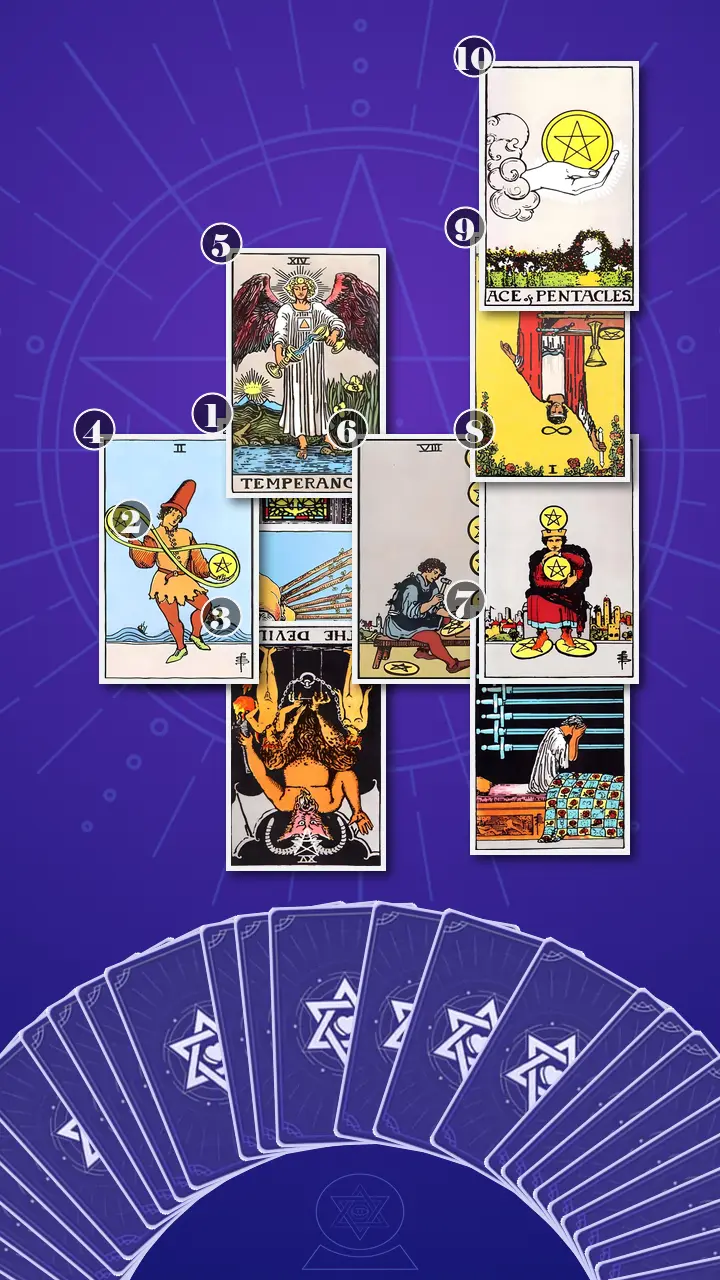
Reading the Map: The First Four Cards
Position 1: What’s currently ‘off’ across work, money, and health (the most visible symptom).
Now opened is the card representing what’s currently ‘off’ across work, money, and health (the most visible symptom).
Five of Pentacles, upright.
“This is the week where you’re technically functioning—showing up, answering emails—but you feel like you’re doing it from the cold,” I said. “Low energy. Tight budget. And that quiet shame that life maintenance is slipping.”
In the image, there’s a lit window—warmth and structure—and two figures moving through snow like they can’t access what’s right there. “That’s the coat on the couch,” I told her. “Not as a moral failing. As a symptom: your system is operating from scarcity. Even when support exists, your body is convinced there’s no room for comfort.”
Jordan let out a short, bitter laugh. “That’s… cruelly accurate.” Her hand went to her chest like she was checking that the tightness was still there.
I softened my tone without softening the truth. “You’re not “bad at adulting”—you’re running a whole system on emergency mode.”
Position 2: The main pressure point that keeps the system unstable (what you’re bumping into repeatedly).
Now opened is the card representing the main pressure point that keeps the system unstable.
Ten of Wands, upright.
This card always reads like a close-up shot: arms full, posture bent, vision blocked. “Your calendar and inbox are the bundle of wands,” I said. “Extra tasks you said yes to. Invisible expectations to be available. The self-imposed pressure to prove you’re ambitious.”
“By the time you get home, there’s nothing left for groceries, movement, or a real look at your finances,” I continued. “So you triage everything in stressed little bursts and call it ‘responsible’—even though it’s draining the whole system.”
I watched her jaw tighten, then release. A tiny nod. The kind that says: yes, and I hate that you’re right.
“And you don’t have to earn rest by collapsing first,” I added, because the Ten of Wands always tries to negotiate rest as a reward instead of a requirement.
Position 3: The hidden driver underneath the coat-on-the-couch pattern (subconscious motivation or habit loop).
Now opened is the card representing the hidden driver underneath the coat-on-the-couch pattern.
The Devil, reversed.
“This isn’t saying you’re doomed,” I said quickly. “Reversed Devil is the moment you realize the chain is loose.”
I described the loop exactly as she’d been living it: work late to feel in control → numb out (scrolling, takeout, convenience spending) → sleep gets worse → the next day feels fragile → you double down. “And then the coat on the couch becomes evidence. Like a little courtroom exhibit against you.”
Jordan’s eyes flicked away from the card, unfocusing. I could almost see the memory replay: her hand auto-reaching for the laptop at 10:30 PM, the ‘just ten minutes,’ the midnight spiral.
“The lock feels real, but the chain is already loose,” I said. “There are small points of choice here. Not huge life changes. Micro-interruptions.”
Position 4: The recent pattern that set this wobble in motion (how you got here).
Now opened is the card representing the recent pattern that set this wobble in motion.
Two of Pentacles, upright.
“You’ve been juggling,” I said. “Shifting money between bills, moving meetings around, squeezing workouts into odd gaps—staying afloat through constant motion.”
The infinity loop in the picture is the belief that keeps people moving even when they’re tired: I can handle it if I just keep moving. “It worked just enough to keep you going,” I told her, “but it also kept you from building a baseline. So health goes reactive, money planning stays shallow, and your nervous system never gets to stand down.”
When Temperance Poured Between Two Cups
Position 5: What you’re trying to make true right now (the ‘ideal fix’ you’re aiming for).
When I turned the next card, the room went quiet in that way it does right before a good song drops—like the air itself is waiting.
Now opened is the card representing what you’re trying to make true right now (the ‘ideal fix’ you’re aiming for).
Temperance, upright.
“You’re trying to make a livable middle true,” I said. “A week that doesn’t require a heroic reset weekend to feel okay. Work boundaries that hold. Meals that happen. Money check-ins that are small and scheduled.”
Setup: You know that moment when you drop your coat on the couch, open your laptop “for ten minutes,” and somehow it’s midnight—and you’ve checked your bank balance in a panicked blur without making a plan?
Delivery:
Stop chasing a perfect reset; start practicing balance in small doses—like Temperance pouring one steady stream at a time.
I let the sentence hang there, like a held note.
Reinforcement: Jordan’s body reacted before her words did. First, a freeze—her breath caught, and her fingers paused mid-fidget on the sleeve of her sweater. Then the idea sank in—her gaze went soft, like she was replaying a dozen “reset” fantasies: the perfect Sunday meal prep, the brand-new Notion dashboard, the Monday where she wakes up as a different person. Finally, the release arrived as a slow exhale that dropped her shoulders a full inch.
“But… if it’s that simple,” she said, and there was a flash of irritation under the relief, “doesn’t that mean I’ve been doing it wrong? Like I could’ve just—balanced?”
I shook my head. “It means you’ve been trying to force stability with intensity. That’s not a character flaw. That’s a nervous system strategy.”
This is where my work as a radio host and music-therapy researcher always slides in. “In audio, if you push the gain too hard, you don’t get clarity—you get distortion. Temperance is the opposite of distortion. It’s leveling.”
I brought in my Space Tuning lens—the way sound behaves in a room reflects how our attention behaves in a life. “Right now, your apartment is acoustically set up for ‘always on.’ The laptop is within arm’s reach. The overhead bulb hums. The fridge has that constant low drone. Your space keeps your nervous system in work frequency. Temperance asks: what if we re-tune the room so your body gets a clear cue that the day has ended?”
“Now,” I said gently, “with that new perspective—rhythm over reset—think back to last week. Was there a moment when you could feel yourself about to reach for the laptop, and this would’ve changed the next five minutes?”
Jordan swallowed, eyes bright but steady. “Tuesday. Exactly Tuesday. I reached for it like I wasn’t even there.”
“That’s the pivot,” I said. “This is how you move from bracing overwhelm and guilt-driven overfunctioning to grounded calm and self-trust built through consistency. Not by becoming a new person overnight—by practicing one steady pour.”
And I said it plainly, because she needed something that didn’t require decoding: “Stability isn’t a reset. It’s a rhythm.”
Position 6: What becomes possible soon if you adjust your approach (near-term direction, not a fixed prediction).
Now opened is the card representing what becomes possible soon if you adjust your approach.
Eight of Pentacles, upright.
“Soon, what helps is craft—not intensity,” I said. “The builder mindset. You get traction by repeating one small system: one weekly money review, one default grocery list, one easy movement routine.”
In real life, this is the opposite of the ‘NEW FINAL v4’ spreadsheet loop. It’s boring reps. The kind that compound.
Jordan nodded again, slower this time. Less defensive. More willing.
Position 7: How you are currently showing up inside the situation (mindset, self-talk, coping style).
Now opened is the card representing how you are currently showing up inside the situation.
Nine of Swords, upright.
“You’re trying to solve life at night,” I said, and she flinched because it was true. “Lying in bed replaying conversations, running numbers, catastrophizing a health symptom, and then waking up depleted.”
I pulled in her sensory reality: the dim phone screen, the fridge hum, the silence that somehow gets louder at 11 PM. “Those nine swords on the wall are nine looping thoughts,” I told her. “Rent. Performance review. Email tone. TTC. Groceries. The appointment you’ve been avoiding. The step count you don’t want to look at. And somehow it all turns into a verdict on who you are.”
“You don’t have to earn rest by collapsing first,” I repeated, because Nine of Swords tries to turn rest into something you’re only allowed after you’ve suffered enough.
Her shoulders didn’t relax fully, but her face softened. Like someone hearing, for the first time, that there’s a way to stop the spiral without ‘failing.’
Position 8: The environment shaping your choices (work culture, costs, support, constraints).
Now opened is the card representing the environment shaping your choices.
Four of Pentacles, upright.
“Toronto cost-of-living pressure. Workplace insecurity. A culture that rewards being always on,” I said. “This card is your environment teaching you to clamp down.”
The figure clutches a coin to the chest like it’s oxygen. “It makes sense you’re holding tight to money, time off, even rest,” I said. “But when protection becomes constriction, the system gets brittle. One small disruption—one unexpected expense, one sick day—feels like everything tips.”
Position 9: What you secretly hope for—and what you’re scared will happen if you change (core fear/longing).
Now opened is the card representing what you secretly hope for—and what you’re scared will happen if you change.
The Magician, reversed.
“This is the tool-overload card,” I said. “The part of you that hopes there’s a hack—and fears there isn’t.”
“You have tools. Apps. Templates. Advice,” I continued, thinking of all the perfectly-built Notion systems that die by day three. “But you don’t trust yourself to focus on one long enough to see results. So you restart. And each restart becomes ‘proof’ you can’t be consistent.”
Jordan’s mouth twisted into a smile that was half embarrassment, half relief. “I literally have a Google Sheet called ‘NEW FINAL v4.’”
“Of course you do,” I said, not mocking—naming. “That’s a high performer trying to feel safe.”
Position 10: The healthiest next step to stabilize the system (integration and grounded action).
Now opened is the card representing the healthiest next step to stabilize the system.
Ace of Pentacles, upright.
“This is the seed,” I said. “A small, tangible stabilizer you can hold in your hand. Not glamorous—effective.”
In the card, a hand offers a pentacle like an invitation: here, start here. “Your next step is already available,” I told her. “It’s not an overhaul. It’s one foundation move that makes tomorrow 5% more supported.”
From Insight to Actionable Advice: Rhythm Over Reset
Here’s the story the spread told, in one clean line: you’re not ‘off’ because you’re lazy or broken—you’re in a burnout-and-avoid cycle. Scarcity thinking (Five of Pentacles) plus over-responsibility (Ten of Wands) pushed you into constant juggling (Two of Pentacles), and now your nervous system tries to regain control through compulsion and nighttime rumination (Devil reversed + Nine of Swords). Your environment tightens the grip (Four of Pentacles), and your hope/fear knot keeps you collecting tools instead of committing to one (Magician reversed). Temperance and the Ace of Pentacles offer the exit: balance as a daily practice, made real through one small foundation step.
Your cognitive blind spot is the sneakiest one: you keep treating stability like something you earn through intensity—like if you push hard enough, you get to relax later. But the reading points to a different transformation direction: from trying to fix everything at once to choosing one small, non-negotiable daily anchor that stabilizes your body and budget.
So I gave Jordan next steps that were deliberately unsexy—because unsexy is sustainable.
- Two-Night Work Stop-Time BoundaryPick two nights this week (e.g., Tue + Thu). Set a calendar event: Laptop Closed at 9:30 PM. When it hits, physically close the laptop and put it out of arm’s reach.If 9:30 feels impossible, do a “15-min earlier” version. You’re collecting consistency data, not proving worth.
- The 3-Line Money Note (7 Days)Create one Note on your phone called “7-day anchor.” Once per day, write: Balance / One spend / One bill due. That’s it—no categories, no “NEW FINAL v4.”Do it right after you brush your teeth (same cue, same time). If anxiety spikes, write only the Balance line and stop.
- One Default Meal You Don’t Have to NegotiateChoose one repeatable meal (yogurt + granola, eggs + toast, or a frozen meal). Stock it once this week so “feeding yourself” doesn’t require a full meal-prep fantasy.Keep it frictionless: put it at eye level in the fridge. Decision fatigue is real—design around it.
Then I layered in my own strategy—because Jordan’s system didn’t just need a plan, it needed a felt cue. “When you close the laptop on those two nights,” I said, “do a 3-minute 21-Day Sound Bath—even if you only do it for seven days to start. Same track, same time, low volume. Think of it as a sonic boundary.”
“Like… a signal?” she asked.
“Exactly,” I said. “Temperance is a steady pour. Sound is a steady pour. Your brain doesn’t always believe your intentions, but it will learn a pattern.”
I could see her want to argue—this isn’t enough—and I met it directly. “Pick one anchor. Let the rest be ‘good enough’ for now.”

A Week Later: The Quiet Proof
Eight days later, Jordan texted me a screenshot: a Note titled “7-day anchor.” Seven entries. Not perfect. Consistent. Under it she wrote, “I closed the laptop Tuesday at 9:30. My body freaked out for like two minutes. Then I played the sound track. I slept.”
Clear but still a little vulnerable: she said she woke up the next morning and her first thought was, What if I’m falling behind? Then she paused—and smiled at herself for noticing it.
That’s the journey to clarity I care about: not certainty, not a dramatic reinvention—just a steadier rhythm where your work output, spending, and health habits become “good enough,” supported by simple systems you can repeat.
When you’re craving stability but terrified that slowing down will make you fall behind, your shoulders stay braced like you’re always one email—and one unexpected expense—away from everything tipping.
If you stopped chasing the perfect reset for a week, what’s one small daily anchor you’d try—just to see how it feels to be 5% more supported?