When Your Transcript Turns Into a Verdict: Safe-Enough Career Experiments

Finding Clarity in the Transcript Tab at 8:47 p.m.
If opening your college transcript still makes you feel like you owe the world a ‘responsible outcome,’ even at 26 in Toronto, you’re not alone.
Alex (name changed for privacy) said that sentence back to me like she was checking whether it was allowed to be true. We were meeting on a rainy Tuesday evening—her camera angled at a Toronto rental kitchen counter, my own desk lamp pooling warm light over a well-worn Rider–Waite deck and a stack of student papers I never quite stop grading out of habit.
“It was literally 8:47,” she told me, rubbing her thumb along the edge of her laptop as if it could sand down the feeling. “Overhead light buzzing. Dark window. I opened my transcript just to check something—and then I saw the GPA line and it was like… a scoreboard. My jaw locked. And suddenly I’m applying for coordinator roles again.”
The way she said again had weight in it—like a drawer she keeps finding herself back in, even after she swears she’s moved on.
Alex worked as an early-career corporate coordinator and was “exploring next steps,” which sounded neat and reasonable until she described what it looked like in real life: LinkedIn filters set to “Analyst” and “Coordinator,” recognizable companies, clear ladders, benefits. Ten postings saved. One resume bullet rewritten for an hour. The tab with the role she actually liked left unopened, like contraband.
“I don’t even like these jobs,” she said, then laughed once—small and sharp. “I just like that they make sense on paper.”
I watched her shoulders brace when she said paper, as if the transcript itself were a hand on the back of her neck. Her anxiety wasn’t abstract; it was physical. A tight chest. A held breath. A jaw that seemed to be trying to bite the uncertainty into a shape she could defend.
“It sounds,” I said gently, “like your transcript becomes a kind of courtroom exhibit. Not just evidence of what you did—but a verdict you’re scared you’ll fail to live up to. Let’s try something different tonight. Let’s give the fog a map. Not a prophecy. A map.”

Choosing the Compass: The Horseshoe Spread for Career Decision Paralysis
I asked Alex to take one breath that was purely functional—not spiritual, not performative. Just a nervous system gear shift. In through the nose, longer out through the mouth. Then I shuffled slowly, the way I used to handle fragile pottery fragments at a dig: steady hands, no drama, attention as a form of care.
“For this,” I told her, “I want to use a Horseshoe spread.”
For anyone reading this who’s curious about how tarot works in a modern, practical way: I chose the Horseshoe because it’s a compact diagnostic arc. It doesn’t turn your career into a fixed prediction. It shows a sequence—past imprint, present coping, hidden belief, the core obstacle, external pressure, grounded advice, and then the direction that opens if you actually work the advice. It’s particularly useful for job search anxiety and that specific kind of analysis paralysis where you keep asking for certainty before you take a single real-world step.
“We’ll read it like a path,” I said. “First: what your transcript reactivates. Then: what you do on autopilot. Then: the quieter belief under the surface. We’ll name the obstacle, separate social pressure from your own inner guidance, and land on next steps you can actually do this week.”
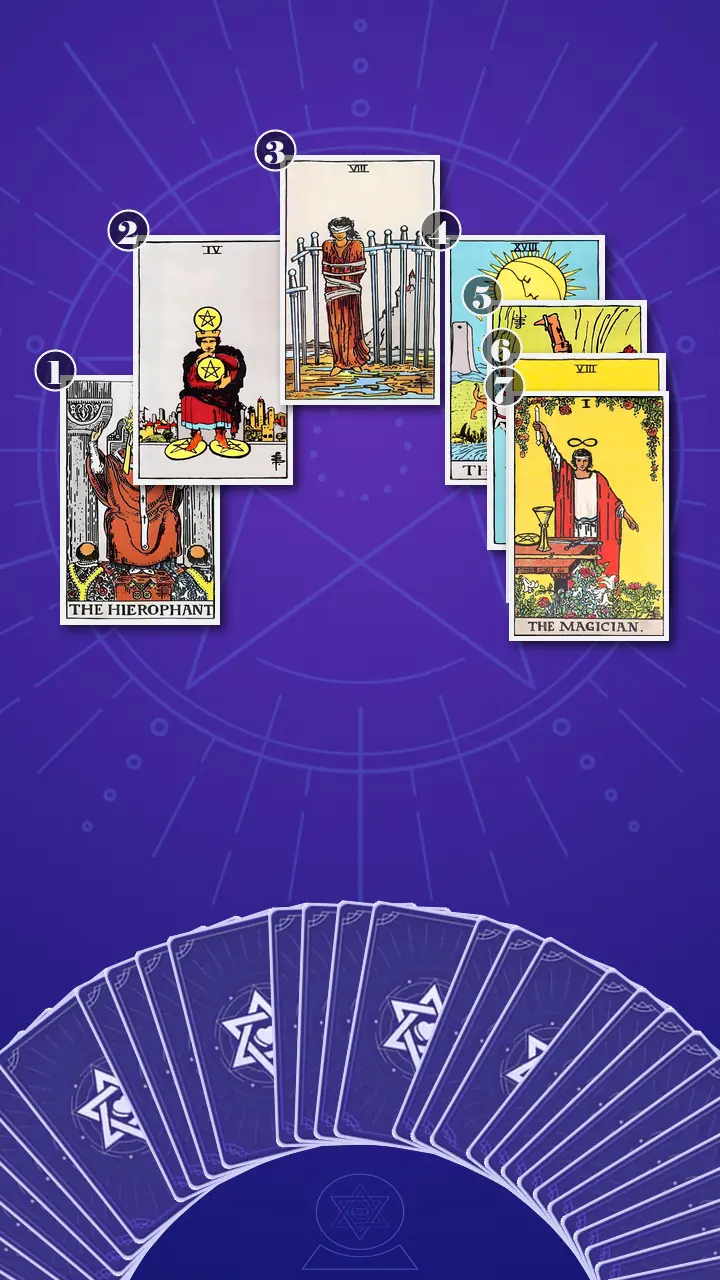
Reading the Arc: When “Safe” Becomes a Shield
Position 1 — Past conditioning: what the transcript reactivates
“Now flipped open,” I said, “is the card that represents past conditioning: what the transcript reactivates—the inherited rulebook about success and legitimacy.”
The Hierophant, upright.
In plain language, The Hierophant is the part of us that learned: there is a correct path. There are approved doors and unapproved doors. In Alex’s life, it translated almost too cleanly into a modern scene: you open your transcript and instantly feel like you’re back in school; there’s a ‘right answer’ career and a ‘wrong answer’ career. You draft your life like a cover letter to an invisible admissions committee.
“Your transcript,” I told her, “is acting like an authority figure. Not a document—an audience.”
As a professor, I’ve sat on enough committees to recognize the internalized version of one. The fear isn’t that you’ll choose wrong. The fear is that you’ll be judged as someone who never deserved to be chosen in the first place. My mind flashed, briefly, to stone tablets and inscriptions: records meant to preserve truth that people later treat as law.
“Your transcript is evidence of effort—not a contract for one life path,” I said, and watched Alex’s eyes flick down, as if she’d been caught holding the paper like a shield.
“When you opened it,” I asked, borrowing the question the spread itself was designed to ask, “what was the very first ‘rule’ that popped into your head about what you’re allowed to do next?”
She didn’t answer right away. She swallowed, and I could almost hear the word forming before she said it: “Responsible.”
Position 2 — Present pattern: the concrete “safe job” behaviors right now
“Now flipped open,” I said, “is the card that represents your present pattern—the ‘safe job’ behaviors and control strategies happening right now.”
Four of Pentacles, upright.
The modern translation landed with that uncomfortable accuracy tarot is known for: after dinner you open LinkedIn and only save postings that feel safe—big-name companies, familiar titles, clear ladders. You keep control by filtering, bookmarking, and spreadsheeting. The job you actually want sits in a tab you don’t open because you’d rather feel briefly in control than risk feeling exposed.
“This card is pure grip,” I told her. “Security held so tightly it starts to choke the air out of curiosity.”
Energetically, Four of Pentacles is an excess of control—so much holding on that movement becomes dangerous. It’s not laziness. It’s bracing.
Alex made an unexpected sound: a quick, bitter laugh that didn’t reach her eyes. “That’s… that’s literally my Tuesday night,” she said. “It’s almost rude.”
She did a three-part micro-reaction I’ve learned to pay attention to: first a tiny freeze—breath held; then her gaze slipped off-camera like she was replaying the scene; then a slow exhale, the kind that admits the truth without liking it.
“A job can be safe to explain and still unsafe to live in,” I said, letting that sentence sit between us like a small lamp.
Position 3 — Hidden influence: the self-story keeping the safety chase running
“Now flipped open,” I said, “is the card that represents the hidden influence—the belief underneath your choices that you rarely say out loud.”
Eight of Swords, upright.
In modern life, this card is brutally familiar: you tell yourself you’re stuck because the job market is brutal and you need to be practical—but what really traps you is the rule that your next move must be perfectly safe and instantly defensible. You edit your ambition down before anyone else can respond.
Eight of Swords is a blockage of mental freedom. The bindings are loose in the picture for a reason: the trap is maintained by belief more than by reality.
“This,” I told her, “is what I’d call a self-made geo-fence. It feels like the job market put it there, but the fence is mostly story: ‘If I can’t explain my career move in one sentence, it proves I don’t know what I’m doing.’”
Alex’s hand went to her collarbone without her noticing. Her fingertips pressed lightly as if checking whether the tightness was still there.
“What’s the quiet belief underneath it?” I asked. “The one that starts with: ‘If I don’t pick the safest option, it proves…’”
She spoke so softly I almost missed it. “It proves my degree—and me—weren’t worth it.”
Position 4 — Obstacle: what makes uncertainty feel intolerable
“Now flipped open,” I said, “is the card that represents the obstacle—what turns uncertainty into paralysis.”
The Moon, upright.
The Moon isn’t a ‘bad’ card. It’s a visibility card. It shows what happens when you’re walking in dim light and your brain insists on filling the darkness with certainty—usually the worst kind.
The modern-life scenario was almost word-for-word what Alex had already described: when you consider a less linear role, your mind becomes a horror-movie trailer—regret, instability, wasted degree, disappointing everyone, falling behind forever. Nothing has happened yet, but your body reacts like it already has—tight chest, braced shoulders—so you retreat to ‘safe job = safety.’
Outside Alex’s window, rain turned the streetlights into halos. It made the night look like it was wearing fog. The environment, as it often does, quietly conspired with the card.
“Uncertainty,” I said, “is like walking home in Toronto fog with your phone battery at 9%. Your brain doesn’t just say, ‘I can’t see.’ It starts producing details. It writes plot.”
The Moon’s energy here is a blockage created by projection—fear-stories taking up all the oxygen. So I asked the question The Moon always wants asked, because it shifts the goal from impossible certainty to workable clarity:
“What part of not-knowing hits you hardest—money, identity, timing, looking inexperienced? And what information would reduce that fear by 10%, not 100%?”
Alex blinked, slower this time. “Ten percent feels… doable,” she said. “If I could just know what a day in the role actually looks like. Like, what they do all day.”
That was the first loosening. Not confidence. Not answers. Just a smaller, smarter question.
Position 5 — External influence: peer comparison and the LinkedIn scoreboard
“Now flipped open,” I said, “is the card that represents external influence—the social proof pressures reinforcing the ‘safe’ default.”
Six of Wands, reversed.
Reversed, Six of Wands often shows the shaky underside of recognition: when the crowd’s applause becomes a mood regulator. The modern translation was painfully current: you can’t tell if you want the role or the relief of announcing it. You refresh LinkedIn after submitting applications, and other people’s promotions rewrite your confidence in real time.
Here the energy is a deficiency of internal orientation—your compass outsourced to the public scoreboard.
Alex winced so hard her nose crinkled. “I hate that I do that,” she said. “I’ll apply and then immediately check LinkedIn. It’s like… I need to know if my choice is allowed.”
“No moralizing from me,” I said. “This is a system. Platforms are designed to make the crowd feel like a jury. But we can measure what’s really happening.”
I offered her a simple counter-metric—one week only, no personality change required: “When you read a job description, rate two numbers from 1 to 10: how calm your body feels after reading it, and how curious you feel about learning the work. Just collect data. Don’t argue with the numbers.”
She nodded, but it was a cautious nod—the kind that says, Part of me wants this; part of me is terrified it’s too simple.
Position 6 — Advice (Key Card): the grounded inner shift that builds self-trust this week
I slowed my hands before turning the next card. “We’re coming to the heart of the reading,” I told her. “The advice position—what you can do this week that actually shifts the loop.”
“Now flipped open,” I said, “is the card that represents the most grounded inner shift and micro-action that builds self-trust.”
Strength, upright.
The room—two rooms, really, separated by a screen—felt quieter. Strength is not loud courage. It’s the kind of courage that doesn’t need witnesses.
Setup. The story Alex had been living was clear now: she opens her transcript and suddenly it feels like she’s standing in front of an invisible committee—like every next step has to be defensible, impressive, and future-proof, or it “doesn’t count.” That’s the trap: treating a life choice like a verdict you must justify.
Delivery.
Stop gripping your career like a pentacle you can’t drop; start practicing calm courage—Strength is the gentle hand that opens the path.
I let the silence do its work for a beat. Then I watched Alex’s face move through the moment in layers: first her eyes widened slightly, like the sentence had touched a nerve; then her mouth tightened—an almost-angry line; then her shoulders dropped in a way that looked like surrender, but wasn’t. It looked like relief that didn’t require self-hate.
“But if I stop gripping,” she said, and her voice cracked on the last word, “doesn’t that mean I was wrong? Like… I wasted time?”
There it was—an unexpected flare of resistance, so human it made me trust her more. I didn’t rush to soothe it.
“Not wrong,” I said. “Protective. The Four of Pentacles grip kept you feeling controlled. It reduced shame in the short term. That mattered. Strength isn’t here to shame the coping. It’s here to lead it.”
This is where my own framework clicks in—what I call Crossroad Adaptation. In the archaeological record, traders rarely committed to one route with perfect certainty. They moved by safe-enough legs: short crossings, known harbors, recalibration. Their success wasn’t built on having a flawless map. It was built on being steady enough to keep moving and adjust when new information arrived. That’s Strength: nervous-system leadership in motion.
“You don’t have to be fearless,” I told her. “You just have to stop letting fear drive the steering wheel.”
Her breath hitched—then released. A three-step reaction chain unfolded again: a tiny pause like her mind was rebooting, then her gaze went unfocused as if she replayed last week’s LinkedIn spiral, then a longer exhale that softened her jaw.
“Now,” I said, “use this new lens and look back: was there a moment last week—closing the tab, rewriting the bullet, filtering for ‘recession-proof’—when this idea could have made you feel even slightly different?”
She nodded slowly. “Sunday. I closed the tab with the role I liked. I didn’t even read it. I just… assumed it was risky.”
And because Strength loves practice more than promises, I gave her a single, contained experiment—something she could do once, not forever:
“This week, do a 10-minute Strength Check one time. Open one job posting you actually like—the one you usually leave unopened. Set a 10-minute timer. Spend two minutes noticing your body like a dashboard—jaw, chest, shoulders. Name what’s there. No fixing. Then write three lines: ‘The story my fear is telling is…’; ‘The smallest real-world evidence I could gather is…’; and ‘A safe-enough version of this is…’. Then spend the last three minutes doing one micro-step immediately—draft the message, save a calendar slot, outline a tiny portfolio proof.”
“Practice,” I reminded her. “Not a test you have to pass.”
Position 7 — Integration: the direction that opens when you act from self-trust
“Now flipped open,” I said, “is the card that represents integration—the direction you grow into when you act from self-trust instead of defensibility.”
The Magician, upright.
The Magician is the opposite of transcript-as-verdict. It’s transcript-as-toolkit. The modern-life scenario was bright, practical, almost tactile: your transcript stops being a judge and starts being raw material. You translate classes and achievements into tangible proof—a small case study, a writing sample, a mini analysis deck. You stop asking ‘Which job is safest?’ and start asking ‘What can I build this month that proves I can do the work and adapt?’
Here the energy is balance—agency aligned with reality. Not fantasy. Not panic. Tools on a table.
This is where my other signature lens, Skill Archaeology, becomes more than a clever phrase. As an archaeologist, I’ve spent years learning that the most valuable information is often in what people overlook because it doesn’t look like treasure yet. “Your transcript,” I told Alex, “is full of artifacts—skills you stopped seeing because you treated them like grades.”
Her eyebrows lifted. “Like what?”
“Like synthesis,” I said. “Like writing under constraint. Like finding patterns in messy information. Those are not just academic. Those are modern career tools. The Magician doesn’t ask permission. He organizes what’s already there and makes proof.”
Alex’s shoulders didn’t brace this time. They stayed level. “That sounds… doable,” she said. “Not easy. But doable.”
From Verdict to Evidence: Actionable Advice That Builds Real Self-Trust
When I stitched the Horseshoe arc together for Alex, the story was coherent in the way a good diagnosis always is: her transcript (Hierophant) reactivated an inherited rulebook; she coped by gripping stability (Four of Pentacles); a hidden belief kept tightening the loop (Eight of Swords); uncertainty turned into fear-stories (The Moon); LinkedIn and peer timelines acted like a public jury (Six of Wands reversed). The turning point wasn’t a perfect plan. It was Strength—inner steadiness—and then The Magician—evidence through doing.
The cognitive blind spot was subtle but powerful: Alex kept mistaking “I feel calmer after choosing it” for “it’s the right fit.” Calm can be a relief response. It can also be a cage.
The transformation direction was equally clear: shift from “I must justify my career like a verdict” to “I can run small, low-risk experiments that build real evidence and self-trust.” In my language, it’s a move from worshipping the institution to working the tools.
I offered her a plan using my Megalith Transport strategy—because you don’t move a stone circle in one heroic lift. You move it with rollers, levers, and small coordinated effort.
- The 5-Sentence Informational DMSend one low-stakes informational interview message (LinkedIn DM or email) to a person in a field you’re curious about. Keep it to 5 sentences. Ask for 15 minutes max. Do it in a calm window—ideally midweek, not at peak Sunday Scaries.Expect your brain to protest: “This is pointless unless it guarantees a job.” Treat that as the old verdict mindset. Your goal is evidence, not certainty. Stop after you hit ‘send.’
- A “Safe-Enough Experiment” Calendar BlockCreate a 20-minute calendar block titled: “One small proof.” Use it once to draft a tiny artifact: a one-page case study, a short writing sample, a mini analysis, or a mock project outline connected to the kind of role you actually want.Define “done” before you start (one page, six bullets, one slide). If anxiety spikes, reduce it to a 2-minute version or close it. This is practice, not punishment.
- Build Your Magician Table (10 minutes only)Open a Notion page or Google Doc and make four columns: Skills | Proof (what I’ve done) | Next tiny proof | Person to ask. Fill it in for 10 minutes, no polishing. This turns your transcript into a working bench, not a shrine.If you start over-researching, set a timer and switch from reading to making. Clarity isn’t something you find. It’s something you earn through small proofs.
And because my caution has always been academic as much as spiritual, I added a light touch of my Relic Authentication strategy: “Before you commit to any opportunity,” I said, “ask three questions: What do I actually do day-to-day? Who am I learning from? What would ‘safe enough’ look like here? We assess before we worship.”

A Week Later: The Tab Stayed Open
Alex messaged me the following week. Not an essay—just a screenshot and one line.
She’d sent the five-sentence DM. Someone responded. They didn’t offer her a job; they offered a 15-minute call. Alex booked it anyway.
She also did the 20-minute “One small proof” block in a quiet café after work—alone, a little wired, but committed. She made a one-page mini case study. Her celebration wasn’t loud. It was just the fact that she didn’t close the tab this time. She let the interesting thing stay open long enough to become real.
That’s the kind of proof I trust: small, embodied, repeatable. A journey to clarity that doesn’t require certainty—only a gentler grip and a steadier hand.
When your transcript feels like a verdict, it’s easy to clamp down on “safe” titles—not because you don’t want more, but because you’re terrified a messy path will expose that being a “good student” was the only proof you ever had.
If you didn’t have to justify your next step to an imaginary committee, what’s one small, safe-enough experiment you’d be curious to run this week—just to gather real evidence about what fits?