The Vitamin Aisle Felt Like a Courtroom, Then the Five-Minute Timer

The Fluorescent Courtroom in the Vitamin Aisle
You walk into Shoppers Drug Mart for a ‘quick’ vitamin run and suddenly it turns into a 20-minute label-reading marathon—with a tight chest, a buzzing stomach, and full-on decision paralysis.
Jordan (name changed for privacy) said it like she was confessing a bad habit—half embarrassed, half exhausted. She was 28, early-career marketing, Toronto. The kind of person whose job trained her to measure everything: engagement rates, campaign lift, what “worked.” Now her nervous system had picked a new dashboard.
She told me about Tuesday night: 8:19 PM, downtown Shoppers. The fluorescent lights had that faint electrical buzz that feels louder when you’re alone. The aisle smelled like shampoo and plastic packaging. Her thumb kept sliding across her phone screen—ingredient list, price compare, a TikTok review, then Reddit, then back to the label like she could brute-force her body into certainty.
“It hits me in my chest,” she said, pressing two fingers lightly right under her collarbone, as if she could find the source code there. “And my stomach gets… buzzy. Like I’m vibrating. And then I’m standing there thinking, If I pick wrong, it means I don’t care about myself.”
Not-enoughness doesn’t always feel like sadness. Sometimes it feels like being stuck under bright lights with a shopping basket in your hand and the sense that you’re taking a pop quiz on adulthood. That aisle can feel like a courtroom: every bottle is evidence, and your worth is the verdict.
I watched her shoulders hover a fraction too high, the way they do when someone is trying to look calm while their body is already in “solve it, solve it, solve it” mode. “I get it,” I told her. “And we’re not going to shame the part of you that wants to take care of yourself. We’re just going to figure out why this moment turns into a trial—and what the next, kinder move is. Let’s draw a map through the fog. Today is about finding clarity, not finding the perfect bottle.”

Choosing the Compass: The Four-Layer Insight Ladder
I’ve spent ten years guiding people through a Tokyo planetarium—teaching them that the sky isn’t chaos, even when it looks like it. Patterns reveal themselves when you stop staring at one star and start tracking the rhythm.
So before we touched the cards, I asked Jordan to take one slow breath with me—nothing mystical, just a nervous-system handoff from “research mode” to “listening mode.” I shuffled while she held her question in plain language: “In the vitamin aisle, why do I feel not-enough—what next?”
“Today, we’ll use a spread I created called the Four-Layer Insight Ladder · Context Edition,” I said. “It’s built for moments like yours—when a specific situation triggers a bigger identity loop. We’ll start with what you do in the aisle, then we’ll trace the trigger, the deeper fear underneath it, the belief that keeps you stuck, and then we’ll find the most stabilizing inner resource—followed by a grounded next step you can actually try this week.”
For anyone reading along, this is how tarot works at its most useful: not as a fortune-telling performance, but as a structured way to name the pattern you’re already living inside—so you can interrupt it. Six cards is enough here. The spiral is fast; the clarity needs to be simple.
“The first card,” I explained, “shows the surface pattern—the observable behavior and felt sense in the aisle. Position three is the underlying fear—the consequence your mind is bracing for. And position five is the pivot—your antidote. That’s where we’ll slow down.”
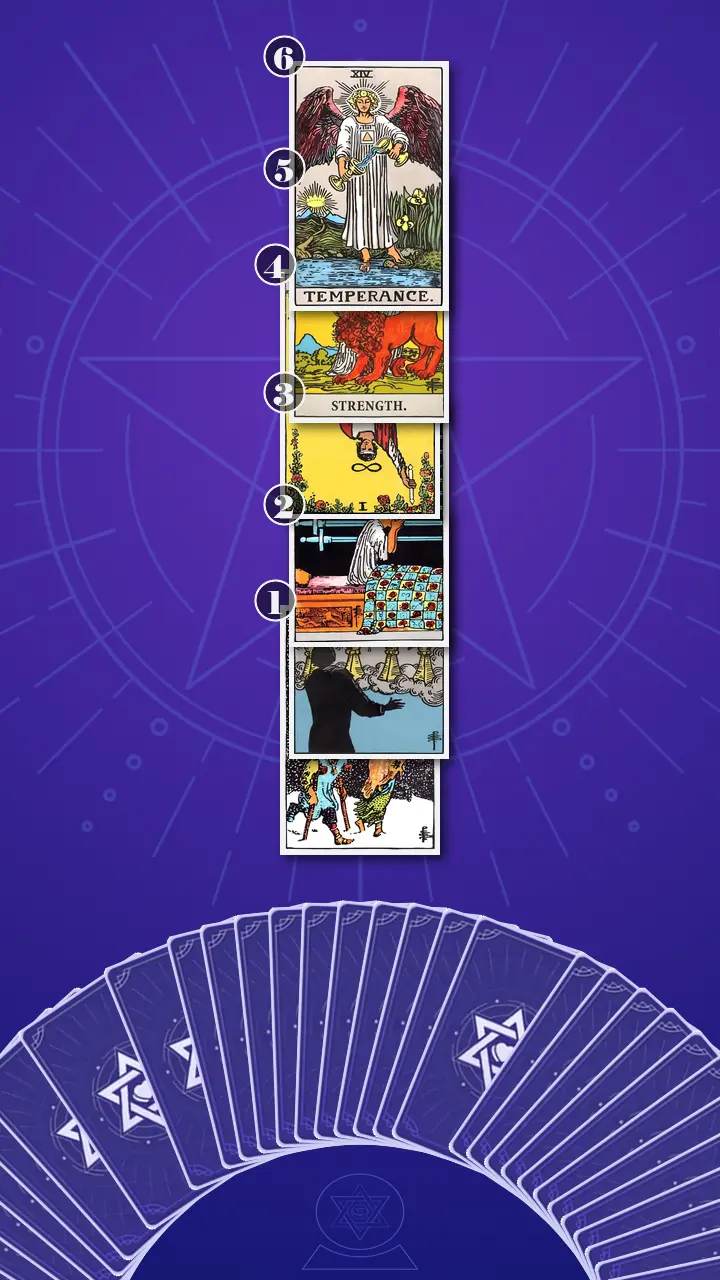
Reading the Map: From Supplement Overwhelm to Self-Trust
Position 1: The “Healthy People Club” Feeling
“Now we’re turning over the card that represents the surface pattern: the specific, observable behavior and felt sense that shows up in the vitamin aisle,” I said.
Five of Pentacles, upright.
I didn’t need to dramatize it; the image did that on its own—two figures limping through snow, a warm stained-glass window nearby, light they can see but somehow can’t enter.
“I’m going to say this in the most modern way I can,” I told her, and I deliberately used the exact language her body already recognized: “You’re in the vitamin aisle and it feels like everyone else got a secret syllabus for ‘being healthy.’ You’re surrounded by options, but inside it’s winter: tight chest, restless stomach, and that quiet thought—‘I’m behind.’ You read labels like you’re trying to earn entry into the ‘healthy people club,’ even though help (a simple plan, a pharmacist, a basic routine) is right nearby—just not emotionally available in that moment.”
Five of Pentacles energy is deficiency—not in vitamins, but in belonging. It’s “I’m on the outside.” And in a store designed to sell solutions, that feeling gets turned into, “I need to buy my way back into safety.”
Jordan let out a short laugh that had no humor in it. “That’s… so accurate it’s kind of mean,” she said, and then immediately looked down at her hands like she’d said too much.
“It’s not mean,” I said gently. “It’s specific. Specific means we can work with it.” I paused. “When the ‘winter’ hits—tight chest, buzzing stomach—what do you think you’re actually needing in that moment? Not the product. The need.”
Her eyes flicked up, then away. “Reassurance,” she said. “Like… permission to not be doing it perfectly.”
Position 2: The Seven Futures That Aren’t Yours
“Now we’re turning over the card that represents the trigger field: what in the environment or messaging activates the spiral,” I said.
Seven of Cups, upright.
“Okay,” I said, and leaned into the echo I knew would land. “The aisle turns into seven different futures at once: sleep gummies, magnesium, probiotics, stress support, collagen—each one pitching a different version of who you could be by next week. Your brain starts scanning like a feed: ‘Maybe THIS is the fix.’ The more you look, the less you can feel what you actually need, because every label is also a mini identity decision.”
Then I gave her the scene the card was already staging in her head: TikTok open, r/Supplements threads, Google snippets, someone confidently saying “this changed my life” with perfect lighting. Each cup a different promise—sleep, glow, calm, productivity—like notifications stacked on top of each other until your brain can’t hear your own body anymore.
Seven of Cups is excess—too much possibility, too much seduction, too many “maybe”s. “This isn’t a personal failure,” I told her. “It’s a designed overload. That’s why you feel like you’re freezing. Your nervous system thinks it’s under threat, not shopping.”
Jordan nodded sharply, like her neck had been holding that sentence back all week. “Oh wow,” she said. “That’s exactly it. It’s like… I’m not even there anymore. I’m in seven imagined timelines.”
Position 3: The 1:13 AM Verdict Loop
“Now we’re turning over the card that represents the underlying fear: the deeper consequence you’re bracing for underneath the shopping decision,” I said.
Nine of Swords, upright.
I felt the room go quieter—not because we were being dramatic, but because this card always pulls the lights down to their truest setting.
“Here’s the modern translation,” I said, keeping my voice plain. “Later that night, you’re in bed with the room dark except for your phone glow, replaying the aisle like a mistake you need to correct. You run worst-case stories: wasting money, messing up your health, proving you’re not disciplined. The decision itself wasn’t the threat—your mind turning it into a moral verdict is.”
Nine of Swords is blockage in the mind—sharp, repetitive thoughts lined up like weapons on a wall. “This card tells me the fear isn’t really, ‘What if I choose the wrong magnesium?’” I said. “It’s, ‘What if this proves I’m careless. What if my body proves I’m falling behind. What if I don’t get a feeling of safety unless I optimize nonstop.’”
Her jaw clenched, then released. That tiny release mattered. “Yes,” she said, quieter. “It’s like… if I’m not constantly doing the best thing, I’m not safe.”
I thought of the planetarium dome—how people panic when they can’t locate true north. In my research life, we look at the Cosmic Microwave Background for a baseline: the background hum that lets you measure everything else. Jordan had no baseline. She was running constant A/B tests on her body with zero control group.
“We’re going to build you a baseline,” I said. “Not a perfect one. A livable one.”
Position 4: When Tools Become a Substitute for Agency
“Now we’re turning over the card that represents the self-sabotaging logic: the belief and coping move that keeps you stuck in analysis instead of care,” I said.
The Magician, reversed.
I exhaled through my nose—not tired, just… recognizing. “This is the card where I’m going to say something blunt,” I told her, because clarity sometimes needs clean edges. “You’re not shopping for vitamins—you’re shopping for certainty.”
I tapped the image: the table of tools—cup, pentacle, sword, wand—everything you could possibly need. But upside down, the posture looked like power misplaced.
“Let’s use the lived version,” I said, and kept it concrete: “You treat supplements like permission slips: ‘Once I get the right stack, I’ll finally feel like I’m taking care of myself.’ So you build mental spreadsheets, chase consensus, and keep moving the goalpost. The aisle becomes a stage where you perform competence—except it never feels like enough proof. You either leave without buying anything (and feel guilty) or buy something fast (and then second-guess it).”
The Magician reversed is deficiency of self-leadership and excess of external authority. It’s outsourcing your nervous system to reviews, brands, and the illusion of consensus.
Jordan’s hand went to her stomach, and I saw the three-step reaction chain land: her breath paused for half a second (freeze), her eyes unfocused like she was replaying a specific aisle moment (cognitive seep), then she swallowed hard and let her shoulders drop a fraction (release). “I literally do the spreadsheet thing,” she said. “Like if I just… pick the correct stack, I’ll finally be the person who has it together.”
“And then it turns into decision fatigue,” I said. “Because you’re asking a bottle to do a job it cannot do: guarantee your worth.”
When Strength Spoke: Meeting the Lion Without Making It a Test
Position 5: The Antidote That Rebuilds Self-Trust
I let my hand hover over the next card for a beat. “We’re about to turn over the most important card in this reading,” I said. “The pivot. The antidote.”
Strength, upright.
For a second, the fluorescent feeling in Jordan’s story—Shoppers, buzzing lights, the sense of being watched—fell away, and the card’s open landscape took over. A woman holding a lion’s jaws, not fighting it, not dominating it. Steadying it.
Setup. I watched Jordan’s face as she tried to fit this into her usual logic. She was still caught in that thought loop: I have to make the right decision. I have to prove I’m responsible. If I don’t optimize, I’m failing. The aisle had become a place where one purchase stood in for her entire relationship with her body.
Delivery.
Stop trying to earn enoughness by picking the perfect bottle; start building enoughness through gentle strength—like the woman who doesn’t fight the lion, she steadies it.
I let the sentence sit between us like a bell tone that keeps vibrating after you’ve struck it.
Reinforcement. Jordan’s reaction came in layers. First, her eyes widened slightly—like she’d been bracing for a harder verdict and got something unexpectedly human. Then her lips parted and she held still, almost too still, as if moving might break the spell. A flush crept up her neck. Her shoulders, which had been perched near her ears, slowly drifted down. Her hands unclenched from an invisible grip.
“But…,” she said, and there it was—an unexpected flash of resistance. Her eyebrows pulled together, and her voice sharpened for a moment. “But doesn’t that mean I’ve been doing it wrong? Like I wasted so much time?”
I nodded. “It can feel like that,” I said. “But I don’t read this as ‘you were wrong.’ I read it as ‘you were trying to create safety with the tools you had.’ The difference now is you get to choose a new method.”
Here’s where my planetarium brain always steps in: “In astronomy, we don’t tell ourselves we’re ‘bad’ because we can’t control the weather. We track cycles. We adjust. Strength isn’t a dramatic overhaul. It’s a steady rhythm.”
Then I brought in my signature framework in the most practical way I know—because Jordan’s issue wasn’t a lack of intelligence; it was a nervous system stuck in chaos.
“I want to offer you something I use with clients who get caught in these fast spirals,” I said. “I call it Pulsar Breathing—syncing your body to a simple, reliable rhythm the way a pulsar keeps time in deep space. When you feel the ‘prove it’ surge in your chest, you do three rounds of: inhale for four, exhale for six. Longer exhale tells your system, we’re not being chased. It’s not spiritual. It’s physiology. And it creates just enough space to lead yourself instead of obeying panic.”
Jordan’s eyes glistened, not in a cinematic way—more like her body was finally allowing water back into a place it had kept dry. She took one long breath, and it looked like a visible exhale through her whole ribcage.
“Now,” I said softly, “use this new lens and look back at last week. Is there a specific moment—on the TTC, in the aisle, in bed at 1:13 AM—where this insight would’ve changed how you treated yourself?”
She stared at the Strength card, then nodded once. “In bed,” she said. “I kept trying to Google my way into calm. I could’ve… just stopped. Put my hand on my chest. Done the breathing. And let the choice be… a choice. Not a verdict.”
“Exactly,” I said. “This is the shift from not-enoughness and fear-driven optimization to grounded self-leadership. Your worth doesn’t rise with optimization; it steadies with self-leadership.”
Position 6: Temperance and the “Good-Enough-for-Now” Protocol
“Now we’re turning over the card that represents next step integration: a grounded action or practice for the next week that makes the shift real,” I said.
Temperance, upright.
“This card is so unsexy,” I told her, and she actually smiled. “It’s the one that works.”
“Here’s the lived translation,” I said: “Instead of swinging between ‘I need a whole new routine’ and ‘forget it,’ you create a balanced plan you can repeat. If you choose a supplement, it’s one choice with a simple time frame (like two weeks) and a check-in—no daily trials, no constant switching. You blend budget reality, actual body feedback, and one steady habit so the aisle stops being a weekly identity crisis.”
Temperance is balance. Measured mixing. One foot on land, one in water. It says: consistency is the flex—not optimization. It also respects the fact that Jordan lives in a high-cost city. Not every caring choice has to be a purchase. And if you do purchase something, it doesn’t get to become your personality.
The Aisle Exit Ramp: Actionable Advice for the Next 7 Days
I stitched the ladder together for her, the way I’d narrate constellations to someone seeing them for the first time: “Here’s the story the spread tells. You walk into a bright place and your body feels like it’s suddenly outside in the cold (Five of Pentacles). The environment throws seven shiny futures at you, like a feed designed to keep you scrolling (Seven of Cups). Underneath, your mind turns a simple decision into a midnight verdict about whether you’re safe or failing (Nine of Swords). The block is that you keep trying to solve self-trust with tools—outsourcing agency to bottles and consensus (Magician reversed). The antidote is Strength: calm, compassionate self-leadership. And the way you make it real is Temperance: one good-enough routine, repeated, not re-decided daily.”
“Your cognitive blind spot,” I added, “is that you’ve been treating research like care. But research is only care when it leads to a livable action. Otherwise it’s just anxiety wearing a lab coat.”
“The transformation direction,” I said, “is exactly what you asked for: shifting from trying to purchase certainty to practicing self-trust through small, consistent care.”
Then I gave her a plan that could survive a real week in Toronto—work, TTC, winter, budget, and all.
- Name the Need (5-minute cap)Before you enter Shoppers (or before you open a new tab), say one sentence out loud: “Today I’m supporting my sleep/stress/energy.” Then give yourself five minutes to look only at that category—no cross-category browsing, no stack-building.If your brain argues “five minutes isn’t enough,” treat that as the Magician reversed talking. Do Pulsar Breathing (inhale 4, exhale 6) once, then start the timer anyway.
- 7-Day Gentle Consistency Rep (no-cost proof of care)Pick one no-cost action you can repeat for seven days: a 10-minute walk after lunch, water before coffee, or a consistent bedtime cue. Check it off once a day—no bonus points for doing extra.If it turns into a perfection test, scale it down to a 2-minute version. Two minutes still counts. The goal is self-trust reps, not performance.
- One Choice + Two-Week Check-In (if you do buy something)If you choose a supplement, choose one (not a stack). Put a two-week check-in on your calendar. Between now and then, you don’t re-decide daily—you only note how you feel.If you want medical guidance, loop in a pharmacist or your doctor. Let a professional handle safety questions so your nervous system doesn’t have to turn it into a moral trial.
Jordan hesitated, then voiced the real-world obstacle—the one that usually kills advice. “But I barely have time,” she said. “I get home, I’m cooked, and then I end up scrolling. Five minutes still turns into thirty.”
“That’s honest,” I said. “So we make it frictionless.” I offered one of my communication strategies, but in her life, not mine: “When you do your seven-day rep at night, put on a neutral background sound—something unglamorous. Even the washing machine. Let it be your ‘cosmic meditation’ track. The point is to give your mind a steady hum so it stops reaching for the next tab.”
She blinked, then laughed—this time with a little warmth. “That’s weirdly doable.”

A Week Later: Ownership, Not Certainty
Six days later, Jordan sent me a message that wasn’t a transformation montage. It was small—and that’s why it mattered.
“Went into Shoppers,” she wrote. “Did the sentence out loud in my car like a dork: ‘Today I’m supporting my sleep.’ Set a five-minute timer. Picked one thing. Left. No Reddit.”
Then: “Still had a moment in bed where my brain tried to put the aisle on trial. But I did the 4/6 breathing, and it got quieter. Slept a full night. Woke up and my first thought was still ‘what if I picked wrong?’—but I kind of smiled. Like… I’m allowed to be a person, not a project.”
That’s the Journey to Clarity I trust: not certainty, but ownership. Not perfect control, but a steadier relationship with yourself—where your body isn’t a problem to debug, and a purchase isn’t a verdict.
We’ve all had that moment under fluorescent lights where your chest tightens, your stomach buzzes, and a simple choice turns into a quiet trial about whether you’re careless—or allowed to be okay.
If you didn’t have to earn ‘enough’ in the aisle, what’s one tiny, steady act of care you’d be willing to try this week—just as an experiment in trusting yourself?
Author Profile