9:58 PM Notes Rewrites—And the Three Anchors That Get You Started

Finding Clarity in the Sunday-Scaries Scroll
You’re a 20-something early-career professional in Toronto who can write a killer cover letter, but the second someone says “Tell me about yourself” on Zoom, your mind goes blank—classic interview freeze.
Alex (name changed for privacy) came to me with that exact problem, but what I remember most wasn’t the question—it was what her body did when she described it. Even through a video call, I could see the tightness gather in her throat like a drawstring being pulled, the jaw going still, the breath turning shallow as if her lungs were suddenly a smaller room.
“It’s the easiest question,” she said, and the way she laughed was… careful. Like she didn’t want the sound to count as emotion. “I hate that it’s the one that makes me blank.”
She told me about 9:58 PM on a Sunday in her condo bedroom—the cool blue glow of her laptop turning her hands a little ghostly as she rewrote the first sentence of her self-intro in Notes. The kettle clicked off in the kitchen. She could practically hear the Zoom chime in advance. Her thumb hovered over delete the way people hover over “Send” when they’re trying to predict every possible reaction.
“I keep thinking one imperfect opener will expose me as not ready,” she admitted. “Like—if I don’t start strong, I’m done.”
I nodded, not because it was “true,” but because it was real. I’ve sat with enough people to recognize the difference. And I said the sentence I say when I want someone to stop making their nervous system into a character flaw: Your brain isn’t empty—you’re just trying to live-edit your identity under a spotlight.
The panic she called “blanking” felt, to me, like standing in winter surf: everything in you bracing for the cold shock, your throat tightening around one fear—say the wrong thing, and you’ll be judged as unqualified.
“Let’s not treat this like a personality issue,” I told her. “Let’s treat it like a pattern. We’ll map the pattern, find the lever that shifts it, and leave you with next steps you can actually do this week. That’s our journey to clarity.”

Choosing the Compass: A Tarot Spread for Interview Anxiety
I asked Alex to take one slow breath—not for drama, not for mysticism, but as a clean handoff from spiraling to observing. While she breathed, I shuffled. The sound of cards sliding against each other is one of my favorite ordinary anchors: it tells the mind, we are doing one thing now.
“Today we’ll use something I designed for moments exactly like this,” I said. “It’s called the Transformation Path Grid (6) · Context Edition.”
And for anyone reading along who’s ever Googled “Why do I freeze when they ask ‘tell me about yourself’ in interviews?” at 11 PM: I chose this spread because Alex didn’t need a prediction. She needed a mechanism.
This six-card grid is built to track a repeatable performance freeze—symptom → immediate block → root driver → the turning point that restores agency → a practical practice step → what integration feels like when it finally becomes natural. It’s a way of showing how tarot works when you use it as a mirror: not fortune-telling, but pattern-finding and decision support.
I also warned her what we’d be looking at: “The first card will name what happens in your first three seconds. The second will show the reflex that shuts you down. The fourth is the pivot—what changes the whole camera angle. Then we’ll ground it into a practice plan.”
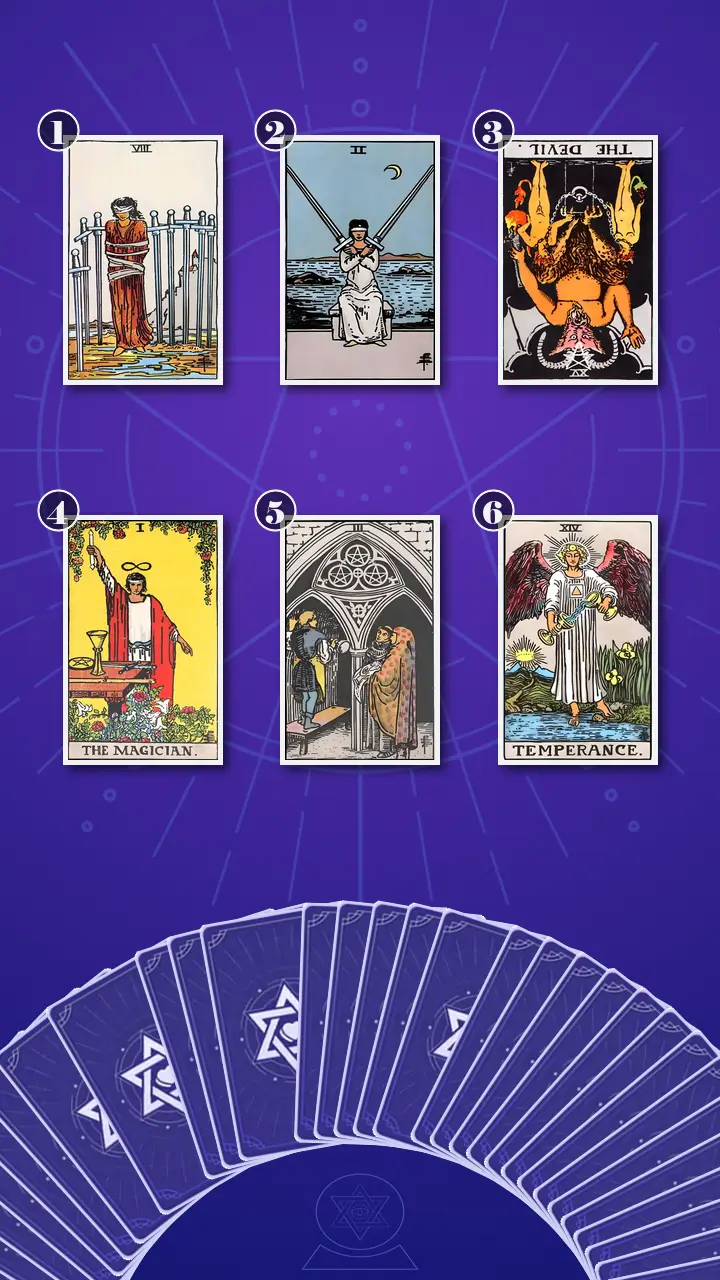
Reading the Map: From Mind-Trap to Interview-Ready Rhythm
Position 1: The presenting symptom in the interview moment
“Now flipped over,” I said, “is the card that represents the presenting symptom in the interview moment: what you do when the prompt lands and the freeze happens.”
Eight of Swords, upright.
In the picture, a blindfolded figure stands surrounded by swords—yet the bindings are loose, and there’s open ground nearby. I told Alex what that looked like in real life, using the scene she’d practically handed me: In the first 10 seconds after “Tell me about yourself,” you’re not unprepared—you’re trapped in self-monitoring. Throat tight. Jaw locked. Brain scanning for the single best sentence like it’s a safety code.
“It’s like having twenty browser tabs open,” I added, “and the moment you click the one you need, everything crashes.”
The energy here is blocked Air: overthinking that becomes paralysis. Not a lack of experience—an attention narrowing. A blindfold.
Alex stared at the card, then she let out a small, bitter laugh—an unexpected little pop of sound. “That’s… mean,” she said, but her eyes softened. “Accurate. But mean.”
“I’ll take accurate,” I replied gently. “Accurate means workable.”
Position 2: The immediate block that shuts down your words
“Now,” I said, “we’re looking at the immediate block: the in-the-moment mental move that shuts down access to words and self-story.”
Two of Swords, upright.
This card always makes me think of a body trying to stay safe by becoming still. Crossed arms. Closed chest. The sea behind it calm on the surface, full of depth underneath.
I translated it into Alex’s exact modern life scenario: Your in-the-moment move is to withhold until you can guarantee a strong start. You stall, smile, silently weigh ten possible versions of yourself—then freeze because interviews don’t wait for the perfect edit.
And I let the inner monologue contrast land, just as it shows up in so many Zoom waiting rooms:
“One voice says, Say something. Another says, Don’t commit yet. Pick the right version. Don’t sound scattered. You hover over unmute like you’re hovering over ‘Send’—and the longer you hover, the more your heartbeat becomes the loudest thing in the room.”
This is protective overcontrol. A strategy that probably helped you once—maybe in school, maybe in a workplace where mistakes were punished. But in real-time conversation, it backfires. Interviews aren’t a document you can revise; they’re a live exchange.
Alex’s shoulders lifted the tiniest bit, then dropped as if she’d realized she’d been holding them up for years. She gave me a tight nod—more body than words.
Position 3: The root driver under the freeze
“Now we go underneath,” I said. “This card represents the root driver: the deeper belief or fear that makes this prompt feel high-stakes and risky.”
The Devil, reversed.
Reversed, The Devil often shows the moment someone notices the chain—and hates that it’s there. It’s not “evil.” It’s the invisible contract you never agreed to out loud: My worth equals my performance.
I brought it to her Sunday-night reality: late-night LinkedIn scrolling, the harsh phone glow two inches from your face, seeing someone your age post “I’m thrilled to announce…” and feeling your chest tighten before your thoughts even catch up. Then the frantic search—best tell me about yourself answer marketing interview—as if the right template could protect you from shame.
“This is the hook,” I told her. “The interview room turns into a judgment chamber in your nervous system. One awkward sentence feels like it could ‘prove’ you’re not legitimate.”
The energy here is loosening bondage—but not fully free yet. A chain that feels tight in the throat even when the clasp is actually within reach.
Alex exhaled like she’d been holding something in her mouth. “I don’t even think I believe that consciously,” she said. “But my body does.”
“Exactly,” I said. “And bodies don’t respond to pep talks. They respond to safety and repetition.”
Position 4: The turning point that restores agency
“This,” I said, letting my hand rest on the deck for a beat, “is the pivot. The lever. The key turning point: what shifts the energy from freezing to speaking, without forcing a fake persona.”
The Magician, upright.
The room felt quieter—not because anything outside changed, but because attention changed. That’s what The Magician does. It takes scattered energy and gathers it into one purposeful act.
Setup. Alex was trapped in that first minute on Zoom: the screen lights up, the chime hits, throat tightens, and her mind tries to write the perfect first sentence live—as if her identity has to be flawless before her voice is allowed to exist.
Delivery.
You don’t need a flawless identity on the spot; you need a chosen script and tools—like The Magician—so your words can actually show up.
I let the sentence hang there for a breath.
Reinforcement. I watched Alex’s face do the three-step thing I’ve come to trust more than any “yes.” First: a tiny freeze—her eyes widening just a fraction, like a window opening in a stuffy room. Second: a faraway look, as if her mind replayed every moment she’d hovered over unmute, editing a sentence that didn’t exist yet. Third: the release—her shoulders lowered, her jaw unclenched, and she swallowed once, not in panic but in recognition.
“But if I choose a script,” she said, and there was a flash of resistance—almost anger—“doesn’t that mean I’ve been doing it wrong? Like… all this time?”
I kept my voice steady. “No. It means you’ve been protecting yourself with the tools you had. The Magician isn’t here to shame you. He’s here to hand you tools that work in real time.”
This is where my family’s way of seeing comes in—my Nature Empathy Technique. In the Highlands, you learn quickly that the weather doesn’t care about your perfect plan. You don’t stand on the hillside arguing with the wind. You watch. You choose your route. You pack what you need. Intuition isn’t magic—it’s attention trained by reality.
“Right now,” I told Alex, “your attention is blindfolded by evaluation. The Magician’s direct gaze is the antidote. It’s the switch from watching yourself being watched to choosing what you want them to understand.”
“So… what do I choose?” she asked, quieter now.
“Three anchors,” I said. “Role-now. Through-line strength. One proof story. Not your whole life. A self-intro isn’t a verdict. It’s a chosen angle.”
Then I asked her the question that turns insight into a lived memory: “Using this new lens—think back to last week. Was there a moment you froze where, if you’d had those three anchors in front of you, you would’ve felt even 5% different in your throat or breath?”
She nodded slowly, almost surprised by herself. “Thursday. The pause. I could feel my jaw lock. If I’d had a default first line… I think I would’ve started.”
And there it was—the first step of the transformation: from panic-driven self-monitoring to agency.
Position 5: The next practical step for the next seven days
“Now,” I said, “we land this in the real world. This card represents the next practical step: a concrete way to practice and deliver a grounded, repeatable answer within a week.”
Three of Pentacles, upright.
This is the card of building skill where it can be seen—apprentice work, feedback, refinement. It doesn’t romanticize confidence. It engineers it.
I used the card’s modern translation exactly: Your next step is to make your self-intro a practiced skill, not a private document. Two short reps this week—one recorded voice memo, one mock run with a friend/mentor—so you can refine based on what actually lands.
The energy here is Earth: structure, repetition, the dignity of doing it more than once.
Alex grimaced. “I always think I’ll practice when it sounds authentic,” she admitted.
“That’s the trap,” I said, not unkindly. “Authentic isn’t something you discover by polishing alone. You hear it by speaking.”
And I gave her the line I’ve watched people borrow and carry: Clarity comes from reps, not from a flawless script.
Position 6: Integration—what success feels like internally
“Finally,” I said, “this card represents integration: what ‘success’ looks like internally—how it feels when the answer becomes natural and balanced.”
Temperance, upright.
Temperance is the angel pouring between two cups—blending, not forcing. One foot on land, one in water. A path leading toward a rising sun. It’s not dramatic. It’s steady.
I brought it into modern language: Integration looks like a calm, conversational rhythm: you can give your intro in ~60 seconds, pause without panicking, and adjust when they ask follow-ups. You sound like a real person who’s competent—not a robot reciting a script.
This is balanced Water and Fire: warmth without oversharing, structure without stiffness.
“Structure is a container, not a costume,” I reminded her. “Temperance isn’t asking you to perform. It’s asking you to mix your professional facts with your human tone until your voice feels like it belongs to you again.”
The One-Week System: The Chosen Angle + One-Take Rep
When I looked back across the whole grid, the story was clean: Eight of Swords showed the symptom—blanking, tight throat, jaw locked—because attention narrows into self-policing. Two of Swords revealed the reflex—protective withholding, “say nothing until it’s perfect,” the decision jam. The Devil reversed named the root—an invisible worth = performance contract that turns a normal prompt into a threat. Then The Magician broke the spell with agency: you don’t find the perfect you; you choose what to highlight and you use tools. Three of Pentacles turned it into a process. Temperance promised the felt result: warm, steady, adaptable.
The cognitive blind spot here is subtle: you’ve been treating starting as if it has to prove your worth. That’s why you freeze. The transformation direction is simpler—and kinder: shift from searching for the perfect self-description in the moment to delivering a practiced three-part outline you can adapt.
Here are the next steps I gave Alex—small enough to start, real enough to change something.
- Build the Three-Anchor Outline (10 minutes)In your Notes app, write a 3-part outline (not a script) for “Tell me about yourself”: (1) role-now, (2) through-line strength (what you’re consistently good at), (3) one proof story (a specific project with a result). Keep it to 6 bullet points max.If you feel the urge to add “one more achievement,” stop and ask: “Am I adding clarity—or trying to earn worth?” Choose clarity.
- Choose Your Always-Start Sentence (2 minutes)Pick one default opening line you can say even when nervous (example: “Sure—quick overview: I’m a marketing specialist focused on X, and I’ve been building Y…”). Save it as the first line of the note above so it’s always there before interviews.Energy protection tip: block LinkedIn for 60 minutes before interviews. Comparison isn’t “motivation” when your nervous system is already braced.
- Do Rep 1 Out Loud (One take, 60 seconds)Record one 60-second voice memo today using your three anchors. No re-records. Title it “Rep 1.” If you want extra grounding, do it while walking slowly around your room and letting environmental sounds (the fridge hum, traffic, your footsteps) keep you present.Expect your brain to label the first rep as “cringe.” That’s your internal editor hearing reality. Set a 3-minute timer and stop when it rings—ending is part of the boundary.
And because Alex’s spiral peaked at night, I added one more stabilizer from my own toolkit—quiet, practical, and surprisingly powerful: a 3-minute bedtime energy review. “Before sleep,” I told her, “name one neutral note (structure/pacing) and one kind note (what sounded real). Then stop. No post-interview rumination, no reopening Notes to write FINAL v7.”
Temperance also gets seasonal about it, in my experience. Toronto winter air can make throats feel tighter, voices thinner. I suggested a small seasonal self-care adjustment: warm tea, earlier sleep the night before a call, and a conscious exhale when the question lands—because your voice is part body, not just branding.

A Week Later: The Quiet Proof
Six days later, Alex sent me a message that made me smile into my mug. “Did Rep 1,” it read. “Didn’t delete it. My throat still tightened at first, but once I started the always-start line, it loosened. I scheduled a mock with my friend for Thursday.”
That’s what change looks like most of the time: not a dramatic personality makeover, but a small proof that the pattern can be interrupted.
She told me something else too—bittersweet in the way real growth often is: she slept a full night for the first time in weeks, but in the morning her first thought was still, What if I mess it up? Then, she said, she actually smiled. Not because the fear vanished—because it no longer had the whole microphone.
That’s the journey tarot is good at, when we use it honestly: moving from panic-driven self-monitoring and blanking out to calm, flexible confidence built through a chosen, practiced story structure. Not certainty. Ownership.
When that question lands, it can feel like your throat tightens around one fear: that a single imperfect sentence could expose you as not worthy of the room you’ve already earned a seat in.
If you didn’t have to find the perfect “you” on the spot, what’s one simple three-part outline you’d be willing to choose—and practice—just enough to let your real voice show up?