When Your Mom DMs Your Friend: Trading Long Texts for One Rule

Finding Clarity in the 8:47 p.m. TTC Scroll
You leave your mom on read for a few hours during a packed workday, and the next message you get isn’t from her—it’s from a friend saying, “Hey… your mom reached out,” and you feel that instant stomach-drop pressure.
Maya (name changed for privacy) told me that line like she was confessing to a crime she didn’t remember committing. She was 24, in Toronto, a junior professional with a calendar that looked like Tetris and a phone that never truly went quiet—even when it was set to Do Not Disturb.
She described Tuesday at 8:47 p.m. on the TTC Line 1 heading south: standing by the doors, fluorescent lights buzzing like a tired insect, her phone warm in her palm from being gripped too long. The window reflected her screen back at her—her mother’s thread, missed messages stacked like unpaid bills—and she swiped out of it like the glass was hot.
“I don’t even need space forever,” she said, voice tight in that way you can hear before you understand it. “I just need space without it turning into a whole thing.”
I watched the smallest tells: how her shoulders hovered near her ears, how her throat tightened when she said “friend,” how her breath clipped short like she was trying not to make noise in her own life.
The contradiction was painfully clean: she wanted the freedom to reply on her own timeline, but she was bracing for escalation—social monitoring, her mom going around her, her friendships becoming a pressure channel.
Pressure, in her body, wasn’t an abstract feeling. It was a hand at the base of her throat, and a quick drop in her stomach like the TTC had lurched unexpectedly—only it was her nervous system slamming on the brakes.
“We can work with this,” I told her. “Not by finding the perfect paragraph. By finding clarity. Let’s draw a map that gets your friends out of the middle—and gets your life back onto your own rhythm.”

Choosing the Compass: The Five-Card Cross Tarot Spread for Boundaries with Parents
I don’t treat tarot like a mystical performance. I treat it like a mirror with structure—something that helps you see the pattern you’re already living inside.
I asked Maya to take one slow breath in through her nose, and let it out like she was fogging up a window. While she did, I shuffled—slowly, deliberately—so her question could land somewhere other than her clenched jaw.
“Today,” I said, “we’ll use a Five-Card Cross.”
For anyone reading who’s wondering how tarot works in a situation like this: this spread is small, but it’s sturdy. It separates the present behavior pattern from the immediate block, then goes down to the deeper driver, and back up into concrete guidance and follow-through. That matters here, because this isn’t about predicting what her mom will do next. It’s about clarifying what Maya will do consistently.
I told her what each position would do in plain language:
“The center card shows the current dynamic—how the ‘no reply → she DMs your friend’ loop is playing out right now. The crossing card shows the hesitation that freezes you. The root card shows the family script underneath. Then we’ll pull a card for the boundary you set—and a final card for how to hold it without turning your phone into a courtroom.”
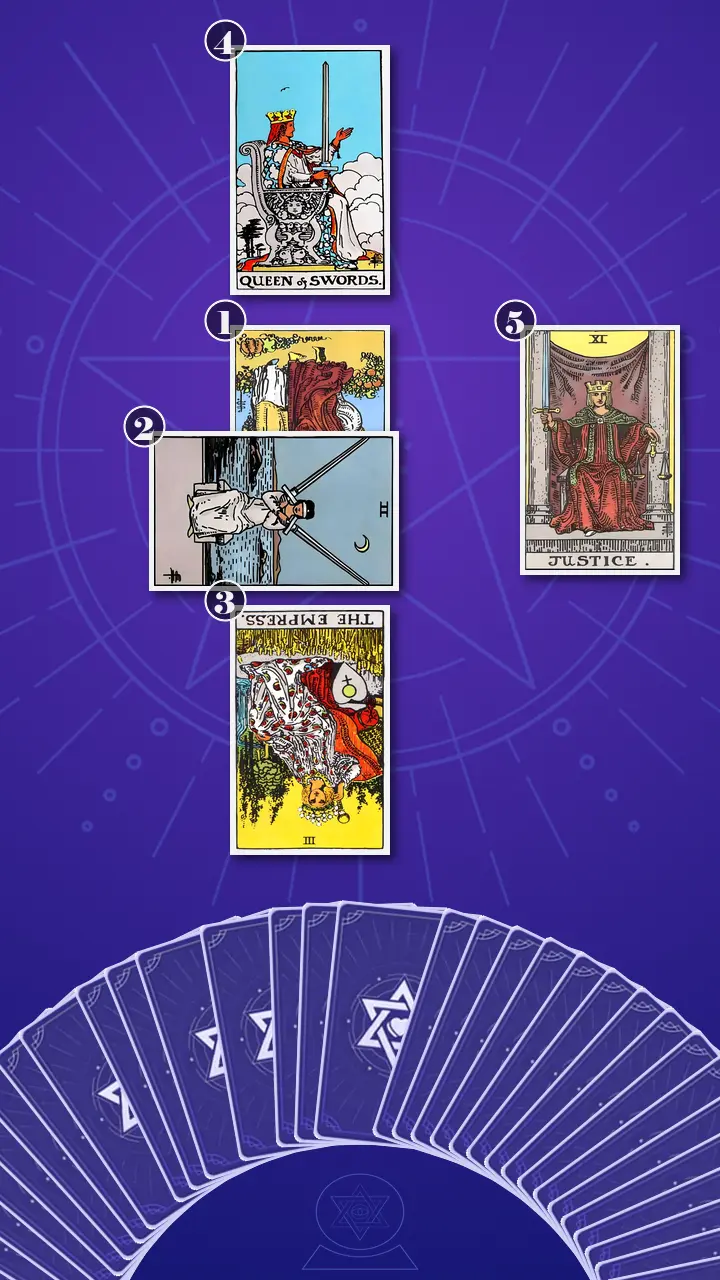
When the Queen of Swords Cut a Clean Line
I laid the first card in the center. “This is the present dynamic—what it’s doing to your friendships and your sense of privacy.”
Position 1: Present dynamic — Three of Cups, reversed
“Three of Cups, reversed,” I said.
In modern life, this is the exact moment Maya already described: opening Instagram DMs on a work break and seeing her mom has messaged her friend because she didn’t reply fast enough. A friendship space—supposed to be a safe, easy hallway—suddenly becomes a hallway her mom can walk down.
Energetically, the Three of Cups is community and support. Reversed, that energy gets misrouted: a third person is pulled in, and what should be light becomes awkward, exposed, and pressurized. This is triangulation—therapy-TikTok’s word for “why is my mom in my friend’s DMs?”
Maya let out a short laugh that didn’t reach her eyes. “Yeah,” she said. “That’s… brutally accurate.” Her fingers pinched the edge of her sleeve, then released it, like she was trying not to make a scene in her own body.
I kept my voice steady. “Your friends are not a backdoor into your attention.”
Position 2: Primary challenge — Two of Swords, upright
“Now we flip the card that represents the hesitation pattern that keeps you from responding or setting a boundary in the moment.”
“Two of Swords, upright.”
This one always makes me think of a frozen typing cursor: you’re staring at the thread, thumb hovering, body going rigid. You tell yourself you’ll respond when you can ‘do it right,’ but the longer you wait, the more trapped you feel between two outcomes that both sound awful: reply and invite control, or don’t reply and trigger escalation.
This is Air energy in blockage. Not a lack of intelligence—an overload. The mind crosses its own arms. The blindfold isn’t ignorance; it’s self-protection.
I said it plainly, because she needed plain: “When you don’t choose directness, the system chooses for you. It recruits a third party.”
Maya swallowed. Her throat moved like it had to push past something. “And then I’m writing two apology texts,” she said, “like it’s a PR crisis.”
“Stop writing texts like a legal document,” I told her gently. “Not because you’re wrong for wanting to be understood—because you’re trying to prevent a reaction by building a closing argument.”
Position 3: Root cause — The Empress, reversed
“Now we go to the root,” I said, “the deeper family script that makes a delayed reply feel loaded.”
“The Empress, reversed.”
Even people who don’t know tarot can feel the mother-coded weight of this card. Upright, she’s nourishment. Reversed, the nourishment can turn into overreach—care that demands access.
I offered Maya a contrast list, because it’s often the cleanest way to name what’s happening without shame:
Care is… “I worry about you. Can you check in when you can?”
Control starts when… “If I can’t reach you, I’ll reach through someone else.”
“You don’t have to be reachable to be loving,” I added. “That’s the spell this card breaks.”
Here’s where my own lineage comes in. I’m Esmeralda Glen, seventh-generation in a family of healers, and my work often begins with what I call Generational Pattern Reading: spotting the inherited rules that no one remembers agreeing to.
“Maya,” I said, “this doesn’t feel like it started with Instagram DMs. This feels like a family rule—maybe unspoken—where responsiveness equals love, and silence equals danger. In some families it’s ‘If I can’t reach you, I can’t breathe.’ That’s not an accusation. It’s a pattern.”
She nodded more slowly now. I saw the shift the way I see seasons change: not dramatic, but unmistakable. The anger softened into recognition—without turning into permission.
“Growing up,” she said, “being a good daughter meant… replying fast. Always. Even if I was in class. Even if it was dumb. If I didn’t, she’d spiral.”
“That’s the root,” I said. “You’re not only texting. You’re negotiating a nervous system contract you never drafted.”
Position 4 (Key Card): Boundary prescription — Queen of Swords, upright
I held my hand over the next card for a beat. The room—my small reading space with a pot of rosemary on the sill—felt suddenly quieter, like the moment right before snowfall when even traffic sounds muffled.
“We’re turning to the boundary prescription now,” I told her. “The tone. The line.”
“Queen of Swords, upright.”
This card doesn’t beg. It doesn’t rant. It doesn’t submit a ten-page memo titled Text to Mom (final FINAL). It makes one clean cut and then holds it.
Setup. Maya was right back on the TTC in her mind: phone warm in her palm, typing cursor blinking, stomach dropping—because she already knew that if she waited, her friend might become the messenger again. She’d been trying to solve the entire relationship inside one reply, and that was why every reply felt impossible.
Delivery.
Stop trying to earn peace through perfect explanations, and start cutting a clean line like the Queen of Swords: direct contact only, no friends as messengers.
I let the silence sit. Not dramatic—just spacious enough for the sentence to land.
Reinforcement. Maya’s reaction came in a chain, small but clear: first a brief freeze—breath caught, eyes fixed on the card like it had said her full name. Then her focus softened, as if her mind rewound a week of drafts and reread them with a new filter. Finally, her shoulders dropped a centimeter, and she exhaled through her nose with a sound that was half relief, half grief. “That’s… so much simpler,” she said, and then immediately, nervously, “But if it’s that simple, why can’t I do it?”
“Because simple isn’t the same as easy,” I said. “Simple means repeatable. Easy means no discomfort. Boundaries rarely give us both on day one.”
This is where I fused my Nature Empathy Technique into the medicine: “In the Highlands, we don’t argue with winter. We dress for it. We plan for it. A boundary is like that—you design it for your worst day, not your best mood.”
I asked her to do something specific, right then. “Open Notes. Draft a two-sentence script—max 240 characters each. Read it out loud once. If your chest tightens, shorten it again. Then choose one low-stakes moment to send it—not during an active spiral. If you feel flooded, pause—no one gets instant access to you just because they’re anxious.”
Then I looked her in the eye through the screen. “Now, with this new lens—can you think of one moment last week where this would’ve changed how your body felt?”
Her eyes went shiny, not with drama, but with that specific sting of being seen. “Thursday,” she whispered. “I was in back-to-back meetings. If I’d had a script, I wouldn’t have… disappeared.”
“Exactly,” I said. “This is your emotional transformation in miniature: from hyper-vigilant pressure and over-explaining to calm self-respect and repeatable boundary confidence.”
Position 5: Integration — Justice, upright
“Now we ask how to hold the boundary,” I said. “Not perfectly. Consistently.”
“Justice, upright.”
Justice is not a vibe. It’s a policy. Scales and sword: what’s fair, and what’s consistent.
In modern life, this looks like treating the boundary like a standing agreement—like a calendar availability setting—rather than a mood you negotiate in real time. When escalation happens, you repeat the same line and stick to the same check-in rhythm. Over time, the relationship stops testing for loopholes because the pattern becomes predictable.
“Consistency is the consequence,” I told her. “Not punishment. Not a threat. Just boring cause-and-effect.”
Maya gave a small nod that looked like someone picking up a heavy bag correctly—still weighty, but no longer twisting her spine.
The Two-Sentence Policy Text: Actionable Advice for Adult-Child Texting Boundaries
I pulled the five cards back into one story, because clarity needs integration, not just insight.
“Here’s the loop,” I said. “Your mom’s worry spills into your social world (Three of Cups reversed). You freeze because any reply feels like it has to solve everything (Two of Swords). Underneath is a family script that equates fast access with love (Empress reversed). The antidote is a clean, adult-to-adult line—no intermediaries (Queen of Swords). And the way it holds is by turning it into a fair, repeatable policy you follow even on a chaotic Tuesday (Justice).”
“The blind spot,” I added, “is thinking you can buy peace with better explanations. But explanations invite debate. A boundary isn’t a debate. It’s a repeatable rule.”
Maya frowned, then said the practical truth that so many people carry: “But I can’t even find five minutes. I’m slammed. If I set a check-in time and then miss it once, she’ll use that.”
I nodded. “Good. That’s real. So we design a rhythm you can actually keep. Justice doesn’t ask for perfection. Justice asks for something defensible on your worst day.”
Then I gave her the smallest, most doable next steps—what to do, when, and how long it takes.
- Write the Two-Sentence Policy TextIn your Notes app, draft and save: (1) “Please don’t message my friends if I’m slow to reply.” (2) “If it’s not urgent, I’ll check in by 7pm on weekdays.” Keep it under two sentences—no location updates, no timestamps, no courtroom-style context.If your throat tightens when you read it, shorten it again. Warmth can be one neutral line (“I know you worry”)—but do not add extra access.
- Send It at a Calm Time (Not Mid-Spiral)Choose one low-stakes moment (for example: after dinner, before you’re in bed scrolling). Send the script once, cleanly, and stop. No follow-up paragraph.Use my “3-minute family energy check”: stand by a houseplant, notice the leaves, the dryness of the soil, your breath. The goal isn’t magic—it’s to get your body out of panic before you hit send.
- Use the Repeat Line When She EscalatesIf she DMs a friend again, don’t write a new essay. Repeat: “I’m not available to communicate through friends. Please contact me directly. I’ll reply by 7pm.” Then text your friend: “Thanks for letting me know—no need to respond. I’ll handle it directly.”Track consistency, not intensity: one tiny checkmark in Notes each day you followed your check-in rule—even if the message was short.
Finally, I offered one more piece of realism—something my clients always need to hear: “Expect pushback the first one to three times. That doesn’t mean the boundary is wrong. It means the old system is testing if escalation still works.”

A Week Later: The Quiet Proof
Six days later, Maya messaged me a screenshot. It wasn’t a dramatic reconciliation. It was almost boring—which is exactly what made it powerful.
Her mom had texted twice during a chaotic Tuesday. Maya didn’t disappear. She didn’t send a three-paragraph update. At 6:52 p.m., she sent one line: “Hey—busy day. Checking in now. Talk tomorrow.”
Then, later, she admitted something bittersweet: she’d sat alone in a coffee shop for an hour afterward, not celebrating, just feeling the unfamiliar quiet. Her first thought the next morning was still, What if I did it wrong?—but this time she noticed it, breathed, and didn’t write an apology memo to chase the feeling away.
That’s the Journey to Clarity in real life. Not certainty. Ownership. A boundary you can repeat without rewriting your whole history every time your phone buzzes.
When your phone turns into a courtroom—tight throat, spinning thoughts, drafts that read like a legal brief—it’s usually because you’re trying to buy peace with explanations instead of protecting your privacy with one simple line.
If you didn’t have to defend your timing, what would your simplest “direct contact only” rule sound like—one you could repeat even on a chaotic Tuesday?