Six Tabs, One Text, Tight Shoulders—And the Dog-Care Terms Talk

The Laptop Glow and the “Dog Rules” Doc
I see this exact pattern all the time: you open one shelter listing, and suddenly it’s pet insurance tabs, a Google Sheet budget, and a full “Sunday Scaries” level spiral about who keeps the dog if things change.
Jordan (name changed for privacy) came into my café in Toronto with that kind of energy still stuck in her shoulders—like she’d been carrying a backpack she didn’t remember putting on. She’s 29, a UX designer, the kind of person who can make a messy system elegant at work… and then get trapped in her own “research loop” at home.
She told me about Tuesday night, 8:58 PM in her condo living room: laptop glow as the only light, streetlight leaking through the blinds, the fridge humming like it had opinions. Rescue listing. Pet insurance quote. A shared Notes doc titled Dog Rules. Her phone warm in her palm from holding it too tightly.
Then the text from her partner: “So… are we doing this?”
Jordan’s throat tightened the way it does right before you have to say something that might change the shape of your life. “I’m not saying no,” she said, and I watched her fingers twist her napkin into a tight rope. “I just… can’t tell if I’m being responsible or just scared. I want the shared life part. I’m just terrified it’ll all land on me if things shift.”
Her anxiety wasn’t abstract. It sat in her body like a lid screwed on too tight—restless chest, shoulders creeping up, a breath that never quite finished. Like she was trying to exhale through a straw and calling it “being fine.”
I nodded and slid her cappuccino closer, the foam still glossy. “You’re not broken for reacting this way,” I said. “You’re getting a signal. Let’s turn that signal into something useful. We’re here for clarity—not a perfect answer, but a plan you can actually live inside.”

Choosing the Compass: How Tarot Works for a Real-Life Relationship Decision
I didn’t light candles or tell Jordan her future was fixed. In my café, tarot is like coffee: it doesn’t decide for you. It reveals what’s already in the cup—what’s strong, what’s bitter, what’s unbalanced—so you can adjust the recipe.
I asked her to take one slow breath in, one slow breath out, and hold the question as simply as possible: “We want to adopt a dog together—do I say yes or slow down?” Then I shuffled while the espresso machine hissed behind the counter, that familiar steam like a metronome for honesty.
“Today I’m using a spread called Pros and Cons · Context Edition,” I said. “It’s made for moments like this—when the question isn’t ‘predict the outcome,’ but ‘help me make a grounded decision at a career-crossroads level of pressure… except it’s your relationship.’”
For readers: the rationale is simple. A lot of adopting a dog with a partner anxiety is really commitment anxiety disguised as practicality. A pros-and-cons layout helps separate what’s emotionally nourishing, what’s practically heavy, and what’s being projected onto the relationship as a test.
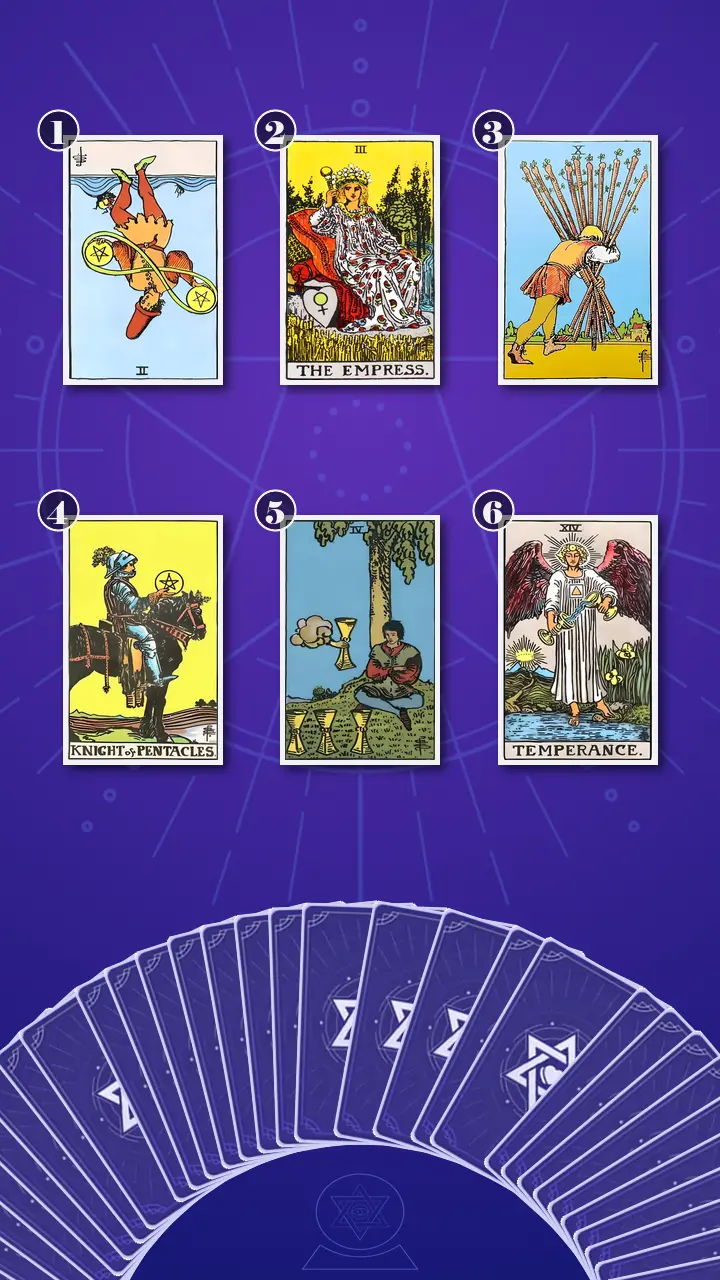
I tapped the table lightly where the grid would go. “The first card shows what your day-to-day reality actually looks like right now. The next two show the benefit and cost of saying yes. The next two show the benefit and cost of slowing down. And the final card—the integration card—tells us how to turn this into actionable advice and next steps.”
Reading the Grid: When the Cards Named the Real Test
Position 1: Your day-to-day reality right now
“Now flipped over,” I told her, “is the card representing what the situation looks like day-to-day right now.”
Two of Pentacles, reversed.
I didn’t even need to reach for poetry—this card already speaks in browser tabs. “It’s 10:30 PM and you’re running mental dual monitors,” I said, staying very close to her real life. “One screen is the cute rescue bio and imagined morning walks. The other is vet costs, travel plans, who does the 7 a.m. walk. You keep trying to balance excitement and responsibility in your head… and the more you juggle, the less stable you feel.”
In my mind I saw a rapid-cut montage—like a TikTok you didn’t ask to watch: Google Sheets budget v3 → pet insurance quote → TTC delay notification → Slack calendar overload → your partner’s “so are we doing this?” text. And underneath it, the inner debate that sounds like maturity but feels like panic: I’m being responsible vs I’m trying to control the feeling of uncertainty.
“Reversed,” I added, “this isn’t ‘you’re bad at adulthood.’ This is a system overload alarm. When your nervous system is overloaded, every option feels like a trap.”
Jordan let out a small laugh that had a bitter edge to it. “Yeah… that’s literally me,” she said, and her shoulders dropped about half an inch, like her body was relieved someone named it first.
Position 2: What saying yes supports
“Now flipped over is the card representing what saying yes supports emotionally and relationally,” I said.
The Empress, upright.
“This is the truth of why you’re even considering it,” I told her. “You picture your apartment feeling softer. Weekend errands becoming a shared routine. The dog as the little daily ‘we’ that makes the relationship feel like home—not just two people coexisting between commutes.”
Upright Empress energy is abundant care—but not martyrdom. “The Empress doesn’t nurture by silently doing everything,” I said. “She nurtures by creating an environment where care is reciprocal.”
Jordan’s eyes softened in a way I’ve seen a hundred times across my café tables. The longing isn’t loud. It’s quiet—and it’s real.
Position 3: What saying yes costs
“Now flipped over is the card representing what saying yes costs practically and psychologically,” I said.
Ten of Wands, upright.
This one landed like a grocery bag set down too hard. “You imagine becoming the default dog-parent,” I said, keeping it concrete. “Racing home between meetings. Doing the vet calls. Finding pet-sitters. Paying surprise expenses. Still trying to be a present partner and a high performer at work.”
I watched Jordan go still—breath held, fingers frozen around her cup—then her gaze drifted past me as if she was replaying old relationships where she carried more than she agreed to.
“A dog isn’t the test,” I said gently, because sometimes you need a clean sentence. “The unspoken labor split is.”
And here’s the hard contrast at the heart of it: “I want the cozy morning walk” vs “I’m scared of becoming the default dog-parent.” The Ten of Wands doesn’t tell you to say no. It tells you to stop pretending weight won’t exist—and to name it before it becomes resentment sediment at the bottom of your cup.
Position 4: What slowing down supports
“Now flipped over is the card representing what slowing down supports,” I said.
Knight of Pentacles, upright.
“This is slow as a strategy,” I told her. “Not avoidance. Readiness-building.”
I described it the way her UX brain could trust: “Instead of deciding in a spiral, you run a real-world trial. A 30-day routine test. A morning walk rotation. A weekly pet-fund transfer. A plan for travel weeks.”
Then I gave her the line I give so many high-functioning overthinkers, because it’s almost always true: “If you need certainty to commit, you’ll keep paying for it with delay.”
Jordan blinked, like that hit a nerve she’d been pretending wasn’t there.
Position 5: What slowing down costs
“Now flipped over is the card representing what slowing down costs relationally,” I said.
Four of Cups, upright.
“This is the risk moment,” I said. “Your partner sends a shelter link with actual excitement, and you respond with ‘cute’ while you’re emotionally somewhere else—building escape plans.”
Four of Cups energy isn’t villain energy. It’s protective energy that accidentally blocks connection. “A ‘not yet’ without a plan can sound like a no,” I told her. “Not because your partner is unreasonable—because silence is easy to misread.”
Jordan’s mouth tightened, and she nodded once, small. The sting of recognition was there, but so was relief: it wasn’t a character flaw. It was a pattern she could change.
Position 6: Integration and next step
When I turned the final card, the café felt quieter—not because the street outside stopped, but because Jordan’s attention finally stopped sprinting ahead of her.
“Now flipped over,” I said, “is the card representing integration and next step—how to hold both needs, connection and safety, and turn this into a concrete conversation plan.”
Temperance, upright.
In my world, Temperance is the barista’s card. It’s the careful pour. The difference between a drink that tastes like harmony and one that splits into watery milk and burnt bitterness because you rushed the blend.
And this is where I used my own framework—my Relationship Stage Diagnosis, the one I’ve built over two decades of watching couples talk over cups. “Jordan,” I said, “adopting a dog isn’t just a pet decision. It’s a relationship-stage shift. It’s moving from espresso energy—intense, flexible, easy to pick up and go—to latte energy: daily care, shared routine, a life you have to stir and maintain.”
She gave me a look that was half ‘that’s ridiculous’ and half ‘that is painfully accurate.’
The Aha Moment: A careful pour, not a verdict
Setup. You know that moment when your partner says, “It’ll be fun,” and you’re already three tabs deep in shelters, vet costs, and who walks the dog during a 9 a.m. standup. That’s the moment your brain turns a living thing into a permanent verdict—and your body braces like you’re about to sign something you can’t get out of.
Delivery.
Stop treating the dog as a leap that traps you, and start treating it as a careful pour—mix love and logistics until the plan holds without spilling.
I let the sentence sit there between us like steam over fresh espresso.
Reinforcement. Jordan’s reaction came in layers. First, a brief freeze—her breath caught high in her chest, her hands hovering above the cup. Then the defensiveness flashed, quick and hot: “But if we need terms… does that mean we’re doomed? Like, shouldn’t this just feel… easy?”
Her eyes shone, not quite tears, more like pressure finding a crack. Her shoulders, which had been braced near her ears, slowly lowered. The napkin rope in her fingers loosened. And then she exhaled—long, shaky, the kind of breath that sounds like someone putting something heavy down on the floor.
“Terms are intimacy, not mistrust,” I said. “Especially when you’ve been the one carrying invisible labor before. You’re not asking for a colder relationship. You’re asking for a fairer one.”
I pulled out my phone and showed her a simple practice, like I would for any regular who needed their nervous system to stop treating love like danger. “Do a 10-minute ‘Care & Capacity’ micro-check,” I said. “Open a note and write two columns: (1) ‘I can genuinely offer weekly’—time blocks, money buffer, flexibility. (2) ‘I need protected’—sleep, travel, solo time, budget ceiling. Circle one non-negotiable in each. Then text your partner: ‘I’m not a no—I’m a yes-with-terms. Can we do a 20-min planning chat this week to split care + money + a trial timeline?’”
She stared at the words like they were a door that had been there the whole time.
“Now,” I asked softly, “with this new lens—careful pour, not leap—think back to last week. Was there a moment the spiral hit where this would’ve changed how you felt?”
Jordan swallowed and nodded. “Tuesday,” she said. “When they texted. If I’d had terms, I wouldn’t have panicked. I wouldn’t have gone vague.”
And that was the shift happening in real time: from anxiety-driven over-planning and avoidance to grounded, boundary-based confidence about pacing commitment together.
The “Careful Pour” Plan: Actionable Advice You Can Actually Use
I gathered the whole spread into one clean story for her: the Two of Pentacles reversed showed her current overload and decision fatigue—the constant tab-switching that looks like responsibility but functions like avoidance. The Empress was the honest desire for a warmer shared life. The Ten of Wands named the real fear: invisible labor and default-parent energy. The Knight of Pentacles offered the antidote—slow as structure, not slow as silence. And the Four of Cups warned that without clear communication, her pause could read like rejection.
Her cognitive blind spot was subtle but common: she’d been treating the dog as a single irreversible yes/no that would “prove” whether the relationship is safe, instead of treating it as a designable commitment with shared ownership. The transformation direction was equally clear: stop chasing a perfect feeling of certainty; start negotiating testable agreements that make your pace feel safe enough to move.
I gave her next steps that were small, specific, and doable—even on a Toronto schedule.
- The 20-Min “Terms, Not Vibes” ChatPick one day/time this week. Sit at the kitchen counter. Phones face down. Say: “I’m not a no—I’m a yes-with-terms. I need to know this won’t all land on me. Can we name what ‘fair’ looks like for walks, vet admin, and money?”If either of you gets defensive, call a pause: “Let’s take 10 and come back.” A regulated conversation beats a perfect one.
- One Page Only: The Minimum Viable Dog-Care PlanBring one page (not a binder): (a) daily care split, (b) money cap + pet fund rule, (c) travel/deadline-week coverage, (d) emergency plan. Limit it to three non-negotiables total.Set a timer for 15 minutes when drafting. If it turns into self-punishment, stop—this is information, not a test you have to pass.
- My “Cup Bottom” Checkpoint (Before Any Adoption Appointment)Use my Cup Bottom Divination as a relationship tool: after your chat, each of you writes two lists—“Dog tasks I’m happy to own” vs “Dog tasks I will resent if they default to me.” Compare. Then agree on one 30-day routine test (simulate walk times + auto-transfer to a shared pet fund) and schedule the review date.If the word “terms” feels unromantic, rename it: “our dog-care recipe.” Same idea, less shame.

A Week Later, a Quieter Chest
A week later, Jordan messaged me a photo—not of a puppy, but of a screenshot. A calendar invite: “Dog Decision Chat (20 min).” Under it, a note with two columns: “I can offer weekly” and “I need protected.”
Her text was simple: “We did it. Phones down. We picked a 30-day routine test and a pet fund auto-transfer. I didn’t go vague. I said the sentence.”
Clear but still human: she told me she slept a full night for the first time in weeks… and then woke up with the thought, What if we’re wrong? She paused, breathed, and wrote back to herself: We’re not leaping. We’re pouring.
That’s the journey I care about. Not forcing certainty—building a yes you can live inside. Tarot didn’t hand her a verdict. It gave her a structure for finding clarity and protecting trust at the same time.
When you want the warmth of a shared life but your body tightens at the thought of being the one who carries it if things shift, even a sweet idea like a dog can start to feel like a trap.
If you let “yes” be something you can design together—not just something you have to feel sure about—what’s one small term or checkpoint that would make your pace feel safe enough to move?