One Gray Hair Felt Like Proof I Was Slipping—Until I Stopped Scorekeeping

The 8:12 a.m. Bathroom-Light Interrogation: An Appearance-Based Self-Worth Spiral
If you’re 29, live in a big city, and one gray hair sent you into a full bathroom-light interrogation like it’s an emergency—welcome to the “first gray hair panic” club.
Maya (name changed for privacy) said it with a laugh that didn’t quite land. “It’s one gray hair and somehow it feels like a full personality flaw.”
As she spoke, I could almost see the moment: 8:12 AM on a Wednesday in a tiny NYC bathroom, leaning into the harsh overhead vanity light. Damp fingers parting hair three different ways. The tile cold under bare feet. The fan buzzing like a small accusation. And then the same silver strand again—bright as a thread pulled from the wrong sweater.
Her body remembered it before her mind could dress it up: a stomach-drop like missing a stair, and a chest-tightening that made every breath feel smaller than it should be.
“A gray hair isn’t a problem. It’s a trigger that your brain knows how to weaponize,” I said gently, watching her shoulders tense as if she were bracing for a verdict.
She nodded, then looked away—toward the window, toward anywhere but the mirror memory. “I don’t want to be shallow,” she said. “But I also don’t want to be invisible.”
Underneath the strand was the true contradiction: wanting to feel confident and self-accepting as she ages, versus the fear that visible aging means she’s losing value—at work, in dating, in the invisible competition of a city where everyone looks like they have a routine and a ring light.
I let the silence settle for a beat, like dust finding the floor after a door closes. “We can work with this,” I told her. “Not by pretending it doesn’t matter, and not by letting it run your life. Let’s draw a map through the fog—this is a Journey to Clarity, not a trial.”
Choosing the Compass: The Horseshoe Spread · Context Edition
I asked Maya to take one slow breath and place both feet on the ground—not as mysticism, but as a practical way to shift her attention from the mirror in her head to the room we were actually in. While she did, I shuffled the deck in an unhurried rhythm, the way I once brushed soil from pottery fragments: patient, methodical, respectful of what’s underneath.
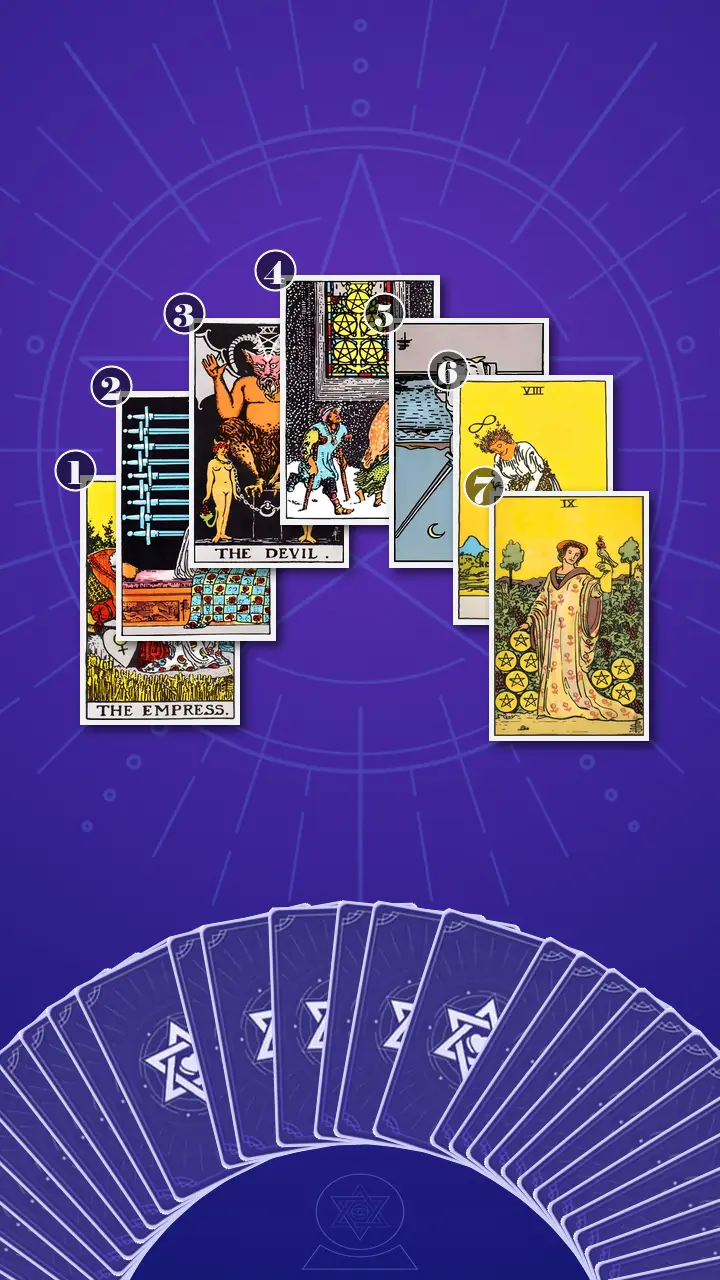
“Today, we’ll use something called the Horseshoe Spread · Context Edition,” I said. “It’s a seven-card tarot spread for aging anxiety and appearance-based self-worth—small enough to stay clear, but complete enough to show the whole loop: what shaped this, what triggers it now, what’s feeding it, what fear keeps it sticky, and what to do next.”
For you, the reader: this is how tarot works when it’s useful. Not fortune-telling. Pattern-mapping. The Horseshoe Spread’s arc moves from past conditioning into present behavior, then pauses at the core obstacle—like reaching the doorway in an excavation trench where you suddenly understand why the whole structure was built that way.
In this reading, position 1 traces where the “beauty = safety” template formed. Position 4 sits at the crown as the core fear. And position 6 is the key shift—the most supportive inner move that interrupts mirror checking and comparison loops.
“We’ll read left to right,” I told Maya, laying the cards in their horseshoe arc. “And when we reach the top card, we’ll stop and tell the truth about what this is really about.”
Reading the Map: The First Five Cards of Getting Older Insecurity
Position 1: Past conditioning — The Empress (upright)
“Now turning over,” I said, “is the card that represents Past conditioning: where your ideas about beauty, desirability, and ‘being valued’ first got reinforced.”
The Empress, upright.
The image is lush—wheat, abundance, the promise that the body is a home and a gift. In modern life terms, it’s the day you get ready for work and notice how differently you treat yourself on ‘polished’ days: hair behaving, skin cooperating, outfit hitting. Your brain quietly files it as proof you’re doing life right—more confident emails, more eye contact, more ease taking up space. The Empress is that original blueprint: beauty as abundance, beauty as safety, beauty as social protection in a city where being put-together can feel like part of being employable and dateable.
Energetically, this isn’t “bad” at all—it’s excess only when it becomes your only definition of safety. A single strand can’t just be a strand if the nervous system learned long ago that looking radiant keeps you inside the warm room.
Maya made a small, bitter sound—half laugh, half wince. “It’s brutal,” she said. “Like… I know I’m nicer to myself when my hair looks good. It’s embarrassing to hear it said out loud.”
“Archaeology taught me something about this,” I admitted. “In a dig, the top layer always looks like the whole story—until you realize it’s just what survived on the surface. We’re going to look underneath the ‘polished day’ layer without shaming you for having it.”
Position 2: Present symptom — Nine of Swords (upright)
“Now turning over,” I continued, “is the card that represents Present symptom: what the gray-hair moment is triggering in your day-to-day behavior and self-talk right now.”
Nine of Swords, upright.
This card is the night mind: worry that multiplies in the dark. And the modern life scenario is painfully specific—late, in bed, one gray hair becomes nine mental tabs: What if there are more?What if I look older in photos?What if I’m not the one people notice? You scroll product reviews like they’re going to soothe your nervous system, but your eyes feel dry, your jaw is tight, and your chest won’t unclench. You’re not solving hair—you’re trying to solve the fear of being downgraded.
The energy here is overactive Air—an excess of thinking used as an emergency response. It’s decision fatigue disguised as “research.” It’s reassurance checking disguised as “being responsible.”
Maya stared at the card like it had been reading her Notes app. “That’s my exact 11 PM brain,” she said, and her fingers pressed into her palm as if she could physically hold her thoughts in place.
“This is where I want to name something cleanly,” I told her. “If you’re checking again, you’re not looking for hair—you’re looking for reassurance.”
She blinked fast, then nodded once—tight, quiet recognition.
Position 3: Hidden influence — The Devil (upright)
“Now turning over,” I said, “is the card that represents Hidden influence: the less obvious force feeding the self-worth spiral.”
The Devil, upright.
In my mind, the Devil is never just “temptation.” It’s a contract you didn’t realize you signed. And Maya’s modern life translation matches it perfectly: you know filters aren’t real—you can say it out loud—and still your body reacts when you compare your unedited reflection to someone’s curated ‘effortless’ Story. The Devil is the invisible contract: Stay youthful to stay valuable. It shows up as compulsive checking, fix-it urgency, and the feeling that you’re not allowed to relax until you’ve neutralized the evidence of time.
This is blockage energy—attachment that behaves like a chain. It’s like being on a subscription you didn’t knowingly sign up for: the “youth = winning” plan keeps auto-renewing. TikTok #grwm, “clean girl aesthetic,” the Sephora app wishlist, the accidental front-camera check—none of it is evil, but the algorithm can be relentless in what it suggests your face is “for.”
“This isn’t vanity,” I said, carefully. “It’s a safety strategy that got stuck on ‘appearance.’”
Her shoulders lowered a millimeter. “That makes it feel… less like I’m broken,” she admitted. “More like I’m caught.”
Position 4: Core obstacle — Five of Pentacles (upright)
“Now turning over,” I told her, “is the card that represents Core obstacle: the belief or fear that keeps you stuck in checking, comparing, or fixing mode.”
Five of Pentacles, upright.
Snow. A stained-glass window. Two figures limping past warmth they can’t quite enter. The Five of Pentacles meaning, in this context, is not about money—it’s about belonging. It’s the gut-level fear of being excluded or not chosen once time shows up on you.
And the modern life scene is a winter-in-the-city contrast: you imagine other people warm inside the “chosen” category while you’re outside in the cold, watching through the glass. The real terror isn’t gray. It’s the flash image of walking into a bar, a meeting, or a wedding and being read as “tired”—like you’ve moved from “in demand” to “background.”
In her head, the monologue escalates in that exact structure:
If they see it, then… they’ll think I’m letting myself go.
And if that’s true, then… I won’t be chosen.
And if I’m not chosen, then… I’m not safe.
The energy here is deficiency—a felt lack of belonging that makes the mind treat a strand of hair like a social emergency.
Maya didn’t cry. Instead, she gave me the smallest nod I’ve ever seen someone give, like she was trying not to disturb the truth by moving too much.
“Yeah,” she said quietly. “It’s the fear of being overlooked, not the hair.”
Position 5: Your stance and protection strategy — Two of Swords (reversed)
“Now turning over,” I said, “is the card that represents Your stance and protection strategy: how you’re trying to manage the discomfort, and why it doesn’t fully work.”
Two of Swords, reversed.
This is the swing—the dam that holds all day and breaks at night. The modern life scenario is exactly that: all day you tell yourself, “It’s not a big deal.” You keep moving, keep working, keep performing competence. Then you catch your reflection again and the dam breaks: mirror-scanning, tweezing, opening Google, checking old selfies.
Energetically, it’s blockage turning into overflow. The more you blindfold the feeling, the more pressure builds behind it.
I mirrored the split-screen out loud, because it’s often the first moment the pattern becomes changeable:
What you say out loud: “I’m above this. It’s silly. I don’t care.”
What your body does: shoulders creep up, jaw tightens, thumb opens the front camera “just to check,” and suddenly you’re auditing your face like it’s a quarterly report.
Maya exhaled—small, involuntary. “Okay,” she said. “I do bounce between pretending and panicking.”
“That’s not a character flaw,” I replied. “It’s a coping strategy that gives short relief and long-term stress.”
When Strength Spoke: From Appearance Scorecard to Care-and-Choice
Position 6: Key shift — Strength (upright)
When I reached for the sixth card, the air in my office felt unusually still. Even the street noise outside—sirens and delivery trucks—seemed to lower its volume, as if the city itself was briefly listening.
“Now turning over,” I said, “is the card that represents Key shift: the most supportive inner move that interrupts the spiral and restores self-trust.”
Strength, upright.
The modern life version of Strength isn’t a motivational poster. It’s a behavior: instead of yanking yourself into “fix it now,” you practice a steadier kind of control. You pause, soften your shoulders, and decide from care—not fear. Maybe you still color your hair. Maybe you don’t. Strength isn’t about letting everything go; it’s about guiding your reaction like a powerful animal—firm, gentle, and self-respecting.
The energy here is balance: courage without aggression, control without punishment.
This is where my own “professor brain” always reaches for a myth—not to romanticize pain, but to make a growth metaphor you can actually hold. In ancient reliefs, the lion isn’t conquered by panic. The hero who survives isn’t the one who flails hardest; it’s the one who steadies his hands and breath and learns the animal’s weight. That’s Strength. Not domination—relationship.
“Stop treating your body like a problem to control and start relating to it like a powerful animal you can guide with calm hands—Strength over panic.”
The Aha Moment (Setup → Delivery → Reinforcement)
Setup: I watched Maya’s eyes flicker, as if she could see herself at 11:27 PM again—phone warm in her hand, deep in root touch-up reviews while her chest felt tight, like she had to solve her worth before she could sleep.
Your worth doesn’t need to be defended by perfection; it can be protected by tenderness and self-respect.
Reinforcement: The reaction came in layers—three quick beats I’ve seen in a hundred different crises, whether in a student’s face after a hard exam grade or in a client’s hands when a truth finally lands. First, a tiny freeze: her breath held mid-inhale, fingers hovering near her hairline without touching it. Second, a cognitive shift: her gaze unfocused, like she was replaying every time she’d turned a mirror into a courtroom. Third, the release—an exhale that softened her jaw and lowered her shoulders, followed immediately by something more complicated: a flash of irritation.
“But if that’s true,” she said, voice sharp for a moment, “then what does it say about me that I’ve been doing all this? Like… was I just wrong? Was I just being vain?”
I shook my head. “No. It says you learned a rule that looked like protection, and it worked—until it didn’t. Strength is not you scolding yourself into being ‘evolved.’ It’s you becoming reliable to yourself in the moment your nervous system asks for reassurance.”
I leaned forward slightly. “Now, use this new perspective and remember last week: was there a moment—the bathroom light, the Zoom self-view spiral, the L train front-camera check—where this insight could have made you feel different?”
She swallowed, eyes glassy but steady. “On Zoom,” she said. “I kept checking my hairline while my boss was talking. I wasn’t even listening. I was… trying to earn my spot in the meeting with my face.”
“That,” I said softly, “is the shift right there—moving from shame-driven reassurance checking to self-respecting, self-defined confidence. Not overnight. But in a real, repeatable way.”
Position 7: Integration direction — Nine of Pentacles (upright)
“Now turning over,” I said, “is the card that represents Integration direction: how self-worth can feel when you practice the shift.”
Nine of Pentacles, upright.
This is the quiet outcome: confidence that doesn’t depend on looking untouched by time. The modern life scenario is simple and radical: a few weeks from now, the goal isn’t “never caring.” It’s caring without desperation. You choose clothes, hair, and routines that feel like you—less like you’re auditioning for approval. You stop avoiding photos and start picking ones you genuinely like.
Energetically, it’s grounded Earth—self-contained confidence. You’re inside your own life, not outside begging the mirror to let you belong.
Maya looked at the garden on the card and let out a breath that felt like stepping into a warmer room.
The Pattern, Named: Why One Gray Hair Feels Like a Social Emergency
I gathered the arc of the horseshoe with my fingertip, card to card, like tracing a river back to its source. “Here’s the story the spread tells,” I said.
“The Empress shows an early template where looking radiant equaled safety and value. Then Nine of Swords shows what happens now: the night mind goes into emergency mode—mirror checking, Googling, comparing, rehearsing worst-case judgments. The Devil shows the hidden system feeding it: an external validation loop, a contract you keep paying into through algorithms and polish culture. At the crown, Five of Pentacles names the real engine—belonging-worth anxiety, the fear of being outside looking in, not being chosen. Two of Swords reversed shows your coping stance: denying the feeling until it floods. And then Strength interrupts the whole chain by offering a different kind of control—tenderness with authority. Nine of Pentacles is where that lands: cultivated, self-defined confidence.”
“The cognitive blind spot,” I added, “is thinking you’re solving hair when you’re actually trying to solve safety. Your brain treats visible aging like a threat because it’s trying to prevent exclusion. But the more you use appearance as a scorecard, the more the scorecard owns you.”
“So the transformation direction is clear,” I said. “Shift from ‘I must stay visually untouched by time to be worthy’ to ‘I can respond with care and choice without using appearance as a scorecard.’ That’s finding clarity—not in the mirror, but in the relationship you have with yourself when the mirror tries to start the trial.”
Before I gave her next steps, I offered the method plainly, the way a good syllabus tells you what you’re actually doing:
- Position 1: Past conditioning (where “pretty = safe” got reinforced)
- Position 2: Present symptom (what the trigger makes you do now)
- Position 3: Hidden influence (the system feeding the loop)
- Position 4: Core obstacle (the fear that makes it an emergency)
- Position 5: Coping stance (the strategy that gives short relief)
- Position 6: Key shift (the interrupt—Strength)
- Position 7: Integration direction (how self-worth stabilizes)
That’s the Horseshoe Spread tarot positions meaning, in context—less mystical, more practical: a structure to sort the spiral without moralizing.
Actionable Advice: The “Strength Over Panic” Experiments
Maya’s eyes narrowed a little—not in skepticism, but in the way high-achievers do when they’re bracing for homework. “I want something I can actually do,” she said. “But also… I don’t have time for a whole self-love ritual at 8 AM.”
“Good,” I replied. “We’re not building a personality overhaul. We’re building a pause.”
I reached for one of my own tools—what I call an Inscription Affirmation. Archaeologists know this: the sentences that survive on stone are short because the medium demands truth without fluff. “Pick a line that’s carved, not performed,” I told her. “Something you can repeat when your brain starts negotiating.”
- The 5-Minute Strength Container (once this week)The first time you notice the gray hair, set a 5-minute timer. Write (1) what you fear it means, and (2) what you actually need (comfort, rest, reassurance, choice). Then do one grounding action for 2 minutes (make tea, step outside, take a shower) before you decide anything cosmetic.If 5 minutes feels impossible, do the “2-minute version.” The goal is choice, not endurance.
- The Reassurance Check (7-day experiment)Before you Google a fix or open your front camera, ask out loud: “Am I seeking information—or reassurance?” If it’s reassurance, choose one non-appearance reassurance first (text a friend, drink water, step outside for one block).Your brain will call this “unproductive.” Treat it as nervous-system first aid, not laziness.
- One No Self-View Work Block (one meeting)Hide Zoom self-view for one meeting. In the first 60 seconds, notice what your body does (jaw, shoulders, breath). Then bring your attention back to the actual agenda—what you want to contribute.If anxiety spikes, you can unhide it. This is calibration, not punishment.
“And your inscription,” I added, “can be this—short enough to be carved, strong enough to hold you: ‘Care, not verdict.’ Put it on a sticky note by your bathroom mirror, or as your phone lock screen. Not because it’s cute—because it’s a boundary.”
A Week Later: The Quiet Proof (Not Perfection)
A week later, I received a message from Maya while I was grading a stack of essays—students arguing about identity as if it were purely an idea, not something you feel in your ribcage at 11:27 PM.
“I hid self-view for one Zoom,” she wrote. “My chest got tight for like 30 seconds. Then it eased. I actually listened. Also—did the timer thing once. I still want to tweak stuff, but it felt less like an emergency.”
I imagined her on a Friday night, getting ready for a birthday in the East Village: blow dryer humming, heat prickling her scalp, the silver strand still there. She doesn’t “win” some flawless enlightenment. She just pauses, reads her own note—Care, not verdict—and steps out the door anyway, a little steadier, a little braver, still human.
That’s what clarity looks like most of the time: not certainty, but orientation. A shift from being ruled by a scorecard to making one small, self-respecting choice.
When one gray hair makes your stomach drop, it’s rarely about the strand—it’s about the fear that being visibly human will make you less chosen, less safe, and less worth staying for.
If you didn’t have to use your appearance as a scorecard today, what’s one small, caring choice you’d actually want to make for your body—just because you live in it?
Every reading at AceTarot is a Journey to connect with inner wisdom and empower next step.
Learn more about our Journey to Clarity.