When Comfort Feels Like Settling: The IKEA Cart Experiment in Agency

The 11:47 p.m. Checkout Hover
You’re a late-20s city renter with an IKEA cart full of “basics,” but you keep tab-switching to reviews and your bank app at midnight like it’s a personality trait—classic analysis paralysis.
That’s the first thing I said to Taylor (name changed for privacy) when their video call connected—because I could see the glow on their face, that specific laptop-light sheen that only happens when you’ve been “researching” for too long.
It was 11:47 p.m. in their Toronto rental. Their laptop was balanced on their knees on the couch, a measuring tape abandoned on the coffee table like courtroom evidence. The overhead light buzzed with that faint, irritating electrical whine. Outside, the last of the TTC hum faded into the kind of city-quiet that makes your thoughts louder.
On the shared screen: an IKEA cart. A Notes app titled, with brutal honesty, “Don’t get trapped.” And their cursor hovering over Checkout the way people hover over “Send” on a text that might change something.
Taylor’s hands were restless—fingers tapping, then flattening on the trackpad, then tapping again. “I can afford the shelf,” they said, voice low like they didn’t want their own apartment to overhear. “But the second it looks like a real adult purchase, my chest does this… clamp thing. And I start thinking, if I buy it, I’m basically agreeing to a whole life. The one I promised I wouldn’t repeat.”
The unease wasn’t abstract. It sat in them like they’d swallowed a small motor that wouldn’t stop vibrating—tight chest, keyed-up hands, and a mind that kept revving at red lights.
I nodded, slow and careful. “I’m really glad you named the body part of it. Because that means we’re not dealing with ‘you can’t decide,’ we’re dealing with a nervous system trying to protect you.” I let my voice soften. “Let’s make a map through this. Not to force a purchase—just to find clarity about why a bookshelf feels like a verdict.”

Choosing the Compass: The Four-Layer Insight Ladder
I asked Taylor to put both feet on the floor and take one breath they could actually feel. No crystals. No theatrics. Just a clean transition from spiraling to noticing.
“Before we pull cards,” I said, “we’ll do what I call a pre-meeting 3-minute cosmic breathing. Think of it like stepping into a planetarium show: the lights dim, the outside noise fades, and your brain stops trying to multitask the universe.”
When their shoulders dropped a millimeter, I shuffled.
“Today, we’re using a spread I designed for this exact kind of ‘small choice, big meaning’ problem: the Four-Layer Insight Ladder · Context Edition.”
If you’ve ever googled things like tarot spread for decision paralysis and overthinking or Two of Swords meaning in real life, this method is built for you. Because this case isn’t really about buying a thing—it’s about a meaning conflict rooted in an inherited story about what stability costs. The Ladder goes from the observable behavior (the IKEA-tab stalemate), into the protection strategy (control, withholding), down to the root script (the “settling” rule), and then back up into a reframe and a micro-action that’s actually doable.
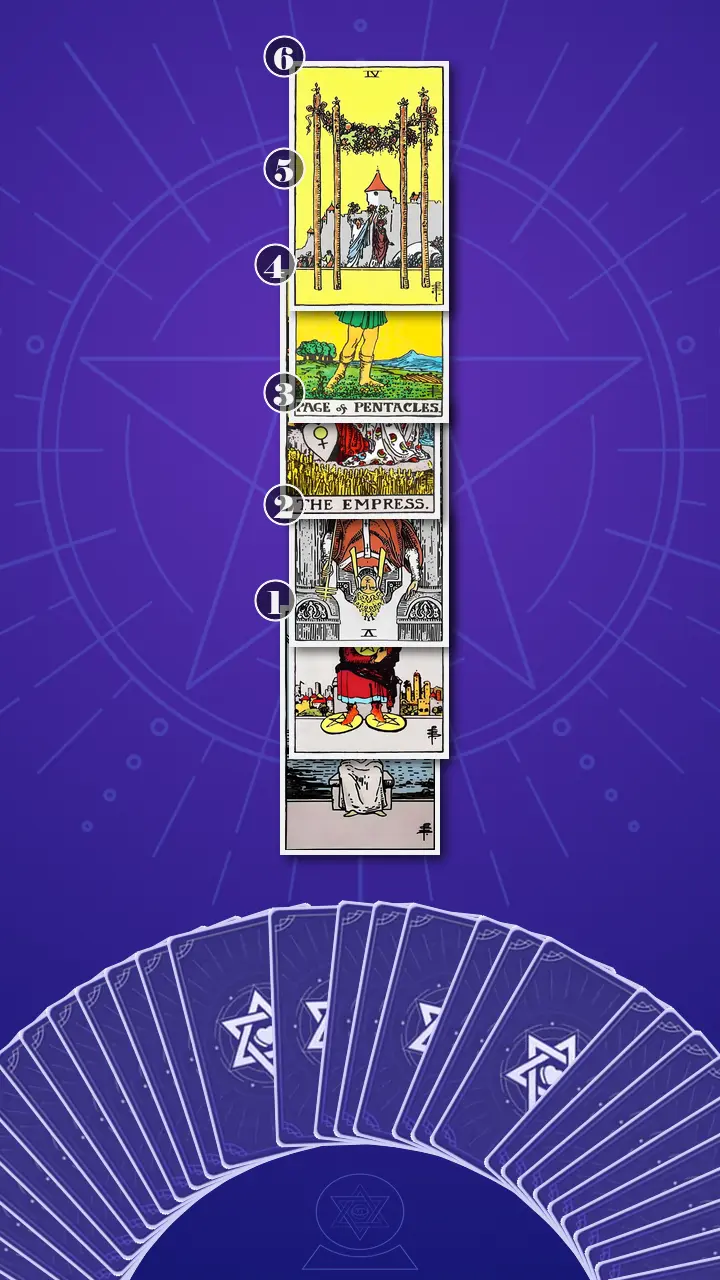
I laid six cards in a vertical column like rungs: bottom to top. “We’ll read it like a climb,” I told Taylor. “Card 1 is the stuck moment you can point to. Card 3 is the deeper rule running the whole scene. Card 5 is a one-week experiment—small enough to try without turning your life into a before-and-after montage.”
Reading the Map: When Overthinking Poses as Practicality
Position 1: The observable stuck moment
“Now flipped over,” I said, “is the card representing the observable stuck moment: what you do with the IKEA tab and what the paralysis protects.”
Two of Swords, upright.
I didn’t even have to reach for symbolism; their screen was already living it. “This is that late-night freeze,” I said, “where the cart is ready… but your body locks. So you open three new tabs—reviews, price comparisons, your bank app—until the decision disappears into ‘I’ll do it tomorrow.’”
In the Two of Swords, the energy isn’t missing—it’s blocked. The swords are held firm across the chest like a barricade, and the blindfold is the perfect metaphor for deciding without letting yourself feel what you want your home to support. The water behind her is calm, but only because it’s being kept at a distance.
I leaned in a little. “And here’s the part that stings but helps: A cart you never check out is still a decision—just one that chooses discomfort by default.”
Taylor let out a quiet laugh—sharp, almost bitter. “Okay,” they said. “That’s… literally me. It’s accurate in a rude way.” Their eyes flicked to the top of their browser like they could see their open tabs judging them.
Position 2: What you’re holding onto for safety
“Now we’re looking at what you’re holding onto for safety: the concrete protection strategy around money, space, and control.”
Four of Pentacles, upright.
“This is the card that says, ‘I can afford it, but spending feels like losing my grip,’” I told them. “You keep your space temporary on purpose—folding things, mismatched storage, nothing that anchors you—because not investing feels like staying mobile.”
The Four of Pentacles energy is excess control. A tight grip that started as self-protection and turned into a lifestyle tax. I watched Taylor’s jaw set slightly as I spoke—like their body wanted to argue before their mind did.
“But I am being responsible,” they said quickly, defensive in that familiar way overthinkers get when their coping mechanism is exposed. “Like… it’s just budgeting.”
“Totally,” I said, because it is responsible to care about money. “But here’s the nuance: this card isn’t about budgeting; it’s about using the bank app like an emotional thermostat. If you don’t spend, you feel ‘in control.’”
I could see the micro-behavior echo in real time: their thumb started scrolling faster, not even on anything useful—just movement to discharge tension. Shoulders tightened. Then, a tiny softening. “Oh,” they said, quieter. “Yeah. It’s… control.”
Position 3: The inherited script (Key Card)
“Now,” I said, and I let the room go a touch quieter, “we’re turning over the card that represents the inherited script: the belief about ‘settling’ you learned growing up that still runs the decision.”
The Hierophant, reversed.
This is the moment in a reading where I always feel like I’m back in the planetarium, right when the star field snaps into focus—because you can almost hear someone’s inner story click into view.
Reversed, The Hierophant is the old institutional template turned upside down. The “adulting checklist” you didn’t subscribe to, but the notifications keep popping up anyway. It’s that internal voice that says, “This is what grown-ups do,” and your whole system flares with Absolutely not—even if the thing would genuinely help you.
Here’s what I said to Taylor, as plainly as I could: “You’re not rejecting furniture. You’re rejecting a script. The one that equates stability with conformity. Or silence. Or being stuck.”
They went still in a three-step chain I’ve learned to trust: first a tiny freeze—breath paused mid-inhale; then their gaze unfocused like a memory reel started playing behind their eyes; then a slow exhale, like something heavy was finally allowed to have a name.
And I delivered the core sentence of the whole spread—because this card was our hinge point, the place where meaning changes and behavior finally can.
Not ‘I can’t buy this because it means I’m stuck,’ but ‘I choose what stability means,’ and that choice starts by turning the old rulebook upside down in The Hierophant reversed.
I didn’t rush the silence after. Taylor’s face tightened—then not in fear, in something closer to anger. “But if that’s true,” they said, voice sharpening, “doesn’t that mean I’ve been letting this… rulebook run me? Like I’ve been reacting this whole time?”
“That’s such an honest reaction,” I told them. “And no—this doesn’t mean you ‘failed.’ It means your nervous system learned a strategy in a home where ‘stable’ had a cost. You kept yourself safe by staying provisional. That was smart then. It’s just outdated now.”
I watched their shoulders lower like a backpack strap finally loosened. Their eyes went a little glassy, not dramatic—more like the body’s quiet ‘oh’ when it realizes it’s allowed to choose. Their hands, which had been jittering near the trackpad, rested flat for the first time in the session.
“Now,” I said gently, “with this new lens—self-authorship instead of inherited rules—think back to last week. Was there a moment you hovered over checkout, felt that chest clamp, and thought, ‘If I do the adult thing, I’m signing up for the life I watched growing up’? What would have shifted if you’d treated that feeling as data, not a verdict?”
This was the breakthrough line in their emotional arc: from tight, control-driven avoidance of “settling” to self-authored comfort that still preserves agency. Not comfort as a cage—comfort as a choice they could revise.
And because I’m me, my brain did a quick astronomy flashback: spacecraft don’t get free by never entering orbit; they get free by choosing their trajectory. Avoiding every gravitational pull doesn’t make you independent—it just leaves you drifting.
“There’s a technique I use in both star navigation and tarot,” I added. “I call it Dark Matter Detection. The point is to look for the invisible force shaping the whole system. Your ‘dark matter’ here isn’t the shelf. It’s the hidden belief: stability equals losing your voice. Once we see that, the whole orbit of the problem changes.”
Position 4: The medicine reframe
“Now we climb,” I said. “This card represents the medicine reframe: what a self-authored version of home could mean for you now.”
The Empress, upright.
“This is the card that says: comfort can be chosen. That’s not the same thing as settling,” I told them, and I watched their eyes soften on the word chosen.
The Empress energy is balanced nourishment—supportive, embodied, practical. Not luxury for Instagram. Not a ‘now you’re a Real Adult™’ badge. It’s the difference between harsh overhead lighting and a lamp you actually like. Between eating on the couch because there’s nowhere else and having one clear surface where your body doesn’t brace.
“If your apartment could support your nervous system, not your image,” I asked, “what would you change first—light, storage, a place to sit, a smoother morning routine?”
Taylor exhaled—the kind that makes your whole chest widen. “Light,” they said immediately. “The overhead light makes everything feel… temporary and kind of sad.”
Position 5: A one-week experiment
“Now flipped over,” I said, “is the card representing a one-week experiment: the smallest grounded step that builds self-trust without demanding certainty.”
Page of Pentacles, upright.
This is my favorite kind of card for overthinkers because it doesn’t ask you to transform your personality. It asks you to practice. Page energy is beginner energy, and here it’s in balance: steady, small, willing to learn by doing.
“Make it a one-week experiment, not a forever identity,” I said. “You’re a UX designer—you already know how to do this. You ship a small change, collect feedback, iterate. You don’t redesign the whole app at midnight because one button feels scary.”
Taylor smiled for real this time—small, but present. “Okay. I can do one thing,” they said.
Then their expression flickered. “But I genuinely feel like I can’t even do five minutes sometimes,” they admitted. “After work I’m fried. And then I’m doing this at midnight, and it’s… chaos.”
“That’s not a character flaw,” I said. “That’s a workload plus a nervous system pattern. So we’re going to prep your mind like a spacecraft preparing for a course correction.”
I named my tool out loud because it mattered: “This is Spacecraft Attitude Adjustment—tiny alignment before a sudden change. We don’t need hype. We need stabilization.”
Position 6: Integration
“And finally,” I said, “this card represents integration: what changes when you act from values, and how ‘settling’ can become belonging instead of a trap.”
Four of Wands, upright.
This card always looks like a decorated threshold to me—a doorway you step through willingly. Not a cage. A base.
“This is you coming home from work and feeling a tiny drop of relief instead of that placeholder sadness,” I said. “Maybe you make tea and sit down without balancing everything on your lap. Maybe you invite a friend over without apologizing for the mismatch.”
Fire energy here is warm integration. The payoff isn’t perfection; it’s pride without cringe. “Stability hits different when you’re the one writing it,” I added, and Taylor nodded like their body understood before their brain tried to argue.
From Insight to Action: A Small Orbit Change You Can Feel
Here’s the story the whole ladder told, in one clean line: you start in Air—overthinking at checkout (Two of Swords). You protect yourself with control-as-safety (Four of Pentacles). Underneath, an inherited rulebook keeps labeling comfort as a trap (Hierophant reversed). The medicine is permission to nourish your actual daily life (The Empress). The method is a small test you can evaluate like data (Page of Pentacles). And the integration is a home that feels like a chosen threshold, not a sentence (Four of Wands).
The cognitive blind spot I named for Taylor was simple but sharp: they were treating “not choosing” as freedom, when it was really a borrowed definition of stability steering their life in the background. Doing the opposite of the script was still letting the script drive.
“So we’re shifting direction,” I said. “From treating comfort as a life sentence… to treating home-making as a reversible experiment you get to author.”
I offered next steps that were small on purpose—because small steps are how you build trust without demanding certainty.
- The 3-minute Cosmic Breathing ResetBefore you open IKEA tonight, sit on the couch with both feet on the floor. Inhale normally, then do three slower exhales (longer out than in). Open your cart only after the third exhale.If your hands get jittery, that’s data—your system thinks this is a life contract. Keep breathing until your fingers stop “buzzing.”
- The Rulebook Flip (8-minute timer)Open your IKEA cart. Pick ONE item you’ve needed for at least a month (a friction-reducer, not a vibe item—lamp, shelf, hooks, hamper). In your Notes app write: (1) “Buying this serves my values because ____.” (2) “Buying this doesn’t trap me because ____.” Then set a timer for 8 minutes to decide: check out, or move it to a “Later (Date)” list with a specific revisit date.If your brain tries to escalate into a full apartment project, cap browsing at 30 minutes total. This is practice in authorship, not a makeover.
- The One-Item Friction Reducer PurchaseChoose one daily-life pain point and buy one item that directly reduces it (for Taylor: a lamp to replace harsh overhead lighting). Treat it as a one-week product experiment: live with it for seven days, then note what changed in your body (jaw, chest, shoulders) when you got home.Keep it reversible: pick something with easy returns or decent resale. Remind yourself: changing your mind is allowed.
To make it stick, I used my other favorite frame—decision-making as interstellar navigation. “You don’t need a perfect destination,” I told Taylor. “You need a next coordinate you can verify. In spaceflight, we do small burns and course-correct. That’s not indecision; that’s competent navigation.”

A Week Later: The Quiet Proof
Six days later, Taylor messaged me a photo: a warm little lamp glowing beside their couch, the overhead light off. Nothing influencer-perfect—just a softer corner, a charger tray, and a book that wasn’t balancing on their knee. “I checked out,” they wrote. “My chest tightened for like thirty seconds, then it… didn’t. And coming home feels less like a waiting room.”
I sat with that for a moment—the way small changes create big internal evidence. Their life didn’t become permanent overnight. They didn’t “settle.” They ran a test, gathered feedback, and proved to their own body that agency still existed inside stability.
When a basic purchase makes your chest go tight, it’s usually not about the item—it’s that old fear that comfort equals a life you didn’t choose, and you’re trying to keep control by keeping everything provisional.
If you treated one small comfort as a reversible experiment you get to author, what’s the first tiny upgrade your space—and your body—would actually say yes to?
Every reading at AceTarot is a journey to connect with inner wisdom and empower your next step. The stories shared here are psychological mirrors, not private records—crafted to reflect universal emotional loops and help you find your own clarity. Learn more about our Journey to Clarity.
Author Profile