The Quote Draft I Kept Backspacing—Until I Let Scope Do the Talking

Finding Clarity in the “What’s Your Rate?” Email
If you keep a “market rates” spreadsheet open like it’s armor, but still end up adding freebies and typing “I’m flexible” unprompted, you’re not being generous—you’re negotiating your self-worth in real time.
Taylor (name changed for privacy) showed up to my studio call from a cramped East Village kitchen at 8:43 on a Monday. The Keurig sputtered like it was personally offended to be awake. Her laptop screen was turned up too bright for the gray morning light, and Gmail sat open with one subject line that had already hijacked her body: “What’s your rate?”
She did what she always does: Notes app, then a half-built spreadsheet, then a competitor’s “starting at” page. Her coffee tasted suddenly bitter, like someone had swapped the beans mid-sip. When she typed a number, her backspace key started to look worn from the repetition. She pressed her palm against her stomach for a second without realizing it.
“I want to be paid fairly,” she said, staring at the draft like it might accuse her. “But the second I type the number, I feel… exposed. Like if I quote high and they disappear, that means I misread everything and I’m not actually good.”
I watched her breathing go shallow—tight stomach, quick mind, shoulders creeping up. The feeling wasn’t a vague anxiety; it was more like trying to hold a glass of water perfectly still while someone is watching for the tiniest tremor. Charging a fair quote for her work versus the fear of being judged as greedy and losing the opportunity—that was the whole tug-of-war, right there on her keyboard.
“We’re not here to ‘fix’ you,” I told her. “We’re here to map the mechanism. Let’s see where the undercharging actually starts—and what would make quoting feel like structure instead of a trial. We’re aiming for clarity you can use in the next email.”

Choosing the Compass: A Tarot Spread for Pricing Anxiety
I asked Taylor to take one slow breath—not as ceremony, just as a reset. “Feel your feet,” I said. “This is an email, not a courtroom.” While she did, I shuffled slowly, the way I used to brush dust from pottery fragments on digs: patient, practical, focused on what’s real.
“Today we’ll use an original spread I call the Four-Layer Insight Ladder · Context Edition,” I explained. “It’s a six-card vertical ladder—like climbing out of an inherited script into a self-authored agreement.”
For anyone reading who’s curious about how tarot works in a situation like this: a spread is simply a structured way to ask better questions. This one is built for quote requests and undercharging because Taylor isn’t choosing between two external options. She’s confronting an inherited belief that compresses her asking. The ladder is the smallest map that still shows: the live symptom, the freeze moment, the old money story underneath, the hidden cost, the stabilizing reframe, and the real-world communication move.
“The first card,” I said, “will show the observable pricing behavior—what happens on the screen. The third card will name the inherited rule running in the background. And the final card will give us the ‘email voice’—how to communicate the quote with clean structure: scope, terms, boundaries.”
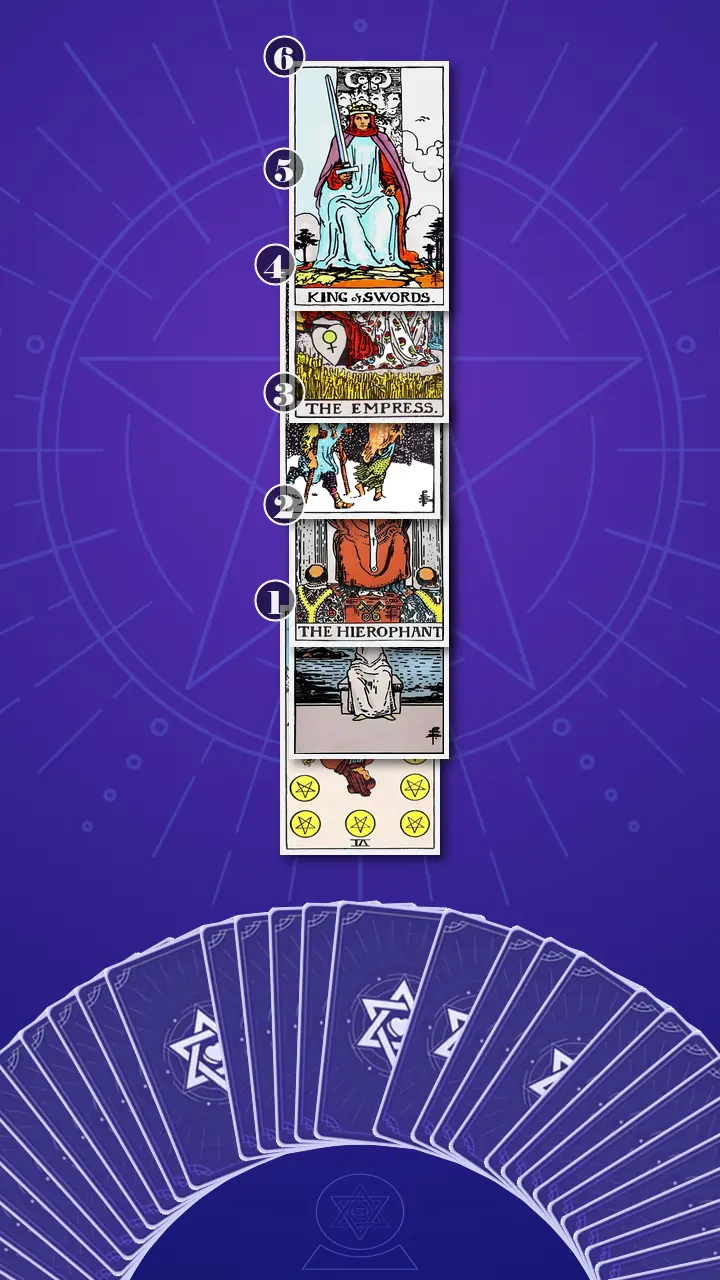
Reading the Map: Card Meanings in Context
The Symptom in Real Time (Position 1)
“Now we turn over the card that represents the observable pricing behavior when the quote request arrives—the real-time symptom.”
Six of Pentacles, reversed.
I didn’t have to reach far to translate it into her Monday-morning reality, because this card is basically the screenshot of her inbox spiral. You draft a quote for a branding package, then immediately start trimming the price and padding the scope: “I’ll throw in two extra concepts,” “I can do an extra round of revisions,” “I’ll include social templates.” Not because the project needs it, but because you’re trying to control the client’s reaction by making your offer feel like a “no-brainer.”
Reversed, the energy here is a blockage in fair exchange. The giving is over-functioning; the receiving is negotiated down before it even arrives. In plain terms: the scale isn’t balanced, and you keep placing yourself beneath it.
Taylor let out a small laugh—sharp, almost embarrassed. Then her face tightened, like the laugh had scraped something tender. “That’s… too accurate,” she said. “Like, it’s kind of brutal.”
“Brutal, but not personal,” I said gently. “This is a pattern, not a character flaw. And patterns can be redesigned.”
The Five-Minute Freeze (Position 2)
“Now we turn over the card that represents what happens internally in the first five minutes after seeing ‘What’s your rate?’—the freeze mechanism.”
Two of Swords, upright.
This one always reads like a browser-history confession. In the first five minutes after seeing “What’s your rate?”, you go emotionally offline and operational: open a rate calculator, pull up competitor tabs, reread the thread, search “how to price brand identity,” and keep toggling so you don’t have to feel exposed.
I spoke it as a montage, because that’s how avoidance moves—fast, efficient, almost impressive:
“Notes app → rate calculator → competitor site → draft email → back to Notes. One more reference point. One more benchmark. If you just research a little more, you’ll feel certain… but you’re actually avoiding the vulnerability of choosing.”
In tarot terms, the Two of Swords is protective Air. Here it’s a deficiency of decision paired with an excess of analysis. The blindfold isn’t stupidity; it’s self-defense: If I don’t decide, I can’t be judged.
Taylor’s shoulders dropped a millimeter, like her body heard the word “protection” and stopped arguing for a second. She nodded once, slow. The recognition wasn’t relieving yet—but it was clarifying.
The Old Money Story Under the Keyboard (Position 3)
“Now we turn over the card that represents the inherited rule about money, worth, and what’s acceptable to ask for—the old money story.”
The Hierophant, upright.
Under your pricing is an inherited rulebook you didn’t consciously agree to: “Good people don’t talk about money directly,” “Being low-maintenance is respectable,” “Asking for a lot makes you look greedy,” “Real professionals don’t need to say the number out loud.”
The Hierophant isn’t always a villain. He’s a librarian of norms. But in Taylor’s case, the energy is an excess of borrowed authority. The moment she types a number, she’s not just answering a client—she’s answering an internal compliance officer who flags her price as “too much” before anyone sees it.
I’ve spent years teaching history at Cambridge, and before that, years in the field as an archaeologist. The Hierophant reminds me of standing in front of a museum case: the label tells you what the object is supposed to mean, and people stop looking closely. But the artifact itself always has more to say.
“Whose voice do you hear when you’re about to type the rate?” I asked.
Taylor stared off-camera for a second, eyes unfocusing the way they do when a memory loads. “Honestly? My dad. And… like, this whole vibe of ‘don’t be difficult.’ If you’re ‘easy to work with,’ you’ll be okay.”
The Shadow Bill (Position 4)
“Now we turn over the card that represents what undercharging silently creates over time—the shadow bill.”
Five of Pentacles, upright.
This is where the story stops being about ‘pricing math’ and starts being about belonging. The hidden cost shows up as a constant low-grade survival stress: you say yes to work that doesn’t hold the scope, you work late to ‘make it worth it,’ and you brace for the next gap in income. When a client questions your price, your mind doesn’t translate it as “budget fit”—it translates it as “I don’t belong at this level.”
The energy here is a blockage of safety—Earth energy that’s supposed to feel resourced, but instead feels like cold pavement. And now I used the echo I most wanted her to see: the split-screen.
On the left: a proposal with extra freebies, the apologetic softeners, the “I’m flexible” line slipped in like a peace offering. Shoulders hunched over the keyboard, trying to shrink the number.
On the right: 11:58 PM, radiator clanking, Chase balance open, jaw clenched while she adds “bonus deliverables” because it feels less risky to overwork than to be seen asking for what she needs.
Undercharging buys short-term relief, then charges interest in energy.
Taylor’s reaction came in a three-step chain: first a tiny freeze—she stopped bouncing her leg. Then her gaze slipped away from the screen as if replaying a dozen late nights. Then, finally, a long exhale through her nose that sounded like resignation mixed with anger. “Sometimes you’re not protecting income—you’re protecting belonging,” she said quietly, almost like she hated how true it was.
When The Empress Spoke: The Permission You Don’t Need
The Inner Anchor (Position 5 — Key Card)
I held the deck for a moment before turning the next card. The air in the room felt different—still, like the second right before you open exam results, except this time the grade wasn’t about her talent. This was the antidote card.
“Now we turn over the card that represents the internal anchor that helps you quote from value and embodiment rather than fear of judgment.”
The Empress, upright.
You treat your creative energy like something worth tending. Before replying, you ground: feet on the floor, hand on your chest, one deep breath. You choose a fee that supports you to do the work well without shrinking your life—sleep, time, focus, actual weekends. Instead of pricing to prevent rejection, you price to sustain your ecosystem.
Here the energy is balance: giving and receiving as two halves of one living system. Not the hustle-gospel version of abundance. The practical, bodily version—what you can sustain.
Setup. Taylor was still trapped in the old loop: coffee going cold, Gmail open, stomach clenching as she typed a number and deleted it, editing her own confidence out of the email because certainty felt like the only shield. She kept trying to earn safety by being the cheapest option, the easiest yes.
Delivery.
Stop trying to earn permission to be paid, and start pricing like you’re tending something valuable—The Empress asks you to receive as naturally as you give.
I let it sit. No extra explanation. Just air around the sentence.
Reinforcement. Taylor’s face went still in a way that wasn’t numb—it was like her brain stopped running for half a beat. Her eyes widened slightly, then softened, glassy at the edges. Her shoulders lowered, not dramatically, but as if she’d been holding them up to protect her throat and had forgotten. One hand slid to her chest without instruction this time, fingers splayed over her sternum. She inhaled, shaky at first, then deeper. On the exhale, her jaw unclenched, and a sound came out—half laugh, half relief.
“But if I do that,” she said, and there was a flash of anger in it, “doesn’t it mean I’ve been doing it wrong? Like… I’ve been giving everything away.”
“It means you’ve been surviving with the tools you had,” I replied. “And now you’re upgrading the tool.”
This is where I used what I call Skill Archaeology—my habit of excavating what’s already there but ignored. “If I dug through your last year of projects like layers in a site,” I said, “I’d find evidence of value you’ve stopped counting: speed, taste, client management, decision-making, the way you prevent brand chaos before it happens. Those are not freebies. They’re the pillars holding the work up.”
“Now,” I added, “use this new lens and look back at last week: was there a moment when a client asked about budget, and you made yourself smaller first? What would have felt different if you’d let the quote be a boundary instead of a plea?”
Taylor closed her eyes for a second. “Thursday,” she said. “They asked if I could ‘keep it lean.’ And I immediately offered a discount instead of asking what ‘lean’ meant.” Her voice got quieter. “I could’ve just… changed the scope.”
That was the shift: from contracted self-doubt and people-pleasing pricing toward grounded self-worth and clean, direct pricing communication. Not a personality makeover—an internal anchor.
The One-Page Boundary-First Quote
Integration in the Inbox (Position 6)
“Now we turn over the card that represents how to communicate the quote with clean structure: scope, terms, boundaries.”
King of Swords, upright.
You send the quote like a professional agreement, not an emotional essay. The email is clean: (1) scope summary, (2) project fee, (3) timeline, (4) revisions/terms, (5) next step. You remove the preemptive apology and the bait-to-accept.
This is Air energy used well: clarity as a container. It’s the opposite of spiraling. It’s the opposite of begging. It’s also the line I want every freelancer to tattoo on their draft folder:
Pricing isn’t a personality test. It’s project structure.
When you let structure hold the line, you stop bargaining with yourself before the client even replies.
I pulled the whole ladder together for her: “You start with imbalance (Six of Pentacles reversed): you over-give to manage their reaction. Then you freeze (Two of Swords): you tab-switch to avoid the vulnerability of choosing. Under that is the inherited rule (Hierophant): ‘be respectable, be low-maintenance, don’t be too much.’ The shadow bill is scarcity and exclusion fear (Five of Pentacles): a ‘no’ becomes ‘I don’t belong.’ The medicine is The Empress: receiving as part of making, pricing as tending your ecosystem. And the practice is the King of Swords: clean terms so the number doesn’t have to carry your feelings.”
The blind spot was painfully simple: Taylor kept trying to earn safety by being cheaper and easier, but what would actually build trust was clear scope, clean boundaries, and self-respecting pricing.
“We’re going to turn this into something you can do in under half an hour,” I said. “I call it Megalith Transport—the way ancient builders moved impossible stones: not with one heroic heave, but with repeatable, specific steps.”
- Do the Fair vs Fear SplitBefore you send your next quote, write two numbers in Notes: (1) your fair scope-based price, (2) your fear-based price. Circle the fair price. If they need it lower, you only discuss scope changes—not self-discounting.Expect resistance (“They’ll ghost”). Do it privately first; no sending required. If anxiety spikes, make it a 7-minute version.
- Run a 20-Minute Quoting TimerSet a timer for 20 minutes. Draft the quote. When it ends, stop editing and save the draft. No new competitor tabs after the timer—especially not LinkedIn.If your body tightens (stomach, jaw), take one sip of water and step away for two minutes. Clarity beats panic-speed.
- Send the 5-Line Quote EmailSend your quote in five lines: Scope / Fee / Timeline / Revisions & Terms / Next step. Replace “I’m flexible” with: “If you’d like to adjust the budget, I can offer a reduced-scope option.”If you worry it sounds cold, add one friendly opener line—then let the structure do the work.

A Week Later: The Quiet Proof
Six days later, Taylor emailed me a screenshot—not of a client’s glowing praise, just her own sent message. The subject line was boring. The quote was clean. No “no worries,” no preemptive discount. She wrote, “My stomach still did the thing, but I didn’t backspace the number.”
She didn’t tell me the client said yes. She told me she slept through the night. In New York, that can be a kind of wealth all its own. Clearer structure, steadier nervous system—proof that this wasn’t about becoming fearless. It was about becoming legible to herself.
When you’re about to hit send and your stomach tightens, it’s not just a number on the screen—you’re bracing for the moment someone might decide you’re “too much,” so you make yourself smaller first.
If you let your quote be a boundary instead of a plea, what’s one line you’d want to write tonight that you wouldn’t need to “walk back” later?