When Mutual Friends Kept Inviting Your Ex—and a Rule Replaced Panic

The 8:43 p.m. Spiral When Mutual Friends Keep Inviting Your Ex
When Jordan (name changed for privacy) sat across from me, I recognized the look immediately. I see it a lot in late-20s city clients: fully capable of sending a clean work email in two minutes, completely derailed by one personal notification. Jordan worked in marketing, lived in Toronto, and had the particular exhausted focus of someone who could function all day and still get flattened by a group chat at night.
They told me about a Wednesday at 8:43 p.m., half out of work mode on the couch in a small apartment, laptop still open, phone glowing hot in their hand. The radiator hummed. The screen light hit their face. Someone dropped a casual little message—everyone’s coming—and their ex’s name sat in the thread as casually as weather. Before Jordan had even decided what they thought, their throat tightened, their jaw locked, and their body was already doing the seating chart, exit plan, and emotional damage control.
“I’m not trying to make anyone choose sides,” they said. “I just want one hangout where I’m not bracing for my ex to walk in.”
There it was: the real contradiction underneath the logistics. Jordan wanted to stay connected to their friend group, but they were scared that if they asked for any accommodation at all, they’d be seen as difficult and quietly replaced. The dread around it felt to me like wearing a wet wool collar too tight around the throat—heavy, scratchy, and impossible to forget once it was there.
I nodded. “That makes sense to me,” I said. “You’re not being dramatic. You’re trying to keep your people without having to audition for your place with them. Let’s draw a map through the fog and find the kind of clarity your nervous system can actually use.”

Choosing the Compass: The Energy Diagnostic Map (7)
I asked Jordan to take one slow breath and hold the real question in mind, not the polished version. Then I shuffled slowly and let the rhythm do what it always does in a good session: move us out of social noise and into something more honest.
For this reading, I chose the Energy Diagnostic Map (7) · Context Edition. This is how tarot works best for me in a situation like this—not as fortune-telling, not as a yes-or-no machine, but as a structured way to read card meanings in context. This problem wasn’t only about an ex. It was a networked boundary problem: friend-group limbo, a freeze response, a fairness script, and the question of what Jordan could actually control.
The spread fit because it let me track the whole system. The top card would show the surface social energy—what the group dynamic actually felt like when the ex was included. The center card would name the core blockage—the belief that made boundary-setting feel dangerous. And the lower-right card, the key transformation, would tell us what principle could reorganize the entire situation from dread into something workable. The final card would ground that insight in real plans, real invitations, and real weekends.
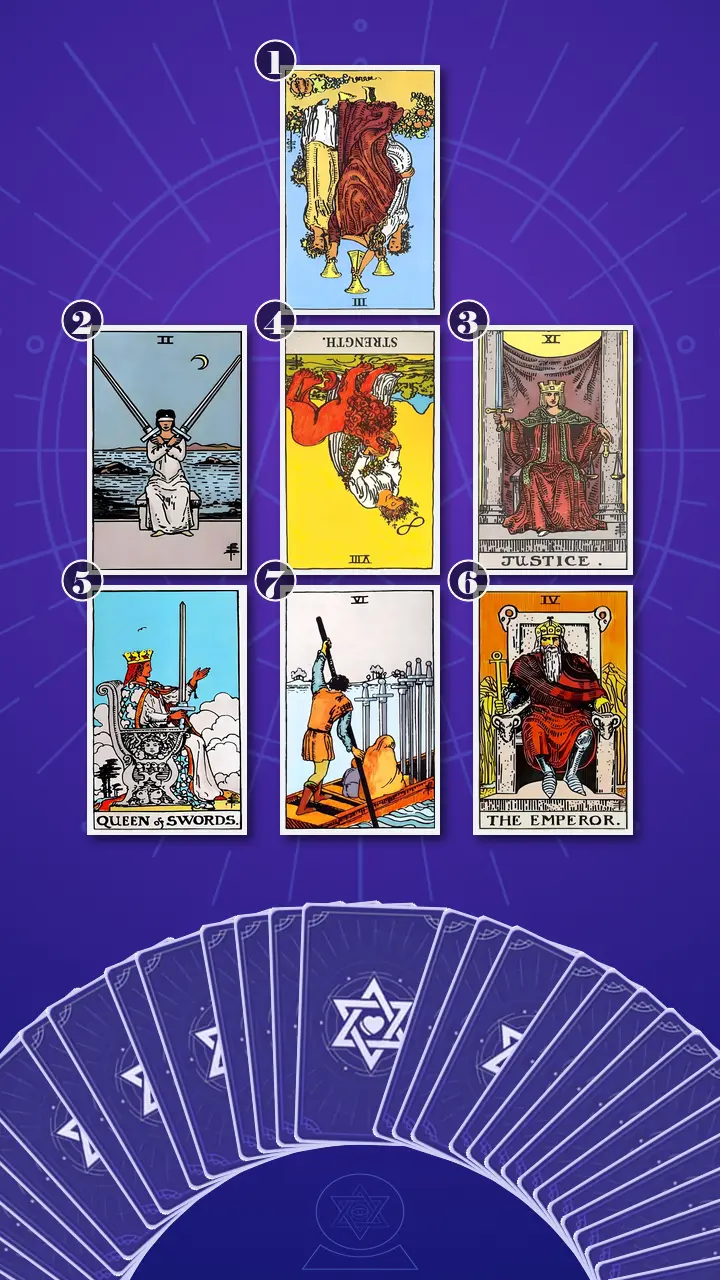
Reading the Fairness Script in the Room
I turned the cards in the order I always use for this spread: the visible weather first, then the internal split, then the external script, then the knot at the center. By the time I reached the fifth card, the whole pattern was already speaking.
Position 1: Group Fun With a Hidden Cost
The first card I turned was the one representing the surface social energy: Three of Cups, reversed.
I told Jordan this card made perfect sense for post-breakup friend-group limbo. In modern life, it looks exactly like that “we’re all out tonight” text that used to mean ease and now means private emotional labor. Rooftop drinks, birthday dinner, patio night—on one side. On the other side: scanning the guest list, checking who already posted from pre-drinks, calculating where to sit, and whether leaving early will look weird. The card’s energy wasn’t a lack of friendship. It was friendship turned askew—shared joy on the surface, emotional safety missing from the container.
“Everyone else thinks this is easy,” I said. “Meanwhile, you’re already calculating exits.”
Jordan gave a grim little laugh and looked straight at the card. “Wow,” they said. “That’s accurate enough to be rude.” Their fingers tapped once against their cup and then went still.
“That’s the reversal,” I told them. “Belonging versus performance. And being chill is not the same thing as being okay.”
Position 2: The Stalemate Dressed Up as Flexibility
The next card I turned was the one representing the inner tug-of-war: Two of Swords, upright.
I pointed to the blindfold and crossed blades. “This is what happens when your mind calls it flexibility, but your body knows it’s a freeze response.” In real life, this was Jordan opening the group thread, drafting a message, deleting it, and telling themself they’d just decide later depending on the vibe. From the outside it looked easygoing. Inside, it was a deadlock: stay quiet and preserve access to the group, or say the truth and risk being cast as the difficult one.
This card felt like blocked Air to me—clarity present, but held in suspension. The decision already existed. Jordan just kept refusing to let it become language. I said it plainly: “A vague yes is often just a delayed no with more dread attached.”
Jordan dropped their gaze to the table. “Yeah,” they said softly. “I keep saying maybe because it buys me a few more hours of not having to know.”
Position 3: The Fairness Policy That Fails in Practice
The next card I turned was the one representing the external pressure script: Justice, upright.
I always pay attention when Justice shows up in friendship readings, because it often means people are trying to do the morally tidy thing. In Jordan’s world, this was the line they kept hearing: “We’re not choosing sides.” Everyone stays invited. No one gets excluded. On paper, it sounds mature. In practice, Jordan is the one doing the emotional gymnastics, carrying the cost of that neutrality in their own body.
For a second, I had a flash from my old Wall Street life. I remembered deals that looked beautifully balanced on paper and still dumped all the real risk onto the person with the least room to absorb it. Justice can do that too. It can mistake equal treatment for actual care.
“This isn’t you being dramatic,” I said. “This is a fairness script. Technically fair, emotionally impossible.”
Jordan’s shoulders shifted, the smallest release. “So I’m not asking for too much?”
“No,” I said. “You’re not asking for special treatment. You’re naming the terms of your participation.”
Position 4: The Self-Trust Wobble at the Center
At the center of the spread, I turned the card representing the core blockage: Strength, reversed.
This was the real ache underneath the logistics. I told Jordan that reversed Strength rarely means weakness in the childish sense people fear. It means the relationship with your own instincts has become strained. In real life, it’s saying you should be able to handle one casual group night, going anyway, laughing a little too brightly, going quiet on the TTC ride home, brushing your teeth while replaying every interaction, then waking up irritated and ashamed that something “small” took out your whole night.
That is what blocked energy looks like here: not a lack of worth, but self-trust drained by repeated self-abandonment. The lion in the card was Jordan’s raw reaction—hurt, tension, the instinct to pull back. The calm figure was the part of them trying to manage that reaction. Reversed, those two parts weren’t working together. Jordan had started equating being strong with staying silent.
When I said that, I watched a clear three-step reaction move through them. First, their breath caught high in their chest. Then their eyes unfocused, like they were replaying the ride home after one specific night. Then a long exhale left them, slow and shaky. “I keep telling myself I’m fine,” they said, “and then I’m not fine at all.”
Position 5: The Sentence That Changes the Air
The next card I turned was the one representing the resource Jordan could use now: Queen of Swords, upright.
I smiled a little when I saw her. “Good,” I said. “Because this is usable.” The Queen of Swords is clear language, clean boundaries, and self-respect without cruelty. In modern life, she looks like closing the Notes app full of unsent paragraphs and keeping one sentence you can actually stand behind.
I said the shift out loud so Jordan could hear it: “You do not need a closing argument. You need a line.” Then I gave them the line that matched the card perfectly: “If my ex is coming, I’m going to sit this one out, but I’d love to do something smaller soon.”
This was balanced Air—the opposite of the Two of Swords stalemate. Not over-explaining. Not performing indifference. Just being clear enough to let reality organize around the truth.
Jordan visibly exhaled and reached for their phone. “That’s so much shorter than what I’ve been drafting,” they said.
“Exactly,” I told them. “Being liked and being clear are not the same task. Right now, clarity is the kinder one.”
When The Emperor Spoke About Boundaries After a Breakup
When I turned the lower-right card, the room changed. The radiator clicked off. The apartment suddenly felt quieter, as if the reading itself had stopped talking around the issue and finally put a hand on the exact hinge.
Position 6: The Throne, the Rule, and the End of Weekend-by-Weekend Panic
The next card I turned was the one representing the key transformation: The Emperor, upright.
Jordan was still living inside the same loop the moment this card appeared: the group chat lights up, the ex’s name is casually in the mix, and suddenly the whole evening becomes strategy—do I go, do I cancel, do I act chill, do I disappear?
I told them The Emperor was not about controlling the guest list or punishing the group. It was structure. Protection through consistency. The throne and armor in the card translated, very simply, into a standing policy for Jordan’s own access, time, and participation. Like setting app permissions, not deleting the app. I could feel my old strategist brain click in, and I named the tool I use at moments like this: Negotiation Alchemy. “In any negotiation,” I said, “clarity starts when you know your BATNA—your best alternative to a setup that doesn’t work. Your BATNA here is not loneliness. It’s a smaller, safer plan. Coffee. A walk. One-on-one. That’s why this card matters. You can’t run the group, but you can run your participation.”
You don’t need to be the ‘chill ex’ who absorbs discomfort; you need to sit on your own throne and set the terms of your presence.
I let that sentence sit between us for a beat.
Jordan’s fingers froze above their phone as if their body had understood before their mind had caught up. Then their gaze drifted past me toward the window, unfocused, replaying some Thursday-night thread only they could see. A streetcar bell rang somewhere outside, thin and far away, and their shoulders dropped an inch. Not all the way. Just enough to show the brace was loosening. “But if I do that,” they said, and there was a flash of anger in it that was really grief, “doesn’t that mean I’ve been handling this wrong?” I shook my head. “No. It means you’ve been trying to survive without a structure.” Their mouth tightened, then softened. The jaw unclenched. They breathed out like someone setting down a grocery bag that had been cutting into their fingers for blocks. I asked, “Now, with this new perspective, think back to last week—was there a moment this would have changed how you felt?” Jordan nodded immediately. “Thursday,” they said. “If I’d already had a rule, I wouldn’t have spent three hours spiraling.”
That was the hinge of the whole reading: the move from dread-driven self-silencing to calm self-led clarity and steadier belonging. Not because the group was suddenly solved, but because Jordan’s role inside the pattern had changed.
Position 7: Calmer Water, Not Better Acting
The last card I turned was the one representing next-step grounding: Six of Swords, upright.
I told Jordan this card answered the practical question beautifully. The next move was not more endurance. It was a different container. In modern life, that meant not forcing themself into the loud mixed-group night and then grading their performance afterward. It meant choosing a quieter route home: coffee with one trusted friend, a Sunday walk, a smaller plan where their body did not have to stay on high alert. The energy here was transition—Air guiding Water toward calmer conditions.
“Maybe the answer isn’t proving you can survive the loudest room,” I said. “Maybe it’s choosing the room that doesn’t require survival mode.”
Jordan leaned back for the first time since the reading began. “That actually feels doable,” they said, and this time the words landed low and solid, not squeezed through a tight throat.
From Insight to a Participation Policy
Once all seven cards were on the table, the story was clean. The visible problem looked like invitations. Underneath it, I could see the actual chain: a shaky social container, an internal freeze response, a group fairness script that sounded neutral but ignored impact, and a core self-trust wobble that kept Jordan performing chill instead of protecting their own bandwidth. The blind spot was twofold: confusing equal invites with emotional safety, and confusing strength with silence.
The transformation direction was equally clear. Jordan did not need a perfect group outcome. They needed one clear boundary and one workable alternative. That is why I use the Energy Diagnostic Map (7) · Context Edition tarot spread for post-breakup friend-group boundaries: it takes a problem that feels like pure emotion and turns it into actionable advice without flattening the feelings that are real.
Jordan looked at me and said, “Okay, but what if I can’t do a whole conversation when I’m activated?”
“Then don’t do a whole conversation,” I said. “Do a template.”
- Boundary-First RSVPFor the next invite that spikes you, message only the host within 20 minutes and ask: ‘Quick check—who’s coming / what’s the vibe before I commit?’ Get the information first, then decide. If your ex is included, answer with a clear no or ‘not this one,’ not a vague maybe.Keep it logistical, not confessional. If the stomach-drop feeling hits, put your phone face down and wait 20 minutes before replying.
- The Cocktail Party AlgorithmUse my three-phase template in your Notes app: 1) clarify, 2) boundary, 3) alternative. Example: ‘If my ex is there, I’m going to skip this one, but I’d love to grab coffee another day.’ Practice it out loud three times while standing or walking, then send it to the host or your closest friend this week.One sentence is enough. You do not owe the full breakup narrative to justify a present boundary.
- The 4-Week Participation PolicySet one time-bound rule for the next month: no mixed-group hangs if your ex is there; yes to one-on-one or small-group catch-ups you can genuinely tolerate. Pin that rule in Notes, your calendar, or a message to yourself before the weekend so each new invite is not a fresh referendum on your worth.If anyone pushes back, repeat the policy once instead of re-litigating it. Structure reduces decision fatigue.

A Week Later: The Quiet Proof
A week later, Jordan sent me a short message. They had used the host text. They had skipped one mixed-group Friday plan without inventing an excuse. They had met one close friend for coffee on Sunday instead. “Still weird,” the message read. “Still sad, a little. But I wasn’t wrecked after.”
That was enough. Not a solved social life. Not a cinematic ending. Just the first real proof that belonging built on consent feels different from belonging built on endurance. Jordan told me they had slept through the night after sending the text; their first thought the next morning was still, what if they think I’m difficult?—but this time they laughed, made coffee, and let the thought pass.
I sat with that for a moment after our session thread closed. This is the part of the work I trust most: not the dramatic reveal, but the steady reorganization that happens when someone stops outsourcing access to themselves. Jordan did not become colder. They became clearer. And clarity, in this kind of reading, is often the first honest form of relief.
If every invite lately has made your throat tighten because you want your people and you’re scared one honest boundary could cost you your place with them, the exhaustion is real—even when you look perfectly chill from the outside.
If you stopped trying to prove you can handle every room and chose one calmer shore of connection this month, what would you want that to look like?