Stuck as the Family Admin? Turning Parent Paperwork Into Fair Terms

The Sunday Night Admin Spiral
You’re a late-20s/early-30s Toronto professional who can run a project plan at work, but one “Can you help me with this form?” text still hijacks your entire evening—classic Sunday night admin spiral.
Jordan (name changed for privacy) said that first, like they were quoting a meme they didn’t even find funny anymore.
They were sitting across from me in my small studio space off Queen West—half radio booth, half reading room. Outside, streetcar brakes sighed and the sky had that early-evening gray Toronto does so well. Jordan’s phone was face-up on the table like a tiny threat. Their shoulders stayed lifted, not dramatic—just… braced. The kind of posture you get when your nervous system has been living in “approve/deny” mode for too long.
“It’s always ‘just one form,’” they said, rubbing their jaw like they could physically loosen the memory. “And somehow it becomes my whole night. CRA logins, password resets, scanning stuff, uploading PDFs. I’ll be in bed at 11 and I can still feel the laptop glare on my eyes.”
I watched the way their stomach pulled in on the inhale, like they were expecting impact even in a quiet room. Resentment, for Jordan, didn’t look like shouting. It looked like a tight jaw and a calendar that kept getting edited for other people.
“And the worst part,” they added, voice dropping, “is I get irritated… and then I feel guilty for being irritated. I love them. I just… I can’t tell if I’m helping or disappearing.”
That sentence landed like a low note. In music therapy, we call that moment “where the body tells the truth before the mind can decorate it.”
“Okay,” I said gently. “Let’s make today about finding clarity—specifically: where this ‘adult kid’ role started, and what would let you support your parents with limits instead of living on-call.”

Choosing the Compass: The Horseshoe Spread for Family Boundaries
I asked Jordan to take one slow breath—not as a ritual, just as a handoff from adrenaline to attention. While I shuffled, I told them, “Keep the question simple in your mind: ‘Where did my adult-kid paperwork role begin, and what’s the fairest way forward?’”
For this, I chose a Horseshoe Spread. If you’ve ever wondered how tarot works in a real-life boundary problem, this is one of my favorite examples: the Horseshoe is basically a map from origin to present reality to what’s blocking you—then toward a practical direction. It’s especially good when the question is both ‘how did we get here?’ and ‘what keeps repeating?’
The positions are clean for this situation: the first card shows where the role began, the second shows what it looks like now, the middle cards expose the invisible rule and the main imbalance, and the final card points to the best integration direction—not a prediction, but a healthier structure you can build.
“We’ll read this like a curved bridge,” I added, laying the arc. “We’ll start with the origin, walk through the pressure points, and end with the most adult-to-adult path forward.”
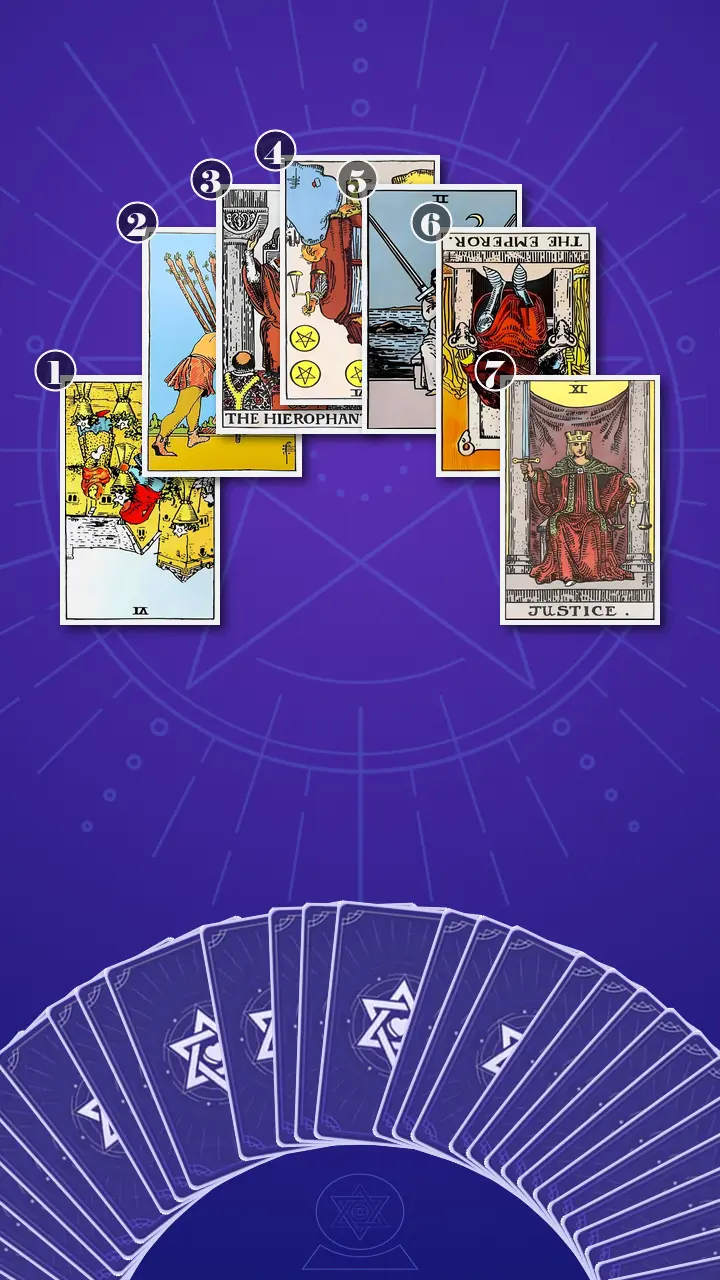
Reading the Arc: Seven Cards, One Inherited Job Description
Position 1 — Where the ‘adult kid’ role began
“Now flipped over is the card representing where the ‘adult kid’ role began: the early relational script and what got normalized.”
Six of Cups, reversed.
I tapped the image lightly. “This is you dropping back into a familiar role without noticing it: the moment your parent asks for ‘help,’ you feel like the responsible kid again—soft voice, fast compliance—because being helpful once earned safety or praise. Reversed, it’s the past still running the script.”
Jordan gave a small laugh—half pain, half disbelief. “That’s… rude,” they said, but there was relief in it too, like someone finally named the thing. “I can hear my own voice change on the phone. It’s like I’m twelve.”
“That’s important data,” I said. “Not because you’re ‘immature’—because your system learned a tone that kept things smooth.”
Then I used one of my own lenses—my Generational Echo skill. “Quick question,” I asked. “When you were a kid, what played in the background at home when stressful stuff happened? Bills, letters, calls.”
Jordan blinked, surprised by how specific it was. “My dad always put on the news. CBC radio. Loud.”
“Mm.” I nodded. “That’s a family sound-memory pattern. Information as safety. When the radio’s on, the family ‘handles things.’ So when a form appears now, your body tries to recreate that old safety by becoming hyper-competent. It’s not just paperwork—it’s a cue.”
Position 2 — The present: what the loop costs you
“Now flipped over is the card representing what the dynamic looks like right now in daily life.”
Ten of Wands, upright.
“This is the whole stack,” I said. “Not one form—passwords, renewals, bills, appointments, scans, uploads. You carry it alone because you’re good at it, and that competence has turned into an invisible second shift.”
I kept my language concrete, because this card is concrete. “The figure’s posture is bent. Their view is blocked. That’s you with your phone warm in your hand, laptop already open, shoulders up near your ears, telling yourself you’ll relax after—and then it’s 11:23 PM and you’re scrolling because you can’t downshift.”
Jordan’s mouth tightened, then they exhaled through their nose. “Yeah. And friends are like, ‘Sunday Scaries,’ and I’m like… my Sunday Scaries have a printer.”
Position 3 — The invisible rule you’ve been living inside
“Now flipped over is the card representing the invisible rule: unspoken family values or expectations that keep you saying yes.”
The Hierophant, upright.
“This is the inherited rulebook,” I said. “Competent people handle the boring stuff. Family requests are priority. Saying no equals being ungrateful.”
I pointed to the keys on the card. “Keys are access. Who holds access to the accounts, the processes, and—quietly—the moral authority? The hidden belief is: if you don’t hold the keys, you’re not a good kid.”
Jordan swallowed. Their eyes went a little unfocused, like they were replaying old scenes. “If you only feel like a good kid after you over-give,” I added softly, “that’s a script— not a law.”
Position 4 — The main imbalance (and why it keeps stinging)
“Now flipped over is the card representing the main imbalance: where giving has lost clear terms and becomes draining.”
Six of Pentacles, reversed.
I didn’t rush this one. “Your help operates on fuzzy terms,” I said. “You start by ‘just explaining,’ and it quietly becomes you finishing everything later alone. Because nothing is explicitly agreed, every new request feels heavier.”
It’s not the form. It’s the unspoken contract.
I gave Jordan a modern contrast because this card is literally scales. “It’s the difference between Venmo-request-level clarity—‘I’ll cover this, you cover that’—and the foggy ‘family help’ zone where no one names scope, so you end up auto-assigned every Jira ticket because you’re fast.”
Jordan nodded tightly. A quiet “yeah…” escaped them like air leaking from a tire. Then their face flickered with something they didn’t love admitting. “And then I start… counting,” they said. “Not out loud, but in my head. Like, I did this, and this, and this. And I hate that I do that.”
“Of course you do,” I said. “Scorekeeping is what happens when generosity turns into obligation. It’s your psyche trying to restore balance with the only tool it has left: a tally.”
Position 5 — Your coping stance (the decision you keep postponing)
“Now flipped over is the card representing your coping stance: how you’re mentally managing the tension and what decision is being postponed.”
Two of Swords, upright.
“This is peacekeeping through stalemate,” I said. “You keep the surface calm, but inside you’re braced. The blindfold is ‘not looking’ directly at how tired or angry you are, because looking would force a boundary conversation.”
I described the exact moment because Jordan’s life runs on exact moments. “You’re on the phone. You’re already opening the laptop. Voice calm—too calm. Inner script: ‘If I just do it fast, we won’t fight.’ Conflict pair: peacekeeping vs. self-respect.”
Jordan’s shoulders dropped a millimeter. They exhaled, like they’d been holding their breath for years. “So it’s… not that I’m bad at boundaries,” they said slowly. “It’s that avoidance is… a strategy.”
“Exactly,” I replied. “A very smart strategy that used to keep you safe. We’re just updating it.”
Position 6 — External influences (why the system keeps pulling you in)
“Now flipped over is the card representing family system pressure: how structure and authority around responsibility is operating around you.”
The Emperor, reversed.
“When structure isn’t holding,” I said, “authority migrates to whoever will step in.”
“In your family’s practical life—documents, deadlines, tech—there’s no shared framework. So you become the operations manager by default. Not because anyone is evil. Because the system is leaky, and you’re the only one walking around with a bucket.”
Jordan made a face that was almost a smile, but bitter. “I did not apply for the job of Household Operations Manager,” they said.
“No,” I agreed. “And yet here you are, doing incident response for a CRA login.”
When Justice Spoke: Turning Help Into Fair Terms
Position 7 — Best integration direction (the healthiest way forward)
I held the last card for a beat before turning it over. The room felt quieter—not mystical, just focused. Even the streetcar outside seemed to pause between stops.
“Now flipped over is the card representing best integration direction: the healthiest way to define boundaries and create a fair system.”
Justice, upright.
Justice is one of those cards that makes me think of sound engineering as much as tarot: clarity doesn’t come from volume. It comes from structure—clean input, clean output, less distortion.
Setup. I looked at Jordan and said, “Here’s the trap you’ve been living in: it’s 9:41 PM, you’re finally on the couch in Toronto, and the ‘Can you help me with this portal?’ text lands. Your stomach braces before you even decide—because your brain already assumes the cost will be your whole night.”
Delivery.
Stop peacekeeping through silent over-giving, start naming fair terms—let Justice’s scales and sword turn ‘help’ into a clear agreement.
I let the sentence sit there like a sustained note.
Reinforcement. Jordan’s reaction came in layers. First: a freeze—eyes widening slightly, their fingers hovering over the edge of their phone as if a notification might jump out at them. Second: a soft, stunned processing—gaze slipping off the card, unfocused, like they were replaying every “no worries, I’ll do it” they’d ever said. Third: the release—shoulders dropping, jaw unclenching in a way you could almost hear, followed by a breath that sounded like relief and grief at the same time.
“But if I set terms,” they said, and the words came sharper than I expected, “doesn’t that make me… cold?”
There it was—an unexpected flash of anger, not at their parents, but at the idea that fairness had been mislabeled as cruelty.
“No,” I said firmly. “Fair terms are not cold—they’re what lets help stay real. Justice isn’t a punishment. It’s an agreement where everyone’s humanity—including yours—counts.”
Then I gave them something practical immediately, because Justice loves a written plan and your nervous system loves a next step.
“Do a 7-minute ‘Fair Terms Draft’ tonight,” I told them. “Stop anytime if you feel flooded. Open Notes and write two lines: (1) ‘I can help with ___ during ___.’ (2) ‘I can’t ___.’ Then add one gentle copy-paste sentence: ‘I want to help, and I need to do it in a way that works with my week—can we do this during our admin hour?’”
“If guilt spikes,” I added, “set a 60-second timer. Put one hand on your chest. Just notice what your jaw and shoulders do before you edit the message. Guilt is loud. It isn’t always accurate.”
And because I’m Alison Melody—radio host, sound-nerd, and someone who has watched families fight over the tiniest logistics—I brought in my Conflict Mediation tool in a way that didn’t require anyone to believe in anything mystical.
“One more thing,” I said. “Before you send the boundary text, put on a steady, low-key background track—something around 60–70 BPM. Nothing dramatic. You’re basically giving your body a metronome so it doesn’t sprint. Sound can be a ‘sword’ too: clean, grounding, not aggressive.”
I paused, then asked the question I always ask after Justice lands: “Now, with this lens—fair terms instead of silent over-giving—can you think of one moment last week when this would’ve changed how you felt?”
Jordan’s eyes got glassy, then they laughed quietly, like they’d caught themselves mid-pattern. “Tuesday. 8:58 PM. Leftovers on the counter. My parent called about an insurance form. I heard myself say yes while my whole body tightened. If I’d had… terms? I could’ve said, ‘I can do Saturday.’”
“That,” I said, “is you moving from guilt-driven over-functioning into self-respectful, adult-to-adult boundaries. Not less love. Better structure.”
From Insight to Action: A Fair System You Can Actually Hold
When I looked back at the whole arc, it told a clear story: a sweet origin (Six of Cups reversed) hardened into a daily burden (Ten of Wands) because an inherited rulebook (Hierophant) treated compliance like virtue. The real choke point wasn’t effort—it was the terms (Six of Pentacles reversed). Jordan’s coping strategy was to stay polite and efficient (Two of Swords), especially because the family structure was shaky (Emperor reversed). Justice didn’t ask them to stop caring—it asked them to stop paying for closeness with their time and nervous system.
Jordan’s cognitive blind spot was subtle but powerful: they were treating every request like a mini-emergency that proved their worth. That’s why “just be better at boundaries” never worked. The transformation direction was simpler—and braver: shift from “I must fix it” to “I can support with limits,” by defining what they do, when they do it, and what stays their parents’ responsibility.
Here are the next steps we chose—small, specific, and designed to be repeatable:
- Block a “Family Admin Hour”Create a recurring 45-minute calendar event called Family Admin Hour (e.g., first Sunday of the month at 4:00 PM) and invite your parent(s). During that time, you guide steps live—outside that time, you don’t take new admin tasks.Expect the first try to feel “mean” even if it’s reasonable—guilt is not a reliable fairness detector. Offer two options: “Tuesday 7–7:30 or Thursday 6–6:30.”
- Use the “Scope-of-Help” note (guide live vs. finish later)Before any call, write at the top of Apple Notes: “I will guide steps live; I won’t finish it later alone.” Keep it visible while you talk. When the timer ends, stop—even if it’s incomplete—and name the next step that is theirs.If you freeze, say: “Let me check my week and I’ll get back to you.” Then actually check your calendar before answering.
- Build structure without becoming the managerPick one recurring task (CRA login reset, insurance renewal, ServiceOntario form) and write a 6-step checklist in a shared Google Doc. Ask your parent to keep one folder/phone album called “Important Docs” and bring it to admin hour—no folder, no session.This is “teach-not-takeover” help. If you catch yourself grabbing the wheel, switch to screen-share teacher mode instead of “I’ll just do it.”
To make it easier to hold emotionally, I offered Jordan one of my communication tools too: a Soundproof Barrier. “If your phone buzzes at 9 PM,” I said, “put on noise-canceling headphones for five minutes before you answer. Not to ignore them—to give your body a boundary first. Being reliable isn’t the same as being on-call.”
And because Jordan loved their parents and didn’t want every interaction to become a policy meeting, I suggested a softer bridge: Kitchen Radio. “If you do an admin hour in person,” I told them, “cook something simple together with a chill playlist in the background. It’s not manipulation. It’s nervous-system design: music creates enough warmth that boundaries don’t feel like a courtroom.”

A Week Later: The Quiet Proof
Eight days later, Jordan messaged me a screenshot: a calendar invite titled Family Admin Hour, and beneath it a Notes app draft that started, “I can help with CRA portal stuff during Sunday 4–4:45.” Under that, a single line: “I can’t do forms at night anymore—I can do weekends.”
“I sent it,” they wrote. “My hands were shaking. They didn’t freak out. They asked one question. I repeated the sentence. And then I made dinner without opening my laptop.”
It wasn’t a Hollywood ending. Jordan told me the next morning their first thought was still, What if I’m being unfair?—but this time, they noticed their jaw, breathed, and didn’t undo the boundary. Clear, but a little tender. That’s real change.
That’s the Journey to Clarity tarot can offer at a career crossroads, in dating, or in family admin fatigue: not a cosmic verdict—just a map. In Jordan’s case, the map led from an inherited “good kid” script to Justice’s adult-to-adult agreement: fair terms, clear scope, and a system that protects a life.
When a “quick form” hits your phone and your body braces before you’ve even answered, it’s not laziness or drama—it’s the moment you realize your love keeps getting measured in how much of yourself you hand over.
If you treated your time like something worth protecting (without making your parents the enemy), what’s one fair term you’d be willing to name this week?