Slack, Rent, and a Dead Plant: How Sequence Softened the Spiral

Finding Clarity in the 7:18 p.m. Three-App Spiral
“If your after-work routine is basically opening three apps in five minutes and finishing none of the tasks inside them,” I told Jordan (name changed for privacy) when our video session connected, “welcome to the tab-switching spiral.” It was 7:18 p.m. in her west-end Toronto rental. She was half-sunk into the couch, Slack open on her laptop, her banking app lit on her phone, and a dead plant in the corner catching her eye every time she looked up. The laptop fan kept whirring. The phone looked warm in her hand. Even through the screen, I could see her shoulders inching toward her ears every time the fridge hum rose out of the background.
“I know these are basic tasks,” she said, glancing from the unread Slack count to the rent screen and then away, “so why do they feel like sirens?” She wanted to stay on top of work, rent, and basic home care; instead, when all three landed in the same window, she pinballed between them and finished none. What she brought me was the kind of adulting overload spiral caused by tab-switching between Slack, rent, and home care that makes smart people search, late at night, why basic tasks feel overwhelming after work. Her overwhelm was not abstract. It sat across her ribcage like a seatbelt locked too hard after a sudden stop.
I nodded. “Struggling to choose first doesn’t mean you’re bad at life; it usually means your alarm system grabbed the wheel.” I let that settle for a beat. “Tonight, we’re not trying to become perfect adults in one hour. We’re going to draw a map of the noise, and find the first piece of clarity inside it.”

Choosing the Compass: The Five-Card Cross for After-Work Overwhelm
I asked her to put both feet on the floor and take one slow breath before I shuffled. I do this not for drama, but because the body needs a small bridge between reaction and choice. A reading begins there more often than people think.
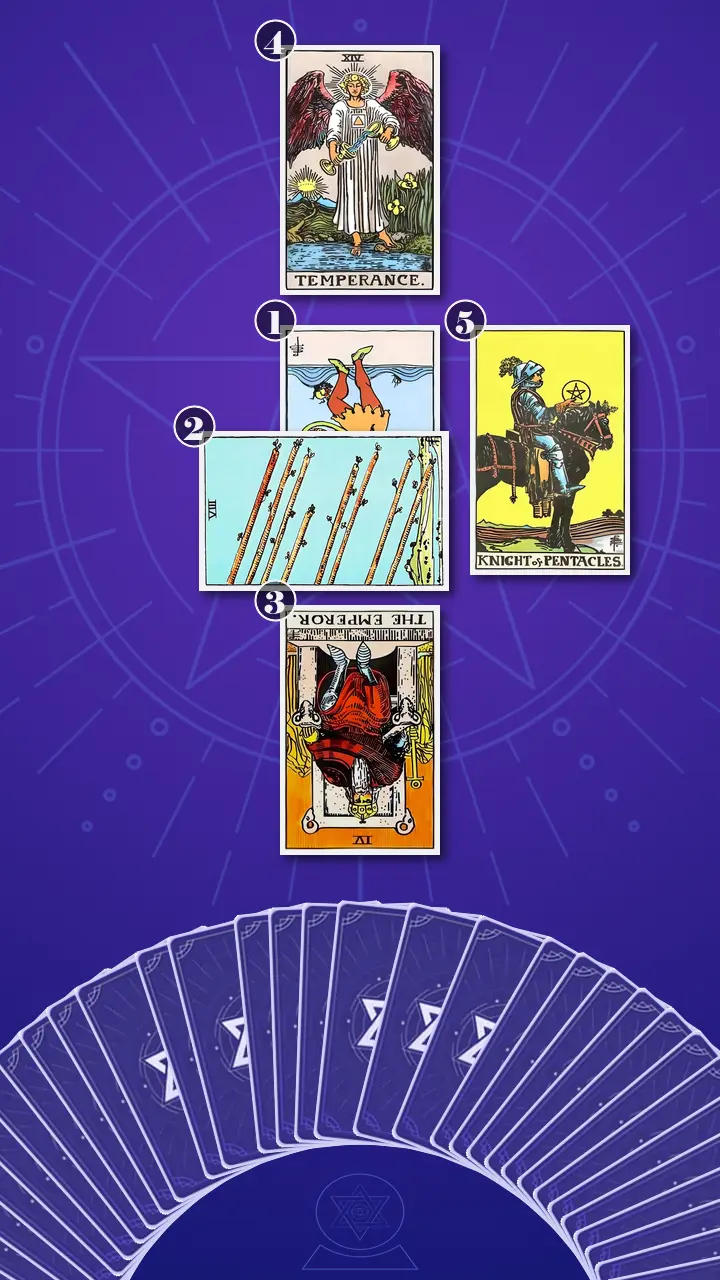
For this question, I chose a Five-Card Cross. If you have ever wondered how tarot works when everything feels urgent, this is one of the clearest spreads I know. I was not looking for prediction. I was looking for structure: the visible symptom at the center, the pressure crossing it, the root underneath, the regulating perspective above, and the grounded direction that can become a repeatable habit. The spread is logical on purpose. When life feels like a busy intersection, clarity often begins with a better road sign.
I told Jordan that the center card would show what her spiral actually looks like on the ground. The crossing card would reveal what scrambles her ranking system and creates notification-driven urgency. The lower card would take us to the deeper fear about competence and control. The upper card—our bridge—would point to the energy that interrupts the loop. The final card would show how insight becomes ordinary behavior. In other words: card meanings in context, not vague mysticism, and a path toward actionable next steps.
The Loop, the Pings, and the Inner Manager
Position 1: The Juggle That Never Lands
I turned over the card representing the current symptom pattern: the visible spiral of bouncing between unread Slack, rent pressure, and neglected home care without finishing anything. Two of Pentacles, reversed.
In modern life, this looks exactly like Jordan on the couch after work with Slack open, her banking app open, and a half-started apartment reset in mind—bouncing between all three so she can feel in motion without fully committing to the one task that would actually lower the pressure. The infinity loop around the coins mirrors the same three apps cycling through attention without resolution. The lifted foot is that restless, never-fully-landed feeling. The rough sea behind the figure is what happens when practical life stops feeling practical and starts feeling like weather.
Energetically, I read this as overloaded Earth with grounding in deficiency. There are real material tasks here, but her attention is trying to keep them all in the air at once. “If I answer Slack first, I feel guilty about rent,” she had already told me. “If I pay rent first, I assume I’m already behind at work.” That is the loop. It feels productive because there is movement, but nothing in the body gets the message that something is actually handled. Busy is not the same as relieved.
Jordan gave a short laugh, the kind with a little bitterness in it. “That’s almost rude how accurate it is,” she said, rubbing her thumb against her palm. The laugh mattered. It was the sound of recognition, and recognition is often the first crack in task paralysis after work in a small apartment.
Position 2: When Every Ping Wears a Siren
I turned the crossing card, the immediate pressure amplifier: what makes every incoming demand feel equally urgent and hard to rank. Eight of Wands, reversed.
This is the moment a cluster of Slack pings, reminders, and mental tabs all arrive at once, and her brain treats simultaneous arrival as proof of equal urgency. I told her it had The Bear-level ticket-printer energy, except the tickets were unread messages, a rent alert, and the visual guilt object of the dead plant after hours. The wands descend fast, but no visible hand is guiding them. That is exactly how backlog becomes urgency fog.
Here, the fire element is blocked rather than cleanly moving. Instead of directed momentum, she gets scattered reaction. She answers the loudest thing first, not the thing with the biggest real-life consequence. “It’s like work refuses to stay at work,” she said. I nodded. There was something very Severance about it—the office still humming in the room long after the day should have ended.
I asked her, “What came in right before everything started feeling equally urgent?” Her eyes shifted to the side, replaying the sequence. “Slack badges,” she said. “Then the rent banner. Then I looked up and saw the plant.” Her breathing went shallow just remembering it. In my work, I pay attention to that. The body often tells the truth a few seconds before the mind explains it.
Position 3: The Harsh Manager in the Notes App
I placed the next card below the center: the underlying root, the deeper fear about competence and control that turns ordinary tasks into a spiral. The Emperor, reversed.
Underneath the practical mess sat a harsh inner authority. This card is not really about a plant or a rent screen. It is about the moment those things become evidence. Evidence that she is behind. Evidence that she is losing control. Evidence that everyone else can handle basic adulting except her. In modern terms, it is like an inner manager opening a performance review because of one unread message and one cluttered corner.
Energetically, this is structure in excess and support in deficiency. The Emperor’s stone throne, armor under the robe, and barren mountain all tell the same story: safety has been confused with hardness. When I looked at that throne, I had a brief flash of the dry-stone walls of the Highlands where I learned my first lessons about steadiness. The strongest walls survive frost because they leave room for weather. A wall built too rigidly cracks. So does an inner standard of competence.
I watched Jordan’s jaw lock before she answered me, and that was my Body Signal Interpretation speaking as clearly as the card. A locked jaw often means a person is trying to create control with muscle when what they actually need is a simpler rule. “When basic life admin goes sideways,” I asked, “what are you afraid it says about you?” She stared at the card for a moment too long. “That I’m failing at being a functional adult,” she said finally, and her shoulders rose and stayed there.
That was the root. Ordinary backlog had turned into personal failure. No wonder the room felt heavier than the tasks inside it.
When Temperance Poured Between Two Cups
When I turned the fourth card, the room changed. The laptop fan was still there, the fridge was still humming, but the moment took on the hush I have learned to trust—the kind that arrives when a reading stops describing the trap and starts showing the door.
Position 4: The Bridge Back to Sequence
I turned the card representing the key shift: the regulating perspective or behavior that interrupts the loop and restores proportion. Temperance, upright.
In real life, this is not Jordan becoming a different person overnight. It is Jordan paying rent first if rent is truly due, then checking which Slack message actually needs a same-evening response, then deciding what one small home-care task matters tonight. One foot in water and one on land: emotion and practicality working together. The angel pours steadily between the cups instead of trying to drink from all of them at once.
Jordan was still inside that familiar moment: Slack open, the rent reminder glowing on her phone, the room looking vaguely accusatory, her body acting like all of it had to be solved in the same breath. This was the exact edge where her evenings tipped from manageable into flooded.
The goal is not to prove you can handle everything at once. The goal is to slow the pace enough that one stabilizing choice can actually happen.
Stop obeying every alarm at once; let Temperance pour your attention cup to cup until urgency turns into sequence.
She went very still. First came the physiological freeze: her thumb stopped above the phone, suspended in midair as if her body had missed a stair. Then came the cognitive replay: her eyes lost focus for a second, not blank, but busy, as though an earlier Tuesday night had started running in the background. Then came the emotional reaction, and it was not immediate relief. She looked back at me with a flash of resistance. “But if I stop reacting,” she said, her voice suddenly sharper, “doesn’t that mean I’m already dropping something?”
“No,” I said, gently and clearly. “It means you’re refusing to let panic choose the order.” This is where my Elemental Balance lens became useful. The reading had opened with strained Earth and jammed Fire: too much to hold, too much alarm, too many incoming demands without a clean channel. And there were no Swords here at all, which told me something important—more analysis was not the cure. Her tight chest and buzzing shoulders were not proof she lacked discipline. They were energy messages. Fire was flaring with nowhere to go. Temperance brings Water into the system, not to drown responsibility, but to cool it enough that real prioritization can return. Urgency is loud. Stability is specific.
I asked her to test the insight against real life. “Now, with this new frame, think back to last week. Was there a moment when one stabilizing choice would have changed the whole evening?” Her breath caught, then lengthened. I saw the shoulders drop—not dramatically, just honestly. “Rent,” she said. “If I had just paid rent first, I would’ve stopped treating the rest of the night like a crime scene.” She gave a softer laugh then, almost embarrassed, and after it came the strange little wobble I often see after a true aha moment—the lightheadedness of putting down something heavy and realizing you were carrying it with every muscle. That was the turning point: the first step from notification-driven overwhelm and shame to calmer competence through sequence and one grounded completion.
Position 5: Boring Reliability, on Purpose
I turned the final card to the right: grounded integration, the next practical stance that turns insight into repeatable stability. Knight of Pentacles, upright.
This card is adulthood without theatre. Same simple evening checklist. Same place every night. Same expectation that calm follow-through matters more than last-minute heroics. The still black horse, the pentacle held at chest height, and the plowed field behind the knight all say the same thing: completion over adrenaline. Energetically, Earth returns here in balance. Not the wobbling Earth of the first card, and not the rigid stone of the third, but solid ground you can actually stand on.
I told Jordan, “You do not need a better panic. You need a repeatable order.” She looked at the card and smiled for the first time that evening. “Honestly,” she said, “boring sounds incredible.” That is how I knew the reading had landed. Real guidance often sounds less exciting than the spiral, and much kinder.
From Panic Volume to Stability Impact
The whole spread told one clean story. First came the visible symptom: opening three apps and finishing nothing. Then came the notification-driven urgency that flattened every ping into equal importance. Beneath that sat the real bruise: the belief that if work, money, and home were not handled cleanly, it meant something shameful about her competence. Temperance interrupted that old contract. The Knight of Pentacles showed how to live the interruption. This was never really about choosing between Slack, rent, and a dead plant. It was about learning a form of adulthood that does not use fear as its organizing principle.
The blind spot was subtle but brutal: Jordan had been waiting to feel calm enough to choose. In truth, calm was more likely to arrive after one clear choice had already been made. That is the transformation direction here: stability-first sequencing that picks the first practical task by stability impact, not panic volume. A finished five-minute task calms more than forty minutes of tab-switching.
- Balcony-to-Note ResetWhen you get home from work and feel the three-app pull, step onto your balcony, front stoop, or an open window for five minutes. This is my 5-minute balcony energy awakening practice: feel the actual weather on your skin, then open a note titled “Money / Work / Home” and give yourself 60 seconds to choose which category would most reduce tomorrow’s stress if handled first.Tip: if your mind says you do not have time, count the 60 seconds aloud. The pause is part of the task, not a luxury add-on.
- One-Task LandingFinish exactly one task before opening another app. If rent is truly due tonight, press pay before reading any Slack thread. If rent is not due tonight, identify the single Slack message that genuinely needs a same-evening reply, send it, and only then choose one small home task.Tip: after the first task, take one full breath cycle before choosing the second. That breath is how you stop urgency from grabbing the wheel again.
- Boring Reliability RitualOn two worknights this week, use the same three-line checklist at 7:15 p.m.: 1) urgent money item, 2) urgent work item, 3) one home reset item. Keep it pinned in Notes, on a widget, or on the fridge, and end with the line “Anything beyond this is extra.”Tip: if you miss a night, do not turn the checklist into a performance review. Boring is the point; punishment is not.

A Week Later, the Quiet Proof
A week later, Jordan texted me: “Paid rent, answered one real Slack thing, put the dead plant by the door, then ate dumplings alone by the window. The room still wasn’t perfect, but my chest finally stopped acting like the night was on fire.”
That is the kind of finding clarity I trust most. Not a perfectly managed life dashboard. Not a magical personality transplant. Just the first honest step from frantic juggling to calmer competence, helped along by a Five-Card Cross tarot spread for after-work overwhelm and prioritization.
When three ordinary things hit at once and your chest goes tight, it can feel less like a task problem and more like you’re one missed step away from proving you cannot quite hold your life together.
If tonight’s alarms did not get to choose first, which five-minute task would you place in the first cup of your own three-container evening?