Calendar reminder, stomach drop—then the 3-sentence update sent early

Finding Clarity in the Calendar Pop-Up
You’re an early-career project coordinator in Toronto, and a simple calendar reminder can trigger instant deadline panic—like “Sunday Scaries,” but for a Tuesday 3 PM due time.
Jordan (name changed for privacy) said it like they were quoting a fact they hated knowing about themselves.
When they sat down across from me, I could still see Monday night on them—the kind of night where the laptop glow is the only light in a condo living room, your phone is warm from doom-scrolling, and you keep nudging commas and spacing in a doc that was already “fine.” The radiator clicks. Somewhere through the wall, a neighbour’s TV laughs at the wrong time. And even in the quiet, Slack timestamps feel loud.
“It’s not the work that scares me,” Jordan told me, palms flat on their thighs like they were trying to pin themselves to the chair. “It’s the moment I have to be seen.”
They described the loop: a deadline reminder hits, their stomach drops before they even open the file, and suddenly they’re in a private trial. A manager’s “How’s it going?” turns into a cross-examination. A teammate posting “shipped it” becomes evidence against them. They’ll over-edit, over-polish, reformat headers nobody asked for—anything to delay the one thing that matters: sending it.
What they wanted was simple and honestly reasonable: to meet deadlines confidently and be seen as reliable. The thing that kept hijacking them was just as simple, and far more brutal: the fear that if anything is late or imperfect, they’ll be judged as incompetent or careless.
The panic wasn’t abstract. It had a body. Jordan’s jaw held tight like it was clamping a scream back into place; their breathing stayed shallow, like their lungs didn’t trust the room. It reminded me of watching a market open on a trading floor—nothing had happened yet, but the air already braced for impact.
“Okay,” I said, keeping my voice steady on purpose. “We’re not going to treat this like a personality flaw. We’re going to treat it like a pattern you learned—one that can be updated. Let’s make a map through the fog. Today is a Journey to Clarity, not a verdict.”

Choosing the Compass: The Four-Layer Insight Ladder Spread
I asked Jordan to take one slow breath in through their nose, and a longer breath out—nothing mystical, just a way to signal to the nervous system, we’re here now. While they held the question in mind—Why do deadlines still trigger panic, and what’s my next step?—I shuffled.
“For this,” I said, “I’m using a spread I call the Four-Layer Insight Ladder · Context Edition.”
Here’s why this layout works so well for deadline anxiety at work, especially when perfectionism and old feedback are tangled together: it separates the symptom (what you do and feel under pressure) from the trigger imprint (the old note, the old tone, the old moment), and then from the deeper rule you built to survive it. Once we can name those layers, we can interrupt the loop with a practical next step instead of more self-blame.
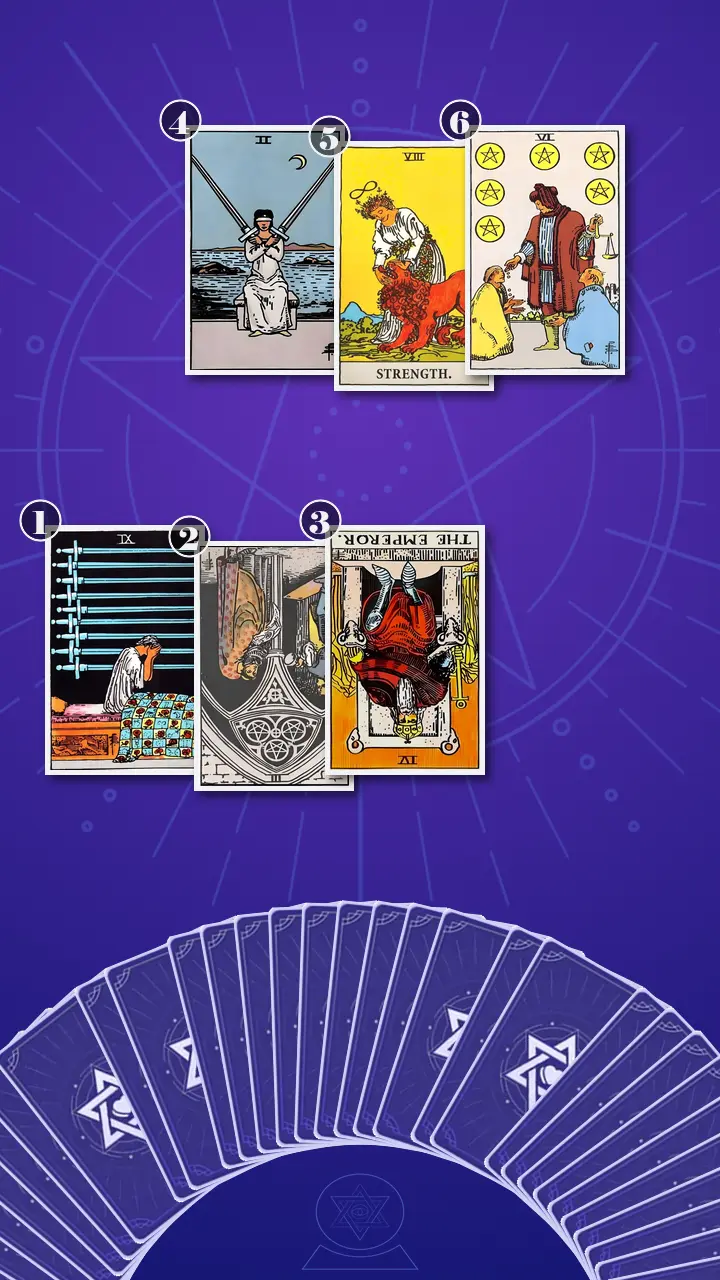
I pointed to the stepped shape of the cards as I laid them down. “Position 1 shows the surface symptom—what deadline panic looks like on your screen and in your body. Position 3 is the foundation—what inner authority belief turns a schedule problem into a threat. Position 5 is the key shift, the medicine. And Position 6 is the grounded next step—something socially realistic you can do this week, not a fantasy version of you.”
Card Meanings in Context: The Loop, the Trigger, the Rule
Position 1 — Surface symptom: the most observable deadline-trigger behavior and immediate mental load.
“Now flipping over,” I said, “is the card that represents the surface symptom—what’s happening on the surface, the most observable deadline-trigger behavior and immediate mental load.”
Nine of Swords, upright.
There it was: the private, dark room of the mind. Not the office. Not the manager’s face. Not the actual deliverable. The mind’s night-shift—running a prosecution case while the rest of the world is asleep.
“This is like 3:22 AM,” I told Jordan, using the exact modern translation the card demanded. “You’re half-awake, replaying an old late-work note like it’s happening live. Before you even open your laptop, you’ve already imagined the Slack thread, the disappointed tone, the performance review language—like you’re drafting a case against yourself.”
The energy here isn’t “you’re bad at time.” It’s Air overload: thought pressure in excess, spiraling into catastrophic forecasting. The Nine of Swords doesn’t ask, What’s due? It asks, What does this due date mean about you? That’s why the chest tightens before the task even begins.
“Perfection is a hiding place that looks like productivity,” I added, watching to see if it landed.
Jordan let out a quick laugh that sounded like it scraped their throat on the way out. “That’s… yeah. That’s too accurate,” they said, and the smile was half there, half bitter. “Like, rude. But accurate.”
I nodded. “It can feel a little brutal when the pattern is described cleanly. But clean is good. Clean means we can work with it.”
Position 2 — Trigger imprint: the old feedback/late-work memory and how it still frames today’s deadlines.
“Now flipping over,” I said, “is the card that represents the trigger imprint—the old feedback/late-work memory and how it still frames today’s deadlines.”
Three of Pentacles, reversed.
In the traditional image, this is teamwork and craft—learning in public, building something with others. Reversed, it warps into being graded. Collaboration turns into evaluation. Feedback turns into a scoreboard.
“This,” I said, “is you drafting a simple status update—three lines, totally normal—then deleting it because you picture your manager reading it as evidence you’re behind. So you go silent, work harder in private, and accidentally create the exact surprise you feared.”
The energy here is Blockage. The Pentacles want steady, visible craftsmanship. Reversed, that steady visibility gets blocked by fear of critique. And when visibility gets scary, the nervous system tries to protect you by making everything private and final-only—which is exactly what makes deadlines tighter.
I asked, gently but directly, “What’s the line from that old note? Not the whole email—just the piece that still replays.”
Jordan’s eyes flicked down and left, like their brain had pulled a file from a cabinet. “It was short,” they said. “Like… ‘Please don’t let this be late again.’ That was it. But it felt… sharp.”
“Short notes can hit hardest,” I said. “Because your mind fills in the rest with whatever you fear most.”
Position 3 — Root mechanism: the inner rule or authority belief that turns deadlines into threat.
“Now flipping over,” I said, “is the card that represents the root mechanism—the inner rule, the authority belief that turns deadlines into threat.”
The Emperor, reversed.
Reversed Emperor isn’t a lack of discipline. It’s discipline turned into self-attack. It’s an inner boss voice that confuses control with safety, and mistakes with loss of respect.
“This is you treating the due date like a moral test,” I said, grounding it in the modern-life scenario. “You make an overly strict plan, cut sleep, and add rules no one asked for—because a part of you believes control is the only thing keeping you from being labeled unreliable.”
Then I used the contrast that always clarifies this card for high performers: “There’s a difference between an inner protector and an inner prosecutor. The protector says, ‘Let’s create structure so we’re safe.’ The prosecutor says, ‘If we slip, we deserve punishment.’”
In my mind, I flashed to my old life—Wall Street, screens everywhere, time pressure baked into every decision. The best leaders I ever worked under weren’t the ones who barked “no excuses.” They were the ones who made the plan simpler under stress. Structure as support, not a weapon.
Jordan swallowed, hard. Then they exhaled like they’d been holding a breath they didn’t know they had. “Oh,” they said quietly. “Yeah. That’s… that voice.”
“And that voice,” I said, “is why a deadline feels like judgement day. It’s not just a schedule; it becomes a character trial.”
The Freeze Response That Looks Like Productivity
Position 4 — Protector pattern: the specific way they ‘stay safe’ that accidentally increases time pressure.
“Now flipping over,” I said, “is the card that represents the protector pattern—the way you stay safe that accidentally increases time pressure.”
Two of Swords, upright.
“This is the blindfold card,” I said. “The panic UI. Options disappear.”
And then I gave it to Jordan exactly as life looks: “You have the draft and the ‘final’ version open side by side. You keep toggling between them, fixing small things, waiting for a moment of certainty that never arrives—while the clock quietly does what clocks do.”
In terms of energy dynamics, this is Balance that becomes paralysis. The Two of Swords is trying to protect your heart—crossed arms, crossed blades. But under a deadline, it becomes a stall tactic dressed up as caution.
I narrated the montage, quick-cut style, because this card lives in motion that goes nowhere: “Two versions of the same doc open. Slack notifications piling up. Google Calendar flashing. Cursor hovering over ‘Send’ while you rewrite the first sentence again.”
Jordan nodded, and then a half-laugh slipped out—the uncomfortable kind, like being caught doing something you didn’t realize had a name. “You’re not scared of the work. You’re scared of being seen,” they said, repeating it back to me like they were testing if it was allowed to be true.
“Exactly,” I said. “And the stall makes total sense as protection. It just has a brutal long-term cost.”
When Strength Spoke: A Calm Rule for the 60 Seconds Before “Send”
Position 5 — Key shift: the most transformational reframe and inner capacity to practice under pressure.
I let my hands pause above the next card for an extra beat. The room felt quieter—not in a dramatic way, just in the way it gets quiet when someone finally stops arguing with themselves and starts listening.
“Now flipping over,” I said, “is the card that represents the key shift—the transformational reframe and inner capacity you can practice under pressure.”
Strength, upright.
Not force. Not hustle. Not another stricter system built at 1 AM. Strength is regulated courage. Gentle hands. A lion that doesn’t get punched into submission—just met.
“Right before you send anything,” I said, tying it to real life, “you stop arguing with your inner critic and do a tiny regulation ritual: long exhale, shoulders down, one clear action. You don’t become fearless—you become steady enough to deliver without self-attack.”
Setup: “If you’ve ever watched the calendar reminder pop up and instantly felt your stomach drop—then found yourself changing one more line, one more font, one more bullet—this is the moment where the due date stops being a schedule… and starts feeling like a verdict.”
Stop treating the due date like a lion that will devour your reputation; meet it with steady hands, a slowed breath, and one brave deliverable—Strength over force.
Reinforcement: Jordan’s reaction didn’t come out as a big epiphany sentence. It came out in layers, the way real nervous systems shift.
First, a brief freeze: their breath hitched, and their fingers stopped fidgeting with their sleeve mid-motion. Then the cognition seeped in: their gaze went unfocused for a second, like they were replaying every midnight “rescue plan” they’d built in Notion and every time it still didn’t make them feel safe. Then the emotion released: a slow exhale, longer than the inhale, and their shoulders dropped—just a few millimeters, but enough that I could see their neck look less braced.
“That feels… doable,” they said, and their voice surprised them a little. “Like… I don’t need a tougher personality. I need a calmer pre-send moment.”
That was the pivot. Force vs leadership. Bully yourself into shipping vs guide yourself into shipping.
Here’s where I brought in one of my own tools—because Strength isn’t one-size-fits-all. “I use something I call a Potential Mapping System,” I told Jordan. “It’s basically an energy profile. Under pressure, some people are Sprinters—they do best with short bursts and quick sends. Others are Deep Thinkers—they create safety through refinement, but they can get trapped in endless polishing.”
I looked at the spread, then back at them. “You read like a Deep Thinker under stress. Your gift is quality. Your trap is using quality as fear management.”
“So the Strength move for you isn’t ‘work harder,’” I continued. “It’s: regulate for 60 seconds, then choose one delivery action that can’t be endlessly polished.”
I leaned in slightly, keeping it practical. “Now, with this new frame, think back to last week: was there a moment right before you hit send—or didn’t—where this would have changed how you felt?”
Jordan blinked, eyes a little brighter. “Thursday,” they said immediately. “11:58 PM. I had the update drafted. I deleted it three times. If I’d… just led myself for a minute instead of negotiating with that voice… I would’ve sent something.”
“That’s the exact shift,” I said. “This isn’t about becoming a different person. This is from performance-triggered panic and shame around being ‘seen’ to calm, values-based reliability through small visible increments.”
Position 6 — Next step: one grounded, socially realistic action that builds repeatable deadline trust.
“Now flipping over,” I said, “is the card that represents the next step—one grounded, socially realistic action that builds repeatable deadline trust.”
Six of Pentacles, upright.
“This is the scales,” I said. “Not vibes—agreements.”
And then I translated it into modern work life: “Instead of disappearing until the last minute, you send an early checkpoint and ask one scope question. The deadline stops being a private crisis and becomes a shared plan—measurable, adjustable, and way less personal.”
Energy-wise, this is Balance moving into Earth: coordination, resourcing, reciprocity. It’s the antidote to the isolation implied in the reversed Three of Pentacles. The Six of Pentacles says: you don’t prove worth by suffering silently; you build reliability by being findable and predictable.
“A due date isn’t a verdict—it’s a coordination point,” I said, and Jordan’s face softened like something inside them finally unclenched around that sentence.
Actionable Advice: The 60-Second Strength Reset + Coordination-First Deadlines
I pulled the whole ladder together into one story, because people don’t change from isolated insights—they change when the insight becomes a narrative they can recognize mid-spiral.
“Here’s what your spread says,” I summarized. “The Nine of Swords is the symptom: your mind turns deadlines into a private prosecution. The Three of Pentacles reversed is the trigger imprint: collaboration and updates feel like being graded, so you go quiet until you can appear ‘final.’ Underneath it, the Emperor reversed is the root rule: an inner authority voice equates control with worth and mistakes with humiliation. That pushes you into the Two of Swords protector pattern—freezing while looking busy. The medicine is Strength: calm, compassionate leadership in the minute before you act. And the application is the Six of Pentacles: turn deadlines into shared agreements—scope, checkpoints, realistic expectations—so you’re not carrying the whole thing alone.”
The cognitive blind spot I wanted Jordan to see was simple: they kept trying to solve a nervous-system alarm with more mental control. More planning. More polishing. More self-interrogation. But the transformation direction is the opposite: lead the body first, then make a small visible move.
To make it practical, I used one of my own frameworks—my 5-Minute Decision Tools. It’s a tri-axis check that stops overthinking from pretending it’s “being responsible.” Advantage / Risk / Breakthrough. We don’t need a perfect plan; we need a small experiment and a weekly calibration.
- The 60-Second Strength ResetBefore one deadline this week, set a timer for 60 seconds. Feet on the floor. Inhale 4, exhale 6 (longer exhale). Unclench your jaw on purpose. Then immediately do one irreversible delivery action: send a 3-sentence status note, attach the rough draft, or book a 10-minute alignment call.If your chest spikes and your brain says “this is pointless,” shorten it to 30 seconds. This is practice, not punishment.
- The 3-Sentence Progress Note (48-hour checkpoint)48 hours before the next due date, send a message (Slack or email) with: (1) what’s done, (2) what’s next, (3) one question that clarifies scope or priority. Keep it boring and specific—coordination, not confession.Use a template so you don’t overthink tone. Remind yourself: you’re not asking for permission to exist—you’re coordinating work.
- Three Non-Negotiables + Optional PolishPick one deliverable and write, inside the doc itself, your three non-negotiables (what must be true for it to ship). Label everything else “optional polish.” When you feel the urge to over-edit, ask: am I improving a non-negotiable, or am I doing fear management?If you’re a Deep Thinker, optional polish is where you can disappear for hours. Put a 15-minute cap on it and ship v1.

A Week Later: Small Visibility, Less Lion
A week later, Jordan messaged me—no long explanation, just a screenshot of a Slack update draft in their Notes app.
“Did the 60-second thing,” they wrote. “Sent the 3 sentences 2 days early. Didn’t die. Also… my manager replied with one line: ‘Perfect—ship v1 Friday.’ I slept like a person.”
It wasn’t a fairy tale ending. Jordan added, “Still felt the spike in my chest. But it passed faster. And I didn’t open Notion at midnight to build a new system.”
That’s the kind of proof I trust: not “I’ll never feel anxious again,” but “I can feel it and still deliver one brave thing.” In our Journey to Clarity, the cards didn’t promise a new personality. They offered a new relationship with pressure: Strength in the minute before action, and Six of Pentacles in the systems around it.
When the clock gets loud, it’s not the task that crushes you—it’s the old fear that being late or imperfect will expose you as someone who can’t be trusted.
If deadlines were allowed to be coordination instead of a verdict, what’s one small ‘visible increment’ you’d be willing to share before you feel ready?