When Quiet Slack Felt Like a Verdict, the Question Turned to Ownership

The Rainy Tuesday When Quiet Slack Felt Like a Verdict
Before I even reached for the deck, I said what I have learned to say when a career reading walks in wearing the face of competence and the nervous system of a fire alarm: if you are a late-20s project person on a hybrid tech team, and a slow Slack afternoon makes you check the green dots like a pulse check, you are not being dramatic. You are usually standing inside productivity-based self-worth.
Alex (name changed for privacy) nodded from her kitchen table in East London. Rain streaked the window behind her. Slack was pinned on the left side of her laptop; a Jira board glowed on the right. I could hear the radiator clicking through my headphones. Her coffee had gone cold. The light from the screen was a little too bright, the way it always is when a quiet day at work starts to feel accusatory. She glanced offscreen, then back at me, and said, “If nobody needs me all day, I start wondering what I am even doing here.”
I watched the sentence land in her body before it fully left her mouth: shoulders rising, chest tightening, that tiny hollow drop low in the stomach that comes when no notification appears and the brain decides silence must mean something personal. The shame in her voice felt like a lift dropping one floor inside her ribs every time the chat stayed still. I told her, gently, that this did not sound like laziness or lack of talent. It sounded like work validation anxiety — the kind that uses Slack notifications like a heartbeat monitor for your value. “Let’s draw a map for the fog,” I said. “We’re not here to make you more indispensable. We’re here to find clarity.”

Choosing the Crossbeam: A Five-Card Cross for Career Self-Worth
I asked Alex to put one hand over the center of her chest, take one slow breath, and hold the question in plain language: why do I feel useless at work when my team doesn’t need me? Then I shuffled slowly, not for theatre, but for focus. I have spent years guiding people beneath artificial night skies in a Tokyo planetarium, and I trust simple rituals for the same reason I trust a darkened dome before a constellation appears: the mind needs a threshold.
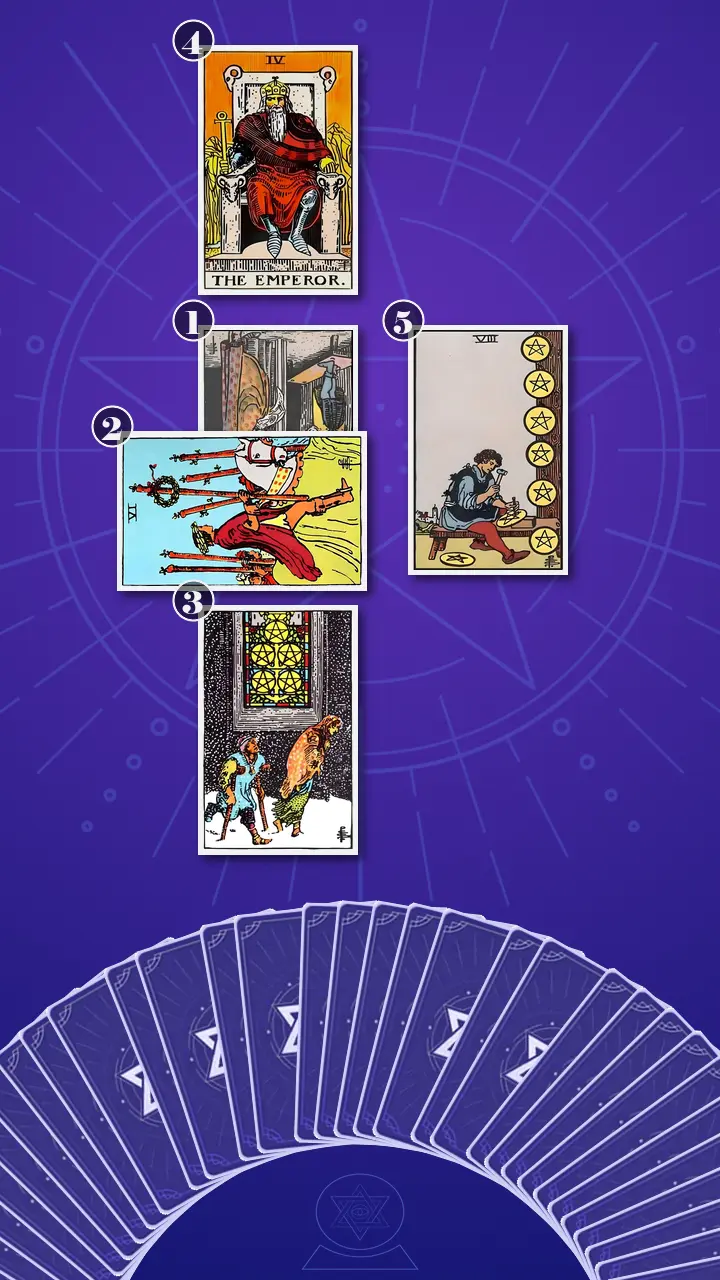
For a question like this, I use a Five-Card Cross tarot spread for career self-worth and workplace validation anxiety. I did not need a heavier spread. A Celtic Cross would have added more weather than this sky required. What mattered here was the chain itself: the present symptom, the pressure point, the deeper wound, the corrective principle, and the habit that could make the insight livable. The cross shape is especially useful when someone feels caught between external team dynamics and internal worth; it lets me show exactly where those lines intersect.
I told her how I would read it. The center card would show the surface pattern — what actually happens in the first minutes of a quiet work block. The crossing card would reveal the active tension that makes the moment sting harder than it needs to. The lower card would uncover the root driver underneath the productivity story. The upper card, our key card, would offer the stabilizing principle. And the card to the right would show the next steps: how insight turns into muscle memory.
Reading the Threads Beneath the Thread
Position 1: The Blueprint You Keep Reopening
I turned over the first card and said, “Now I’m opening the card that shows the surface workplace pattern — what happens when quiet periods or low team dependency trigger the feeling of uselessness.” It was the Three of Pentacles, reversed.
I know this card well in career readings. Reversed, it often shows blocked earth: contribution exists, but the sense of place inside the structure is unstable. I showed Alex the image and translated it into her actual life. A project brief sits live in Notion. Engineering has moved. Design has left comments. Nobody tagged her. The spike hits immediately, and she jumps in with extra edits or a quick ‘happy to help’ message — not because the task truly needs her, but because visible involvement briefly reassures her that she still has a place in the build.
“Yes,” she said, and then gave a short, bitter laugh. “That’s accurate to the point of being rude.”
I smiled. “The card is not calling you needy. It’s showing me that your role starts feeling unreal unless you can see yourself reflected in the group project in real time.” The reversal mattered. This was not a lack of skill. It was a blockage in belonging through structure. She was rereading team threads for proof of where she fit, treating normal teammate autonomy as evidence that the blueprint no longer included her.
I watched her rub her thumb along the rim of her mug. That tiny motion told me the card had already pierced the surface.
Position 2: The Private Scoreboard
I moved to the crossing card. “This position reveals the active challenge — the habit of using visible recognition and demand from other people as a measure of worth.” The card was the Six of Wands, reversed.
This is where blocked fire turns inward and starts grading you. I told Alex that the raised wand and cheering crowd in this card, when reversed, become something painfully modern: a private performance dashboard made of Slack mentions, follow-up asks, meeting shout-outs, reaction emojis, and whether anyone publicly thanks you for something. On a slow afternoon, the loop can get brutally clean: Nobody asked for me. Nobody mentioned me. Did I even matter today?
I could see her face tighten before she answered. “The private scoreboard part is exactly it.”
“That’s the pressure point,” I said. “Not simply being useful, but being witnessed being useful.” I told her that this card often shows excess effort built on deficient self-trust: speaking just to be seen, rewriting status updates so the contribution sounds more central, offering too much on the next task because the last quiet hour felt like failure. “A quiet inbox is not a character reference,” I said. “And if your worth only shows up in emergencies, your nervous system never gets a quiet day.”
She winced, then let out a long breath through her nose. Her hand fell away from the mug. That was the sound of a defense loosening.
Position 3: The Lit Window You Assume Is Closed
I turned the third card. “This one sits underneath everything. It shows the deeper fear — the part of you that hears quiet and translates it into exclusion, replaceability, or lack of worth.” The card was the Five of Pentacles, upright.
The room changed when this card appeared. The Five of Pentacles always asks me to stop talking about efficiency and start talking about belonging. I told Alex that this was the image of having the job, the salary, the manager’s trust, the valid ticket — and still emotionally feeling as if she had been left at the gate. The glowing window in the card is the support already nearby. The cold outside is the shame story that makes support hard to register.
“Nothing is technically wrong,” I said, “and that’s part of why it hurts so much. You’re not reacting to an actual firing. You’re reacting to the feeling of standing outside a lit office window while everyone else seems already inside.” For a second it reminded me of the emotional atmosphere of Severance — not because her workplace was sinister, but because ordinary silence had become alienation inside her own interpretation of it.
Alex went very still. Her throat moved once before she spoke. “That’s embarrassing,” she said quietly. “Because yes. That’s exactly what it feels like.”
“It isn’t embarrassing,” I told her. “It means the work problem is wearing the clothes of a belonging wound.” In this position, the card showed deficiency and scarcity, not objective reality. Her mind had fused being included with being valuable, so any quiet spell at work risked feeling like being left out of the room entirely.
When the Emperor Took the Chair
Position 4: The Stone Seat Above the Noise
When I turned the fourth card, I felt the entire reading click into focus. The small lamp on my desk threw a clean line across the card’s stone throne, and on my screen the London rain had softened to a grey blur. “This,” I said, “is the guidance position — the corrective stance, the higher principle, the most stabilizing perspective available to you.” The card was The Emperor, upright.
Alex had been living in that remote-work moment where the coffee goes cold, the Slack dots barely move, and the cursor starts drafting little offers to help just so the day will confirm she still belongs. Her mind kept asking the same old question: Do they need me right now?
Silence is not proof that you do not matter; take your seat on the Emperor’s throne and let structure, not urgency, define your worth.
I let the sentence sit between us for a beat.
Then I watched the reaction arrive in three clear waves. First, a small physical freeze: her breath stopped halfway in, and her fingers hovered over the trackpad as if they had forgotten their next command. Then came cognitive seep-through: her eyes slid to the side of the screen where Slack was still open, unfocused now, as if she were replaying a dozen quiet afternoons at once — the dead air after a stand-up, the resolved Google Doc comments, the one-on-one where “everything’s fine” somehow landed like abandonment. Then the release: one deep exhale from the chest, shoulders dropping at last, followed by that strange, almost dizzy stillness that sometimes comes when a person is no longer holding the old argument together.
But relief was not the first emotion that fully formed. She frowned. “But if that’s true,” she said, and I heard a flicker of anger under it, “doesn’t that mean I’ve built half my workday around being noticed?”
“Around being reassured,” I said softly. “That’s not the same thing.”
This was the moment I brought in the lens I call Orbital Resonance. After so many years working under a planetarium dome, I have a reflex I trust: I look for what stays true in a system even when nothing dramatic is happening. Planets do not prove their existence by being watched. They hold their orbit because structure, mass, and relationship are already there. In healthy workplace energy, people do not need to collide every minute to be affecting one another. Sometimes the quiet is not rejection. Sometimes it is a stable orbit doing its job.
The Emperor, in that sense, was not asking Alex to become colder. He was asking her to stop using incoming requests as her real-time job description. “Being needed is one signal,” I told her. “It is not your job description. What you need is a seat in the structure that does not vanish whenever the room goes quiet.” In my mind, I flashed to the planetarium again — children staring up at Saturn, assuming a thing becomes real only when everybody looks. I have spent a decade correcting that misconception in the sky. Here I was correcting it in a career.
Then I gave her the practical interrupt. “Within ten minutes,” I said, “open Apple Notes, Notion, or a notebook and title a page, ‘What I own even on quiet days.’ List three responsibilities that still count when nobody pings you, one quality standard for each, and one next step you can do without being asked. If your chest tightens and the list turns into self-surveillance, stop at one item. This is orientation, not self-criticism.”
I leaned in a little closer to the camera. “Now, with this new perspective, think back to last week. Was there a moment when this would have changed how you felt?”
She nodded slowly. “My manager said everything was in a good place,” she said. “And I walked away thinking that meant I was irrelevant. If I’d had this… I think I would’ve heard trust instead.”
That was the crossing. Not perfection. Not instant healing. But the first real move from shame-driven approval-seeking to grounded self-trust and role ownership. From feeling replaceable in every quiet hour to carrying an internal sense of role that could survive one.
Position 5: One Coin at a Time
I turned the final card. “This position shows the embodied next step — how to turn insight into daily habits that build steadier self-trust at work.” The card was the Eight of Pentacles, upright.
I love this card after The Emperor because it takes authority out of theory and puts it on the workbench. Here the energy is balanced earth: repetition, craft, visible progress, one coin at a time. I told Alex that this looked like keeping a quiet record of systems improved, handoff notes clarified, timelines cleaned up, risks caught early, and skills sharpened even when nobody applauds it that day. It was the opposite of rescue-mission confidence. It was a body of work.
“Move from being seen to being solid,” I said.
She inhaled more evenly this time. I could almost see the thought rearranging itself. Instead of ending the day with six half-touched tasks and no clean proof of what she had built, this card invited her to trust the kind of evidence that does not trend on LinkedIn. It wasn’t flashy. But it was real. That is how self-trust accumulates — not as a dopamine spike, but as quiet compound interest.
From Being Seen to Being Solid
When I stood back from the spread, the story was clean. At the center, the Three of Pentacles reversed showed a shaky sense of place inside the team structure. Crossing it, the Six of Wands reversed showed the applause habit — the part of Alex that had outsourced confidence to visible demand and public acknowledgment. Underneath both sat the Five of Pentacles, the deeper scarcity wound: the fear that if she was not actively needed, she was drifting toward the edge of belonging. Above them, The Emperor offered the antidote of internal authority, role clarity, and self-defined standards. And the Eight of Pentacles showed the lived path forward: repeatable craft, quiet evidence, steadier ownership.
I also named the blind spot clearly. “Your mind keeps reading team autonomy and manager trust as omission,” I said. “You’re translating hurt feelings into productivity questions because that sounds more manageable. But this is both a work problem and a belonging problem.” I pointed out something I always notice in spreads like this: there were no Cups here. The feelings were real, but they had been rerouted into workflow. That mattered. Once named, the transformation direction became simple, even if not easy: stop using other people’s immediate dependence as proof of worth, and start measuring value through ownership, consistent craft, and standards you can recognize even on a quiet day.
- Seat-in-the-Structure ResetBefore your next morning stand-up or the first quiet work block of the day, use my Earth-rotation perspective before morning meetings: put both feet on the floor, take one breath, then open Notes and write a three-line list — ‘What I own,’ ‘What good looks like,’ and ‘What is not mine to chase.’If three lines feel rigid or your role is especially fluid, keep only one item. This is orientation, not self-surveillance.
- Applause Habit InterruptBefore you type ‘happy to help’ in a live Slack thread, wait ten minutes and ask whether there is a real gap or whether you are hungry to be visible. If support is still useful, make it narrow and time-bound: ‘If useful, I can review X by 3 PM.’If ten minutes feels impossible, start with two. The goal is not detachment; it is boundary-friendly contribution.
- Receipts of Good WorkSpend five minutes at the end of the day logging one system improved, one risk reduced, or one piece of work clarified in Apple Notes, Notion, or a Friday folder. Build a quiet Git commit history for your competence.One line counts. If a daily log starts feeling performative, switch to a Friday-only version and make evidence gentle.

A Week Later, the Quiet Held
A week later, Alex sent me a message with a screenshot of a note titled ‘What I Own This Week.’ No dramatic career plot twist. No cinematic promotion. Just three bullets, a cleaner timeline update, and one sentence beneath it: ‘A thread moved without me today and I finished my actual work instead of jumping in.’
She told me the quiet still felt strange sometimes. One morning she woke with the old thought — what if I’m still getting this wrong? — but this time she smiled, opened her ownership list before Slack, and let the question pass without obeying it. Clear, but still a little vulnerable. That, to me, is real change.
This is why I trust tarot for questions of career self-worth. A good reading does not flatter the wound or shame the coping pattern. It separates the trigger from the story, gives the story structure, and turns structure into actionable advice. In Alex’s case, the Five-Card Cross did exactly what I hoped: it helped her stop auditioning for a role she already held.
If the chat goes quiet and your chest drops anyway, it can feel as if you have to earn your seat from scratch, as though usefulness is the only thing keeping your place in the room. So when the next quiet hour opens, what part of your role would you choose to sit in a little more deliberately — your standards, your craft, or that stone chair — instead of refreshing the green dots for permission?