At 11:47 p.m., a Shared Deck Spiral Turned Into One Clear Ask

Finding Clarity in the 11:47 p.m. Google Slides Spiral
If you're an early-career project person in a city like Toronto and you've ever opened a shared deck the night before a deadline only to realize you're about to do unpaid cleanup again, I can usually feel the pattern before the first card is even turned.
Chloe (name changed for privacy) joined me from her small condo kitchen in downtown Toronto at 11:47 p.m., Slack open beside a glowing Google Slides deck. The fridge hummed behind her. The radiator had dried the air to paper. The smell of reheated leftovers still lingered while her thumb kept flicking between comments and version history. Her phone was warm in her hand, and her shoulders were so high they nearly touched her ears.
She gave me the question in one exhale: 'Why do I always end up fixing everyone's mess, and why am I so resentful when I do it?' Then she added, with the tired little half-laugh I hear from competent women far too often, 'I want teamwork, not a group project where I'm the unpaid emergency department.'
What I heard underneath was the real contradiction: she wanted shared responsibility and solid work, but she was terrified the whole project would wobble, look sloppy, and somehow stick to her name if she stopped rescuing it. The feeling in her body was not vague. It was like a streetcar brake locked inside the chest—metal-tight jaw, shoulders cinched upward, sparks of urgency under the skin, the whole nervous system saying, 'Open the file again.'
I met her there gently. 'This isn't random stress,' I told her. 'It's the competent-person trap in collaborative work. You're not failing at teamwork. You've become the cleanup system.' I could see the polished-professional and private-spiraling split so clearly it reminded me of Severance: one self saying 'all sorted' in the channel, the other still doing after-hours rescue alone. 'Let's make a map for the part of this that can become clear,' I said. 'That's our journey tonight.'

Choosing the Compass: The Shadow Spread for Work Boundaries
I asked Chloe to place both feet on the floor, take one full breath, and hold the question without softening it to sound easier or nicer. Then I shuffled slowly. I do that not for theatre, but for focus. Rhythm gives the mind somewhere to land when it has been sprinting between Slack threads, deadlines, and imagined consequences.
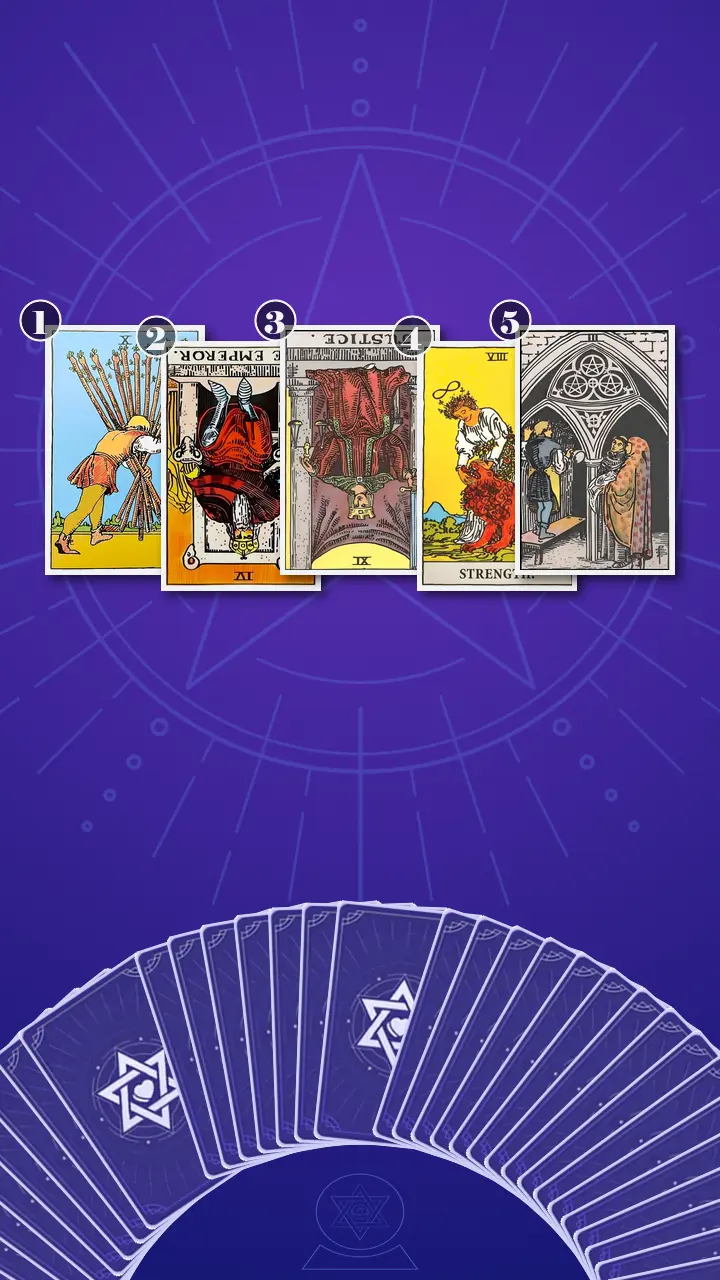
For her, I chose The Shadow Spread · Context Edition, a five-card tarot spread for collaboration patterns, team-project resentment, and overfunctioning at work. This is how tarot works when I use it well: not as fortune-telling, but as a practical mirror. It helps me trace the visible behavior, the hidden driver, the emotional cost, the corrective energy, and the next embodied step.
This spread fit her perfectly because the issue was larger than 'my coworkers are disorganized.' Position 1 would show the surface pattern of fixing, rewriting, and carrying. Position 2 would show the shadow motive beneath it—the fear that if she did not control the outcome, the project would reflect badly on her. Position 3, placed at the center, would track resentment as a fairness signal. Position 4 would reveal the medicine. Position 5 would turn the insight into something concrete enough to use in a real team chat, meeting note, or review window.
Small spreads can be merciful. This one is the smallest structure I know that still follows the whole arc: visible burden, hidden fear, emotional invoice, steady leadership, and a practical reset toward shared accountability.
Reading the Map: The Cards That Named the Cleanup System
Position 1: The Bundle That Blocks the Horizon
I turned the first card for the current pattern—the specific behavior of fixing, rewriting, and carrying the project for the group. It was the Ten of Wands, upright.
I showed her the figure bent forward beneath the bundle, the horizon nearly blocked by what he carries. 'This,' I said, 'is the 11 p.m. shared-deck spiral. You are still in Google Slides, fixing two sections that were never really finished, because the project has started to feel like something you have to drag over the line by yourself.' You wanted a team project; somehow you became the after-hours cleanup crew.
In energetic terms, this card is excess. Too much fire. Too much doing. Too much private hauling. Once you are carrying everyone's loose ends, your options narrow until doing more looks like the only responsible move. That is the trick of overfunctioning: it makes your burden look like your best idea.
Chloe's reaction came in three tiny beats. First her breath stalled. Then her thumb froze over the trackpad as if she were seeing last Wednesday's slide deck play back in real time. Then she gave a dry, almost offended laugh. 'Okay,' she said, 'that's... painfully accurate.' The recognition mattered. Shame softened the instant the pattern had a name.
Position 2: The Private Backup System
I turned the second card for the hidden driver—the control-based fear that the project will reflect badly on her if she does not personally manage the outcome. It was The Emperor, reversed.
The stone throne. The armor beneath the robes. The whole image of structure becoming defense. 'This looks like leaving a team meeting, rebuilding the task list in your own system, keeping a private checklist, and only relaxing once you've personally verified every moving part,' I told her. 'Not because you love control for its own sake, but because uncertainty feels harder to sit with than extra work.'
I know this card well. Whenever I see The Emperor reversed, I think of old Highland stone walls after a hard winter: solid, yes, but built so tightly against the weather that nothing living can breathe inside them for long. That is what I felt here. Competence had turned into armor.
So I gave voice to the monologue the card was holding: 'If I don't check it, it lands on me. If I ask too directly, I sound intense. If I leave it alone, the whole thing looks sloppy.' Then I said the line she most needed to hear: Being the backup system is not the same as being the leader.
This card showed blockage. Leadership had hardened into private control. Safety had become dependent on personal verification, which meant the team could keep leaning while she kept carrying.
Her chest visibly tightened. She looked down, then back at me. 'Oof,' she said softly. 'I didn't realize control was part of it. I thought I was just being responsible.' That was the first real opening in the wall.
Position 3: When the Ledger Tips
I turned the center card for the emotional cost signal in the team dynamic—the way resentment forms when responsibility stays uneven and unspoken. It was Justice, reversed.
I pointed to the tilted scales and the sword out of true. 'This is the internal spreadsheet,' I said. 'The one that tracks every late reply, every vague handoff, every rushed section, every time someone goes offline while you stay in the doc history collecting receipts.' This is the moment Chloe scrolls through Slack timestamps, knows exactly who left what unfinished, says none of it out loud, and feels the sharp, tired resentment of a bill that keeps growing without ever being openly split.
'Resentment is often a boundary draft you never sent,' I told her. 'No one said this was fair, but your body already knows it isn't.'
Justice reversed showed blocked air. The truth was present, but trapped inside thought instead of becoming language. Fairness was being measured privately rather than structured publicly. The emotional bill kept rising because the work stayed uneven and the imbalance stayed unnamed.
She went still again, but differently this time. First a long exhale. Then her shoulders dropped a fraction. Then her eyes filled with that specific look people get when they realize the thing they have been calling moodiness is actually information. 'I literally do that,' she said. 'I read Google Docs version history like it's evidence.' We both smiled, because once spoken plainly, the pattern lost some of its power to masquerade as personality.
When Strength Put a Hand on the Lion
Position 4: Calm Hands, Not Forced Rescue
When I turned the fourth card, the room changed. Even over video, the fridge hum seemed to recede. A streetcar bell drifted up faintly from below her window, one clear note through all that static. This was the card for the core transformation energy that could interrupt the loop. It was Strength, upright.
I let the image sit between us: the relaxed posture, the soft hand on the lion, the kind of power that does not need to dominate to be real. 'This is the moment before takeover,' I said. 'Your cursor is hovering over someone else's weak slide. Your jaw is tight. The urge is buzzing through you to rewrite it so you can breathe again. Strength asks a completely different question: what actually needs leadership here—instant fixing, or one clear ask?'
This is where I brought in the part of my work I call Intuition Development through natural phenomena. In the Highlands, I learned to trust what weather teaches faster than what panic teaches. Heather survives wind not by fighting the whole moor into obedience, but by staying rooted enough to move without snapping. In my Nature Empathy Technique, I teach clients to read their body's surge the way a shepherd reads a sudden shift in air: not as an order, but as information. Chloe's tight jaw was not a command to rescue. It was a signal that a boundary was due.
Stop treating control as strength and start practicing steady boundaries, because the lion is guided by calm hands, not dragged by force.
I let that land. Then I added, more quietly, 'Your resentment is not proof that you care too much. It may be the moment your standards are asking for visibility, not another late-night rescue.'
Her reaction came as a full chain. First there was a physical freeze: breath paused, fingers locked around the mug handle, eyes fixed on the lion. Then came cognitive penetration: her gaze slipped out of focus, and I could almost see her replaying those midnight moments when she reopened the file because chasing people felt riskier than doing it herself. Then the emotion broke through—but not as relief first. It arrived as resistance. 'But if I do that,' she said, sharper now, 'and they still don't fix it, I'm still the one attached to the deck.' The flare of anger lasted a second, and underneath it I heard the deeper thing—the exhaustion of someone who has been on unpaid emergency duty for too long.
I answered without pushing. 'That fear makes sense. But fear is not the same as instruction. Control can feel like strength right up until it starts costing you respect, rest, and real collaboration.' I asked her to open her notes app then and there. 'Within the next 10 minutes, write two lines: 1) what I keep fixing without saying, and 2) what standard needs to be named earlier. Then turn one line into a low-drama sentence you could actually use in team chat. If your body spikes, stop there. The minimum version counts.'
She typed slowly. I watched the unclenching happen in increments: jaw loosening, shoulders lowering, one longer breath, then another. When she read back, 'For this round, can each section owner make their revisions before 3 PM so final review stays shared?' her voice had changed. Not louder. Steadier. I asked her, 'Now, with this new angle, can you see a moment last week when that sentence would have changed the night for you?' She looked down at the cards and gave a softer laugh. 'Yeah,' she said. 'I probably would've gone to bed.' That was the crossing point—from private rescue and silent scorekeeping to calm boundaries and shared ownership.
Position 5: The Blueprint Everyone Can See
I turned the final card for the concrete next step—the move that could turn insight into a workable collaboration system. It was the Three of Pentacles, upright.
Three people gathered around one visible plan. Shared craft. Visible roles. 'This,' I told her, 'is the fix that actually scales. Not you becoming more efficient at hidden cleanup, but the work moving out of your nervous system and into the process.' In real life, it looked like a clear project page with named owners, deadlines, review points, and revision responsibility written where everyone could see it.
This card was grounded earth after all that strained fire. Balanced, practical, embodied. 'Clean deliverables can hide messy ownership,' I said. 'And shared work only becomes shared when ownership is visible.' That landed differently from the earlier cards. I could see the practical part of her wake up—the part that saves screenshots, rewrites templates, and knows exactly what a better workflow would look like if she stopped carrying it alone.
She nodded almost immediately. 'That I can do this week,' she said. And that was important. Tarot is not useful if it only leaves people moved. It must also leave them equipped.
The Visible Ownership Reset
The story the cards told was painfully coherent. First the blocked path of the Ten of Wands: the visible burden, the late-night rewriting, the one-person load. Then The Emperor reversed: the private armor, the backup system humming behind the official project plan. Then Justice reversed: the tilted ledger, the resentment produced by doing fairness silently. Strength changed the logic entirely, teaching her to regulate before rescuing. And the Three of Pentacles replaced hidden cleanup with a shared blueprint.
The blind spot was not that Chloe cared too much. It was that she had been treating association with the project as ownership of every flaw in it. She was trying to protect quality through private rescue, when what actually protects quality is visible structure. I also noticed the elemental story immediately: too much fire, almost no water. Her feelings were not being processed cleanly; they were being routed into labor. So the transformation direction was clear: move from quietly compensating for weak follow-through to naming standards early and letting other people own their part.
I gave her three next steps, each small enough to survive a real workweek.
- The One-Clear-Ask MethodBefore the next project check-in, draft one sentence that names both the standard and the owner, then place it in the real Slack thread, meeting notes, or shared doc comments. For example: 'Can each section owner update their own slide by 3 PM so final review stays shared?' Use it before you start cleaning anything up.If the awkward pause hits, let it exist for one breath. Specific and time-bound is better than perfectly diplomatic.
- The Visible Ownership ResetCreate one shared project note with three columns: owner, due time, and review time. Under each task, add one more line: 'Who revises if feedback comes in?' That keeps revision ownership from silently sliding back onto you.Use comments in Google Docs or Slides instead of rewriting the section directly unless the team has explicitly agreed you are the editor.
- The 3-Minute Bedtime Energy ReviewBefore you reopen the deck after hours, give yourself three minutes only. Write: 'What I fixed without saying.' Then: 'What standard needs to be named earlier.' Then draft one sentence for tomorrow. This was my way of turning Justice reversed into information instead of midnight labor.If your body feels flooded, do the minimum version or take a five-minute sound walk first—streetcar bell, crosswalk chirp, your own footsteps—and decide after that.
None of this asked her to care less. It asked her to protect the work through structure rather than self-erasure. That is the difference between overfunctioning in collaborative projects and actual leadership.

A Week Later, the Quiet Proof
A week later, while I was watering rosemary by my own window, Chloe's message arrived. She had sent the sentence before the next deadline. She had built the owner-deadline-review-time page. She had used comments instead of silent editing. One teammate revised without drama. Another missed the first cut and had to answer for it in the shared thread—which turned out to be survivable, for everyone.
She wrote one line that made me smile: 'Nobody died, and I didn't end up rewriting the whole thing.' Then came the more honest line after it: 'I still worried I'd sounded difficult for about twenty minutes.' Of course she did. Clarity does not always arrive as instant fearlessness.
She slept a full night after sending the ask, but the next morning her first thought was still, am I being too much? This time she smiled, made coffee, and did not reopen the deck.
That, to me, is what finding clarity often looks like. Not a perfect personality transplant. Not a magical team. Just a quieter nervous system, one visible line of ownership where there used to be hidden labor, and the first real move from private rescue and silent scorekeeping to calm boundaries and shared ownership.
If tonight you know that chest-tight moment when a project starts wobbling and it still seems safer to carry too much than risk being linked to something imperfect, I want you to remember this: the instant you notice the rescue reflex, you are already no longer fully trapped inside it.
Before the next deadline, what is one expectation you would want to move out of your nervous system and make visible to the team?