Two Chats, One Night—Using the Lantern Question to Choose Cleanly

The 6:30 p.m. Closet, Two Chats, One Tight Chest
If you’re 27, in Toronto, and your Friday night starts with you half-dressed in front of the closet toggling between two group chats like it’s a stock ticker—this is you.
Jordan (name changed for privacy) sat down across from me with their coat still on, like their body didn’t trust they’d be “allowed” to settle yet. Even through the screen, I could see it: the half-made decision living in their shoulders.
They told me what the last hour looked like. 6:30 p.m. in their apartment, one sleeve on, one shoe kicked off, phone warm from being gripped too long. Blue light smearing across the closet mirror. Chat A: “we need a headcount.” Chat B: “we might go somewhere else.” Google Maps ETAs open like a third opinion no one asked for.
“I just want to have a good night without doing social calculus,” they said, then exhaled like it cost them something.
The conflict wasn’t actually about which bar or which neighborhood. It was simpler—and heavier: wanting to feel included and valued by everyone, while fearing that choosing one group would mean missing out and disappointing the other. Their chest held it like a clenched fist, tight and buzzy, the way your body feels when you’re bracing for a text you can’t control.
I nodded. “We can work with this. Not by predicting which hangout is ‘better’—but by finding the cleanest truth underneath the noise. Let’s try to draw a map through the fog, so you can choose one plan with calm commitment and still stay connected to the people you don’t see tonight.”

Choosing the Compass: The Decision Cross · Context Edition
I asked Jordan to take one slow breath—not as a ritual for luck, but as a way to shift their nervous system out of the group-chat tempo. While I shuffled, I invited them to hold the question in plain language: Two friend groups, one Friday night—how do I pick without FOMO?
“For this,” I told them, “I’m using a decision tarot spread called Decision Cross · Context Edition.”
For anyone reading along who’s ever googled how to choose between two friend groups same night at 6:58 p.m. with one eyebrow raised at your own life: this spread works because it follows the actual shape of modern decision anxiety. It starts with the present loop (what you’re doing in texts and in your body), compares the real offering of each option, names the specific FOMO story inflating the stakes, then drops you into the one internal need that makes the choice honest. It ends with the part people skip: communication and boundaries—because the core issue isn’t only picking a plan, it’s committing cleanly so the night doesn’t become an all-evening comparison.
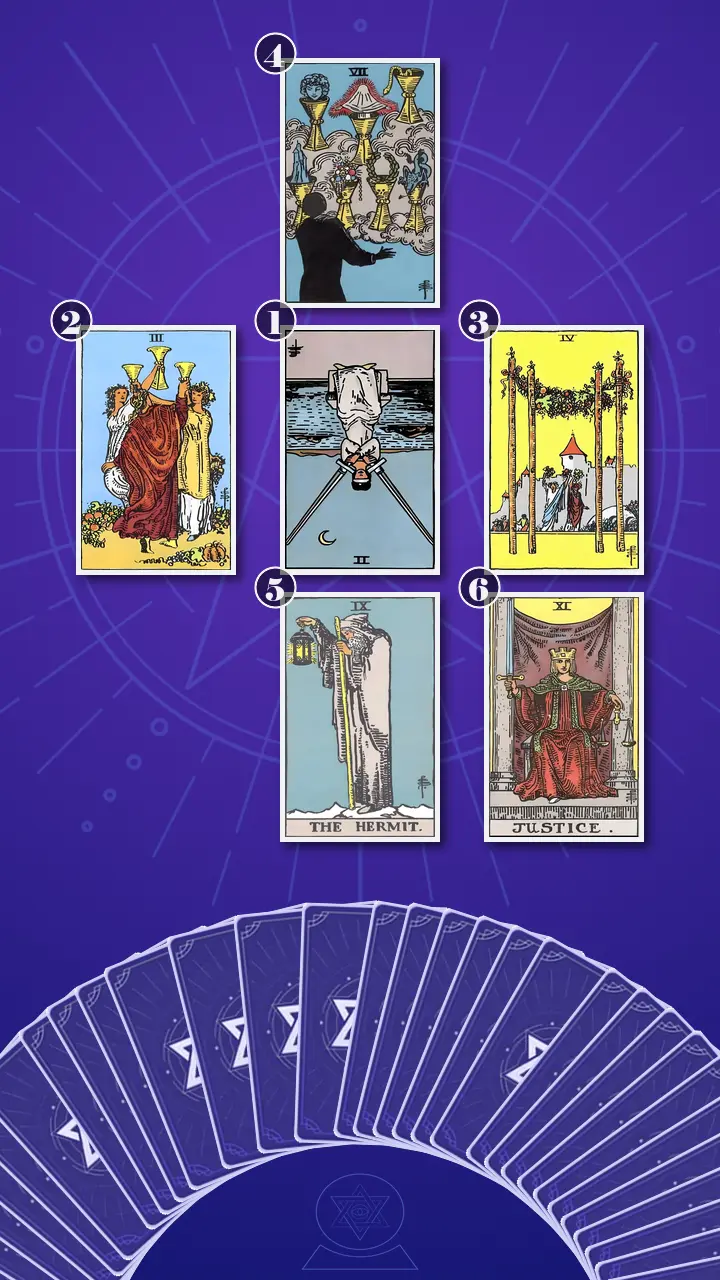
I previewed the map. “Card 1 is the stuck point you can feel right now. Cards 2 and 3 are your two paths—what each plan gives you and what it asks of you. Card 4 is the ‘thought bubble’: the FOMO projector. Card 5 is your inner compass. Card 6 is how to communicate and follow through without spiraling.”
Reading the Map: Two Paths and a Thought Bubble
Position 1: The observable present-moment stuck point
“Now we’re looking at the card that represents the observable present-moment stuck point: how indecision and people-pleasing show up in texts, planning, and body tension,” I said, and turned the first card.
Two of Swords, reversed.
It was almost too on-the-nose. The image is tension held tight: crossed swords against the chest, eyes covered. And in Jordan’s modern life, it translated perfectly into the scene they’d described: standing in front of the closet at 6:30 p.m. with one outfit half-on, thumb bouncing between two group chats, asking for logistics because it buys time. “Maybe” to both, so they don’t have to feel the door closing—while their chest stays tight like they’re bracing for someone to take it personally.
In energy terms, this is Air blocked: the mind trying to solve an emotional problem with optimization. The reversal isn’t “bad”—it’s just honest. It shows how the decision becomes a protection strategy: if you don’t commit, you can’t be accused of choosing wrong. But the cost is immediate: you’re tense before you’ve even left the house.
I let the words land, then said the line I’ve learned people need to hear early: “You’re not indecisive because you’re flaky—you’re indecisive because you’re trying to protect belonging.”
Jordan didn’t nod. Instead, they let out a small laugh—dry, almost embarrassed—and their eyes flicked away from the card like it had said something too personal. “That’s… so accurate it’s kind of brutal,” they murmured.
“Brutal,” I agreed softly, “and also workable. Archaeology teaches you this: when you finally name the layer you’re standing in, you stop digging in circles.”
Then, staying practical, I asked, “In the last hour, what have you been doing—texts, checks, ‘maybes’—that keeps both options alive but keeps you tense?”
Position 2: Path A — Friend Group 1
“Now we’re looking at the card that represents Path A: what you gain (and what it asks of you) if you commit to Friend Group 1,” I said, and turned the next card.
Three of Cups, upright.
In modern terms, this is the plan where you can show up as-is: the cozy bar, someone already saved you a seat, the conversation actually slows down. You leave feeling emotionally fed—like you didn’t have to perform, just participate. The ‘ask’ here is simple and, for someone with group chat anxiety, strangely hard: presence. You can’t half-attend and still get the warmth.
Energetically, this is Water in balance: connection that nourishes rather than stimulates. It’s not trying to be cinematic. It’s trying to be real.
I watched Jordan’s face soften by half a degree—the tiny shift people make when their body recognizes the truth before their brain has a rebuttal ready.
“If your goal tonight,” I asked, “is to feel seen and restored, which plan offers that kind of simple closeness?”
Position 3: Path B — Friend Group 2
“Now we’re looking at the card that represents Path B: what you gain (and what it asks of you) if you commit to Friend Group 2,” I said, and turned the third card.
Four of Wands, upright.
This one often feels like the “main event” card. In Jordan’s life: a bigger crowd, louder energy, that satisfying sense of I showed up. It can be genuinely fun—especially if you want momentum and celebration—but it carries an unspoken pressure to be seen there. The ‘ask’ is commitment without performance spirals.
Energetically, it’s Fire in balance—but Fire is persuasive. It can warm you, or it can start bargaining with you: Wouldn’t this look better? Wouldn’t this count more?
I said it plainly. “Notice whether you’re drawn to this plan because it aligns with you, or because it’s the most socially legible choice. One is desire; the other is defense.”
Position 4: The FOMO projector
“Now we’re looking at the card that represents the FOMO projector: what you’re imagining you’ll miss, and how that mental movie distorts the choice,” I said, and turned the fourth card.
Seven of Cups, upright.
Here it was: the cloud of options, the floating fantasies. I’ve called it many things over the years, but Jordan’s generation has a clean phrase for it: the highlight reel.
In their modern scenario, it’s brutally specific: their brain runs two parallel movies. In one, they’re missing the “real night” and everyone bonds without them; in the other, they picked the wrong vibe and they’ll feel stupid tomorrow. A single Story thumbnail turns into a full narrative. They’re not choosing between two real plans anymore—they’re choosing between two imagined highlight reels.
I leaned into the screen-versus-room contrast. “This is the part where Instagram Stories becomes a live broadcast you didn’t ask to be part of—and your nervous system reacts as if the other group’s fun is evidence against your belonging.”
Then I gave them the simplest spell-breaking sentence I know: “That’s a highlight reel, not a fact.”
Jordan’s thumb—resting against the side of their phone—stopped moving. Their breath caught for a second, their gaze went unfocused like they were replaying a memory, and then they exhaled through their nose, slow. Not relief yet. More like: Oh. There’s a name for this.
“When you feel the urge to check,” I asked, “what are you picturing you’ll miss—and how sure are you that the picture is real?”
When The Hermit Lit One Lantern
Position 5: Your real need tonight
I paused before turning the fifth card. The room felt quieter in that way it does when the central question finally becomes visible. “This,” I told Jordan, “is the card for your real need tonight: the internal compass point that makes the choice simpler and more honest.”
The Hermit, upright.
The lantern glowed from the card like a small, stubborn truth. In the modern translation, it was immediate: you put the phone face-down and ask one quiet question—What would actually feel good tomorrow morning? Not what looks best online. Not what’s most impressive. Just what meets one real need tonight: rest, depth, play, or novelty.
The Hermit’s energy is Earth grounding: selective attention, discernment, quality over quantity. It doesn’t reject people. It rejects noise.
And because I’m who I am—an archaeologist who has watched entire cities rise and fall based on what they chose to value—I reached for a framework I trust: historical case matching. “Civilizations,” I said, “don’t usually collapse because of one dramatic mistake. They erode because, over and over, they confuse loudness with importance. The Hermit is the opposite instinct. It’s the settlement choosing the reliable well over the flashy parade.”
Jordan’s mouth tightened. “But if I choose the quiet plan,” they said, “what if everyone else bonds without me? What if… I chose the wrong timeline?”
That was the exact moment the old story tried to reclaim them. So I followed the Hermit’s logic: one light, one sentence.
Here is the setup, exactly as their nervous system lived it: It’s 6:30 p.m., they’re half-dressed, phone warm in their hand, toggling between two chats like the “right” plan is about to reveal itself. Their chest is tight—not from excitement, but from the pressure to stay included everywhere at once.
Stop treating Friday night like a popularity referendum; choose by the lantern of what you need, not the floodlight of what you might miss.
Jordan reacted in a three-beat chain I’ve come to recognize as real insight, not polite agreement. First: a physical freeze—shoulders held, breath briefly suspended, fingers hovering like they were about to type. Second: the mind absorbing—eyes glassing over, as if their brain replayed every “maybe” text they’d ever sent. Third: the release—an exhale that dropped their shoulders a full inch, followed by a blink that looked suspiciously like they were fighting tears and laughing at the same time.
“But… doesn’t that mean I’ve been doing it wrong?” they asked, and there was a flash of anger in it—toward themselves, toward the whole social economy, toward the feeling that a normal Friday had become an exam.
I met it directly. “It means you’ve been trying to solve belonging like it’s a one-night referendum. That isn’t ‘wrong’—it’s protective. But it’s expensive. Tonight, we’re testing a cheaper strategy: one honest need.”
I invited them into a small experiment, because the Hermit is not about grand declarations; it’s about a single steady criterion. “Open Notes,” I said. “Write one line: Tonight I need ____—rest, depth, play, or novelty. Set a 15-minute timer. When it ends, you choose. Not perfectly. Honestly.”
Then I asked the question that anchors the transformation in lived reality: “Now, with this new lens—can you think back to last week? Was there a moment where the ‘floodlight’ of what you might miss hijacked you, and this lantern question would have changed how you felt?”
Jordan nodded once, slow. “Yeah,” they said. “I was at dinner with one group and kept checking the other chat like I was… grading my own night.”
“That,” I replied, “is the shift: from comparison to presence. From imagined regret to grounded enjoyment.”
Justice, or: The Clean Yes / Kind No
Position 6: Integration and communication
“Now we’re looking at the card that represents integration and communication: how to choose, set expectations, and enjoy the night without future regret spirals,” I said, and turned the final card.
Justice, upright.
Justice is the card people think will feel cold. In practice, it feels like relief. Scales and sword: care plus clarity. A decision you can stand behind.
In Jordan’s modern scenario, Justice looked like two texts that don’t read like a legal brief: one clean yes, one kind no. No hedging. No over-explaining. No keeping the night “on appeal” with continuous renegotiation.
I said the line I wanted them to remember the next time they hovered over the keyboard: “A clean yes is kinder than a shaky maybe.”
Then I did what I always do when someone’s people-pleasing wants to turn a simple boundary into a closing argument: I gave them a script.
“Type this,” I said. “And then watch the urge to add disclaimers. That urge is not politeness; it’s anxiety trying to manage someone else’s interpretation.”
Jordan’s eyes narrowed in concentration—like they were bracing for the emotional aftershock of being straightforward. I watched them swallow once. Their shoulders rose. Then, as they imagined sending the message without a paragraph attached, their jaw unclenched a little, like a knot remembering it’s allowed to loosen.
Justice also demanded one boundary so the decision could stay real. “For the first hour after you arrive,” I said, “Do Not Disturb. Let yourself actually arrive. You can allow calls from two favorites if you need a safety net.”
The One-Page Voyage Log for Your Next 48 Hours
I pulled the whole spread together for Jordan the way I’d outline a site report after an excavation: not as judgment, but as a coherent story of cause and effect.
Two of Swords reversed showed why this feels like a trap: indecision masquerading as kindness, but functioning as self-protection. Three of Cups and Four of Wands clarified that neither plan is “wrong”—they’re different nutrients. Seven of Cups named the real culprit: the mental highlight reel that inflates stakes and turns a normal choice into a referendum. The Hermit offered the antidote: one lantern-need that cuts through noise. And Justice delivered the practical outcome: clean communication and a boundary that protects presence.
The cognitive blind spot was clear: Jordan had been treating future regret like a fact, and belonging like something you prove in one night. The transformation direction was just as clear: shift from trying to avoid regret to choosing based on one clear need tonight—and communicating that choice directly, with integrity.
To make it concrete, I taught them a method I use in the field: Time Stratigraphy. “In archaeology,” I told them, “you don’t mix layers. You separate what’s recent and reactive from what’s older and enduring. Do the same here: separate the impulse to be seen (the newest, loudest layer) from the longer-term value of being consistent and honest with both groups.”
Then I gave them a short, workable plan—what I call a Voyage Log, because ancient navigators didn’t wait for perfect weather; they logged, adjusted, and sailed by reliable stars.
- The 15-Minute Decision TimerSet a 15-minute timer. Choose one need for tonight: rest, depth, play, or novelty. When the timer ends, you pick—even if it’s not “perfect.”If resistance pops up (“I should just be flexible”), don’t argue. Shrink it: you’re not deciding your social life—just one night. Take three slow breaths before opening any other app.
- The Lantern Question (No-Stories Test)Open Notes and answer: “If no one posted anything tomorrow, which plan would still feel right?” Write the answer before you text anyone.If you catch yourself writing a paragraph, you’re slipping back into optimization. One line only—like the Hermit’s lantern, not a floodlight.
- Clean Yes / Kind No + One-Hour Presence ShieldSend two texts: (1) Clean Yes: “I’m in for tonight—what time are we meeting?” (2) Kind No: “I can’t make it tonight, but I’d love to catch up soon—are you free Sunday afternoon?” Then put your phone on Do Not Disturb for the first hour after you arrive (allow calls from two favorites if needed). Mute the other group chat for the night.If they push for details, reply once: “Nothing dramatic—I’m just choosing one plan tonight. Have so much fun.” If you break DND once, don’t spiral—restart the next hour. You’re practicing, not performing.

A Week Later: Ownership, Not Certainty
A week later, Jordan messaged me on a Thursday afternoon—right in the pre-Friday ramp-up when the “Friday FOMO Scaries” start whispering. They’d used the Lantern Question, chosen depth, and sent the two texts without a paragraph. “I felt like I was being mean for about thirty seconds,” they wrote, “and then it was… fine. Like weirdly fine.”
They told me the bittersweet part too, which is how I know the change was real: they slept a full night, but in the morning their first thought was still, What if I chose wrong? Only this time, they noticed the thought, smiled a little, and didn’t pick up their phone like it was evidence.
This is what a Journey to Clarity usually looks like in practice: not certainty, but ownership. Not proving belonging in one night, but building it over time—through honest choices and clean communication.
When two plans are pulling at you at once, it can feel like your chest is a little too tight and your phone is a little too loud—like choosing one door means proving you deserve to stay included behind the other.
If you trusted that belonging doesn’t vanish in one missed night, what’s the one need you’d let guide your next Friday choice—rest, depth, play, or novelty?
Every reading at AceTarot is a journey to connect with inner wisdom and empower your next step. The stories shared here are psychological mirrors, not private records—crafted to reflect universal emotional loops and help you find your own clarity. Learn more about our Journey to Clarity.
Author Profile