When "Pick Any Topic" Triggers a Freeze: The One-Spark Draft Plan

When “Pick Any Topic” Feels Like a Spotlight
When your advisor says “Pick any topic,” your throat tightens and your brain goes blank like you just got cold-called for your entire personality.
Alex (name changed for privacy) sat across from me in my small studio space, jacket still on like she hadn’t fully decided she was allowed to take up the chair. She told me about 2:18 PM in a glass-walled office hours room—Toronto winter light bouncing off the hallway tiles—when her advisor smiled and said, “Pick any topic.”
“My mouth went dry,” she said. “I nodded like I was thinking, but it was just… static. Like my brain got unplugged.”
I could see it as she described it: shoulders inching up toward her ears, the held-breath feeling sitting high in her chest. Pressure, but not the dramatic kind—more like a hand closing around your throat in a quiet room where everyone is waiting.
She wasn’t short on ideas. She was short on safety. The core contradiction was right there in how she said it: she wanted a topic that felt truly hers, but she was terrified that choosing “wrong” would make her look incompetent.
“A blank prompt can feel like a spotlight, not an invitation,” I said gently. “We’re not here to force you into the perfect answer. We’re here to find clarity—real, usable next steps—so the next time you’re asked, you can move instead of freeze.”

Choosing the Compass: A Tarot Spread for Decision Paralysis
I asked Alex to take one slow breath—not as a mystical ritual, just a nervous-system reset. Then I shuffled while she kept the question simple in her mind: “Pick any topic”—why do I freeze? What’s next?
“Today I’m going to use a spread I love for open-ended prompt anxiety,” I told her. “It’s called the Four-Layer Insight Ladder · Context Edition.”
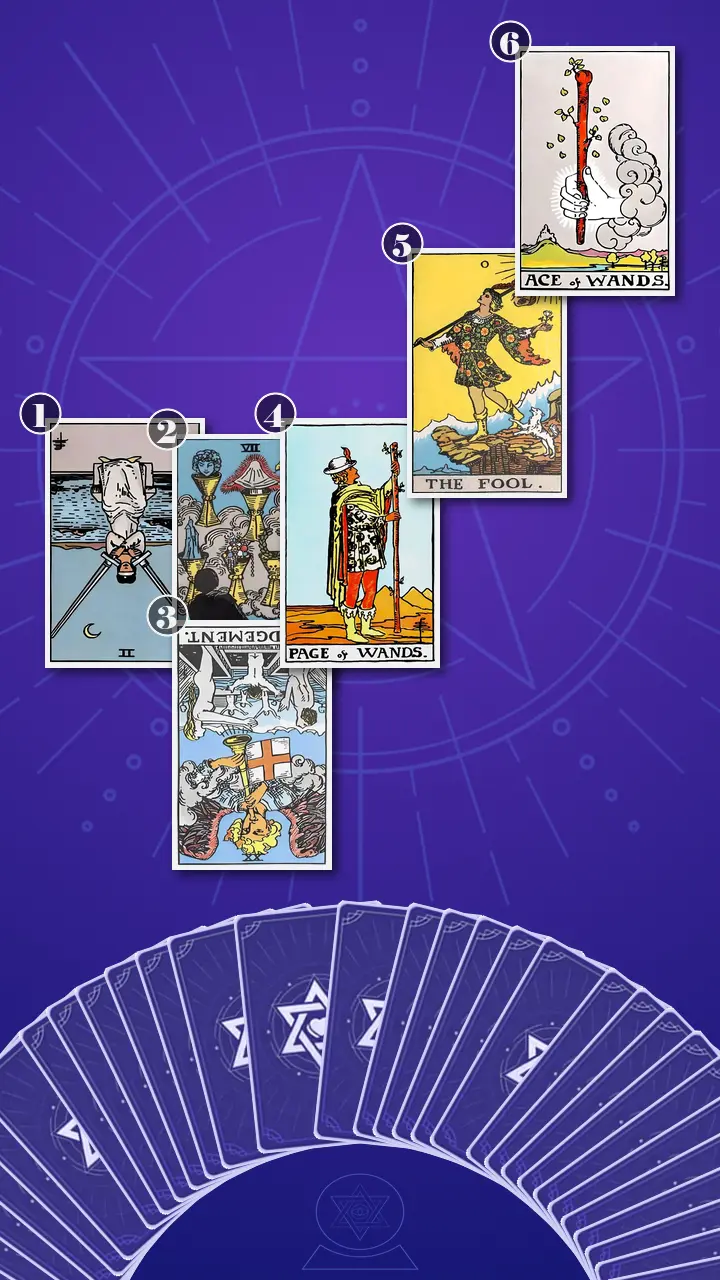
For readers who’ve wondered can tarot help with overthinking and fear of being judged?—this is exactly why this 6-card ladder works. Alex’s problem wasn’t a lack of options. It was an internal fear loop: ambiguity + perceived evaluation = shutdown. A smaller, structured spread keeps us practical. It maps the freeze you can see, the overload that fuels it, the deeper fear underneath, then pivots into a resource, a turning point, and one grounded next step.
I laid the cards in a straight line like rungs: 1 → 2 → 3 → 4 → 5 → 6. “The first card is the freeze snapshot—what it looks like in the room. The third card is the deeper ‘what’s really at stake’ layer. And the fifth is our bridge: the mindset shift that unlocks movement.”
Reading the Ladder, One Rung at a Time
Position 1: The Freeze Snapshot
“Now we turn over the card that represents what the freeze looks like in real time: the specific way you stall, blank out, or defer when asked to choose.”
Two of Swords, reversed.
“In the room—office hours, a thesis check-in—someone says, ‘Pick any topic,’ and you feel your throat clamp,” I said, using the scene exactly as it showed up between us. “You smile, say you’re ‘still exploring,’ and quietly rotate between two ‘safe’ ideas in your head—never saying either—because once you say one out loud, it feels like you’ve volunteered to be evaluated on it.”
Reversed here, this isn’t calm indecision. It’s a blockage: self-protection so tight it becomes visible. The blindfold and crossed arms aren’t subtle—your body is literally saying, don’t make me real.
I leaned in a little. “The inner logic is brutal but coherent: ‘If I say it, it becomes real → if it becomes real, it can be judged → so I’ll buy time.’ Silence feels like safety… until it starts multiplying pressure.”
Alex gave a quick laugh—dry, a little bitter. “That’s… painfully accurate. Like, rude,” she said, but her eyes softened the second she said it, like being seen was a relief even when it stung.
Position 2: The Overload Amplifier
“Now we turn over the card that represents what makes it harder: the form of option overload or ambiguity that spikes the problem in the moment.”
Seven of Cups, upright.
“You get home, open your laptop, and immediately start building a ‘perfect research nest’: 20 tabs, a Notion board, a Notes list, a saved TikTok folder,” I said. “Every topic looks brilliant for a moment—until the next option makes it feel flimsy. The night ends with more material and less certainty, and the blank doc still blank.”
This card is excess. Too many shimmering possibilities, none with weight. The cups float like browser tabs in the cloud—pretty, seductive, and impossible to stand on.
I watched her hands while I spoke. Her thumbs did the tiniest scroll motion against each other, muscle memory from doomscrolling. “More tabs won’t make you safer; one sentence will,” I said. “Seven of Cups isn’t a lack of creativity. It’s creativity with no container.”
Position 3: The Inner Tribunal
“Now we turn over the card that represents what’s really at stake: the underlying fear about identity, competence, or being evaluated.”
Judgement, reversed.
“Before you even choose, you start pre-answering the criticism: ‘This is basic,’ ‘This is too broad,’ ‘This isn’t original,’” I said. “You rewrite your idea to sound smarter and more complex, not because it’s truer—but because it feels safer to be impressive than to be real. The original spark gets edited out to avoid imagined judgment.”
Judgement reversed is a distortion: evaluation energy turned inward until it becomes an inner tribunal. The advisor’s neutral face becomes a projected panel of judges. It’s like writing the mean Reddit comments you assume you’ll get… before you’ve even written the pitch.
Alex’s shoulders dropped a fraction. Her gaze went slightly unfocused, like she was replaying a meeting in her head. “I always thought I was just… bad at choosing,” she said quietly. “But this feels more like I’m… scared to be seen choosing.”
“Exactly,” I said. “That’s not laziness. That’s fear-of-being-judged indecision.”
Position 4: The Underused Resource
“Now we turn over the card that represents the resource you’re underusing: a strength that already exists and can be accessed quickly.”
Page of Wands, upright.
“When you’re talking casually—walking to grab coffee, texting a friend—you suddenly light up about a niche question or a strange connection you noticed,” I said. “That version of you is quick and alive. Then the second you remember it has to be ‘good,’ you flatten it into something safe and sterile.”
This is Fire in balance: curiosity, early-stage courage, the right to be a beginner. The Page isn’t trying to be impressive. He’s interested. That’s the part of Alex that exists—she just doesn’t let it drive when the “advisor spotlight” turns on.
She pressed her lips together, then nodded once. “I do have ideas,” she admitted, like it surprised her to say it out loud. “I just… don’t trust them.”
When The Fool Stepped Off the Cliff (and the Air Changed)
Position 5: The Turning Point Bridge
I paused before flipping the next card. The room felt quieter—not dramatic, just… more attentive. Even the street noise outside my window seemed to step back.
“Now we turn over the card that represents the key shift that unlocks movement: the bridge from waiting-for-certainty to starting-with-curiosity.”
The Fool, upright.
In my head, I flashed to a scene from classic cinema—the moment a character walks out of a cramped apartment and the camera finally finds sky. That’s The Fool’s whole language: air, space, movement. The opposite of a courtroom.
Setup (the stuck loop, in real life): I told her, “I keep seeing you at 8:47 PM on the TTC ride home, laptop on your knees, reorganizing the doc title instead of writing—because choosing a topic still feels like choosing how you’ll be judged. Your brain is trying to solve identity with certainty, and it keeps coming up empty.”
Delivery (the line that changes the lens):
Stop treating the first choice as a final verdict; take the Fool’s first step and let the path teach you what your topic really is.
I let it sit there for a beat.
Reinforcement (what shifted in her body): Alex’s reaction came in layers. First, a small freeze—her inhale stopped halfway, like her ribs forgot how to move. Then her eyes drifted off the cards and past my shoulder, unfocusing the way people do when they’re suddenly watching an old memory on an internal screen. Finally, she exhaled—one long, shaky breath that sounded almost like a laugh that didn’t fully happen.
“But… if I do that,” she said, and her voice sharpened with a quick flare of anger, “doesn’t it mean I’ve been doing it wrong this whole time? Like I wasted so much time?”
I didn’t rush to soothe it. “It means you’ve been trying to protect something important,” I said. “And protection is not the same thing as failure.”
Then I pulled in one of my own anchor tools—my Einstein thought experiments. “Einstein didn’t wait for the universe to hand him the perfect dataset before he moved. He ran small, clean thought experiments: What if I rode alongside a beam of light? He wasn’t branding himself. He was learning. The Fool is that same energy applied to your topic: a controlled experiment, not a permanent label.”
“Here’s the practice I want you to borrow from this card,” I continued. “A 10-minute ‘Temporary Topic’ drill: set a timer for 10 minutes. Pick one idea—any one—and write a five-sentence mini-pitch (what it is, why it matters to you, one example, one question, one next step). Stop when the timer ends. If you feel your chest tighten or your thoughts start spiraling, pause and step away—this is practice, not a test.”
Then, exactly as I always do when The Fool appears, I asked the question that turns insight into evidence: “Now—use this new lens and think back. Last week, was there a moment when you felt the urge to keep options open? If you had treated the choice like a draft, how would that moment have felt different?”
Alex swallowed—her throat still tight, but less locked. “I would’ve said one idea out loud,” she whispered. “Even if I wasn’t sure.”
And right there, the emotional transformation cracked open: from performance-pressure paralysis and an inner tribunal… to curiosity-led experimentation and self-trust built through action.
Position 6: The Grounded Next Step
“Now we turn over the card that represents a grounded next step: one concrete way to move forward this week without needing the perfect topic.”
Ace of Wands, upright.
“You make one concrete thing this week—one page max: a question statement, a micro-outline, or a mini-pitch you can show someone,” I said. “As soon as the idea exists in the real world (not just in your head), your energy shifts from panic to momentum, because now you can refine based on feedback instead of fear.”
The Ace is Fire in pure ignition. Not the whole bonfire. Just the match. It’s the opposite of the Seven of Cups—one living spark you can hold.
From Inner Tribunal to Actionable Advice: The One-Spark Draft
When I looked back across the whole ladder, the story was almost painfully clear. In the room, Two of Swords reversed: Alex protects herself by not choosing out loud. Immediately after, Seven of Cups: she tries to manufacture safety through option overload, the research spiral that looks productive but keeps everything hypothetical. Underneath, Judgement reversed: the prompt becomes a verdict fantasy—submit your personality for review. The Page of Wands reminds her she already has real sparks, but she edits them too early. The Fool changes the contract: your first topic isn’t a verdict—it’s a draft. And the Ace of Wands makes it tangible: one small output that creates real feedback, which creates real clarity.
The cognitive blind spot wasn’t “I don’t have a niche.” It was: “If I choose, I’m on trial.” Once you name that, the transformation direction gets simple: move from trying to prove yourself with the perfect topic to building self-trust through small experiments.
Alex blinked and said, very practically, “Okay, but… I work part-time and I’m in two seminars. I barely have five minutes some days.”
“Good,” I said, coach-voice on purpose. “Then we design this so five minutes counts. Temporary picks are still real movement.”
- The 24-Hour Temporary Topic (Out Loud)Text or voice-note one person today (a friend, classmate, mentor): “I’m trying [topic] for the next 24 hours.” Say it as a time-boxed experiment—no defending paragraphs.If your throat tightens, send it as a voice note while walking outside. Movement lowers the “courtroom” feeling.
- The 10-Minute Five-Sentence Mini-Pitch (Topic v0.1)Set a 10-minute timer. Pick one idea and write five sentences: (1) what it is, (2) why it matters to you, (3) one example, (4) one question, (5) one next step. Save it as “Topic v0.1 — May 11.” Stop at the timer.Expect the “this is cringe / too basic” voice. Label it inner tribunal and keep writing anyway. If 10 minutes is too much, do 2 minutes.
- The Three-Tab Rule (Research After Output)Only after you’ve written the five sentences, you’re allowed to open up to three tabs—max—to support the pitch. No tab opening before the sentences exist.If you feel the urge to reorganize folders or fonts, do my “Manuscript Mindmaps” workaround: mirror-write one messy mindmap for 90 seconds on paper first. Then return to the doc.

A Week Later: The Quiet Proof
A week later, Alex messaged me from the TTC: “I did the Topic v0.1 thing. It was embarrassing for like two minutes. Then it was… fine. I brought it to office hours. I didn’t die.”
She told me she’d slept through the night for the first time in weeks—then admitted that the next morning, her first thought was still, what if I picked wrong? But this time she noticed the thought, exhaled, and opened the doc anyway.
That’s the real Journey to Clarity I see again and again: not a perfect answer dropped from the sky, but a shift from being judged by your first move… to learning from it. From “I need certainty” to “I can start, and adjust.”
When it’s your turn to answer and your throat tightens, it can feel like you’re not choosing a topic—you’re choosing whether you deserve to be taken seriously.
If you didn’t need your first topic to prove anything about you, what’s one small spark you’d be willing to begin with—just long enough to learn what it turns into?