Missed-Deadline Shame Spiral—and the Two-Sentence Start to Repair

Finding Clarity in the 1:12 a.m. Slack Glow
If you're a late-20s agency person who can manage everyone else's timelines but goes completely silent the second a follow-up Slack lands after one missed deliverable, this will probably feel painfully familiar. Jordan (name changed for privacy), a 27-year-old junior project coordinator in Toronto, booked my Zoom session with one question: why do I stop eating, sleeping, and replying after missing a deadline?
When her camera came on, I could see the remains of the exact kind of night she meant. It was 1:12 a.m. in her small rental kitchen downtown. Slack was still open on her laptop. The microwave had just clicked off beside the same pasta she'd reheated twice. The light on her face was blue and mean; the coffee in her mug had that burnt, stale smell of something reheated past the point of comfort.
'I know disappearing makes it worse,' she said, looking at three half-written updates on her screen. 'I just can't make myself hit send. If I reply before I have a fix, it feels like I'm admitting I'm incompetent.' Then, softer: 'Once I'm late, my whole body acts like I'm in danger.'
I believed her immediately. What she was describing was a mistake-triggered shutdown after missing a deadline at work, and her body was carrying every second of it. The shame in her wasn't abstract. It sat in her like a smoke alarm wired straight into her stomach—shrill, invisible, impossible to negotiate with. I could see it in the tight jaw, the knotted belly she kept pressing with her palm, the wired stillness of someone who hadn't eaten enough and definitely hadn't rested enough.
I told her, 'What you're describing isn't just poor time management. You want to repair the missed deadline and reply, but another part of you is terrified of what facing it will expose. So tonight, let's make a map for the fog and find the cleanest path back to clarity.'

Choosing the Compass: A Five-Card Cross for Why You Go Silent After a Work Mistake
I asked her to plant both feet on the floor, take one slow breath, and say the question out loud once. Then I shuffled slowly at my desk, not as theater, but because the hands need something steady when the nervous system is running hot.
For a question like this, I use a Five-Card Cross tarot spread. It's one of the clearest ways I know to understand why someone goes silent after a work mistake. Instead of drowning the moment in ten different angles, this spread separates the visible shutdown pattern, the coping move that makes it worse, the deeper fear underneath it, the corrective perspective, and the next embodied step. This is how tarot works when it is most useful for feeling stuck, career crossroads, and decision fatigue: card meanings in context, not abstract fortune-cookie language.
I told her what I was looking for. The center card would show the shutdown itself: not eating, not sleeping, not replying. The crossing card would show the defensive move that intensifies it. The card underneath would reveal why one late task feels identity-threatening. The card above would offer the reframe. The card to the right would show the next grounded repair step.
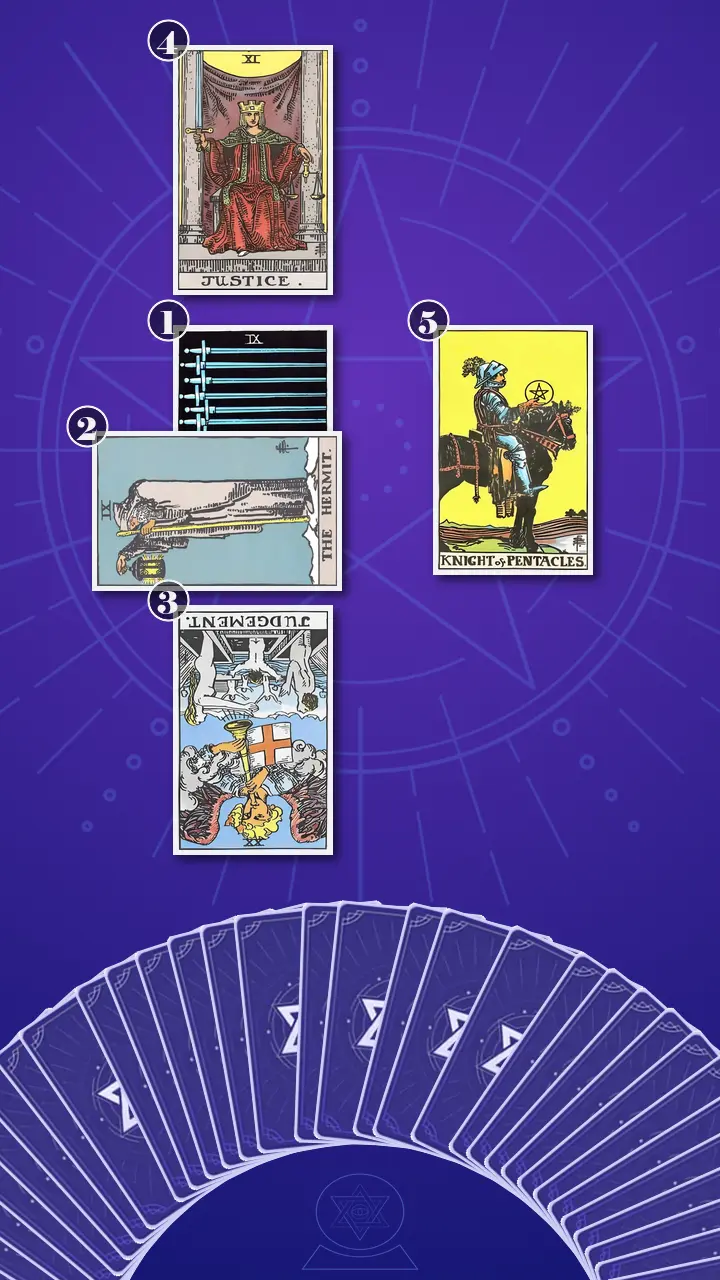
Reading the Map of the Missed Deadline Shame Spiral
Position 1: The Night Alarm
I turned over the card representing the visible shutdown pattern named in her question. Nine of Swords, upright.
I didn't need to stretch for the meaning. This was Jordan at 2:40 a.m., refreshing Slack, rereading the missed timestamp in her head, and polishing explanations while her actual body got shakier and less functional. The work issue was real, yes—but her mind had turned it into an overnight emergency, the way one browser tab auto-plays worst-case scenarios until the whole laptop sounds like danger.
In energetic terms, this was excess Air: too much thinking, none of it useful. Thought had stopped being a tool and become a punishment chamber. 'This is the part,' I told her, 'where you are not even solving it anymore. You are just staying loyal to the panic.' Her mouth twitched into a bitter little laugh. 'Wow,' she said. 'That's accurate enough to be rude.' Even as she said it, her hand went to her chest, as if some part of her felt relieved to have the midnight version of herself recognized instead of judged.
Position 2: Silence in a Responsible Outfit
Next came the card representing the coping move that intensifies the spiral: retreating from contact and trying to handle the fallout alone. The Hermit, reversed.
Reversed, the Hermit's lantern doesn't light the path; it narrows into private, hidden information. I told Jordan this looked exactly like the moment on Line 1 when she sees the follow-up Slack, flips her phone face down, and tells herself silence is the mature choice because she's still 'working on it.' In real life, though, that private regroup becomes a mini-exile. It's like closing Slack to get clarity and accidentally building a bunker instead. The team has less information, she has more shame, and now the problem includes a communication gap on top of the task itself.
This was blocked wisdom: solitude turning into disappearance. 'Silence feels protective for an hour and expensive for the next two days,' I said. She stared at the card and whispered, 'I really do call it being responsible when I'm actually hiding.' Her shoulders lifted toward her ears and then loosened a fraction, the way people do when a defense finally gets named without being mocked.
Position 3: The Inner Verdict
The third card was the foundation: the deeper fear and self-judgment that make a late task feel like a threat to identity rather than a manageable mistake. Judgement, reversed.
This is one of the hardest cards to receive in a work-shame reading, because it shows the exact moment a practical miss becomes a character sentence. I told her this was like opening a simple message—any update on this?—and hearing it not as a project question but as a notification blast through the nervous system: now they know what you really are. The task was late, but her body heard accusation. That is why the mouth goes dry, the chest goes hot, the hands hover over the keyboard and refuse to land.
I asked her, 'If they know you're late, they'll think you are... what?' She didn't answer right away. Outside my studio window, a siren passed and then the room went strangely still. Finally she said, 'Unreliable.' Then, after a swallow: 'And kind of... fake. Like I'm only organized until I'm not.' That was the true root. LinkedIn competence culture, polished agency energy, the whole beautiful-Notion-dashboard version of adulthood—one slip, and her inner voice turned it into a full performance review of her worth.
When Justice Held the Sword Upright
Position 4: The Antidote
When I turned the fourth card, even the call seemed to quiet down. This was the position offering the central reframe that interrupts the shame spiral and points toward proportion, accountability, and self-respect. Justice, upright.
Whenever Justice appears in a reading like this, my mind flashes to the jury room in 12 Angry Men: the heat, the certainty, the way emotion keeps trying to pose as evidence until one person starts separating fact from assumption. Before I said anything else, I used one of my favorite Einstein-style thought experiments—the kind that changes the frame so the hidden law becomes visible. I asked Jordan, 'If the most reliable coworker you know missed the exact same deadline and sent a short update before she had the full fix, would you decide she had no worth? Or would you think she was late and handling it?'
She blinked. 'I'd think she was late and handling it.'
At 1:12 a.m., with Slack still open and dinner untouched beside you, it can honestly feel like replying before you have the full fix would expose you more than the missed deadline itself.
This missed deadline is not proof that you are fundamentally unreliable; hold the sword upright, balance the scales, and answer the real issue with proportionate action.
The spiral is not proof that you care more. It is what happens when a work problem gets mistaken for a worth problem. A missed deadline is a problem to communicate, not a character reference.
Jordan went completely still. First came the freeze: her breathing paused and her fingers hovered above the mug like a loading icon. Then came the cognitive hit: her eyes slipped past my camera, unfocused, as if replaying every unanswered Slack and every draft apology she'd ever tried to perfect into innocence. Then the feeling broke through, but not as instant relief. 'But doesn't that mean I've been putting myself on trial every single time?' she said, sharper now, angry in the way people get when clarity arrives a second before compassion does.
'Yes,' I said. 'And that anger makes sense. You built a survival system around not being seen mid-mistake. But Justice isn't asking you to be softer with facts. It's asking you to stop using facts as weapons.' I had her open her Notes app and type three lines, each under twelve words: Fact. Story. Next Step. The fact: 'I missed the deadline.' The story: 'This proves I'm unreliable.' The next step: 'Send the update by 10:15.' I told her that if her chest spiked or her hands went numb, she could stand up, drink some water, and send the shorter version later rather than perfecting the longer one. She was allowed to stop after that first contact. Her face changed as she wrote. The tight line of her jaw eased. One shoulder dropped, then the other. Her exhale came out shaky, almost disbelieving, the kind that leaves a person a little lightheaded because the panic room door has opened and now there is space where there used to be pressure.
I asked her, 'Now, with this new perspective, think about last week. Was there a moment when this would have changed how your body felt?' She nodded immediately. 'The commute. 8:46. I could've sent two sentences instead of turning the whole train ride into a trial.' That was the hinge of the reading: from shame-driven disappearance and self-punishment to grounded repair and restored self-trust.
Position 5: One Boring, Solid Calendar Block
The final card translated the insight into an immediate recovery style: one steady, practical next step that repairs trust without self-erasure. Knight of Pentacles, upright.
I loved seeing him here. After all that air-heavy panic, this card brings Earth back into the room. Not a redemption montage. Not a heroic all-nighter. Just tea or toast, water by the laptop, one honest message, one 25-minute work block, one follow-up when promised. Less dramatic comeback scene, more one calm calendar block.
'Reliability comes back through boring acts, not dramatic self-punishment,' I told her. The Knight's horse is standing still for a reason. Recovery is deliberate pacing, not frantic speed. Jordan gave the smallest real smile of the session. 'That,' she said, 'I think I can actually do.'
From Courtroom Brain to Repair Brain
Seen together, the spread told a very clean story. Nine of Swords showed the visible collapse: missed deadline, no dinner, no sleep, no reply. The Hermit reversed showed the coping move: disappearing and calling it responsibility. Judgement reversed showed the root fear: one late task becoming evidence that she was fundamentally unreliable. Justice cut through the distortion by separating fact from self-attack. Then the Knight of Pentacles turned that clarity into grounded repair: food, water, a message, a manageable chunk of work. In other words, the reading moved her from courtroom brain to repair brain.
The blind spot was not the deadline itself. It was the belief that repair had to be earned through suffering. Jordan had been treating self-punishment like proof of accountability. The real shift was simpler and braver: move from treating a missed deadline as proof of personal failure to treating it as a signal to communicate, reset the body, and make one concrete repair step. That is proportionate accountability. Your body does not have to earn the right to be fed before you send an update.
Because her mind kept blending receipts with fanfiction, I borrowed another studio habit of mine and gave her a tiny Da Vinci-style note structure: put the fact on one line, the meaning your panic is adding on the next, and the next visible move underneath. When the page is separated, the nervous system often follows.
Your Next 48 Hours
- Build the Two-Sentence Repair Update.Save a note titled 'Late Update' with three lines: Fact / Impact / New timing. Within 30 minutes of noticing a miss, send the shortest honest version in Slack or email, even if you do not have the full fix yet.If timing is still unclear, use the placeholder version first: 'I'm behind on this and reviewing the fastest realistic timing now. I'll update you again by 11:00 a.m.'
- Use the Snack Before Send rule.Before you reopen the thread, eat something low-effort—toasted bread, yogurt, a banana with peanut butter, soup—and put water beside the laptop.The bar is intentionally low. Half a sandwich counts. One glass of water counts. Regulation is part of repair, not a reward for it.
- Do one 25-minute repair block.After the message is sent, set a timer and complete only the next 25-to-60-minute piece of work that visibly moves the task forward.Turn Focus mode off for 15 minutes, answer the oldest work ping before social media, and let one completed chunk matter more than a perfect recovery fantasy.
Jordan looked at the list and said, 'But what if I can't do all of that when I'm really in it? Sometimes even five minutes feels impossible.' I shook my head. 'Then we go smaller. One line counts. One sip of water counts. Repair starts before you feel fully ready.' That was the whole point: not becoming a different person by morning, but interrupting the spell early enough that the night stopped owning her.

A Week Later: The Quiet Proof
Five days later, she messaged me: 'Sent the update before I had the full fix. Ate toast. Slept. Woke up with the old what-if-they-think-less-of-me thought—but this time I made tea and sent the next check-in anyway.'
I sat with that for a moment after reading it. The deadline had still been missed. The work still needed repair. But she had crossed the real threshold: from self-punishment to self-respect, from disappearing to practical repair. That is what a journey to clarity often looks like in real life—less cinematic certainty, more honest contact and steadier hands.
When one missed timestamp makes your stomach drop and your whole body go quiet, it can feel like you have to earn the right to reply before anyone sees you being imperfect. But the moment you separate the fact from the story, the sword is already back in your hand.
If you treated the miss as something to address rather than something to hide, what would your smallest honest next message sound like?