When Guilt Felt Like Ethics: Relearning What a Closed Door Means
The Door Left Open Two Inches
When a warm, low-drama work-from-home person in a city apartment tells me she still leaves the bedroom door cracked before a Zoom call so it doesn't look too intense, I know I'm not hearing a bad-manners problem. I'm hearing boundary guilt.
Maya (name changed for privacy) sat across from me on a rainy Toronto morning and described 9:57 a.m. in her apartment so clearly I could almost hear it: Slack pinging from her laptop, the kettle clicking off in the kitchen, the hallway floor giving that tiny warning creak. She had one hand on the cool brass doorknob. She went to close it. She stopped. She reopened it two inches. Then she sent a cheerful message before anyone had asked a thing.
'I know it's just a door,' she said, looking down at her tea, 'but it still feels loaded.' The contradiction was right there in the room: she wanted privacy, and she was afraid that claiming it would make her look rude. The guilt lived in her body like a smoke alarm with no visible fire—shoulders up, breath held, that tiny flinch whenever she needed space.
I nodded. 'That makes sense to me,' I told her. 'If you grew up with porous privacy, a closed door can feel weirdly moral. But half-availability keeps the peace for a minute and drains the connection for hours. So let's not treat this like a personality flaw. Let's make a map for it, and see where the guilt is coming from—and where your clarity actually lives.'
Choosing the Shadow Spread for Boundary Guilt
I asked Maya to take one slow breath and keep the question simple in her mind: why does closing the door still feel rude? Then I shuffled slowly, not to create mystique, but to help her nervous system cross a threshold—from reacting inside the problem to observing it with me.
For this reading, I chose The Shadow Spread. I use it when the real issue isn't an external choice, but an old internal belief that still carries charge. In this case, the question wasn't whether closing a door is acceptable. It was why privacy still felt like a social offense. This spread works cleanly because it moves through exactly the layers the problem needs: the visible symptom, the inherited family script under it, the corrective truth that restores fairness, and the grounded daily practice that makes the shift real.
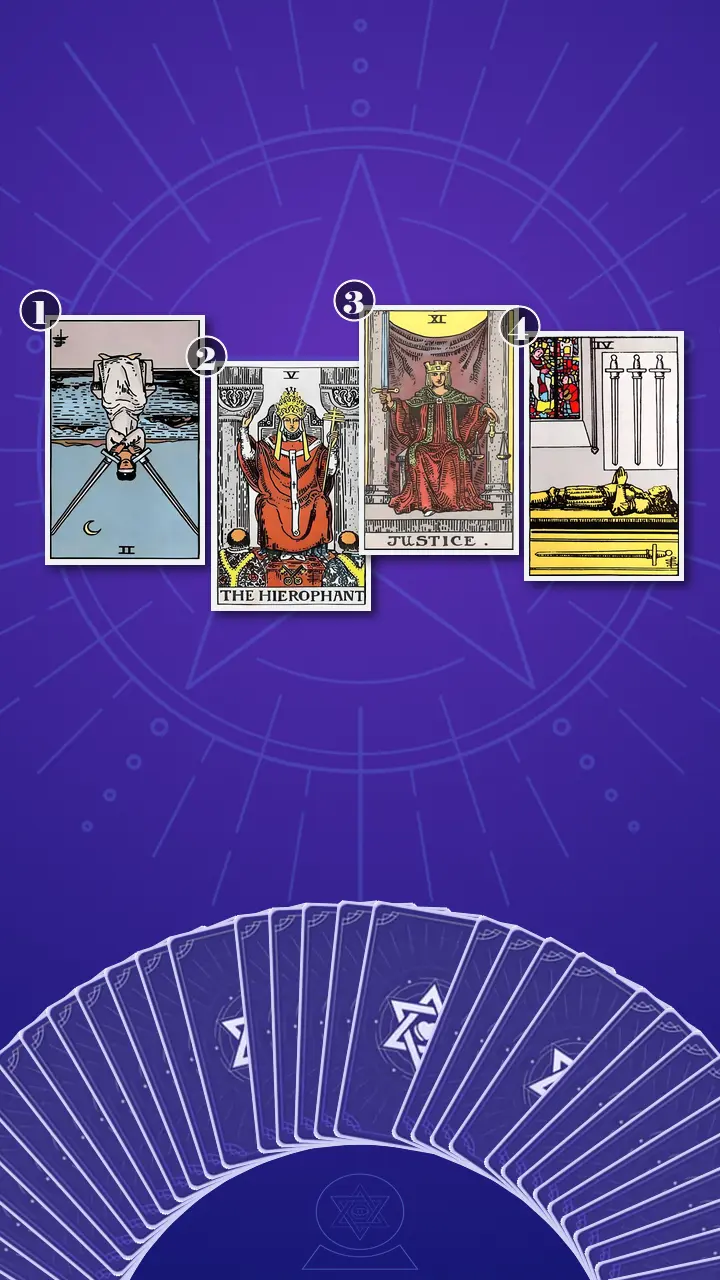
I told her what I would be looking for as I laid the cards left to right. The first position would show the presenting behavior: the half-open, half-apologetic way she handled privacy now. The second would reveal the hidden rule underneath it—the family code and belonging fear that made the whole thing feel morally loaded. The third, the pivot of the reading, would point to the truth that could loosen the guilt. The fourth would translate that truth into something livable: a repeatable way of taking space without turning it into drama.
Reading the House Manual
Position 1: The Door That Never Quite Closes
I turned the first card and said, 'This is the card representing the presenting behavior from the diagnosis: the half-open, half-apologetic way you're handling privacy right now.' It was the Two of Swords, reversed.
As soon as I saw it, the scene she had described came right back: a Toronto work-from-home morning, Maya reaching for the bedroom door before a meeting, hearing movement in the hall, leaving the door cracked instead of fully closed, then sending a light message so nobody had to react to a clear boundary. That is Two of Swords reversed in modern life. The blindfold becomes guilt-based mind-reading. The crossed swords mirror the way her chest, thoughts, and decision all lock up at once. This isn't balance. It's blocked Air—mental overload, social forecasting, and a simple need becoming an impossible referendum.
'This card is a half-made boundary,' I said. 'Not a dramatic no. Just enough of a boundary to protect you a little, but not enough to force anyone else to acknowledge that you need something. It's like putting your phone on Do Not Disturb and still staring at lock-screen previews so nobody feels ignored. Your body wants relief, but your mind is already whispering, maybe just leave it a bit open, maybe then it won't look like a statement.'
Maya let out a tight, startled laugh and shook her head. 'Okay,' she said, and there was a little bitterness in it, 'that's accurate enough to be rude.' Her fingers hovered over the rim of her mug, then curled around it for warmth.
I smiled, gently. 'What's more dangerous in your body right now,' I asked her, 'closing the door—or being seen needing space?' That landed. Her eyes dropped to the card, and she gave me the kind of immediate nod people give when a truth reaches them before they have polished it.
Position 2: The Rulebook Nobody Signed
I turned the second card. 'This one shows the hidden family rule and belonging fear that keep the whole pattern morally charged.' The card was The Hierophant, upright.
The energy changed right away. The Hierophant is structure, inherited codes, the kind of rule that becomes so normal you stop noticing it is a rule at all. In Maya's case, this looked exactly like living by a household law she never consciously chose: respectable people stay accessible. In adult shared space, she was still treating open-door energy as the polite default and clean privacy as something that needed justification. This was rigid Earth—stability turned stiff, manners turned unquestioned doctrine.
When I work with family patterns, I often use what I call my Family Playlist lens. Instead of asking only what rule was spoken, I ask what the home sounded like. Maya answered instantly. Doors were usually open. Someone was always calling from one room to another. The TV ran in the background. Privacy wasn't framed as evil, exactly, but it was unusual enough to attract commentary. Then she paused and said, 'If my door was shut, somebody would ask if I was upset.' A second later she added, softer, 'My mom said it in the same tone my grandma used.' There it was—a Generational Echo.
'Nobody had to say it like a formal sentence,' I told her. 'But your nervous system learned access equals goodness.' The Hierophant's pillars and crossed keys felt almost painfully literal here: old architecture, old permissions, old moral weight. It was the emotional equivalent of still following a building's access policy after you've already moved somewhere with your own keys.
She went quiet after that. First her throat moved in a hard swallow. Then her gaze unfocused for a second, like she was replaying old doorways in her head. When she finally looked back at me, her shoulders had dropped just enough for me to know the frame had shifted. 'So this didn't start with my roommate,' she said. It wasn't really a question.
When Justice Closed the Door Without Drama
Position 3: The Corrective Truth
By the time I reached the third card, the room had gone unusually still. Even the rain at the window had softened. 'This,' I said, 'is the card that pinpoints the key shift—the truth that can loosen the guilt-bound script.' I turned it over. Justice, upright.
Justice is one of my favorite cards for boundary work because it has no patience for emotional distortion. The scales ask what is actually happening. The sword asks what is true enough to say plainly. In Maya's life, this looked simple and radical at once: closing the door for twenty minutes was not a dramatic statement about love, mood, or loyalty. It was a proportionate limit. Not punishment. Not rejection. Just a clean adult boundary.
Whenever I see Justice, my mind flashes back to studio glass from my radio years. In sound work, a closed booth door does not mean the singer hates the band. It means the room is balanced enough for everybody to be heard clearly. That is the lens I call Conflict Mediation. When too many frequencies bleed into each other, nobody gets more connected by turning every channel louder. You create enough separation for the real signal to come through. Justice was asking Maya to do exactly that in her relationships: stop mistaking distortion for closeness.
The Sentence That Changed the Room
That split second before a call, when her hand was on the doorknob and her body acted like a fully closed door would be a whole emotional statement, was the entire pattern in miniature. She was still treating discomfort as evidence, guilt as ethics, and visibility as proof of love.
You do not have to keep the door half-open to prove you are kind; let Justice's scales remind you that real closeness can include a closed door and still stay balanced.
I let the sentence sit there for a breath. Then I added, quietly, 'The guilt may be real, but it is not the same as wrongdoing. A closed door is information, not accusation. Guilt is a feeling. It is not automatic proof you did something wrong.'
Maya froze first. Her breath stopped halfway in, and her fingers went still against the mug. Then came the cognitive part—the faraway look, the tiny crease between her brows, the way her eyes shifted off the card as if she were suddenly replaying a dozen ordinary moments with new subtitles. The emotion hit last. She looked back at me with a flash of resistance that almost sounded like anger. 'But if that's true,' she said, 'then I've been acting like I need permission for something normal.' Her voice was low, and a little unsteady around the edges.
'Yes,' I said, and I kept my tone warm enough to hold the sting of it. 'And that doesn't mean you were foolish. It means an old rule stayed holy in your head longer than it deserved to.' I watched her shoulders loosen one notch at a time. Her jaw unclenched. She gave one long exhale that seemed to come from somewhere lower than the chest, the kind that leaves a person a little lighter and a little disoriented at once. Relief was there, but so was that strange vulnerability that comes when the old script loses authority and the new one isn't fully automatic yet.
I asked her, 'Using this new standard, can you think of a moment from last week that would have felt different?' She didn't answer immediately. Then she nodded. 'Thursday,' she said. 'I could've just closed the door and put Slack on Heads down. I didn't need the extra message. I made it into a whole thing before anyone else did.' That was the crossing point of the reading for me—not perfection, but movement from guilt-driven half-availability toward calm, clean privacy and less resentful closeness.
The Room Becomes a Reset, Not a Statement
Position 4: Four of Swords, Upright
I turned the final card. 'This one shows how to embody privacy as a normal, restorative rhythm in daily life.' It was the Four of Swords, upright.
I loved how practical this felt after Justice. Four of Swords doesn't ask for a personality transplant. It asks for repeatable recovery. In Maya's world, that meant giving privacy a shape: one scheduled reset block, door fully closed, notifications muted, tea or headphones on, then a normal return to shared life. This is balanced stillness, not shutdown. Less storming off, more putting your whole system on Focus mode before it crashes.
'Privacy does not make your care smaller,' I told her. 'It makes your yes more honest.' Then I borrowed from my Soundproof Barrier practice, because I wanted the insight to live in her body, not just in her vocabulary. I suggested pairing the closed door with one consistent sound cue—a lo-fi playlist, noise-cancelling headphones, even the length of one kettle boil—so her nervous system could learn that this was routine, not punishment. Her face softened at that. The door no longer had to mean something was wrong. It could mean, simply, I'm resetting so I can come back like myself.
She gave me a small nod then, not dramatic, just settled. It was the first moment in the reading when she looked less like someone bracing for an impact and more like someone trying on a different rhythm.
From Insight to Action: A Mini Sanctuary Reset
When I stepped back and looked at the whole spread, the story was clear. Maya had been living like a home with no interior walls—and, in the language my radio brain always reaches for, like a studio with every microphone left open. The Two of Swords reversed showed the symptom: the cracked door, the apology drafted before anyone reacts, the half-available version of a boundary. The Hierophant showed why it felt so loaded: an inherited house manual equating access with goodness. Justice interrupted that script with adult fairness. Four of Swords turned the insight into structure.
The cognitive blind spot was simple and brutal: Maya had been treating guilt as evidence that her boundary was unfair. But the transformation direction was just as clear: privacy is not a social offense to soften and explain. It is a normal limit that protects connection. If you only get space once you are overwhelmed, your boundary arrives sounding harsher than your actual need. The goal here was not distance. It was Door-Closed, Connection-Open.
- Boundary Without the Speech On your next work-from-home day, choose one scheduled meeting in your shared apartment and close the door fully before it starts. If logistics truly require a message, use one plain line only: 'On a call till 11, door closed.' If twenty minutes feels too activating, start with five. Keep the sentence boring and brief; that gives guilt less room to hijack it.
- Fairness Over Guilt Check Right after one closed-door block, open a note on your phone and make two bullets: 'what my mind predicted' and 'what actually happened.' Do it within five minutes, while the urge to send a reassuring follow-up text is still hot. You are not fixing the whole pattern in one go. You are collecting data. If writing makes you spiral, record a quick voice note instead.
- Soundproof Barrier Reset Put one recurring 10- to 20-minute quiet block in Google Calendar this week and label it something neutral like 'reset block.' Close the door, mute notifications, and pair it with one sound cue from my Soundproof Barrier practice—a lo-fi playlist, headphones, a lamp click, or one kettle boil—then reopen the door normally when the block ends. Schedule the pause before the crash if you can. If the people around you do not respect privacy in a way that affects your safety, adapt the exercise or skip it entirely.

A Week Later: The Quiet Proof
A few days later, Maya sent me a message. 'Closed the door for my Thursday client call. Slack on Heads down. No extra all-good-lol text. Nobody freaked out.' Then she added the detail that made me smile: 'My roommate just asked later if I'd seen the oat milk.' That night she slept deeply, and the next morning her first thought was still, what if that was rude? This time, she laughed at the old reflex instead of obeying it.
That is what a real Journey to Clarity often looks like in a Shadow Spread tarot reading for privacy guilt and inherited boundary patterns. Not a brand-new personality. Not a dramatic confrontation. Just a new meaning attached to an old moment: symptom, inherited script, corrective truth, then practice. A fully closed door, followed by a normal return to connection.
Sometimes the guilt lands before anyone has even reacted—your hand is still on the doorknob, your shoulders are already tight, and it somehow feels like needing ten quiet minutes could cost you your place in the room. In readings like this, I keep coming back to the same truth: clarity is often just the first clean signal underneath the static.
If the old rulebook gets loud again this week, and you can picture that door closing like studio glass—separating the noise so the relationship can stay clear—what might your smallest version of 'I'll be back, just quieter' look like?