When Splitting the Bill Opens the Old Courtroom: Naming What's Fair

The Brunch Check That Changed the Weather
If your first move at group drinks is opening the calculator app before anyone finishes saying, “we can just divide it evenly,” that’s not just being organized; that’s money-triggered hypervigilance.
When Maya (name changed for privacy), a 29-year-old UX designer, came to me over Zoom from Toronto, she didn’t begin with childhood. She began with brunch in Ossington. As she described it, I could practically feel the sticky syrup on the table and hear forks clinking against plates while somebody laughed loud enough to turn heads. Then the check landed, and before the server had taken two steps away, her banking app was open, her shoulders were up by her ears, and her jaw had locked hard enough to make the next sentence come out too bright.
“Outwardly, I’m chill,” she told me. “Internally, I’m like, do the math fast, keep it light, don’t let the mood dip.” She wanted splitting the bill to be a present-day moment—simple, fair, adult. Instead, the second money came up, she heard her parents’ fights inside it, like old audio bleeding through a thin apartment wall into an otherwise quiet room.
I have heard some version of this question many times from late-20s women in expensive cities: why does splitting the bill make me anxious when I can run a design sprint, present to stakeholders, and handle real life just fine? The feeling Maya described was not abstract. It sat under her sternum like a smoke alarm wired straight into bone—small, shrill, already convinced something terrible was about to happen. It was almost Severance-like: one highly competent part of her could run her life, while another clocked in the second a restaurant bill appeared.
“That makes sense to me,” I told her. “It’s not irrational if your body learned that money changes the weather. We don’t have to shame the reaction to understand it. Let’s make a map, and see if we can find some real clarity inside the noise.”

Choosing the Compass for Money Anxiety in Relationships
I asked her to take one slow breath and hold one recent money moment in mind—not as mystical theatre, but as a focusing device. Then I shuffled until the energy of the session felt less scattered and more honest.
For this conversation, I used a Situation-Obstacle-Advice-Outcome · Context Edition spread, one of the best tarot spread structures I know for money anxiety in relationships when the issue is small on the surface but deep underneath. This is how tarot works at its most practical: not by predicting who pays, but by showing the chain clearly—symptom at the table, inherited script underneath, corrective lens, then the embodied next step.
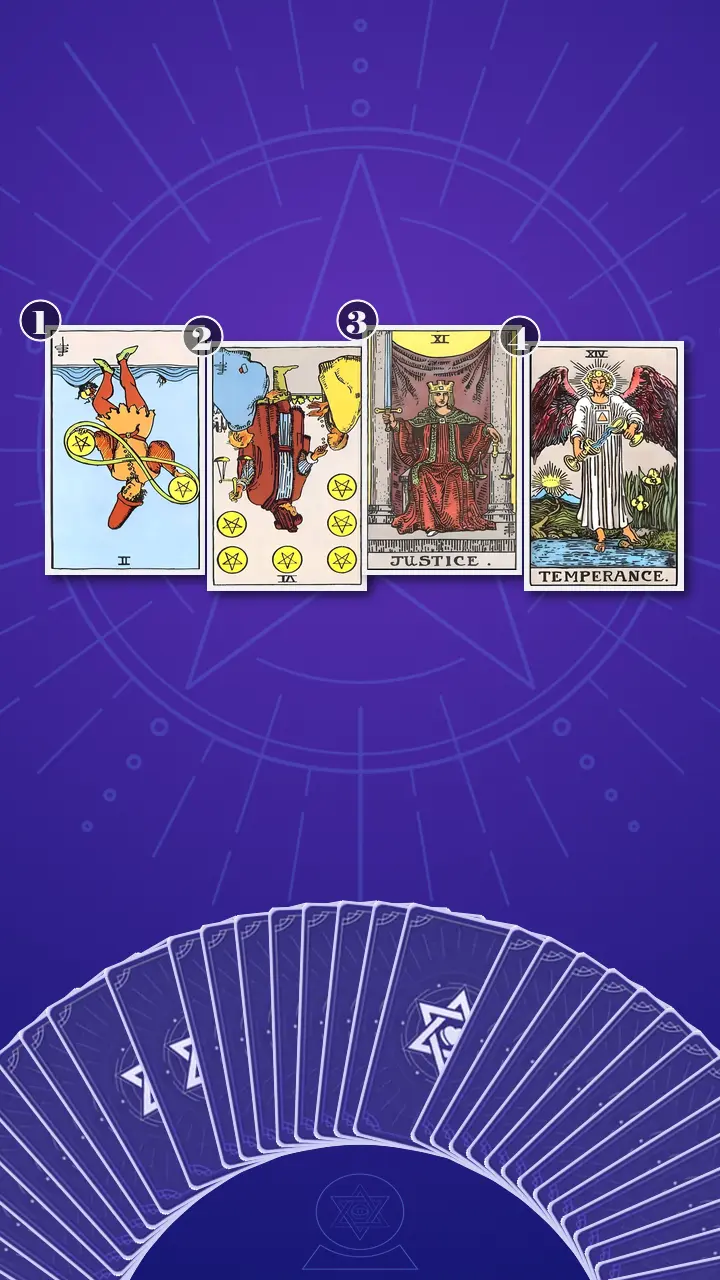
I laid the four cards left to right like a subway line running from flashback to present-day choice. The first card would show what her nervous system does when the check lands. The second would name the inherited money script beneath it. The third—our turning point—would show the corrective lens that could restore adult self-trust. And the fourth would map what integration looks like once the old alarm is quieter in the body.
Reading the Echo Cluster
Position 1: The Calculator Reflex
I turned over the card representing the concrete trigger behavior that shows up when the bill arrives and the nervous system contracts. The Two of Pentacles, reversed.
In plain life, this was exact. The server drops the check at brunch or on a date, and Maya reaches for her phone before anyone has even proposed a split. She is not just doing math. She is trying to stabilize numbers, tone, facial expressions, and future awkwardness all at once. It has the same overstimulated feeling as having ten tabs open in your head and one of them is a group payment thread you suddenly can’t stop checking.
Reversed, this card shows blocked rhythm and excess mental juggling. The earth element here is not grounded; it’s compressed. A small practical task gets promoted into an emotional emergency. I told her what I often tell people who search phrases like “why do I panic when splitting the bill?”: speed can look like competence when it’s really self-protection.
Maya gave a short laugh that had more ache in it than humor. “Wow,” she said, leaning back. “That is accurate enough to be rude.” Her fingers went to the edge of her water glass, tapped twice, then stilled. That tiny bitter laugh told me the first card had landed exactly where it needed to.
Position 2: The Power Ledger Under the Table
I turned over the card representing the inherited money script beneath the trigger, especially the learned link between fairness and conflict. The Six of Pentacles, reversed.
This is where the reading stopped being about dinner and became about power. Under the surface, Maya was not only splitting a bill; she was scanning for who had leverage, who might feel owed, and whether generosity was safe to receive. A friend saying, “Don’t worry, I got this one,” could feel less like care and more like hidden terms and conditions she had somehow failed to read before clicking accept.
Reversed, the energy here is distorted reciprocity. Fairness gets tangled with debt, power, and who gets to feel morally right. That is why a shared expense can turn into a private ledger no one else knows exists. It’s not irrational if your body learned that money changes the weather. But it does mean intimacy slowly gets replaced by monitoring—care versus cost, fairness versus emotional safety.
As I said that, Maya went through a reaction I know well. First, a freeze: her breathing paused so lightly I only caught it because her shoulders stopped moving. Then the cognitive slip: her eyes unfocused, as if an old kitchen scene had started replaying just behind the screen. Then the release: one slow exhale, one hand pressed flat against her chest. “I thought I was just weird about money,” she said softly. “But yes. I always assume there’s a hidden tab.”
“That assumption makes sense in the world you learned from,” I said. “But it may not be telling the truth about the room you’re in now.”
When Justice Lifted the Scales
Position 3: The Adult Arbiter
When I reached for the third card, the session changed temperature. Outside my studio window, the traffic noise thinned for a beat, and on Maya’s screen her hand hovered halfway toward her mug, as if her body already knew this was the hinge point.
I turned over the card representing the key corrective lens that can interrupt the old replay and restore self-trust in the present. Justice, upright.
This was the antidote. In everyday terms, it is the moment Maya pauses long enough to separate the current receipt from the family evidence file. Instead of mind-reading tone, she asks or states one clear fact: what she understood the plan to be, what amount seems fair, or what she can do today. The still scales and upright sword translate into two adult moves: measure the actual facts, then say one direct sentence. The same scale that appeared in the Six of Pentacles as leverage returned here without the kneeling, without the bargaining, without the emotional tax.
Whenever Justice appears, my mind flashes to a classic black-and-white film right at the moment the camera stops chasing rumor and settles on testimony. Fairness is not a vibe; it’s a structure. And one of the private tools I use in my readings—something I call Gallery Communication—helped here. In a gallery, I ask people to describe the painting before they interpret it. First: what is literally on the canvas? Then: what do you feel? Only after that: what does it mean? Justice asks for the same discipline with money. Not, “What disaster could this become?” but “What was ordered? What was said? What feels fair?” The old evidence file closes. The current conversation opens.
The check is not a courtroom unless your history turns it into one. But when the bill lands and your hand moves to the calculator before anyone has finished speaking, it can feel like you are not splitting dinner at all. You are suddenly back inside a much older emotional weather system, trying to prevent a verdict before the case has even begun.
This is not proof that intimacy and money must clash; it is your chance to lift Justice's scales, name what is actually fair, and let the old courtroom close.
I let the sentence sit there. Then I added, more softly, “You do not have to solve the past at the table. You only have to name what is fair in the present.”
Her reaction came in layers. First, her whole face went still and her breath caught. Then her eyes glossed slightly, not with instant tears but with that unmistakable look of someone watching a pattern rearrange itself in real time. Then her shoulders dropped so suddenly it was almost a surrender. “But if I do that,” she said, and there was a flicker of anger under the relief, “doesn’t that mean I’ve been letting ghosts run the meeting?”
“Maybe it means you built a brilliant survival system,” I said. “And maybe it kept running after the emergency ended. Justice isn’t here to humiliate you for that. It’s here to give authorship back.”
I asked her to test the lens immediately. “Think about last week,” I said. “Was there a moment when this would have changed the scene?”
She nodded, slow this time. “An e-transfer request for concert tickets,” she said. “I read the wording three times on the TTC because I thought it sounded annoyed. If I had paused, I could have just asked what total she had in mind instead of building a whole case file.” She gave a tiny, disbelieving smile. “That would have saved me an entire commute.”
That was the breakthrough I wanted for her. Not magical certainty. Not never feeling activated again. A move from guarded scorekeeping and anticipatory anxiety toward present-tense self-trust—the first clean step from bracing to breathing.
The Slower Split Practice
Position 4: Staying Seated Long Enough to Hear the Whole Plan
I turned over the card representing the integrated way of handling shared expenses once the trigger is regulated and reinterpreted. Temperance, upright.
If Justice was the clarifying sentence, Temperance was the body learning how to believe it. In lived terms, this is Maya staying in the money conversation without rushing to end it. She feels the first spike in her chest, stays seated, hears the whole suggestion, and responds without trying to erase the discomfort at top speed. More like adjusting the volume than changing the song: the topic is still money, but her nervous system no longer treats it like an alarm.
Upright, Temperance is balance practiced through pacing. One foot in feeling, one foot in fact. Not excess control, not emotional flooding, but a workable middle. I told her that this card was not promising perfection; it was describing regulation. Fast had been her protection. Slow, here, was the new strength.
For the first time all session, Maya didn’t laugh things off. She just nodded. One hand moved from her throat to the table. “I can actually picture that,” she said. “Not loving it. Just staying.”
“Exactly,” I said. “Progress is not never getting triggered; it’s staying in the room when the old script shows up.”
From Scorekeeping to Spoken Fairness
Seen together, the cards told a clean story. The Two of Pentacles reversed showed the visible symptom: a simple shared expense turning into survival-level mental juggling. The Six of Pentacles reversed revealed why: somewhere deep in her system, fairness had fused with power, debt, and the fear that closeness could go cold. Justice interrupted that inherited distortion by returning fairness to facts, proportion, and adult language. Temperance showed what happens when that clarity drops out of the head and back into the body: the bill becomes coordination again, not a character test.
Maya’s blind spot was not that she cared too much about fairness. It was that she had been asking perfect math and perfect speed to deliver emotional safety. They can’t. The transformation direction was much more practical than that: stop treating every shared expense as a test of whether the relationship is safe, and start treating it as a present-day conversation that can be clarified in real time. Fairness works better when it’s spoken than when it’s guessed.
Because this trigger lived in both language and pacing, I borrowed from two of my own tools. One was Iconic Line Diagnosis: give the moment one sentence strong enough to change the scene. The other was the same gallery rule Justice taught us: facts before story. I asked Maya to keep her next steps almost boringly small.
- The One-Proposal PauseAt the next low-stakes shared bill—coffee, takeout, brunch, or an Uber—wait until one full proposal is spoken aloud before you touch your phone. Let the other person finish the sentence, then decide whether you even need the calculator.Tip: Put your calculator app on the second screen of your phone for one week so the pause becomes physical, not just mental.
- The Present-Tense Fairness LineSave this in your Notes app and use it once this week with a close friend, a roommate, or a date in a low-stakes moment: “I want to make sure we’re on the same page about what’s fair.” If speaking feels too exposed, text it.Tip: Read the line exactly as written if you need to. Clarity is not confrontation, and you do not owe anyone your full backstory in order to ask a practical question.
- The Old Evidence File ResetRight after the conversation, open your phone and make two quick columns: “What was actually said” and “What my body predicted.” Do it in under two minutes while the moment is still fresh.Tip: If a full note feels like too much, record a 30-second voice memo. The goal is not to be chill at all costs; it is to catch whether anticipation was louder than reality.
I also told her something important: if the amount is genuinely significant, or if the relationship actually is unsafe, she is allowed to use the calculator, ask direct questions, and hold firmer boundaries. The point is not to become effortlessly cool about money. The point is to stop handing old family static the microphone when the room in front of her is quiet.

A Week Later, the Room Stayed Quiet
A week later, Maya sent me a message after splitting takeout with a friend: “Used the line. My chest still went tight, and I still wanted to e-transfer before she finished talking. But I waited. She said, ‘Whatever’s easiest,’ I asked one normal question, and nobody got weird. It was just dinner.” Then, after a pause: “I still had the ‘what if I sounded difficult?’ thought on the walk home. I just didn’t believe it the same way.”
That is what I mean by a Journey to Clarity. Not solving a childhood echo in one night, but hearing it sooner, separating past from present faster, and choosing one adult sentence over one old reflex. This is why I trust a Situation-Obstacle-Advice-Outcome tarot spread for relationship money triggers: it turns vague dread into a map, and the map into actionable advice.
Sometimes the hardest part isn’t the money at all; it’s that tiny, body-deep panic when a simple check makes closeness feel one wrong move away from going cold. If the next small split in your life didn’t have to reopen the old courtroom, what one present-tense sentence would you want ready instead?