When a Fair Bill Split Felt Risky, One Text Changed the Ride Home

The 10:18 p.m. Streetcar Mirror
If you are a twenty-something office worker in Toronto who can send client follow-ups all day but somehow loses the ability to write one normal sentence when the Interac request hits after dinner, I know exactly the kind of awkward bill split anxiety that brings you to my table.
When Maya (name changed for privacy) joined me, she did not begin with astrology, friendship, or even money. She began with a timestamp. 10:18 p.m. on a Tuesday, on the TTC heading east after dinner, with the Interac request open and her banking app glowing behind it. The brakes squealed at each stop, cold air slipped in through the doors, and her phone sat warm in her palm. She typed, “Hey, I only had the pasta and soda...” felt her throat tighten, her face go hot, deleted it, and sent the full split instead.
By the time she got home, she was replaying the night in the streetcar window reflection the way people replay a Fleabag-style conversation in their head long after everyone else has gone to sleep. “It is not even about the money,” she told me. “That is what makes it worse.” What I heard underneath was the real contradiction: she wanted to say something about paying more than she actually ate, but she was more afraid of becoming the person who made the group split awkward. The feeling in her body was vivid enough to name: awkwardness like swallowing a paper receipt sideways and pretending your voice still works.
I leaned in a little and said, “You are not being petty. You are standing in that very modern, very human place where fairness and belonging get tangled together. Let’s draw a map of the moment, so clarity does not have to show up three hours later on the ride home.”

Choosing the Compass: Relationship Spread · Context Edition
I asked Maya to take one slow breath and keep the real question in focus: not “Am I cheap?” but “Why does a factual correction feel socially dangerous?” Then I shuffled slowly, not as theatre, but as a transition. In my work, that pause matters. It helps the nervous system stop spiraling long enough for the truth to come into view.
For her, I chose the Relationship Spread · Context Edition. I use this spread when the issue lives inside an interpersonal field rather than inside a single decision. This was never only about an uneven dinner bill. It was about reciprocity, group atmosphere, belonging, and the fear that speaking plainly might cost connection. This is how tarot works when it is useful: not by predicting whether anyone in the group chat secretly dislikes you, but by showing the structure underneath the feeling.
I explained the logic as I laid the cards into a compact cross. The first position would show Maya’s immediate freeze response: the silence, the self-protection, the way fairness turns into a test of likability. The second would show the surrounding social atmosphere and why staying quiet feels safer in the group. The center card would reveal the hidden imbalance under the whole moment. And the card above it would point to the healthiest response — the one that could restore balance without turning the vibe into a courtroom drama.
At the planetarium, I spend a lot of time explaining orbital paths to visitors: bodies influence one another constantly, even in silence. Human groups do the same. A dinner table has gravity. A group chat has gravity. This spread lets me see which force is pulling too hard, and which truth has been drifting out of orbit.
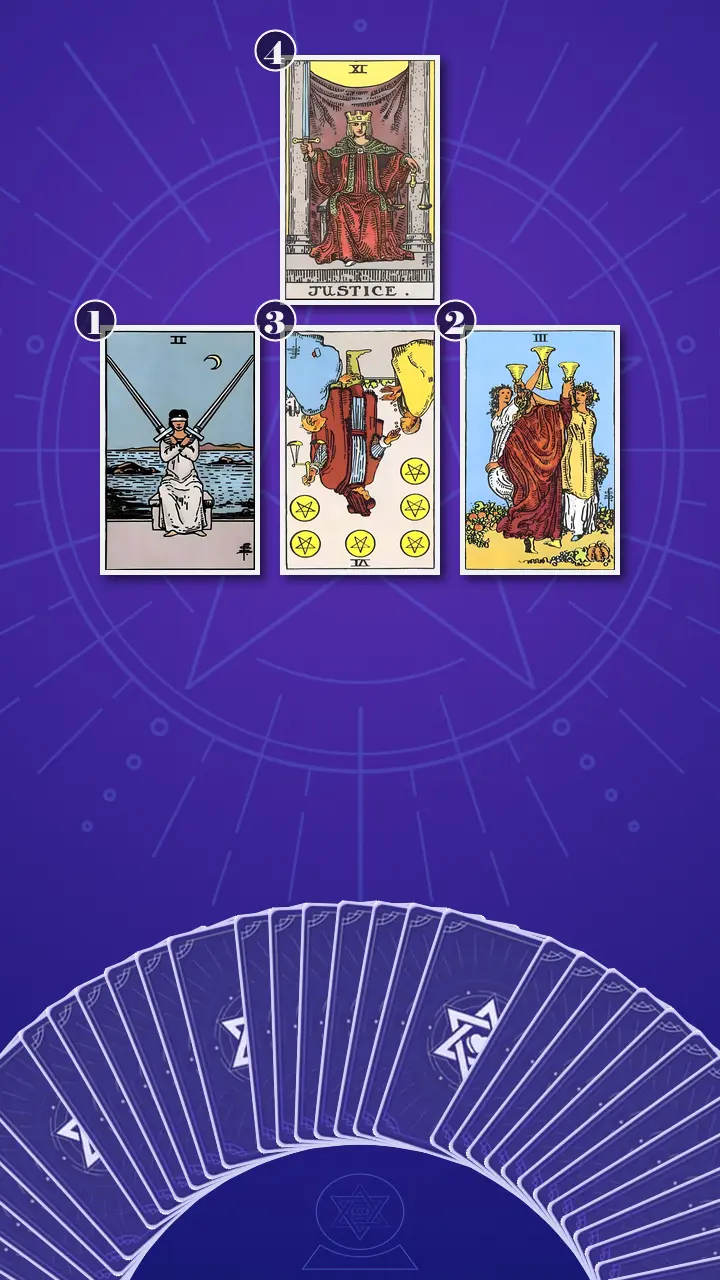
Reading the Map of Uneven Bill Stress
Position 1: The Draft That Never Leaves the Screen
I turned the first card and said, “Now we are looking at the position that presents the current symptom: your immediate freeze response, the self-protective silence, and the contradiction between fairness and social ease.”
The card was Two of Swords, upright.
This card landed exactly where her story had begun. On the ride home with the payment request open, she keeps switching between her banking app and the group chat, typing, “Hey, I just had the pasta and sparkling water...” then deleting it because the longer she stares, the more the message stops being about math and starts feeling like a referendum on whether she is low-maintenance enough to belong. That is Two of Swords in modern clothes: an iMessage draft with the cursor blinking while your brain opens twelve tabs.
Energetically, this is blocked Air. Thought is active. Expression is frozen. The blindfold is not ignorance; it is selective vision. If she does not fully look at the mismatch, she does not have to face the social risk of naming it. The crossed swords over the chest are the two scripts locked inside her body at once: be fair, or be easy.
I asked her, “When the request pops up, what exact identity threat appears first — cheap, difficult, dramatic, high-maintenance?”
She gave a short laugh that had more sting than humor in it. “Difficult,” she said. Then, after a beat: “Maybe awkward. Honestly? That person.”
I nodded. “Yes. That is the part no one talks about. The inner monologue is rarely, ‘It is only twenty dollars.’ It is, ‘It is only twenty dollars... but if I say that out loud, do I become That Person?’”
Her hand went to the rim of her mug. She looked down at the card instead of at me, and the tiny movement told me her defenses had loosened just enough for the real reading to begin.
Position 2: The Soft-Focus Social Montage
I turned the next card. “This position shows the surrounding social atmosphere and what, in the group setting, makes staying quiet feel safer or more appealing.”
The card was Three of Cups, upright.
I could almost smell the night she had described: low amber lighting in a Queen West restaurant, citrus from the drinks, fries on the table, a flash photo catching everyone mid-laugh, someone saying, “We should do this more often.” In card meanings in context, this is the part people miss. Nothing is technically wrong, which is exactly why it is so hard to interrupt. The warmth of the table makes a practical correction feel weirdly intimate, as if asking for an accurate split would puncture the entire soft-focus montage.
Energetically, this is Water in excess around the issue. Connection is real. The friendliness is real. But the emotional tone becomes so precious that Maya treats it like something fragile, as if one logistical sentence could shatter it. She is not freezing because the group is hostile. She is freezing because the group feels good, and she believes she has to protect that goodness with silence.
I said, “Three of Cups is not accusing your friends of bad intent. It is showing me why this feels so loaded. The raised cups, the close circle, the celebratory energy — all of that says you are trying to protect the vibe. But protecting the vibe has quietly become more important than protecting your limit.”
Maya pressed her lips together and nodded. “That’s exactly it,” she said. “I don’t want to be the person who changes the temperature of the table.”
“Of course,” I told her. “And that makes sense. But it also means you may be treating connection as something you have to purchase with silence.”
Her shoulders lowered a fraction at that. Not relaxed, not fully. Just enough to show she felt seen rather than judged.
Position 3: The Math Under the Table
I placed my fingers on the center card before turning it over. “This position reveals the unspoken issue beneath the moment: the reciprocity imbalance and the deeper fear that fairness could cost belonging.”
The card was Six of Pentacles, reversed.
This was the truth under the table. One pasta. One soda. No dessert. No cocktails. No shared plates. Yet on the streetcar home, or later at the kitchen counter under the hum of the fridge, she is tapping the calculator and realizing she subsidized the group’s convenience. The sting is not just the amount on the app. It is the old role underneath it: being the person who quietly absorbs the mismatch so everyone else gets a smoother user experience.
Energetically, this is distorted Earth. Money, value, and exchange are no longer being named clearly. The scales on this card matter because they make the fog measurable. This is not vague hurt feelings. This is countable. Speakable. The number may be small. The pattern is not.
I told her, “This is the card that answers the question hidden inside your resentment. The issue is not that you lost a dramatic amount of money. The issue is that you keep learning your side of the exchange is the flexible one. Belonging gets expensive when silence keeps picking up the tab.”
Her reaction came in three waves. First, a stillness: her breath caught so lightly I would have missed it if I were not watching. Then the cognitive hit: her eyes unfocused, not away from me but through me, the way people look when they are replaying three different dinners at once. Then the release: a long exhale, shoulders dropping, one hand flattening over her stomach as if the truth had finally reached the place where the knot lived.
“Yes,” she said quietly. “It was never just about the amount.”
“Exactly,” I said. “You are not upset because you are petty. You are upset because the mismatch keeps teaching you that fairness is optional when your comfort is the variable being sacrificed.”
When Justice Replaced the Blindfold
When I turned the final card, the room changed in that subtle way it sometimes does during a reading. A band of blue light from the small star projector on my shelf crossed the table and caught the edge of the card. It made the image look sharper, almost cooler. In astronomy, a lens comes into focus by tiny corrections, not dramatic ones. This card felt exactly like that.
Position 4: The Sentence That Restores Proportion
I said, “This position points to the healthiest way to respond: the key shift from apologetic over-accommodation toward clear, factual, respectful expression.”
The card was Justice, upright.
Justice, in real life, looked nothing like a fight. It looked like this text: “Hey, I had the pasta and soda, so my total comes to $34 with tax and tip. I’ll send that now.” No essay. No self-erasing joke. No smiley face added just to prove she was still nice. Just proportion, accuracy, and adult reciprocity.
Energetically, this is balanced Air. The blindfold from the Two of Swords is gone. The crossed blades become one upright sword. Thought and speech are aligned again. Justice does not ask her to become cold. It asks her to become precise.
This was the moment I brought in one of my own diagnostic lenses, something I call the Zodiac Gravity Field. In a healthy social field, everyone gets to stay in orbit without one person surrendering their center. Maya had been letting the group’s comfort become the dominant gravity, so her own accurate number kept drifting outward, as if fairness were the thing that did not belong. Justice re-centers the system. If a connection can only feel smooth when you overpay and stay silent, the field is distorted. Healthy reciprocity can hold warmth and proportion at the same time.
I looked at her and slowed my voice. “You know that ride home when the streetcar windows turn into mirrors, your phone is warm in your palm, and you keep reopening the payment request just to prove to yourself you are not being dramatic for noticing the math?”
Your silence is not proof of grace; one clear, proportional sentence can rebalance the scales and let Justice replace the blindfold.
For a second, Maya did not move. Her thumb froze against the ceramic of her mug. Then her eyes widened just a little, not in shock but in recognition. I watched the thought travel through her face: first the flinch, then the recalculation, then the almost painful relief of seeing the situation more cleanly than she had let herself see it before. Her shoulders loosened, but not all the way; there was vulnerability in the release, that strange light-headed feeling people get when they set down a weight they have been carrying so long it had started to feel like posture.
Her first reaction was not relief. It was resistance. “But if that’s true,” she said, and I could hear the tremor of anger under it, “doesn’t that mean I’ve been turning this into a whole moral thing in my head for no reason?”
“Not for no reason,” I said gently. “For a learned reason. Your nervous system has been evaluating the sentence on social risk, not on accuracy. That is different from being irrational. And it means the shift is possible.”
I let the silence breathe for a beat, then added, “You do not need to overpay to prove you are easy to be with. Fairness can be factual without becoming hostile. A factual correction is not a character flaw.”
She swallowed, glanced back at Justice, and this time when she spoke, her voice was steadier. “If I had seen it like that on Tuesday, I would have sent the amount before I started editing my personality.”
“Exactly,” I said. “That is the real movement here — from tight, embarrassed self-silencing toward calm directness. From approval-seeking to proportion. From asking, ‘Will they still like me?’ to asking, ‘What is simply accurate here?’”
I asked her one final question in that moment: “Now, with this new lens, think back to last week. Was there a point where this would have changed the feeling?”
She let out one small, disbelieving laugh. “Yes. The second I added the smiley face.”
From Insight to Action: The 15-Minute Clarity Window
When I pulled the whole reading together, the story was remarkably clean. Two of Swords showed the freeze: the moment a normal money clarification turns into a referendum on whether she is still easy to be around. Three of Cups showed why the freeze happens: the social atmosphere is warm, and she has been taught to protect warmth at any cost. Six of Pentacles reversed named the hidden imbalance: unequal exchange gets normalized when no one names it, and she keeps being the buffer in the system. Justice gave the correction: fairness is not conflict; clear requests are part of healthy reciprocity.
The cognitive blind spot was also clear. Maya was not judging her sentence on clarity. She was judging it on whether it could guarantee everyone else stayed comfortable. That is too heavy a job for one line of text. Justice asked her to correct one spreadsheet cell, not write a confession.
For the practical part, I gave her my Meteor Icebreaker, a tiny three-beat communication launch I use when a social moment feels overcharged: warm opener, clear number, clean send. Good vibes can include accurate math.
- Save the Justice lineTonight, in your Notes app, save one reusable text: “Hey, I had the ___ and ___, so my total comes to $__ with tax and tip. I’ll send that now.” The next time a dinner or drinks payment request lands, change only the items and the number instead of drafting from scratch.If you feel the urge to add a long apology or a joke, stop at basic politeness. One clear sentence is enough.
- Use the 15-Minute Clarity WindowWhen the Interac or Splitwise request arrives, send your accurate amount within 15 minutes, before your brain rewrites it into a personality issue. If the group chat feels too exposed, send the exact same line privately to the person collecting first.Lower the bar: private first still counts. You do not have to perform bravery in public to practice fairness.
- Do a receipt-before-resentment checkBefore you board the streetcar home, take a quick photo of the receipt or screenshot the order and total only your own items, tax, and tip. If your group defaults to even splits often, ask early and neutrally, “Do we want to itemize or split evenly?”You are checking what you owe, not auditing everyone else. Rounded numbers are fine if exact cents make you spiral.
I reminded her that the goal was not to become a different person overnight. The goal was smaller and sturdier: to make one brief factual payment clarification that treats fairness as normal adult reciprocity instead of social danger.

A Week Later: The Quiet Proof
Six days later, while I was between planetarium shows, Maya sent me a message.
“Birthday drinks last night,” it read. “I used the template. I sent it privately first. She replied, ‘Yep, perfect,’ in like thirty seconds.”
Then came the line I loved most: “I still felt exposed for five minutes. But I wasn’t angry on the TTC home.”
That was the proof. Not a grand transformation. Not a movie ending. Just one sentence sent where resentment used to live.
She slept a full night, woke with the old thought — what if I sounded weird? — and smiled at it before making coffee.
That is what a real journey to clarity usually looks like from where I sit: not certainty, but a steadier relationship with your own voice. In this reading, Maya moved from tight, embarrassed self-silencing and private resentment toward calmer directness and self-respect she could actually feel in her body.
When your throat tightens over a number that does not even seem worth arguing about, what hurts is rarely just the extra money — it is the split-second fear that being fair might make you less welcome.
If the next time the math and the vibe do not match, you let Justice be nothing more dramatic than one accurate sentence, what plain words might you finally allow yourself to send?