Burnout Spillover After Dad’s Job Offer: Building a Simple Container

The 11:32 p.m. Glow, When “Stability” Feels Like Surveillance
“You’re a Toronto early-career professional who can handle pressure—until you realize you’re handling it everywhere, and your Sunday Scaries aren’t just about work anymore,” I said, and Jordan (name changed for privacy) let out a laugh that sounded like it had been stuck behind her teeth all week.
She’d joined me from her condo bedroom, camera angled just high enough to hide the laundry chair. It was 11:32 p.m. on a Tuesday in her world—the kind of late where the laptop fan has a high, whiny edge and the screen glow makes the room look colder than it is. I watched her shoulders hover, hunched like she was bracing for impact, while her jaw worked subtly side to side, as if she was trying to chew through a decision.
“It’s my dad,” she said. “He offered me a job. It’s… objectively a good opportunity. And I should feel relieved, but I feel watched. Like I’m about to sign up for a life where I don’t get to be a person.”
She paused, glanced down at her phone, then back up—eyes a little too bright. “And then I’m weird about money. Like I’ll open my banking app, see a number, and I physically can’t deal. I close it, order Uber Eats, and pretend it’s fine. Dating is the same. I get a Hinge notification and it feels like a demand. So I ghost, or I say yes and then cancel.”
The exhaustion on her wasn’t an abstract idea. It was a weight. The kind that turns your shoulders into coat hooks and your thoughts into a browser with 37 tabs open—work, Dad’s offer, balances, unread messages—and the ones that crash first are always the ones that require steady attention and vulnerability.
“I can handle pressure,” she added, almost pleading with herself. “I can’t handle pressure everywhere.”
I nodded, slow and steady, the way I do on-air when a caller finally says the true thing. “You’re not failing at adulting,” I told her. “You’re dealing with burnout spillover—work stress leaking into money and dating because your boundaries are depleted. Let’s try something simple tonight: we’re going to map the spillover, name what’s driving it, and find one rhythm you can actually live inside. A Journey to Clarity—no heroics required.”

Choosing the Compass: The Four-Layer Insight Ladder for Burnout Spillover
I asked Jordan to take one slow breath and notice where she felt Dad’s offer first—jaw, chest, shoulders, stomach. Her hand went to her sternum without thinking. That told me more than a paragraph of pros-and-cons.
On my end, I did what I always do before a reading: I lowered my voice and softened the pace. Not as a mystical ritual—more like sound engineering for the nervous system. “We’re just focusing,” I said. “Same way you’d tune a radio until the static clears.” I shuffled slowly, letting the cards make that papery hush that feels like a metronome.
“Today, we’ll use a spread called the Four-Layer Insight Ladder · Context Edition,” I explained. “It’s a custom tarot spread for burnout and boundaries—especially when a parent offers a job and suddenly it’s not just a career decision, it’s an autonomy decision.”
For you reading along (because I know you’re here for how tarot works in real life, not smoke and mirrors): this issue isn’t about predicting whether Dad’s job offer will ‘work out.’ It’s about identifying the internal mechanism that turns work pressure into money avoidance and dating withdrawal. This spread keeps it minimal but complete: we look at (1) the burnout pattern, (2) how it spills into money, (3) how it spills into dating, (4) the hidden driver underneath Dad’s offer, then (5) the integration/remedy, and (6) one grounded next step.
“Card one will name what the overload looks like right now,” I told Jordan. “Cards two and three show the spillover channels—money and dating. Card four is the root: the authority/autonomy trigger. And card five and six become the handrail down the staircase—how we move from pressure into steadiness.”
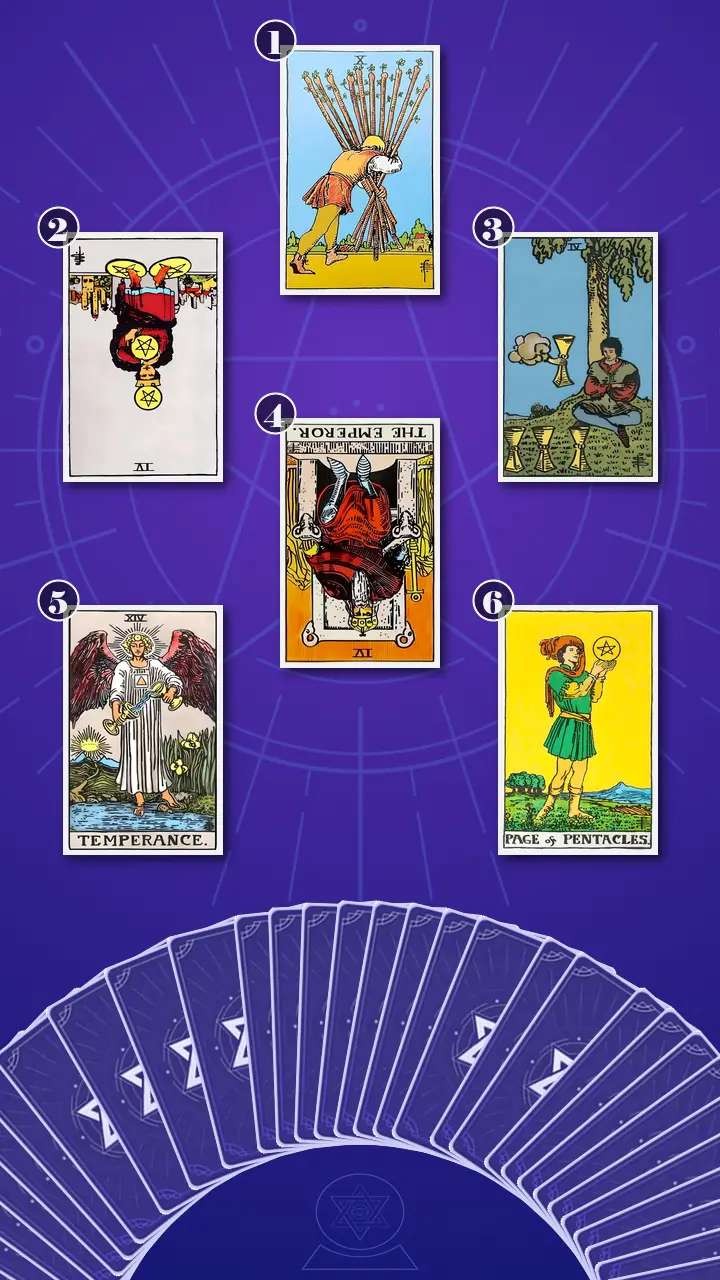
Reading the Map: When Work Stress Leaks Into Everything
Position 1: Surface diagnosis — what the burnout looks like right now
“Now we turn over the card representing Surface diagnosis: what the burnout looks like behaviorally right now,” I said, and laid it down.
Ten of Wands, upright.
“Okay,” Jordan said immediately—then she gave a small, bitter little laugh. “That’s… so accurate it’s almost rude.”
I kept my tone gentle. “This is The Bear energy,” I said, because sometimes pop culture lands faster than poetry. “Not because you’re dramatic—because you’re carrying everything like it has to be carried perfectly, all at once.”
I pointed to the image: the figure bent forward, the bundle blocking his line of sight. “Your modern-life version is painfully specific,” I told her. “You take your dad’s offer seriously, so you start acting like you must prove you deserve it before you’ve even accepted. You say yes quickly, stay late, over-edit, over-deliver. And then at night you’re too depleted to open your banking app or respond to a dating message with warmth—so you postpone, order food, and tell yourself you’ll catch up later.”
Energy-wise, this is Excess—too much fire with no container. The Ten of Wands isn’t “you’re bad at balance.” It’s “you’re carrying more than one nervous system can carry and still have anything left for maintenance or intimacy.”
I watched Jordan’s shoulders inch up again as if the card had named her out loud in a crowded room. “If it spills into money and dating,” I said softly, “it’s not three problems—it’s one container problem.”
Position 2: Spillover channel A — how burnout distorts money behavior
“Now we turn over the card representing Spillover channel A: how burnout specifically distorts money behavior,” I said.
Four of Pentacles, reversed.
“This one is the ‘banking app check-and-close reflex,’” I said, and Jordan winced like I’d read her screen time report. “After a long workday, money becomes a control panel you can’t bear to look at. You either spend on convenience to buy relief—delivery, rideshares, little fixes—or you clamp down and resent every dollar. You’re not careless. You’re depleted. And the moment money needs attention, it feels like you’re being graded.”
In terms of energy, reversed Four of Pentacles is Blockage that flips into leakage. Security becomes a clenched fist, and when the fist can’t stay clenched, it turns into avoidance or swingy spending. That’s why money tasks feel small until they suddenly feel like a crisis—because you’re not interacting with numbers as information; you’re interacting with them as a verdict on your competence.
“Money check-ins are information, not a verdict on your adulthood,” I reminded her. She nodded, but her eyes flicked away—classic shame-avoidance micro-movement. Not dramatic. Just human.
Position 3: Spillover channel B — how burnout distorts dating and emotional availability
“Now we turn over the card representing Spillover channel B: how burnout specifically distorts dating and emotional availability,” I said.
Four of Cups, upright.
“This is the emotional version of leaving tabs open until your phone overheats,” I told her. “A dating app notification lands at the exact moment you finally stop working. Instead of excitement, you feel dread—like you’re being asked to perform a personality while running on fumes.”
The energy here isn’t cruelty. It’s Deficiency—not enough emotional bandwidth. The cup being offered is connection, but when your system is saturated, even good things feel like obligations. “Connection isn’t another task—unless you only let yourself show up when you’re ‘impressive,’” I said, and Jordan’s throat bobbed as she swallowed.
She stared at the card, then said quietly, “I keep thinking I’ll reply when I’m… better. More interesting. Less behind.”
“That’s the trap,” I replied. “You’re waiting for a finish line that burnout keeps moving.”
Position 4: Root mechanism — what Dad’s job offer is really activating
“Now we turn over the card representing Root mechanism: the underlying belief/fear activated by Dad’s job offer,” I said, and I felt the room change even through a screen—like the audio drop when a song hits a bare vocal.
The Emperor, reversed.
Jordan’s mouth pulled into a tight-lipped smile. “Oh. That’s… the thing.”
“Yeah,” I said. “This is the fear of being controlled by a parent’s ‘help.’ The offer isn’t just a role. It feels like an invisible terms-and-conditions page you didn’t agree to.”
I leaned in slightly. “Here’s what I see in real life: you stare at Dad’s text. You draft a careful reply, delete it. You imagine how he’ll interpret your tone. You can feel Thanksgiving in the background like a pressure system. Your shoulders creep up, your jaw clamps, and you say yes in your head before you’ve asked a single question about hours, scope, or who makes final calls.”
Energy-wise, Emperor reversed is rigid structure that’s hard to negotiate. The problem isn’t that you can’t work hard. You already can. The problem is that boundaries feel like rebellion, so you try to “earn safety” by overproducing.
“Boundaries aren’t rebellion,” I said, letting it land. “They’re the terms that make support safe.”
Then I used one of my signature diagnostic tools—not to get mystical, but to get specific. “Jordan, quick question,” I said. “If I asked you to describe your family dynamic as a playlist—what played in your house when you were growing up?”
She blinked. “Um. My dad had classic rock on all the time. Like… loud. Motivational. Always doing something. My mom listened to quieter stuff—coffeehouse playlists, sad indie, ‘don’t make a scene’ vibes.”
“That’s your Family Playlist right there,” I told her. “And here’s the Generational Echo: one generation teaches ‘prove your worth through output,’ another teaches ‘keep the peace through quiet.’ So when your dad offers a job, your nervous system hears two songs at once: work harder and don’t upset anyone. No wonder you can’t rest—rest feels like turning the music off and waiting for someone to comment on the silence.”
Jordan exhaled through her nose. “That’s… exactly it. If I set a boundary, it turns into a fight. If I don’t, it turns into burnout.”
“And that sentence,” I said, “is the hinge. This isn’t a time-management issue. It’s a boundary-negotiation issue.”
When Temperance Poured Between Two Cups
Position 5: Key transformation — the shift that stops the spillover
“We’re turning over the most important card in this reading now,” I said. “The one that shows the remedy energy—the internal shift that changes the whole system.”
Temperance, upright.
Before I even spoke, Jordan’s face tightened like she was bracing for the usual advice—try harder, optimize more, become a new person by Monday.
Setup: I named it the way it actually happens at 11:30 p.m. “You’re stuck in that loop where you tweak one more thing that didn’t need a fifth revision. You open your banking app, feel a jolt in your stomach, close it, and promise ‘tomorrow.’ Then a dating notification pops up—and somehow it feels like a demand. You’re trying to run everything at 100% with no container.”
Delivery:
Stop trying to power through with clenched teeth; start mixing your life in measured pours like Temperance’s two cups.
I let the silence sit for a beat, like the pause between tracks when the next song matters.
Reinforcement: Jordan’s reaction came in layers—three quick, honest steps. First, a tiny freeze: her breathing stopped mid-inhale, and her hand hovered above her trackpad like she’d forgotten what she was reaching for. Then her eyes unfocused, not glazed—more like her brain was replaying a week’s worth of moments: the “I’ll deal with money this weekend,” the unread messages, the too-fast yes to Dad. Finally, the release: a long exhale that softened her whole face, shoulders dropping a full inch as if someone had unhooked a weight from the base of her neck.
“Wait—yeah,” she whispered. “I keep trying to fix it by going harder. Like… if I push enough, everything will stop being messy.”
“Flow doesn’t need more force; it needs a repeatable rhythm,” I said. “Temperance isn’t a hype song on repeat. It’s a sustainable playlist you can live inside.”
I guided her into a practical integration exercise—the one I use when a reading needs to turn into actionable advice. “Set a timer for 10 minutes,” I said. “Two columns on paper: (1) ‘What I’m carrying that isn’t actually mine’ and (2) ‘What I need this week to stay steady.’ Circle one boundary sentence you could say to your dad, and one tiny money task you can do today. And if you feel your chest tighten or you start spiraling—stop early. Closing the notebook is allowed.”
Then I asked the question that locks the insight into real memory: “Now, with this new lens—where in the last week would this have changed how you felt?”
Jordan rubbed her jaw, softer now. “Yesterday. He texted again. I was drafting this… perfect response. Like a PR statement. And I could’ve just… asked for terms. Like an adult.”
“Exactly,” I said. “This is you moving from burnout-driven overfunctioning and approval-seeking to boundary-based self-trust and sustainable pacing. Not overnight. But for the first time, the path is visible.”
Position 6: Actionable next step — what to do this week (without perfectionism)
“Now we turn over the card representing Actionable next step,” I said, and I smiled before I even fully registered it—because the deck was offering something workable.
Page of Pentacles, upright.
“This is the beginner mindset card,” I told her. “One pentacle. One focus. Training mode.”
Her modern-life translation was simple: treat money stability like a skill you’re learning, not proof you’re failing. Do something small, consistently, and let that rebuild trust in yourself. This is Balance energy—grounded earth returning after all that scorched fire.
Jordan’s eyes watered, just slightly. “I keep thinking I need a perfect plan,” she said.
“You don’t need a perfect plan,” I replied. “You need a pace you can repeat.”
The One-Week Container: Actionable Advice You Can Actually Start
I summed up what the spread had told us in plain language: the Ten of Wands showed how Jordan’s burnout presents as overfunctioning—carrying responsibilities to earn approval until she has no bandwidth left. The Four of Pentacles reversed showed money becoming a shame-triggered control problem: avoid, leak, clamp down, repeat. The Four of Cups showed dating going emotionally offline—not because she doesn’t want connection, but because connection feels like another demand when she’s depleted. And at the root, Emperor reversed named the real amplifier: the fear that Dad’s “help” comes with surveillance and ownership, making basic boundaries feel unsafe.
Her cognitive blind spot was painfully common: she’d been treating the spillover as three separate failures—work discipline, money discipline, dating discipline—when it was one system problem: fire without a container. The transformation direction was equally clear: move from proving your worth through nonstop output to setting explicit limits and building a sustainable baseline routine for money and connection.
Then we turned that clarity into small, testable next steps—Page of Pentacles style. I offered her a one-week plan that uses my sound-based approach as a scaffolding, not a gimmick: we’d let music create the container when willpower won’t.
- The 10-Minute Money Window (7 days)Pick one daily slot (e.g., 7:40–7:50 p.m.). Start a 10-minute song or timer. Only do two things: check balances + write the next three due dates. When the song ends, you stop—no spreadsheet marathon.Before you open the app, read one line: “Money check = info, not a verdict.” If you feel the spiral start, close the app early anyway. That’s still a win.
- The 48-Hour Buffer + “Working Agreement” DraftBefore you answer Dad, give yourself a 48-hour response buffer. During that window, draft a one-page working agreement with three non-negotiables: hours, scope, decision rights. Then send one adult-to-adult sentence: “I’m interested, and I need clarity on hours, responsibilities, and who makes final calls before I decide.”If your body goes into fight/flight (tight jaw, racing thoughts), use my Soundproof Barrier: put on noise-cancelling headphones and a slow-tempo track (60–80 bpm) for five minutes before you reply. You’re not avoiding—you’re regulating.
- The “Paired Pour” (Money + One Human Message)Once this week, right after your money window, send one low-stakes message to a friend or a match: “This week’s a bit packed—want to grab a quick coffee this weekend?” Keep it short. Keep it real.If you want to make connection feel safer, borrow my Kitchen Radio strategy: pick a calm background playlist for whatever you do next (making a simple dinner, tidying, a shower). Let the music signal, “We’re switching modes now.”
Jordan hesitated, and here came the real-world friction—the part that matters more than any symbolic meaning. “But I literally don’t have time,” she said, voice sharper with fatigue. “Even 10 minutes. My days are stacked.”
I didn’t argue with her. I respected the data. “Then your current pace is the diagnosis,” I said. “So we do the five-minute version first. One song. Half a song, if needed. This isn’t about time. It’s about proving to your nervous system that you can create a container—on purpose.”
She nodded slowly, like she didn’t love it but she believed it.

A Week Later, the Quiet Proof
Eight days later, I got a message from Jordan while I was prepping for my radio segment—levels bouncing on my screen, the studio monitors humming softly. Her text was short: “Did the money window. Three days in a row. Auto-pay set for my phone bill. Also I asked Dad for hours + decision rights. He didn’t freak out. He just… answered.”
She added a second message a minute later: “I still woke up today and thought, ‘What if I mess this up?’ But I didn’t spiral. I made coffee. I played one calm song. Then I replied to one Hinge message. That’s new for me.”
In my mind, I pictured the bittersweet kind of progress that actually sticks: she sleeps a full night because the container held, then wakes with that old “if I’m wrong?” thought—only this time she doesn’t obey it. She lets it exist, and keeps moving.
That’s the journey I care about—the one from clenched-teeth output to measured pours. Not certainty. Ownership. A rhythm you can repeat.
When “stability” comes wrapped in someone else’s expectations, it can feel like you’re holding your breath—working harder and harder, not to build your life, but to avoid the conflict that might prove you’re not in control.
If you treated steadiness as something you practice in tiny, repeatable steps—like Temperance pouring between two cups, like one song as a container—what’s the smallest boundary or money habit you’d be willing to try for just one week?