From Panic Uninstalls to Aligned Dating: A One-Week Hinge Container

Finding Clarity in the 11:32 p.m. Hinge Uninstall
You draft the perfect reply in Notes, reread it five times, and still close the app without sending.
Alex (name changed for privacy) said it like she was confessing to a tiny crime. She was 28, a marketing coordinator in Toronto, and she had that specific kind of tired that isn’t from lack of sleep—more like your brain has been running in the background all day, overheating.
She described last Wednesday night so precisely I could see it: 11:32 p.m., condo bedroom, the blue phone-glow bleaching her face, the radiator clicking like a metronome. Netflix was queued—some comfort show she didn’t even need to look at to know the jokes. She reinstalled Hinge “for five minutes,” swiped in short bursts, got one like… and her chest tightened like she’d just been handed a pop quiz she hadn’t studied for. Then the stomach-drop. Then Notes app. Then delete, before the episode even started.
“I want to date,” she told me, fingers worrying the edge of her sleeve. “But I hate how dating apps make me feel. If I leave it installed, it’s like I’m on call for rejection. But if I delete it… I can’t tell if I’m protecting my peace or hiding.”
Her apprehension wasn’t an abstract emotion. It lived in her body like a seatbelt pulled too tight across the ribs—safe, technically, but also hard to breathe in.
I let that land, then softened my voice. “You’re not broken. You’re having a very human nervous system response to a very modern setup. Let’s make today a Journey to Clarity—not ‘should you reinstall,’ but what your loop is doing for you, what it’s costing you, and what choice would actually build self-trust.”

Choosing the Compass: The Four-Layer Insight Ladder Spread
I asked Alex to take one slow breath and hold the question in a simple, practical way—not like a spell, more like choosing what tab we’re going to keep open. While I shuffled, I watched her shoulders: still slightly raised, like she was bracing for the next notification even here, even now.
“I’m going to use an original spread I call the Four-Layer Insight Ladder · Context Edition,” I said. “It’s built for moments like this—when the real issue isn’t predicting whether dating will work out, but decoding a self-regulation loop.”
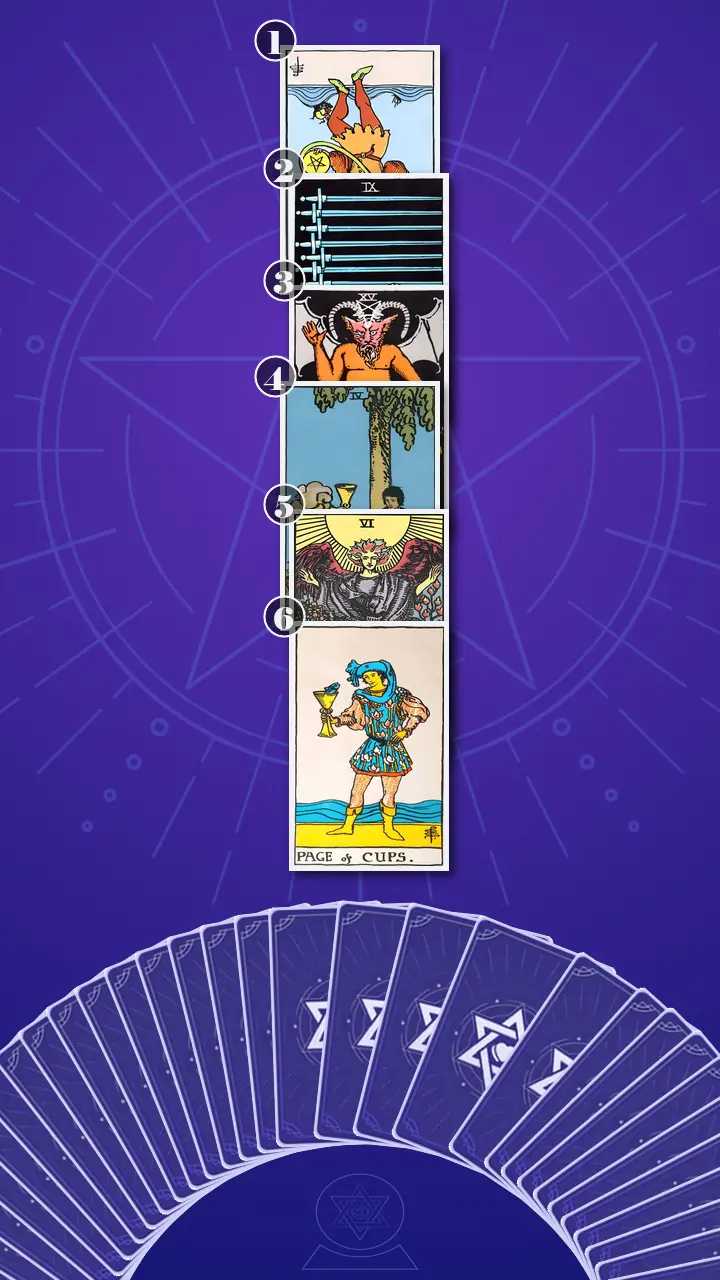
For you reading: this is how tarot works best in modern dating anxiety. Not as a yes/no verdict, but as a map. This six-card ladder keeps things minimal while still tracing the whole chain: what you’re doing now → what spikes inside you → what you’re protecting → how the coping pattern keeps the cycle alive → the key reframe → one grounded next step you can actually do this week.
I told Alex what we’d be listening for: “Card 1 will name the visible loop. Card 3 goes deeper—what the loop is protecting. Card 5 is the turning point, the reframe that pulls your worth out of strangers’ response times.”
Reading the Scroll That Turns Into a Staircase
Position 1: The visible loop—what it’s trying to accomplish
“Now flipping over is the card that represents the visible loop: the most observable delete/reinstall pattern and what it’s trying to accomplish in the moment,” I said.
Two of Pentacles, reversed.
This card is the perfect snapshot of “reinstalling dating apps every few days.” In real-life terms: you’re juggling two internal tabs all week—“I want to date” and “I don’t want to be perceived.” And the moment Hinge turns from possibility into responsibility (a match, a message, a notification), you start doing practical chaos-management: shifting the app around, turning off notifications, uninstalling, reinstalling. It’s less about dating and more about trying to keep your nervous system from tipping over by hitting “reset.”
Reversed, that Two-of-Pentacles energy is a blockage: not adaptive juggling, but frantic toggling. Like having twelve browser tabs open and then force-quitting your whole laptop when one tab pings you.
I described it gently but plainly: “Deleting the app isn’t a break—it’s emotional damage control.”
Alex let out a tight laugh that had a little bitterness in it. “Okay, wow. That’s… kind of mean. But accurate.” She nodded fast—an instant yes—then looked away like she’d been caught doing exactly what she does.
Position 2: The felt experience underneath—what spikes right before delete
“Now flipping over is the card that represents the felt experience underneath: what emotions and thoughts spike right before you delete the app,” I said.
Nine of Swords, upright.
This is the phone-glow insomnia card. The modern version is exactly what you described: late-night hyper-analysis where one chat bubble becomes a courtroom exhibit. Your brain runs worst-case simulations—“they’ll think I’m desperate,” “they’ll ghost,” “I’ll feel stupid.” Your body gets wired (tight chest, fidgety hands), then your stomach drops, and deletion feels like the only way to make the noise stop.
Here’s the Jungian part I always watch for: the mind uses fear to create fake certainty. It’s like doom-scrolling, except the doom is your own imagined future.
I gave her a simple sentence stem: “Right before you delete, your mind tends to say: ‘If I send this and they ___, it means I’m ___.’ What fills those blanks?”
She swallowed. “If I reply and they don’t care… it means I’m not chosen.” Her hand went to her chest without thinking, like she was checking the tightness.
I nodded. “Your nervous system isn’t asking for a verdict. It’s asking for a container.”
Position 3: The protective motive—what you’re trying to prevent
“Now flipping over is the card that represents the protective motive: what need you’re trying to meet and what you’re trying to prevent,” I said.
The Devil, upright.
This card gets misunderstood, so I’m careful here. The Devil isn’t saying you’re doing anything wrong for wanting love. It’s naming a bind: the app becomes a chain made of metrics—matches, likes, response time. Part of you wants the hit of being wanted, and part of you is terrified a slow reply will feel like public rejection. So uninstalling becomes a power move to stop feeling graded.
In this position, the energy is excess—too much “control” trying to compensate for vulnerability. Like mistaking control of the platform for control of your feelings.
And I said the line I wish every anxious dater could hear without shame: “If dating feels like a referendum on your worth, of course you’ll want to disappear.”
Alex’s face stilled, then softened. Her eyes didn’t go watery—just more honest. “I delete it to get my dignity back,” she admitted, quieter. “Like… if I’m the one who leaves first, no one can reject me.”
Position 4: The shadow pattern—how the coping keeps the cycle going
“Now flipping over is the card that represents the shadow pattern: how your current coping strategy keeps the cycle going (and what it quietly costs),” I said.
Four of Cups, upright.
This is the emotional shutdown after the control move. A decent message appears—nothing creepy, nothing demanding—but you feel flat, skeptical, vaguely irritated. Not because there’s nothing there, but because staying present with maybe feels too exposing. You close the app, then interpret the quiet you created as proof that connection isn’t available.
The energy here is a deficiency—not enough emotional engagement. The offered cup is right there, and the pattern is to look away.
I translated it into something she’d feel: “It’s like an unopened email you won’t click because you’re scared it’ll change your day.”
Alex exhaled through her nose, almost a scoff at herself. “I’ve let nice conversations expire. Then I tell myself it’s because I’m ‘not feeling it.’” She made air quotes, then her shoulders dropped a fraction, like admitting it cost something.
Position 5 (Key Card): The reframe—how to date this week without outsourcing your self-worth
I paused before turning this one. The room felt quieter, like the background hum of the city outside her window stepped back to listen with us.
“Now flipping over is the card that represents the key reframe: the most empowering way to relate to dating choices this week without outsourcing your self-worth,” I said.
The Lovers, upright.
Setup: I could feel Alex still clinging to the binary—reinstall or delete, all-in or done forever. She was bracing for the “right answer” the way people brace for a performance review, even though this was about intimacy. About being seen. About not flinching the second a real person appeared.
Stop treating dating like a pass/fail test of your worth; start treating it like a values-based choice—and let The Lovers remind you that alignment beats approval.
Reinforcement: Alex froze first—breath held, fingers hovering as if her phone were in her hand. Then her gaze went unfocused for a beat, like she was replaying every time she’d deleted the app right after a match, every time she’d called it “peace” and still felt behind. Finally she let out a shaky exhale that sounded like her ribs unclenching. Her shoulders sank, and she blinked hard once, not dramatic—just the body recognizing truth. “But if I choose it like that,” she said, voice thinner with the realization, “then I can’t pretend I’m deleting because I’m above it.” She rubbed her palm against her thigh and added, almost annoyed, “I’m deleting because I’m scared.”
I nodded, steady. “Yes. And fear doesn’t get to be your only decision-maker.”
This is where I used my Choice X-Ray—my way of revealing the hidden costs and benefits that sit under a choice. “Let’s X-ray the two options,” I told her. “Not ‘which one makes you safe tonight,’ but which one builds self-trust this week.”
We looked at the hidden cost of reinstalling without boundaries: constant vigilance, the ‘on call for rejection’ feeling, workday distraction. Then the hidden cost of deleting in panic: short-term relief, long-term isolation, and the subtle message to yourself—‘I can’t tolerate being seen.’ And then we looked at the overlooked benefit in the middle: choosing one intentional structure where your worth is not on loan to response times.
“Now,” I asked her, “use this new lens and think back—was there a moment last week when you could’ve made an aligned choice instead of a damage-control deletion?”
She didn’t answer right away. Then: “Tuesday morning. TTC. Notification came in and I felt… exposed. I deleted it at lunch like it was a power move.” She shook her head. “It wasn’t power. It was panic.”
And that was the shift: from apprehensive, fear-driven toggling to the first breath of grounded self-trust and values-led pacing in connection.
Position 6: The grounded next step—what to do that builds self-trust
“Now flipping over is the card that represents the grounded next step: one practical, doable way to act that builds self-trust whether you reinstall or pause,” I said.
Page of Cups, upright.
This is the antidote to perfectionism. It’s one small, sincere emotional reach—one message that sounds like you, sent within a boundary, without trying to pre-empt rejection by polishing forever. The energy here is balance: gentle openness without intensity, curiosity without self-abandonment.
I gave her an example on the spot, intentionally un-fancy: “Hey—your photo at Trinity Bellwoods made me smile. How was that day?”
She made a face. “That’s… almost too simple.”
“Exactly,” I said. “One small reach. Then back to your life.”
The One-Week Container: Docking Windows for Your Nervous System
I pulled the whole ladder together for her in one clear story: the Two of Pentacles reversed showed the visible loop—toggling to manage discomfort. The Nine of Swords named the spike—your mind forecasting rejection to feel prepared. The Devil showed the deeper protection—outsourcing worth to metrics and using deletion to regain control. The Four of Cups revealed the quiet cost—numbness that starts to look like “I don’t care,” even when you do. The Lovers returned agency—values over validation. And the Page of Cups translated that into one small, human action.
“Your cognitive blind spot,” I told Alex, “is thinking the only two choices are be available for judgment 24/7 or disappear. That all-or-nothing switch is what keeps you stuck.”
“The transformation direction is simpler,” I continued. “Not more strategy. Less toggling. One values-led container—so you’re dating with boundaries, or pausing with intention.”
This is where my cruise background always sneaks in. On a ship, you don’t ‘kind of’ dock all day. You dock at a scheduled time window. Then you sail. That’s my Port Decision Model: clear docking windows prevent panic decisions at sea.
Alex hesitated, then hit me with a real obstacle—the kind that makes advice either collapse or become useful. “But I swear I can’t do the whole… mindful container thing. Work is chaos. Group chats. I’m exhausted. I don’t even have five minutes.”
I didn’t argue with her. I narrowed the ask. “Then we do the five-minute version. Your nervous system will believe small.”
- Choose your one-week container (no mid-week toggling)Write down ONE option for the next 7 days: (A) Keep Hinge installed but only open it for 10 minutes on two scheduled days (for example, Wed 7:30 p.m. + Sun 6:00 p.m.), or (B) Keep it deleted all week and do one 10-minute journaling check-in on what you’re protecting.Expect your brain to argue (“this is pointless,” “I should be all in”). Treat that as a Nine-of-Swords moment—not a failure. If 10 minutes is too much, do 5.
- Make it a boundary-first reinstall (you decide the hours)If you choose option A, turn off push notifications for Hinge so a random message can’t hijack your workday. You’ll check only during your two “docking windows.”If you notice chest tightness or that stomach-drop, close the app and come back in the next scheduled window—no dramatic uninstall required.
- Send one Page-of-Cups message in under 5 minutes (no Notes app)Pick one chat. Open it. Send one sincere, low-pressure line that sounds like you—then stop. No A/B testing your dignity. Example: “Hey—your photo at [place] made me smile. How was that day?”After you hit send, put your phone in another room for 10 minutes and do something sensory (tea, shower, a quick walk). Let your body learn: being seen is survivable.

A Week Later: Ownership, Not Certainty
A week later, Alex sent me a message: “I did the docking windows thing. Notifications off. I opened it Wednesday for ten minutes, replied to one person without Notes, and put my phone face-down. My chest still did the thing. But it passed.”
She added, almost surprised: “I slept. Like… actually slept.”
Clear doesn’t mean fearless. It means you stop letting fear run the app store. This was her first real proof of the journey: from disappearing to self-trust—small, steady, and owned.
When a real message comes in and your chest tightens, it can feel like you’re standing in public with your desire showing—and the quickest way to feel safe is to erase the whole situation.
If you trusted your worth didn’t go up or down based on response time, what would your most aligned one-week container look like—installed with boundaries, or deleted with intention?