Stuck in the 'I'm Fine' Reflex—And How to Ask for a Second Check-In

Finding Clarity on Line 1, Between Winter Coats
Being called “low-maintenance” can feel like being praised for disappearing.
Taylor (name changed for privacy) told me that the sentence lands the same way every time—like a door closing softly, politely, in their face.
They came into my café in Toronto with that specific kind of tired you can’t sleep off. Not “busy.” Not “burnt out.” More like their insides had been muted for so long that even their own feelings sounded far away. When they wrapped both hands around a ceramic cup, their fingers stayed tight, like they were trying to keep something from spilling.
“They said, ‘you’re always fine,’” Taylor said. “And I smiled. Like… of course I did. And then I got on the TTC and my throat did that thing.”
I could see it as they spoke: the words catching before they reached daylight. A heavy chest, a tight throat—like a sentence stuck behind a locked jaw. Loneliness, but not the dramatic kind. The quiet kind that sits in your sternum like a smooth stone.
“I’m not upset,” they added quickly, almost reflexive. “I’m just tired. I don’t want to make it a thing.”
I nodded, gentle but direct. “We can hold this without making it a spectacle. Let’s try to give this fog a shape. Today’s goal isn’t to label anyone ‘bad at friendship.’ It’s to find clarity about what’s happening in your pattern—and what you can do next, in a way your nervous system can actually tolerate.”

Choosing the Compass: The Transformation Path Grid Tarot Spread
I asked Taylor to take one slow breath in, one out—nothing mystical, just a clean transition from the rush of the street into the quieter truth underneath. While the espresso machine sighed behind us, I shuffled slowly, like smoothing a wrinkled page.
“For this,” I said, “I want to use a spread called the Transformation Path Grid (6) · Context Edition.”
For anyone wondering how tarot works in situations like this: I’m not using cards to predict whether your friends will suddenly become emotionally fluent. I’m using them as a map for inner mechanics—symptom → blockage → root fear → reframe → micro-action → integration. This spread keeps it minimal (six cards) but still shows the sequence clearly, like a tiny project board for your emotional life.
I laid the cards in a 2x3 grid: top row left to right is where you feel stuck (what you see, what blocks you, what feeds it). Bottom row is the way through (the turning point, the next step, what it looks like when it stabilizes). It’s a spread that makes card meanings in context easier to trust, because you can see the logic across the row—no doom, no fate, just pattern.
“I’ll walk you through three anchors,” I told Taylor. “The first card shows how ‘invisible’ shows up in your day-to-day. The second card shows the habit that teaches people you’re fine. And the fourth card—our turning point—shows the reframe that makes being seen possible without begging for it.”
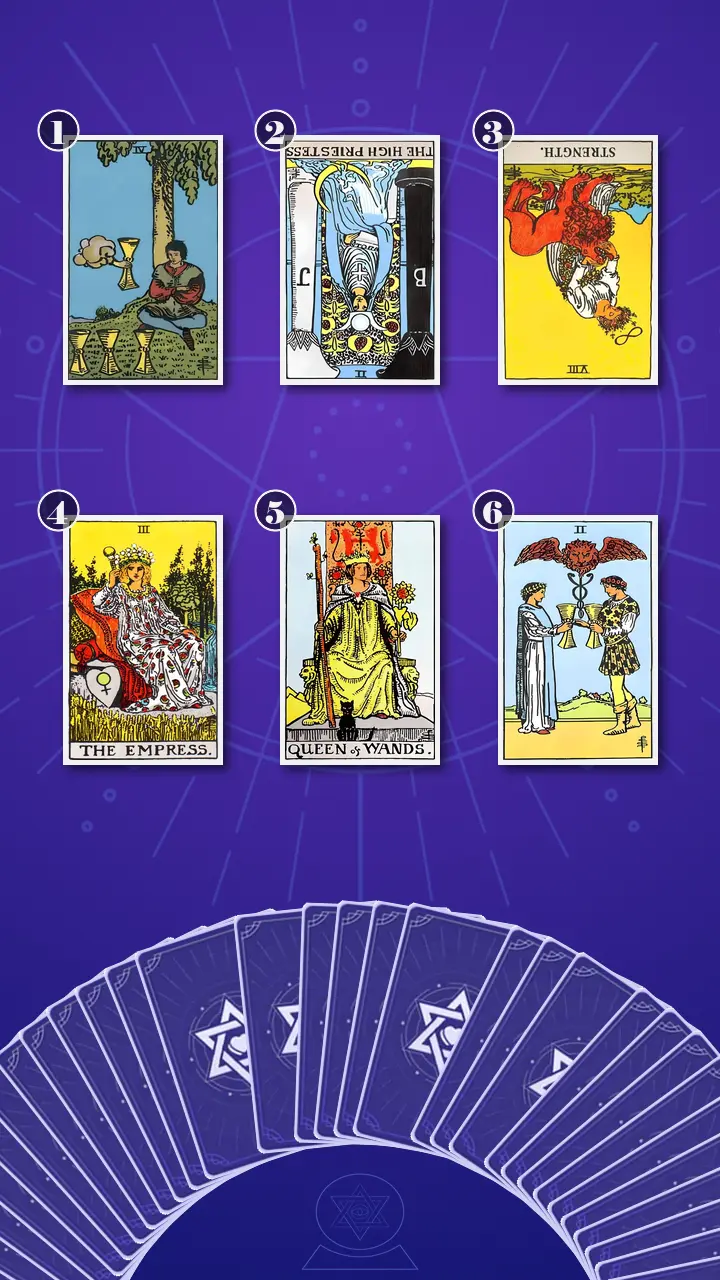
Reading the Map: From Self-Silencing to Reciprocal Visibility
Position 1: The Visible Symptom — Four of Cups (upright)
“Now flipped over,” I said, “is the card representing The visible symptom: how ‘invisible’ shows up in your day-to-day behavior and mood.”
Four of Cups, upright.
“This,” I told them, “is the moment you’re on a call with friends, laughing at the right beats and saying, ‘I’m good, just tired,’ while your chest feels hollow. After you hang up, you stare at your ceiling and feel weirdly lonely—because connection was technically available, but you didn’t put the real feeling on the table, so nobody could meet it.”
In energy terms, Four of Cups is Water gone still—emotion present, but stagnant. Not because you’re cold. Because you’re conserving. You’re crossing your arms over your own heart without realizing it.
Taylor let out a short, bitter laugh—unexpected, but so human. “That’s… yeah. That’s too accurate. Like, borderline rude.” Their mouth smiled, but their eyes didn’t. Their thumb kept rubbing the cup’s handle in the same tiny circle.
“It is a little rude,” I said, softly. “But it’s not accusing you. It’s showing you the mechanism: the offered cup is there—someone does open a door sometimes—and your reflex is to not take it.”
Position 2: The Immediate Blocker — The High Priestess (reversed)
“Now flipped over,” I said, “is the card representing The immediate blocker: the habit or stance that unintentionally teaches others to assume you’re fine.”
The High Priestess, reversed.
“This is you writing the real truth in Notes—clear, honest, emotional—and then sending a tidy version to people: a light update, a joke, a meme,” I said. “Later, you feel invisible and resentful, but the pattern is brutal: you hid behind the veil, so everyone responded to the surface you gave them.”
And I used the line I’ve seen change rooms before, because it’s simple and it’s true: If your truth stays behind the veil, people can only respond to the version you perform.
I watched Taylor’s face do the smallest flicker: first a micro-freeze in their breathing, then their gaze unfocused like they were replaying a text thread, then a tight nod that didn’t look like agreement so much as recognition.
I could almost hear the inner monologue in clipped lines, the kind that sounds like a coping strategy pretending to be maturity: Don’t make it a thing. Don’t be work. Keep it neat.
“And when you do get close to honesty,” I added, “your nervous system reaches for an overcorrection—humor, a meme, a ‘lol sorry’—so nobody has a clear moment to respond with care.”
Taylor swallowed. Their throat moved like it hurt. They didn’t speak, but they didn’t look away either.
Position 3: The Root Fear — Strength (reversed)
“Now flipped over,” I said, “is the card representing The core fear: what you believe will happen if you show need or ask to be held.”
Strength, reversed.
“A friend’s comment stings,” I said, “and instead of saying it landed badly, you clamp down and turn it into ‘being productive’: cleaning, reorganizing, updating your task list. From the outside you look composed; inside it feels like you’re holding a lion by the jaw—terrified that if you loosen your grip, you’ll be ‘too much’ and people will pull away.”
Strength reversed is Fire under strain—inner force spent on control instead of care. Not a lack of strength. An overuse of it in the wrong direction. White-knuckling your voice steady while your body is basically yelling help.
My mind flicked—briefly, quietly—to the years I’ve watched people at this café keep their posture perfect while their hands shake around a demitasse. In service work, you learn the difference between “fine” as a mood and “fine” as a mask. The mask is always polished. It’s also heavy.
“So if the fear is ‘I won’t be able to stop talking,’” I asked, “what are you imagining happens next? What’s the worst-case story?”
Taylor’s shoulders lifted, then dropped. “They get tired of me,” they said. “Or they try to fix it and I feel stupid. Or they just… stop replying.”
“Right,” I said. “Belonging feels conditional. Like you have to be easy to love.”
Position 4: The Turning Point — The Empress (upright)
“Now flipped over,” I said, and even I felt the room quiet a little, “is the card representing The key reframe: the inner permission that makes visibility possible without begging for it.”
The Empress, upright.
Before I said anything else, I watched Taylor’s posture: chin slightly tucked, as if bracing for a verdict. This is the TTC moment in bed on Sunday night—the honest text typed, deleted, replaced with something lighter—followed by the sinking thought, Why do I feel invisible when everyone says I’m fine?
Stop waiting to be noticed as proof you matter, and start nurturing your needs in plain sight—like The Empress who makes care visible and real.
The sentence hung there between us like steam above a cup.
Taylor’s reaction came in three distinct beats. First: a physical freeze—breath caught, fingers still on the mug. Second: the eyes widened slightly, then drifted down to the card like they were reading it for hidden fine print. Third: a sharp exhale that almost turned into anger.
“But if that’s true,” they said, voice tight, “doesn’t that mean I trained them to do this? Like… I did it to myself?”
I didn’t rush to soothe it. I let the truth be adult-sized. “It means you adapted,” I said. “Probably for good reasons. But adaptation isn’t a life sentence.”
Then I shifted the lighting in my voice the way The Empress shifts a landscape—out of subway fluorescents and into something warmer. “Your need isn’t an emergency that requires justification,” I told them. “It’s daily reality that deserves language.”
And here’s where I used my own lens—what I call Social Espresso Extraction. “In coffee,” I said, “if you under-extract, you get something thin. Not because the beans are bad—because the contact time wasn’t enough for the real notes to come through. You’ve been under-extracting yourself socially. You give people quick, polished sips of you—‘I’m fine, just tired’—and then you’re shocked nobody tastes the deeper truth.”
“The Empress is saying: change the extraction time,” I continued. “Not by oversharing. By letting one real note come through—plain, present tense—so people have something to respond to.”
Taylor blinked fast, once, twice. Their throat worked again, but softer this time. The tightness didn’t vanish—it loosened, like a knot you can finally get a fingernail under.
I leaned in a fraction. “Now, with that new perspective,” I asked, “think back to last week. Was there a moment where you could’ve said one plain sentence instead of deleting it?”
They stared at the edge of the table, then nodded. “Tuesday,” they whispered. “Line 1. I literally typed ‘I’m not okay.’ And then I sent ‘all good lol.’”
“That,” I said, “is the first step from numb, low-maintenance self-silencing to self-validated visibility. Not dramatic. Just real.”
And I made it explicit, because it’s the spine of this reading: Visibility starts with self-validation: name the need without apologizing for it.
Position 5: The Micro-Action — Queen of Wands (upright)
“Now flipped over,” I said, “is the card representing The micro-action: how you can take up space and communicate needs in a clear, non-performative way.”
Queen of Wands, upright.
“In a calm moment,” I said, “you send a short, warm, direct message: ‘Quick check: I’m not doing amazing this week. Can we talk?’ Then you stop typing. You let the pause happen without filling it with ‘lol sorry.’”
Queen of Wands is Fire in balance—visibility that isn’t a performance. Warm boundaries. Directness without aggression.
“This is the mantra,” I said, and I saw Taylor’s mouth twitch with nerves, like they already knew how hard it would be: One feeling. One context. Then a pause.
They smiled—small, shaky. “I could try that with one person,” they said. Their cheeks flushed the way they do when you hit “send” on something that’s honest enough to matter.
Position 6: The New Pattern — Two of Cups (upright)
“Now flipped over,” I said, “is the card representing The new pattern: what reciprocal connection looks like when you practice being seen and selecting responsiveness.”
Two of Cups, upright.
“This is you noticing who actually responds when you’re honest,” I said. “Who follows up after the first ‘I’m okay.’ Who asks a second question. Who makes a real plan. And you let that care land without minimizing it.”
Two of Cups is Water that flows between two people—mutual recognition, not one person carrying the emotional admin.
I tapped the card lightly. “And here’s the standard,” I said, because Taylor needed permission to have one: Don’t audition for care—track who actually follows up.
The One-Page Plan for Being Seen (Without Oversharing)
I pulled the whole grid together like a story you can finally retell without blaming yourself. “The Four of Cups shows the symptom: connection around you, but you leaving your real feeling off the table. The High Priestess reversed shows the blocker: the polished veil, the unsent truth. Strength reversed shows the root: the fear that being witnessed will make you ‘too much,’ so you control yourself into silence. The Empress is the turning point: self-worth that doesn’t need to be earned by being easy. Queen of Wands is the delivery method: warm, steady truth. Two of Cups is the result: reciprocity—real follow-through.”
“Your blind spot,” I said carefully, “is that you’ve been treating care like something you receive only after you’ve proven you deserve it. That’s competence-as-armor. It keeps you included, but it also keeps you emotionally unseen.”
“And the direction of the shift,” I added, “is exactly this: shift from performing okayness to practicing one clear, specific request before you reach a breaking point.”
Then I offered actions that were intentionally small—because your nervous system can’t build a new pattern with a grand speech. It builds it with reps.
- Save a Plain-Need ScriptOpen your Notes app and save one line: “I’ve been feeling lonely lately, and I could use a real check-in.” Keep it pinned so you don’t rewrite it into a TED Talk.Expect the inner cringe. Keep it under 15 seconds: one feeling + one context. You’re allowed to stop there.
- Send the Second-Question RequestPick one safer person and text: “Hey—quick check: I’m not doing amazing this week. Could you ask me a second time when you have a minute?”If you panic in the pause, put your phone face-down and take three slow breaths before adding anything. Let the silence do some work.
- Track Reciprocity (Not as a Test, as Data)After you share one honest sentence, write down: Who followed up? What did they do (specific behavior)? How did your body feel afterward—lighter, tighter, steadier?You’re not judging anyone’s character. You’re updating your closeness investments based on real follow-through.
And because Taylor needed a body-based way to sense safety, I used my Social Thermometer strategy. “Notice who feels like ‘warm coffee’—steady, drinkable, safe,” I said. “And who feels like lukewarm obligation or scalding anxiety. Your body’s temperature read is information.”

A Week Later: The Quiet Proof
Six days later, Taylor messaged me a screenshot: a 14-second voice note they’d sent to a friend. No meme. No apology. Just, “Small thing, but I’ve been having a hard week. Can we do a real catch-up soon?”
Under it, one more line: “They asked me a second question. I almost deflected. I didn’t. It felt… terrifying. And then weirdly calm.”
They also admitted something bittersweet: they’d stopped sending their usual check-in text to one low-reciprocity friend. They didn’t get a follow-up. They stared at the empty thread for three minutes, then closed it—sad, but clearer.
That’s what I love about this kind of tarot reading for feeling unseen in relationships: it doesn’t promise instant harmony. It gives you a map from “I’m fine” autopilot into something more honest and sustainable—self-validated visibility and reciprocal emotional connection.
When you’ve spent years being ‘the stable one,’ even a simple “I’m not okay” can feel like you’re about to become too much—and your body holds it as a tight throat and a heavy chest long before anyone hears the truth.
If you didn’t have to earn your right to be cared for, what’s one small, specific thing you’d let yourself ask for this week—before you hit your breaking point?