The Monday Calendar Peek That Triggered Dread—And the On-Ramp I Tried Instead

Finding Clarity in the Sunday-Night Calendar Peek
If you’re a 20-something in Toronto who opens Slack before you’ve even fully sat down, and your chest drops the second you see your Monday calendar—hello, Monday dread.
Jordan (name changed for privacy) booked a session with me after a long weekend, and when our video call connected, I could tell they hadn’t “crashed” so much as locked up. Their eyes kept flicking toward a second monitor like it was still blinking with notifications. Their voice was steady, but their breathing had that shallow, polite rhythm people use when they’re trying not to admit how bad it feels.
“It’s Monday,” they said, like it was a diagnosis. “And my whole life feels off. Like… I had fun this weekend, so why do I feel guilty now? If I don’t start strong, the whole week is ruined.”
As they spoke, I pictured the scene they described—because I’ve lived versions of it in other cities, other decades, other jobs. The couch still warm from Netflix, the radiator clicking in a too-small apartment, and that harsh blue glow of Google Calendar that turns a good Sunday into a quiet panic.
Their dread wasn’t loud. It was physical—like a heavy chest with a low-grade restlessness, the feeling of wanting to move but not knowing where to place your foot first, as if the floor keeps shifting.
“Feeling ‘off’ on Monday isn’t a moral failure—it’s a gear change,” I told them. “Let’s treat this like a journey to clarity. Not ‘fix your life by noon.’ Just: understand what’s happening, then pick one next step that actually works with your nervous system.”

Choosing the Compass: The Four-Layer Insight Ladder
I was calling from Tokyo, freshly home from my shift guiding planetarium guests through the slow choreography of planets and moons. Jordan was in downtown Toronto, where work and rest happen in the same few rooms and Mondays arrive fast. Different skies; the same human nervous system.
I asked them to take one breath—not a mystical thing, just a focusing thing—then to hold the question in plain language: “Monday after a long weekend—why does my whole life feel off, and what’s the next step?” While they exhaled, I shuffled.
“For this,” I said, “I’m using my original spread called the Four-Layer Insight Ladder · Context Edition. It’s built for moments like this—when you’re not asking tarot to predict a future, you’re asking it to explain a pattern and give actionable advice.”
To you, reading along: this is why this spread works. A basic past/present/future layout can over-focus on timeline drama. But Monday dread is often an internal mechanism—symptom, pressure, rule, and then the hinge that changes everything. This ladder separates those layers cleanly so the ‘why’ and the ‘next step’ show up without noise.
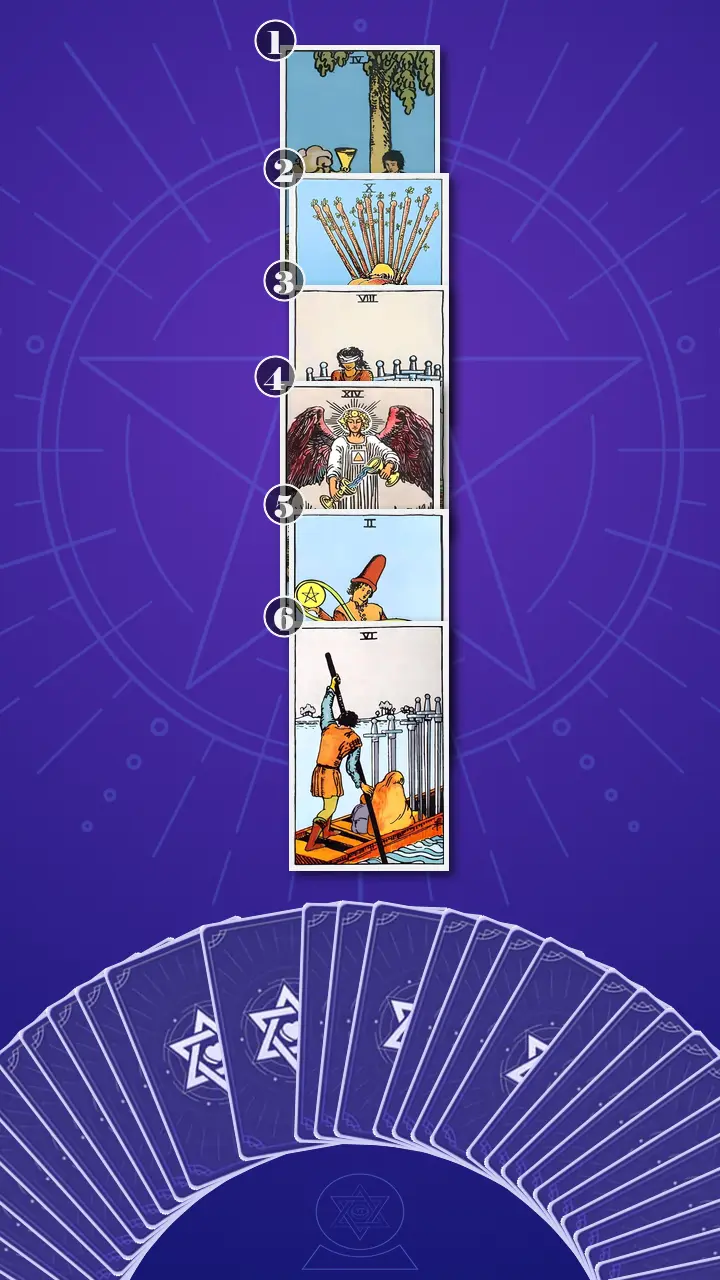
“Here’s the map,” I told Jordan. “Card 1 is the surface symptom—what Monday looks like in your body and browser tabs. Card 3 is the root mechanism—the belief that turns discomfort into paralysis. And Card 4 is the alchemy point—the turning key. That’s where we find your re-entry method.”
Reading the Map: Why Monday Feels Like a Verdict
Position 1 — Surface symptom: what Monday feels like right now
“Now I’m turning over the card that represents the surface symptom: what Monday feels like in your body and behavior right now,” I said.
Four of Cups, upright.
I kept my voice simple. “This is that flat, disconnected feeling—like you’re physically at the desk but emotionally not engaged.”
And I named it in the only language that tends to land on a Monday: “Monday, 10:15 AM. You’re sitting at your desk with your coffee going cold, reopening Slack, your calendar, and a doc you don’t want to touch. You keep waiting for motivation to show up before you start—then you get irritated that you still feel flat, like the whole day is already wrong.”
The Four of Cups isn’t laziness. It’s stagnant water—the energy of waiting for a feeling to arrive so you can finally begin. In Jordan’s system, that energy wasn’t balanced; it was a blockage. The more they waited to feel “ready,” the more the present moment felt like proof something was wrong.
Jordan gave a small, surprised laugh that had a sharp edge to it. “That’s… yeah. That’s exactly it,” they said, then softer: “It’s almost mean how accurate that is.”
I watched their shoulders lift like they were bracing for a lecture they’d heard a thousand times. “No moralizing,” I said. “Just information. The offered cup in this card is always small—like a tiny supportive option you ignore because you’re fixated on not feeling ready.”
Position 2 — Pressure layer: what returns the moment the weekend ends
“Now I’m turning over the card that represents the pressure layer: what load makes you brace the second the weekend ends.”
Ten of Wands, upright.
Immediately, the spread moved from emotional flatness into strain. “This is the moment Monday stops being ‘off’ and turns into ‘I’m carrying everything.’”
I gave them the modern translation: “9:05 AM. You read one Monday message and your brain immediately merges everything into one giant problem: unfinished tasks from last week, new requests, laundry, groceries, workouts, social plans. It’s not that any one thing is impossible—it’s that you’re carrying it all in your head at once, and it blocks your ability to see the next step.”
In the Ten of Wands, the energy isn’t subtle—it’s excess. Too much responsibility, too quickly. It’s the “brace and haul” posture, where your vision narrows until the week looks like a wall instead of a sequence of steps.
Jordan’s mouth went tight, like they were tasting something bitter. “That’s the TTC feeling,” they said. “Like one Slack ping becomes… my entire life.”
“Exactly,” I replied. “Your system is reacting to fused responsibility. And when responsibilities fuse, your nervous system treats them like a threat.”
Position 3 — Root mechanism: the belief that turns discomfort into paralysis
“Now I’m turning over the card that represents the root mechanism: the underlying fear-based belief that turns normal transition discomfort into paralysis and self-judgment.”
Eight of Swords, upright.
I felt the room get quieter through the screen—like even the air in Jordan’s apartment decided to listen. “This is self-surveillance,” I said. “Camera-on brain.”
I made it concrete: “11:50 AM. You’re stuck rewriting a simple email because you’re imagining every possible interpretation. You check LinkedIn and Slack to gauge how ‘on it’ everyone else is. The more you monitor yourself, the fewer options you feel you have—so you freeze, then blame yourself for freezing.”
The Eight of Swords is an Air card, but it doesn’t feel light. It’s restriction—not because someone is actually holding you hostage, but because you’re acting as if one rule is non-negotiable.
And that’s when I used the sentence that tends to cut straight through the fog: The trap isn’t Monday. The trap is the rule you think Monday has to prove.
I saw it hit Jordan in a tight little sequence: (1) their breath paused, like their body froze to avoid impact; (2) their eyes unfocused for a second, like a memory replayed—tab-hopping, LinkedIn “for context,” Slack status watching; then (3) their shoulders dropped a millimeter and they let out a quiet, angry exhale.
“So… the rule is,” Jordan said slowly, “if I’m not focused immediately, it means I’m not disciplined. Like I’m not reliable.”
“Yes,” I said. “And this card is reminding you: the bindings are loose. You have movement. But not while you’re grading yourself in real time.”
For a split second, my own mind flashed back to an old research supervisor of mine, the kind who could turn a minor delay into a character assessment. In astrophysics, you learn fast: a measurement isn’t a moral verdict—it’s a data point. I brought that steadiness back to Jordan. “We don’t treat Monday feelings as evidence. We treat them as signals.”
When Temperance Spoke: The Hinge That Changes Everything
Position 4 — Alchemy point: the internal practice that re-integrates weekend-self and work-self
“We’re turning over the hinge card now,” I told Jordan. “This is the turning key—the alchemy point.”
Temperance, upright.
Even over Zoom, it felt like the temperature changed—like a window cracked open in a stale room. Temperance isn’t hype. It’s calibration.
I grounded it in their life: “Instead of trying to jump straight from weekend ease into peak output, you build a deliberate blend: a short regulating action—water, sunlight, a walk—and a small work artifact—three bullets, one reply, one outline. You stop treating rest-self and work-self like enemies and start treating Monday like a controlled crossfade.”
Jordan nodded, but their eyes still had that haunted ‘but what if it’s not enough’ look. They were trapped in the familiar script: it’s Monday morning, Slack is blinking, coffee cooling, and the mind is hunting for the exact moment they’ll feel ‘back’—while the chest stays heavy, and shame starts whispering that needing time is failure.
Not “force yourself to be fine,” but mix your pace on purpose—like Temperance, pour steadily between rest and responsibility until your system finds balance.
I let that sit. In the silence, I could hear something soft in my own apartment—my washing machine starting a cycle, a low, steady hush. I smiled to myself; it always reminds me of cosmic background noise, the universe’s constant, non-dramatic hum.
“Can I show you something I use?” I asked. “It’s my Pulsar Breathing—syncing your breath to a steady rhythm the way a pulsar keeps time in space. Not mystical. Just reliable.”
I guided them through it like a metronome: five slow breaths, each exhale a fraction longer than the inhale. “Imagine you’re not trying to leap into Monday,” I said. “You’re letting your system find a pulse. Steady. Repeatable.”
Jordan’s reaction came in layers, and it mattered that I didn’t rush it. Their face went still, then their eyes got slightly wet, then they pressed their lips together like they were holding back irritation at how much they needed this.
“But if I have to do all that,” they blurted, a flash of defensiveness, “doesn’t that mean… I’m just bad at being an adult? Like other people can just do Monday.”
I kept my voice calm and firm. “No. It means you’re learning how your system transitions. Adults who look fine often have a ramp you don’t see—routine, commute boundaries, different workload, or just different wiring. Temperance isn’t a workaround. It’s a skill.”
Then I asked the question that turns insight into something you can actually feel: “Now, with this new lens—when was a moment last week where mixing your pace could’ve changed the whole hour?”
Jordan looked up and away from the screen, searching. “This morning,” they admitted. “I opened Slack before I even drank water. And then it was like… the whole day became a test.”
“That’s the shift,” I said, and I named it plainly: this wasn’t just about productivity. It was the move from shame-driven Monday self-surveillance and freeze to regulated transition and self-led, paced focus.
Position 5 — Next step: the smallest realistic action that creates rhythm
“Now I’m turning over the card that represents your next step: a realistic Monday action that creates rhythm without overforcing.”
Two of Pentacles, upright.
“This is rhythm,” I said. “Not perfection. It’s the ability to juggle without turning juggling into self-punishment.”
I used the everyday scene: “You stop trying to plan the entire week perfectly and choose two anchors for today: one must-do outcome and one stabilizer routine. Everything else becomes adjustable.”
In this card, the energy is balance through iteration—the infinity loop says, we don’t solve Monday once; we practice Monday.
I watched Jordan’s hands unclench around their mug. “Two lanes,” they murmured, almost like they were testing whether it was allowed to be that simple.
Position 6 — Integration direction: what calmer clarity looks like (even if it’s not perfect)
“Now I’m turning over the card that represents integration direction: what it looks like to move through Monday with calmer clarity.”
Six of Swords, upright.
“This isn’t a victory parade,” I said. “It’s a crossing.”
I anchored it in their lived reality: “By mid-afternoon, after one small output and fewer check-ins, you feel your shoulders drop. Monday isn’t suddenly enjoyable—but it’s no longer an enemy. It’s a crossing you’re already halfway through.”
And I gave them the phrase I wanted them to keep: “Aim for one-degree calmer, not instantly cured.”
The One-Page Monday On-Ramp Ritual (Actionable Advice, Not Motivation)
I pulled the whole ladder together for Jordan, the way I’d summarize a sky chart for a planetarium crowd: clear lines, no extra mythology.
“Here’s the story,” I said. “You start in Four of Cups—flatness that you interpret as failure. Then Ten of Wands hits—Monday responsibilities fuse into one heavy bundle. That triggers Eight of Swords—the rigid rule that a slow start means you’re incompetent, so you monitor yourself, compare, and freeze. Temperance is the hinge: regulate first and mix weekend-self and work-self on purpose. Two of Pentacles turns that into pacing—two anchors. Six of Swords is the outcome: calmer water through a crossing strategy.”
“Your cognitive blind spot,” I continued, “is treating Monday as a pass/fail personality test. The transformation direction is different: design a transition ritual, then prioritize—rather than forcing productivity and hoping regulation magically appears later.”
I reminded them of the tool by name—because it matters that this is a method you can reuse: “That’s what the Four-Layer Insight Ladder · Context Edition tarot spread for Monday re-entry clarity and next-step pacing is built to do: symptom → pressure → rule → hinge → next step → integration.”
Then I gave Jordan the smallest, most realistic plan I could—one they could do even with a heavy chest and a blinking cursor.
- The 10-Minute Monday On-RampBefore Slack or email, set a timer for 10 minutes: 5 minutes regulating (stand by a window, drink water slowly, or step into the hallway for two quiet breaths) + 5 minutes output (write 3 bullets for a doc, send 1 sentence reply, or schedule 1 meeting).If your brain yells “not enough,” don’t argue—just shrink it. Do an 8-minute version. The win is the ramp, not the volume.
- The Two-Lane Monday PlanOn paper (not Notion), write two lines only: Lane A = one must-do outcome for today; Lane B = one stabilizer (lunch at a real time, a 15-minute walk, a playlist while you clear one admin task).Keep it visible beside your laptop. Two lanes. One must-do. One stabilizer. That’s a Monday you can actually drive.
- The Supernova Focus Reset (Phone Flashlight)When you feel the Eight of Swords freeze (rewriting, tab-hopping, LinkedIn “for context”), turn on your phone flashlight for 30 seconds and point it at a wall. Pick one micro-task and say it out loud: “Three bullets.” Then start immediately for 2 minutes.Treat the light like a “supernova cue”—bright, brief, and decisive. You’re not fixing your mood; you’re breaking the surveillance loop.
Jordan hesitated, then said the most honest thing: “But I can’t even find 10 minutes sometimes. Mondays are chaos.”
“Then we go smaller,” I replied. “Temperance isn’t about doing more. It’s about mixing on purpose. If you can’t do 10 minutes, do 4. Two minutes regulate. Two minutes output. The point is to prove to your body: Monday has a ramp.”

A Week Later: One Degree Calmer, Still Human
Five days later, Jordan messaged me. “Did the two-lane thing,” they wrote. “Lane A: send the draft. Lane B: real lunch. I didn’t love Monday. But I stopped checking Slack every two minutes. I actually sent the email.”
They added, almost as an afterthought: “I went to a coffee shop alone after work and just sat there for a while. It felt… quiet. A little lonely. But quiet.”
That’s what I look for after a reading—not a new personality, but a small, repeatable proof. A crossing strategy. A shift from self-surveillance to self-led pacing.
When Monday hits and your chest goes heavy, it can feel like you’re watching your weekend self disappear—while a louder part of you insists that a slow start means you’re already falling behind.
If you let Monday be a transition instead of a test, what’s one tiny ‘on-ramp’ move you’d be willing to try—just for the next 10 minutes?
Every reading at AceTarot is a Journey to connect with inner wisdom and empower next step.
Learn more about our Journey to Clarity.