The 9:14 a.m. Slack Compliment—And the Practice That Let It Count

Finding Clarity in the 9:14 a.m. Slack Ping
If you’re a hybrid PM in Toronto and you can type “Thanks! Team effort” faster than you can actually feel “good job,” you’re not alone—and yes, it’s very imposter-syndrome coded.
Jordan (name changed for privacy) sat down across from me with their laptop still half-open, like their body hadn’t received the memo that this hour was allowed to be different from a Monday morning. They described it exactly the way I’ve heard it from a thousand competent people who look calm on the outside: a Slack notification pops up right after shipping something, the kettle is hissing in the background, and their throat tightens before their mind even gets a vote.
“It’s like… my thumb hovers,” they said, glancing at their phone as if it might buzz again. “And then I’m already typing, ‘Thanks! Team effort.’ I’m smiling at literally no one. And I can feel my stomach do this weird flinch, like praise means ‘new expectations unlocked.’”
As they spoke, I watched the micro-moment their body replayed: shoulders inching up toward the ears, jaw setting like they were bracing for impact, a quick forced smile that arrived a beat too early. Unease isn’t an abstract feeling in moments like this—it’s like trying to swallow around a tight collar, while your mind sprints ahead to future damage control.
Jordan’s question was deceptively small: Work compliment—what self-worth story makes me brush it off, one step? But underneath it, I could hear the real tug-of-war: wanting recognition for their work vs fearing that accepting it will expose them as not actually deserving.
I leaned in a little, softening my voice the way I learned to do years ago on open decks during transoceanic voyages—when someone would come to me under the excuse of “a fun tarot pull,” but their eyes were already asking for something more honest. “Okay,” I said. “Let’s not force confidence. Let’s just look for clarity. We’ll map the moment your body rejects the compliment—and the story it’s protecting you with—so you can choose a new, tiny response that still fits who you are.”

Choosing the Compass: The Four-Layer Insight Ladder
I invited Jordan to put both hands flat on the table and take one slow inhale—not as a mystical ritual, but as a clean transition. A nervous system that’s been speed-running productivity all day needs a doorway. While they breathed, I shuffled slowly, letting the sound of the cards become a steady metronome.
“Today,” I told them, “we’ll use a spread I call the Four-Layer Insight Ladder · Context Edition.”
And for you reading this—especially if you’ve ever googled why do compliments at work make me uncomfortable or how to accept praise without sounding arrogant—this spread is useful because it doesn’t waste time arguing whether the compliment is ‘true.’ It treats the real problem as the self-worth narrative that makes receiving feel unsafe. The Ladder is the smallest structure that still covers the full arc: surface reaction → belief → deeper root → hidden cost → key reframe → one practical step. No prediction. No drama. Just a map.
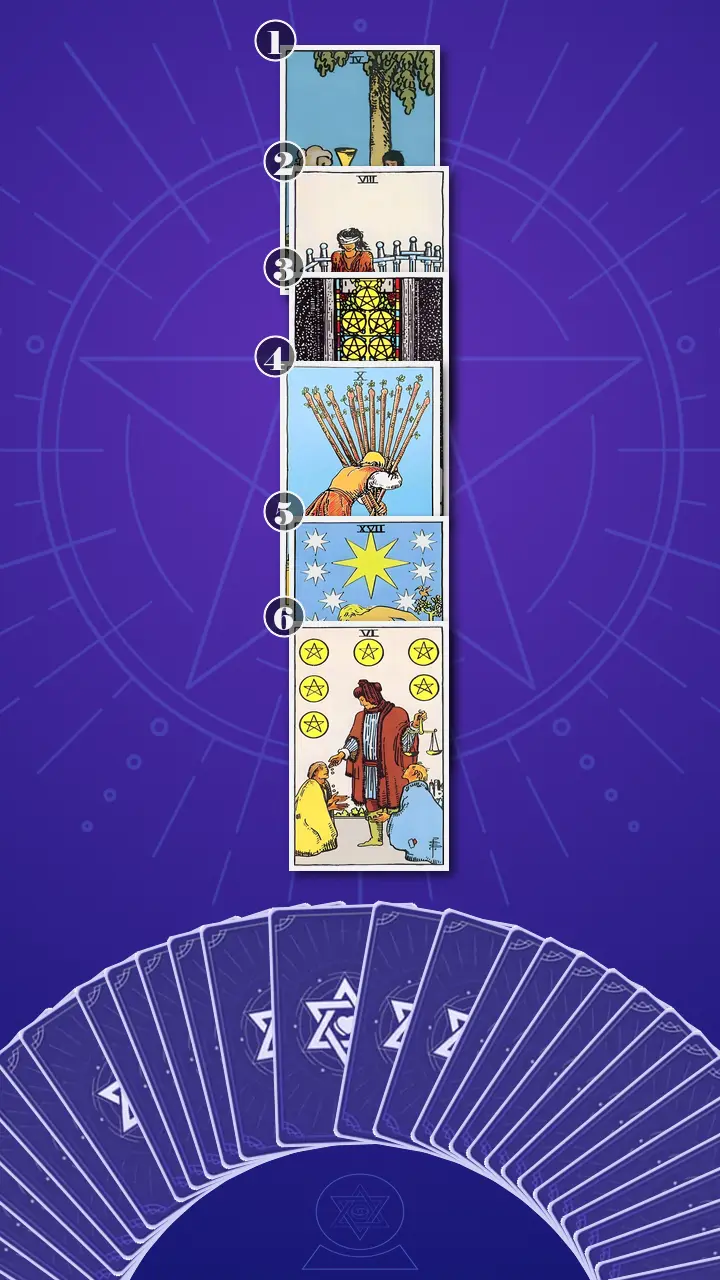
I placed six cards in a vertical line. “We’ll read from the top down,” I said, “like walking down into the basement of a belief and then back up through a single door into action. The first card shows what you do in the exact moment praise lands. The middle cards name what’s running underneath. And the last card gives you a one-step practice you can try this week—something your body can actually learn from.”
Reading the Ladder: What Your Body Does Before Your Brain Decides
Position 1 — The surface reaction: what you do in the moment
“Now we’re looking at the card that represents the surface reaction: what you do in the moment when the compliment arrives,” I said, and turned it over. Four of Cups, upright.
The image shows a person with crossed arms, gaze down, while an offered cup floats in from the side like an opportunity that doesn’t want to beg.
“This,” I told Jordan, “is like when a compliment hits your Slack right after you ship something, and your body reacts like it’s safer not to take it in. You reply with a polite minimizer, look away from the message thread, and go straight back to your checklist—like receiving the praise would create a new obligation you didn’t agree to.”
In energy terms, this card isn’t ‘cold.’ It’s withdrawn water—a protective disengagement. The compliment is present, but your posture says no. Your nervous system treats warmth like a spotlight.
I asked a simple question I’ve learned to ask as both a Jungian psychologist and a lifelong watcher of patterns: “What’s your default compliment reply in Slack—word for word?”
Jordan stared at the card for a second, then gave a small, sharp laugh that had zero joy in it. “Wow,” they said. “That’s… kind of brutal. It’s literally ‘No worries—team effort lol.’ Like I’m allergic to the word ‘thanks.’”
I nodded. “And I want you to hear this cleanly: Deflecting praise isn’t humility—it’s self-protection with good manners. Your system isn’t trying to be difficult. It’s trying to stay safe.”
Position 2 — The self-worth story underneath
“Now we’re looking at the card that represents the self-worth story underneath: the belief you’re buying into when you reject the compliment.” I turned the next card. Eight of Swords, upright.
Eight of Swords is the mental trap that feels like law. Blindfold. Loose bindings. A ring of swords that looks like a cage until you notice the gaps.
“This is the story,” I said, “where accepting praise feels like signing a contract: ‘I hereby declare I will never fall short again.’ So you act constrained—careful wording, credit-sharing, quick topic changes—because the fear isn’t the compliment; it’s the expectations you assume come bundled with it.”
To make it real, I spoke it like an inner transcript:
“If I accept this, they’ll expect perfection.”
“If I relax, I’ll mess up.”
“If I let myself believe it and later fall short, it will prove I’m not competent.”
Jordan’s eyes drifted off the card—not away from it, but through it, like they were watching a replay on a second screen. Their breathing paused for half a beat. Their fingers, which had been tapping their knee, went still.
“Yeah,” they said quietly. “It’s like my brain is in ‘risk mitigation mode.’”
“Exactly,” I replied. “Eight of Swords is Air in blockage. It’s thinking turned into restraint. And the detail that matters: the bindings are loose. This is a story you’ve stepped into—not a prison you’re locked in.”
Position 3 — The root emotional logic underneath the belief
“Now we’re looking at the card that represents the root emotional logic: what wound or scarcity this belief is trying to protect you from.” I turned the third card. Five of Pentacles, upright.
Two figures in snow, outside a warm, lit window. The warmth exists. The belonging exists. The body still stands outside it, convinced it isn’t for them.
“This,” I told Jordan, “is the Outsider Worth Story. You can see warmth and validation exist in your world—supportive teammates, a manager who notices, a partner who says you deserve credit—but you still feel like you’re not the kind of person praise is for. When recognition comes, you brace for it to be taken away, so you reject it first to avoid the ache of wanting it.”
The energy here is Earth in scarcity. Worth feels rationed. Like there’s a limited supply of ‘credit’ and you’ll get caught taking more than your share.
Jordan swallowed, and I saw their throat tighten again—the same body cue they’d described from Slack. “I hate that that’s true,” they said. “Because I have evidence I belong. But it still feels like… I’m borrowing the team’s trust, not earning it.”
“That sentence,” I said gently, “is the window in Five of Pentacles. Support is right there. The story keeps you in the cold.”
Position 4 — The hidden cost: what gets heavier over time
“Now we’re looking at the card that represents the hidden cost: what this pattern is making heavier over time.” I turned the fourth card. Ten of Wands, upright.
Ten of Wands is carrying too much while your view is blocked—weight mistaken for value.
“This is like,” I said, “every compliment turning into extra weight. You stay online late, over-polish, take on tasks no one asked for—because if praise doesn’t count as evidence, you try to make it true by carrying more.”
I could see the scene in Jordan’s face: the blue light sting, the shoulders creeping up, the autopilot move to open Linear/Jira and tweak something tiny no one requested.
“Here’s the contradiction,” I added, keeping it crisp. “You’re trying to feel safer, but you’re piling weight onto yourself. And I want to name it the way your body already knows it: A compliment isn’t a debt you have to repay with more tasks.”
Jordan winced—then laughed, the kind of laugh that’s half a confession. “The ‘owe the compliment interest’ thing,” they said. “I do that.”
“Of course you do,” I replied. “Ten of Wands is Fire in excess—effort as a coping mechanism. It keeps you moving so you don’t have to feel seen.”
When The Star Turned the Spotlight into a North Star
I paused before turning the fifth card. The room got quieter in that particular way it does when someone is right at the edge of a truth they can’t unknow. Even the city outside—street noise, distant elevator hum—felt like it took a step back.
“This next one,” I said, “is the heart of the reading: the key shift.” I turned it over. The Star, upright.
The imagery is open sky, steady pouring—no clenched grip, no scrambling, no drama. Just replenishment.
“This,” I told Jordan, “is you practicing letting praise be calm information instead of a spotlight threat. You receive it slowly—one breath, one ‘thank you’—and you treat it like a North Star: something that guides your self-trust back online without demanding perfection.”
Setup: I watched Jordan’s shoulders lift slightly again as if their body anticipated the old script. “It’s 5:41 PM, the channel pings, and someone says you crushed it. Your throat tightens, your fingers rush to type ‘it was nothing,’ and your brain starts drafting next week’s proof before you’ve even exhaled,” I said, borrowing their real life so the insight could actually land.
Delivery:
Stop treating praise like a trap; let it be a North Star that guides your self-trust back online.
I let the sentence hang there for a beat—like a bell tone you feel in your ribs.
Reinforcement: Jordan’s reaction came in three small waves. First, a physiological freeze: their breath caught, eyes widening the tiniest amount, as if their system had to stop moving to process a new rule. Then, cognitive seep-in: their gaze unfocused past the card, replaying a recent Slack thread like a courtroom transcript—only this time, they weren’t hunting for subtext, they were noticing the simplicity of the words as written. Finally, an emotional release: their shoulders dropped in a slow exhale that sounded almost surprised, and the tightness in their throat softened enough for them to speak without that self-deprecating edge.
“But if I let it count,” they said, voice lower, “won’t I get… cocky? Or lazy? Like I’ll stop trying?”
It was the most honest version of the fear: if I accept this, I have to live up to it.
“That’s your Eight of Swords trying to keep you compliant,” I said. “And The Star is offering a different kind of regulation. In Venice, water stays clean when it circulates—when it’s allowed to move through. When we block it, it stagnates. Venetian Aqua Wisdom isn’t poetic here; it’s practical. Praise is like that: if it can circulate through you—arrive, be received, be stored—your system replenishes. If you block it, you don’t become ‘humble.’ You become depleted.”
I added the line that tends to become a hinge for people: Praise isn’t a trap. It’s data.
Then I did what I do when a pattern is living in the body, not just in thoughts. “Jordan, I’m not diagnosing anything medically,” I said, “but I want you to notice your signals like an energy lens. When praise hits, you described a tight throat and a stomach flinch. That’s an ‘alarm’ response. And alarms can be reset.”
“Try this once,” I continued, keeping it simple and repeatable. “Pause for one breath, reply with ‘Thank you—what I’m proud of is ___.’ Then paste the compliment into a private note verbatim. If it feels too intense, shorten it to ‘Thank you—I appreciate you saying that.’ You’re allowed to stop at any point; the goal is a 10-second rep of receiving, not forcing yourself to feel a certain way.”
I watched Jordan nod—small, careful. There was relief in it, and also a new kind of vulnerability: the slight dizziness of realizing the exit has been there the whole time.
“Now,” I asked, “use this new lens and look back—was there a moment last week when a compliment arrived and you could have let it land for ten seconds?”
They blinked, then their mouth softened. “My manager DM’d me after the roadmap review,” they said. “Just: ‘Really impressed.’ I read it like five times and then… opened Jira.”
“That,” I said, “is exactly the moment The Star is talking about. Not a big personality overhaul. A micro-posture shift—from stepping out of the warm spotlight, to letting it be a point of guidance.”
And I named it clearly, because clarity is often just naming the actual direction of travel: “This is the move from spotlight-avoidant self-protection to grounded self-trust that can receive credit without panic.”
Position 6 — One step this week: the practice
“Now we’re looking at the card that represents one step this week: a small, doable action to practice receiving and internalizing the compliment.” I turned the last card. Six of Pentacles, upright.
Scales. An open hand. A clean exchange.
“This is balanced receiving,” I said. “You respond to praise with a clean receive—‘Thank you—what I’m proud of is ___.’ And you don’t immediately add extra work to deserve it. You log the compliment privately so it becomes evidence you can revisit when your brain tries to zero you out.”
I pointed at the scales. “The scales are the whole lesson: receiving isn’t taking too much. It’s restoring balance.”
Jordan made a face—half cringe, half determination. “I can do the sentence,” they said. “But the pause? I swear my calendar is back-to-back. I barely have ten seconds between meetings.”
“Perfect,” I replied, because real life is always the curriculum. “Then we don’t ask for ten seconds between meetings. We borrow it inside the moment.”
I showed them a tiny reset I’ve taught to people who used to come to me on cruise ships between port days—when they had no privacy, no time, and still needed their nervous system to come back online. “Hands flat on the desk,” I said. “One slow inhale through the nose. On the exhale, drop your shoulders away from your ears like you’re letting a heavy bag slide off. It takes three seconds. That’s enough to interrupt the autopilot reply.”
From Insight to Action: The Praise-as-Data Log (and the No-Payback Boundary)
I gathered the whole spread into one story so Jordan could feel the logic, not just the symbolism.
“Here’s what the cards are saying,” I summarized. “When praise arrives (Four of Cups), your body withdraws—crossed arms energy—because your mind interprets the compliment as a contract (Eight of Swords). Under that is an older scarcity imprint (Five of Pentacles): a feeling that warmth and recognition are for other people, not you, so wanting it is dangerous. Then the coping strategy kicks in (Ten of Wands): you convert praise into workload, trying to pay it back with overtime. The Star is the turning point: steady replenishment, a regulated receive. And Six of Pentacles brings it down to earth: a balanced exchange you can practice without changing your personality.”
The blind spot was obvious once it was named: “You’ve been treating receiving as either arrogance or obligation,” I told them. “As if ‘thank you’ means ‘I agree I’m perfect.’ That’s the cognitive trap. The transformation direction is smaller and kinder: receiving praise as evidence and tracking it in a simple, repeatable way so it can actually count.”
Then I gave Jordan their one-step plan—practical, low-drama, designed for a real hybrid calendar.
- The Two-Beat Receive (10 seconds)Next time you get praised in Slack/Teams (channel or DM), don’t minimize. Reply with: “Thank you—what I’m proud of is ___.” Fill the blank with one concrete thing you did (a decision, a tradeoff, a call you made). Keep it to one sentence.If the full line feels intense, use the minimum version: “Thank you—I appreciate you saying that.” Awkwardness is an alarm response, not a sign you did it wrong.
- Start a Praise-as-Data Log (2 minutes)Open Apple Notes/Notion and create a private note titled “Praise-as-Data Log.” Paste the compliment verbatim (no edits, no ‘but’). Add the date and one neutral line: “Skill shown: ___.”Think of it like saving receipts or tracking metrics: you’re not obsessing—you’re preventing your brain from rewriting history at 10:26 p.m.
- The No-Payback Boundary (30 minutes)After receiving praise, set a 30-minute timer. In that window: don’t open new tickets, don’t “just tweak one more thing,” don’t add work to earn the compliment retroactively. Only continue what was already planned.When the productivity itch hits, label it: “That’s the exposure story talking.” Start with 5 minutes if 30 feels impossible—minimum reps still teach your system.
Before we closed, I added one more piece of my own toolkit—because Jordan’s body had been giving us clear data all along. “If you feel your shoulders creeping up during praise,” I said, “do a quick posture correction: feet on the floor, shoulders down, jaw unclench. It’s not cosmetic. It’s an energy signal that you’re allowed to receive.”
“Like water circulation,” Jordan murmured, almost smiling.
“Exactly,” I said. “Let it move through.”

A Week Later: The Quiet Proof
A week later, Jordan messaged me: “Got a compliment in the channel. Did the two-beat. Didn’t die.” Then, after a pause: “Also… I logged it. Word for word.”
They told me they’d reread the note once on the TTC—fluorescent lights buzzing, phone warm in their hand—and felt the old reflex to argue with it. And then, for ten seconds, they didn’t. They just let the words sit there like a small, steady light. They didn’t feel euphoric. They felt a little looser. That was the point.
In my work—whether I’m reading cards in a Toronto apartment or listening to someone on a ship’s deck confess they’re tired of performing—the journey to clarity is rarely a dramatic reinvention. It’s usually one clean moment of reception: letting what’s true arrive, and not negotiating it away.
When praise shows up and your throat tightens, it’s not because you don’t want recognition—it’s because believing it feels like stepping into a warm spotlight that could turn harsh the moment you slip.
If you let just one compliment this week count as evidence (not a promise), what tiny part of you would you be willing to stop arguing with for ten seconds?